

Electric Vehicle Charging: Everything You Need to Know?
Nov 05,2025
Running out of juice mid-trip scares every EV driver. But smart charging fixes that fast.
EV charging uses electricity to fill your battery, unlike gas pumps. Level 1 adds 2–5 miles per hour, Level 2 gives 12–30+, and DC fast adds 100–300+ miles in 20–30 minutes.
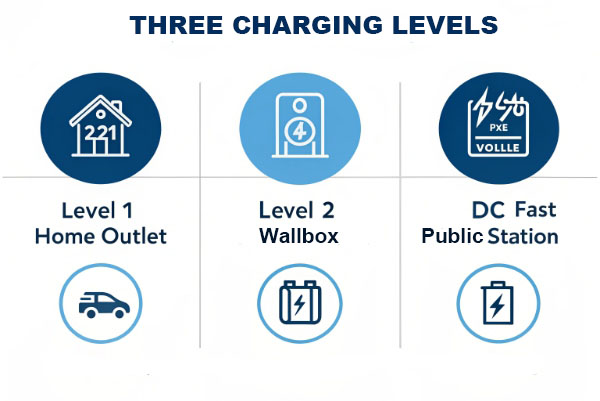
EV charging levels comparison
As a charging hardware maker, I see businesses struggle with unreliable setups daily. Stick with me to build systems that scale without headaches.
Understanding the Basics of Electric Vehicle Charging?
Gas stations feel simple until you own an EV. Then range anxiety hits hard.
EV charging sends electricity from the grid to your battery pack. It rebuilds energy storage cell by cell. Gas burns fuel once. Electricity recharges many times.
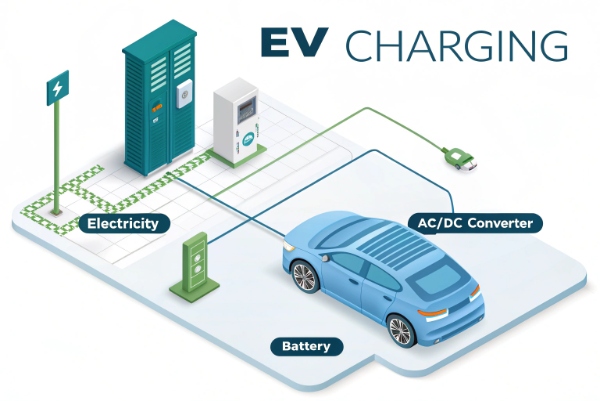
EV battery charging process
How Electricity Replenishes Battery Capacity
Batteries store power in chemical form. Chargers convert AC to DC. DC flows into cells. Lithium ions move between electrodes. This restores capacity. I once watched a fleet operator lose a full shift because his driver skipped preconditioning. The battery stayed cold. Charging crawled at 20 kW instead of 150 kW. Lesson learned: temperature matters more than charger size.
Key Differences from Gasoline Refueling
| Aspect | Gasoline | EV Charging |
|---|---|---|
| Time | 5 minutes | 20 minutes to hours |
| Cost per fill | Fixed per gallon | Varies by kWh rate |
| Emissions | At pump and tailpipe | At power plant only |
| Infrastructure | Nationwide stations | Growing but patchy |
Home charging beats public for cost. Public beats home for speed on trips. Mix both for best results.
Real-World Charging Math
A 60 kWh battery at 10% needs 54 kWh to reach 100%. A 7 kW Level 2 charger takes about 8 hours. A 150 kW DC fast charger does it in 30 minutes to 80%. But rates drop above 80% to protect cells. Stop at 70% on road trips. It saves time and battery life.
Businesses I work with track these numbers daily. CPOs monitor kWh sold per stall. Fleet managers log downtime per vehicle. Simple data drives big savings.
Comparing EV Charging Levels: Level 1, Level 2, and DC Fast Charging?
Slow charging kills productivity. Fast charging costs more. Pick the right tool.
Level 1 uses 120 V household outlets. Level 2 runs on 240 V circuits. Explore Parwatt’s Level 2 AC wallbox chargers
for workplaces and residential projects. DC fast skips the car’s converter and pumps power straight to the battery.
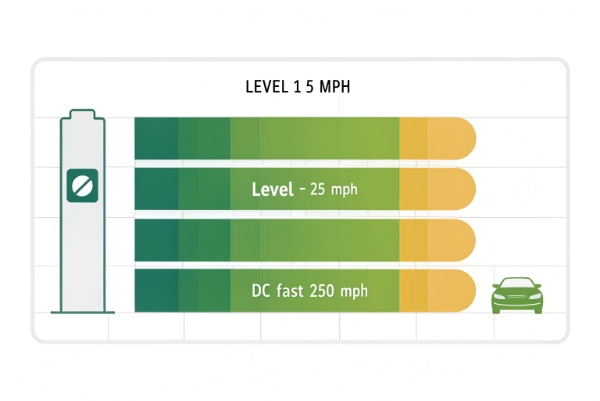
Charging speed comparison chart
Voltage, Speed, and Equipment Needs
| Level | Voltage | Speed (miles/hour) | Equipment |
|---|---|---|---|
| Level 1 | 120 V | 2–5 | Standard outlet + cord |
| Level 2 | 240 V | 12–30+ | Dedicated charger + circuit |
| DC Fast | 400–800 V | 100–300+ in 20–30 min | High-power station |
Ideal Usage Scenarios
- Level 1: Emergency backup or plug-in hybrids with small batteries.
- Level 2: Home, workplace, retail destinations. I installed 50 Level 2 units for a mall chain. Occupancy hit 85% within three months.
- DC Fast: Highway corridors, fleet depots needing quick turns.
Hidden Costs and Limits
DC fast sounds perfect. But sessions taper after 60–70% charge. Pushing to 100% doubles time and stresses cells. Heat builds up. Cooling systems work harder. Long-term capacity drops faster.
Level 2 stays steady. No taper. Full overnight fills cost pennies per mile. My factory runs 200 Level 2 ports for employee cars. Utility bills dropped 15% after we added smart scheduling.
Connector types confuse buyers. North America uses CCS1 for DC. Europe runs CCS2. Tesla’s NACS spreads fast. Adapters exist. But native plugs work best. I ship chargers with multiple cables to cover all bases.
Setting Up Home EV Charging for Maximum Convenience?
Home charging fails when wiring can’t handle load. I see tripped breakers weekly.
Start with a 240 V circuit. Add a Level 2 charger. Charge overnight. Wake up full every day.
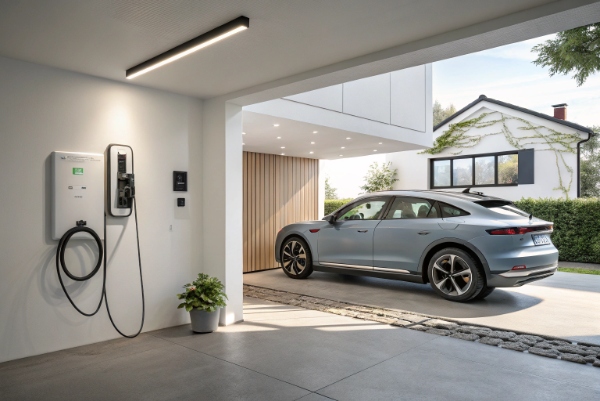
Home EV charger installation
Step-by-Step Installation Process
- Check panel capacity. Most homes need 200 A service.
- Hire licensed electrician. They pull permits.
- Pick wall-mounted or pedestal unit. Hardwire for safety.
- Test load with utility. Avoid peak rates.
Cost Breakdown
| Item | Low End | High End |
|---|---|---|
| Charger hardware | $400 | $1,200 |
| Installation | $500 | $2,000 |
| Permits | $100 | $300 |
| Rebates | -$500 | -$1,000 |
Net cost often falls under $1,000. My clients recover it in 18 months via fuel savings.
Smart Charging Features
Wi-Fi units shift charge times to off-peak hours. Solar panels feed directly to cars. I linked one developer’s chargers to rooftop arrays. Tenants pay zero for daytime fills.
Safety First
Use UL-listed hardware. Install GFCI breakers. Mount away from water. Schedule yearly inspections. One short circuit can burn a garage. I insist on surge protection for every project.
Real estate partners love turnkey packages. We handle permits, wiring, and apps. Tenants move in and plug in. Occupancy rates jump 12% in EV-ready buildings.
Navigating Public Charging Networks and Payment Systems?
Lost drivers circle lots hunting open stalls. Apps solve that in seconds.
Use PlugShare or ChargePoint apps. Filter by speed and connector. Pay via app or RFID card.
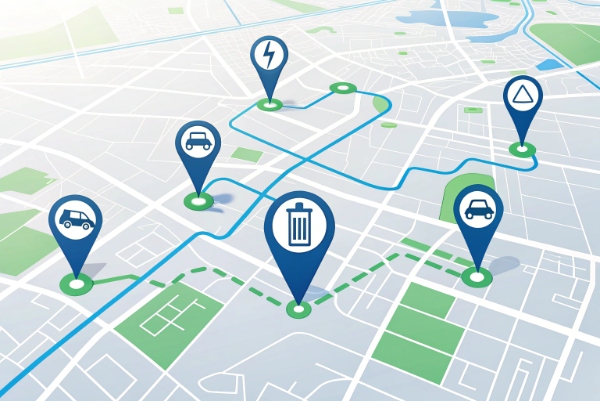
Public charging station network
Finding and Using Public Chargers
- Open app. Search destination.
- Check real-time availability.
- Navigate to stall.
- Plug in. Start session.
Network Memberships and Costs
| Network | Membership | Per kWh | Idle Fees |
|---|---|---|---|
| Electrify America | Optional | $0.43–$0.56 | $0.40/min after grace |
| EVgo | Required for discounts | $0.30–$0.51 | Varies by site |
| Tesla Supercharger | Open to non-Tesla | $0.38–$0.48 | $1.00/min above 80% |
Connector Compatibility
Bring adapters. CCS to NACS works for most new cars. CHAdeMO fades fast. I stock universal cables for fleet clients.
Charging Etiquette
Unplug at 80%. Move your car. Don’t hog stalls. One rude user blocks four others. Stations add idle fees to enforce rules.
CPOs track uptime via OCPP protocols. My hardware sends alerts within 30 seconds of faults. Techs arrive before queues form.
The Future of EV Charging: Ultra-Fast, Wireless, and Connected Technologies?
Tomorrow’s chargers will charge in minutes, not hours. Some won’t need plugs at all.
350 kW stations arrive next year. Parwatt’s ultra-fast DC chargers
already support 350 kW output for next-generation EVs. Wireless pads embed in garages. Cars talk to grids.
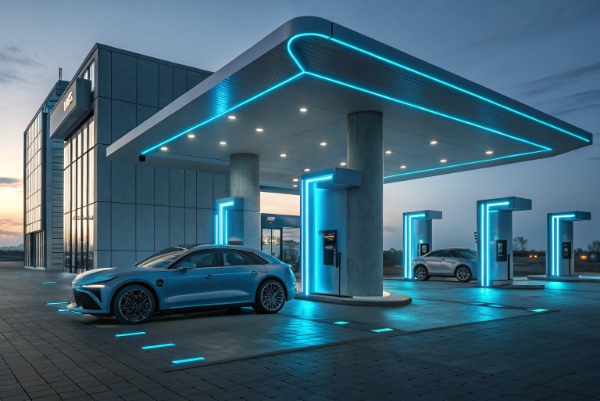
Future EV charging technologies
Emerging Speed and Power Trends
| Tech | Power | Charge Time to 80% (300-mile EV) |
|---|---|---|
| Current DC | 150–250 kW | 25–35 min |
| Ultra-Fast | 350–500 kW | 10–15 min |
| Megawatt | 1–3 MW | <10 min (trucks) |
Batteries must handle heat. Liquid cooling evolves fast.
Bidirectional Charging (V2G/V2H)
Cars become power banks. Send energy home during outages. Sell back to grid at peak rates. I tested V2H with a utility partner. One EV powered a house for 12 hours.
Wireless Inductive Systems
Drive over pad. Charging starts. No cables. Efficiency hits 91%. Pilots run in Norway and Indiana. Costs drop yearly.
Infrastructure Expansion
Governments fund corridors. China plans 5 million stalls by 2030. USA targets 500,000 by 2030. My factory ramps production to match.
Battery preconditioning cuts charge time 30% in cold. Navigation triggers it automatically. Drivers arrive at warm packs ready for max speed.
Conclusion
Master EV charging levels and setups. Save time, money, and range anxiety for good.
FAQ
Q: How long does Level 2 home charging take?
A: Most cars fill overnight in 6–8 hours on a 7–11 kW charger.
Q: Is DC fast charging bad for batteries?
A: Frequent 100% sessions hurt. Stop at 80% for daily use.
Q: Do I need a special outlet for Level 2?
A: Yes. A 240 V, 50 A circuit with NEMA 14-50 or hardwire.
Q: Can any EV use Tesla Superchargers?
A: New models with NACS ports yes. Others need adapters.
Q: How much does public fast charging cost?
A: $0.30–$0.60 per kWh. About $15–$25 for 200 miles.
As Jacky Huang at Parwatt, I build chargers that solve these problems daily. Contact us for bulk orders or custom solutions.
--- END ---
Related Posts
Industry News

Industry News


Product News
