

Safety Standards and Certifications for EV Chargers: What You Must Know in 2026
Aug 04,2026
Skipping proper safety certifications exposes EV charging projects to fire risk, electric shock, insurance rejection, and forced removal after installation. Legal problems and liability follow quickly. At Parwatt I see non-compliant equipment create serious trouble for operators who thought a simple mark was enough.
Safety standards and certifications for EV chargers are mandatory for legal installation, insurance coverage, and real-world protection. Key frameworks include UL standards in North America, CE and IEC standards in Europe, and additional local approvals. Verifying genuine third-party testing and matching the target market prevents costly and dangerous mistakes in 2026.
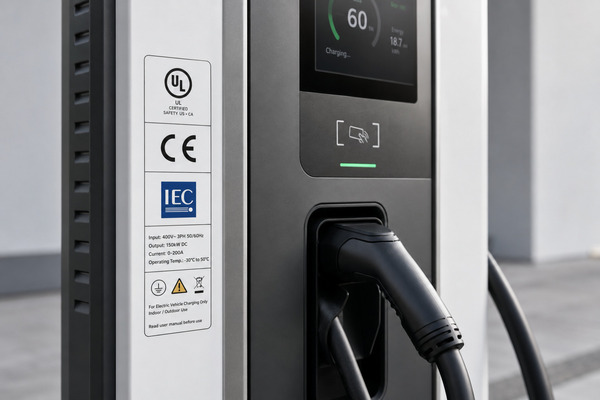
I have worked with charge point operators, real estate developers, and fleet managers for years as general manager at Parwatt New Energy. We supply DC chargers and power modules that must meet strict safety requirements in different markets. I regularly review projects where buyers accepted marketing claims without checking the actual certificates. Some installations were later rejected by inspectors or insurance providers. Our products such as the FES-D30 DC EV Charger and our power modules are developed with the relevant standards in mind because safety and compliance are not optional. In this article I explain the key standards, the common mistakes, and how to verify real compliance before you buy or install.
Why Skipping Safety Certifications Puts EV Charging Projects at Real Risk?
Uncertified or improperly certified chargers raise the chance of electric shock, overheating, and fire. Insurance companies may refuse claims. Local authorities can order the equipment removed. Project delays and legal costs follow. These risks are real and expensive for any commercial or public installation.
Skipping safety certifications creates fire and shock hazards, voids insurance coverage, violates local electrical codes, and can force complete removal of installed equipment. Operators face liability, downtime, and unexpected replacement costs. Proper certification is the foundation of safe and legal EV charging.
The Concrete Consequences Operators Face
I have seen projects where chargers arrived with only a generic CE mark and no supporting test reports. During final inspection the local authority rejected the installation. The operator had to remove the units, store them, and order compliant replacements. The delay cost weeks of planned revenue and damaged relationships with the site owner.
Fire and shock risks are not theoretical. Chargers handle high voltage and high current. Without proper insulation, grounding, residual-current protection, and thermal design, faults can escalate quickly. Certified products have been tested against defined fault conditions. Uncertified products have not.
Insurance is another hard barrier. Many commercial policies require listed or certified equipment. When a claim arises, the insurer checks the certification status. Non-compliant hardware often leads to denied coverage. The operator then carries the full financial exposure.
Here is a table that shows the main risks of skipping proper certification:
| Risk Area | What Can Happen | Practical Impact | Who Pays the Price |
|---|---|---|---|
| Electrical safety | Shock or fire from fault conditions | Injury, property damage, liability | Operator and site owner |
| Insurance | Claim denial | Full financial loss on incidents | Project owner |
| Regulatory approval | Installation rejected or ordered removed | Project delay and re-work costs | Developer or CPO |
| Long-term reliability | Higher failure rate | More downtime and service calls | End users and operator |
| Reputation | Public safety incidents | Loss of trust and future contracts | Brand and network operator |
This table reflects real cases I have reviewed. At Parwatt we treat certification as a core design requirement for every charger and module we supply. Our 30kW Power Module and 40kW Power Module are developed to support systems that meet the applicable safety standards in target markets.
Public sites, workplace installations, and fleet depots face the highest exposure because many people interact with the equipment daily. A single incident can affect dozens of users and attract regulatory attention. The cost of proper certification is small compared with the cost of a rejected installation or a safety event.
In 2026 more jurisdictions are tightening enforcement. Relying on incomplete paperwork or marketing language is no longer a workable strategy. Safety certification must be verified before purchase and again before energizing the system.
Common Mistakes When Evaluating EV Charger Safety Claims
Buyers often accept a CE mark or a simple “UL” reference without further checks. They confuse different types of UL recognition. They ignore local approval requirements. They fail to verify that the certificate actually covers the exact model being purchased. These mistakes lead to non-compliant equipment reaching the site.
Common mistakes include accepting a CE mark as complete proof of safety, misunderstanding UL Listed versus Recognized status, ignoring local electrical and type-approval rules, and failing to verify certificate authenticity and model coverage. These errors allow non-compliant chargers into projects and create later legal and safety problems.
Frequent Errors That Create Problems
One widespread mistake is treating the CE mark as a full safety guarantee. CE marking is a manufacturer’s declaration of conformity with EU directives. It is important in Europe, yet it is not the same as independent third-party certification. Supporting test reports and the correct harmonized standards must still be confirmed.
Another frequent error is misunderstanding UL status. “UL Listed” means the complete end product has been evaluated for safety in its intended use. “UL Recognized” usually applies to components. A Recognized power module is not the same as a Listed charger. Using the wrong category can cause inspection failures.
Buyers sometimes skip local requirements. Even when international standards are met, some regions demand additional type approval or installer certification. Projects that ignore these extra rules face last-minute rejection.
Certificate authenticity is also overlooked. Fake or outdated documents appear in the market. Without checking the certificate number against the issuing body’s database, buyers can accept invalid paperwork.
Here is a table of common evaluation mistakes:
| Mistake | Why It Happens | Result | Better Practice |
|---|---|---|---|
| Accepting CE mark alone | Assumes it equals full certification | Missing test evidence | Request full Declaration of Conformity and reports |
| Confusing UL Listed and Recognized | Marketing language is unclear | Wrong product category accepted | Confirm the exact UL category for the end product |
| Ignoring local approvals | Focus only on international marks | Installation rejected | Check regional type-approval and installer rules |
| Not verifying certificate numbers | Trusts the PDF without checking | Fake or outdated documents accepted | Validate with the issuing body |
| Checking only the brand, not the model | Assumes all models share the same certificate | Uncovered variants installed | Match certificate to exact model and rating |
This table highlights the gaps I see most often. At Parwatt we provide clear documentation for our chargers and modules so customers can complete proper due diligence. You can review our current product range in the EV Charger Category.
I have reviewed purchase files where the certificate applied to a different power rating or a different enclosure variant. The delivered units were not covered. The discovery came only during commissioning. Avoiding these mistakes requires disciplined checking rather than trust in marketing claims.
Key Safety Standards and Certifications Explained for EV Chargers
Different markets rely on different primary standards. North America centers on UL standards. Europe centers on CE marking supported by IEC standards. Global technical requirements for conductive charging are defined in the IEC 61851 series. Additional marks cover environmental protection and personnel safety.
Key safety frameworks for EV chargers include UL 2594 and UL 2202 in North America, CE marking supported by IEC 61851 in Europe, IEC 62196 for connectors, and IP/IK ratings for environmental protection. Understanding which standards apply to the target market is essential for compliant procurement.
Core Standards by Region and Function
In North America, UL 2594 is the main standard for AC Level 1 and Level 2 chargers. UL 2202 covers DC fast chargers. The UL 2231 series addresses personnel protection against electric shock. Products that carry a UL Listing have been evaluated by an independent laboratory for the complete system.
In Europe, CE marking is required. It declares conformity with the Low Voltage Directive, EMC Directive, and other applicable directives. The technical basis is usually the IEC 61851 series for conductive charging systems. IEC 62196 covers the dimensional and safety requirements for plugs, socket-outlets, and connectors.
IP ratings describe protection against dust and water. IK ratings describe impact resistance. Outdoor chargers typically need higher IP and IK values to remain safe and functional in real weather and public environments.
ISO 15118 is sometimes referenced for communication and Plug-and-Charge features. It is important for interoperability and advanced functions, yet it is not a substitute for the core electrical safety standards.
Here is a structured overview of the main standards:
| Standard or Mark | Primary Scope | Typical Market | What It Covers |
|---|---|---|---|
| UL 2594 | AC Level 1/2 chargers | North America | End-product safety for AC charging |
| UL 2202 | DC fast chargers | North America | End-product safety for DC charging |
| UL 2231 series | Personnel protection | North America | Protection against electric shock |
| CE marking | EU conformity | Europe | Directives for safety, EMC, radio |
| IEC 61851 series | Conductive charging systems | Global / Europe | System safety requirements |
| IEC 62196 | Connectors and inlets | Global | Plug, socket, and vehicle inlet safety |
| IP / IK ratings | Environmental protection | All markets | Dust, water, and impact resistance |
This table gives a practical reference for procurement teams. At Parwatt we design our chargers and power modules to support compliance with the standards required in the markets we serve. Our Battery Buffered Ultra Rapid EV Charger is an example of equipment developed with these requirements in view.
No single mark covers every jurisdiction. A product that is fully compliant in one region may still need additional evaluation for another. Buyers must match the certification package to the exact installation location.
How to Verify Real Compliance Before Buying or Installing
Verification requires more than looking at a logo on a datasheet. Buyers should obtain the full certificate, confirm the model coverage, check the issuing body, and review local approval needs. Installation quality must also be controlled because even a certified product can become unsafe if installed incorrectly.
Verify compliance by obtaining the official certificate and Declaration of Conformity, confirming the exact model and ratings are covered, validating the document with the issuing body, checking local type-approval and installer requirements, and ensuring installation is performed by qualified personnel according to local electrical codes.
Practical Verification Steps
Request the complete certificate and the Declaration of Conformity for the exact model, power rating, and enclosure variant being purchased. Marketing summaries are not sufficient.
Check that the certificate number can be validated on the issuing organization’s public database or by direct inquiry. UL, TÜV, and other bodies provide ways to confirm authenticity.
Confirm that the certificate covers the intended use. An indoor rating does not automatically cover outdoor installation. A component recognition does not equal end-product listing.
Review local requirements early. Some markets require additional type approval. Certain incentive programs require certified installers. Discovering these rules after the equipment arrives creates delay and extra cost.
Insist on professional installation. A certified charger still needs correct grounding, over-current protection, residual-current devices, and torque settings. Local electrical codes must be followed.
Here is a practical checklist:
- Obtain the full certificate and Declaration of Conformity for the exact model.
- Validate the certificate number with the issuing body.
- Confirm coverage of power rating, enclosure, and intended environment.
- Identify any additional local type-approval or installer requirements.
- Require installation by qualified electricians following local codes.
- Keep all compliance documents for insurance and future inspections.
- Re-verify if the supplier offers a modified or private-label version.
At Parwatt we support customers with the documentation needed for these checks. Our goal is that every installation using our equipment can pass inspection and operate safely. You can explore our certified product range in the EV Charger Category and find additional system guidance in our article on Electric Vehicle Charging.
I have seen projects succeed when the compliance file was complete before the purchase order was issued. I have also seen projects stop when documentation was incomplete. The difference is disciplined verification rather than last-minute scrambling.
Ready to Choose a Truly Safe EV Charger? Here’s Your Next Step
Choosing a safe charger starts with matching the product to the target market’s standards and then confirming the paperwork. Professional installation completes the process. These steps protect people, property, and the financial viability of the project.
Identify the safety standards required in your installation market. Request and validate full certificates for the exact charger model. Confirm any local approvals and installer qualifications. Only then proceed to purchase and professional installation. This sequence prevents non-compliant equipment from reaching the site.
Clear Actions for Buyers and Operators
Determine the primary market. North American projects normally need the relevant UL Listings. European projects need CE marking supported by the correct IEC standards. Other regions may add their own type-approval rules.
Ask every supplier for the complete compliance package before finalizing the order. Compare the documents against the exact model numbers and ratings in the quotation.
Validate the certificates. Do not rely solely on the supplier’s statement. Use the issuing body’s verification tools.
Engage a qualified installer early. In some jurisdictions the installer must hold specific EV charging credentials. Confirm this requirement before work begins.
Retain all documentation. Insurance providers and future inspectors may request it years after installation.
Here is a short action list:
- Map the required standards for the exact installation location.
- Request full certificates and Declarations of Conformity for the precise model.
- Validate documents with the issuing certification body.
- Confirm local type-approval and installer qualification rules.
- Select only equipment that meets the complete set of requirements.
- Use qualified professionals for installation and commissioning.
- Archive all compliance records for the life of the asset.
At Parwatt we design and document our chargers and power modules so customers can complete these steps with confidence. You can review available solutions in the EV Charger Category or learn more about system considerations in our comparison of AC vs DC EV Charging.
Taking these actions removes the most common sources of safety and compliance failure. The result is equipment that can be installed legally, insured properly, and operated with reduced risk to people and property.
Conclusion
Safety certifications are not optional extras for EV chargers—they are fundamental requirements for legal installation, insurance coverage, and long-term reliability. Different markets rely on different frameworks: UL standards dominate North America, CE and IEC standards are central in Europe, and many regions add local type-approval rules. At Parwatt we treat compliance as a core part of product design so operators can install with confidence. Understanding these certifications helps buyers and operators avoid non-compliant equipment that can create serious liability. Proper verification, combined with professional installation, is the only reliable way to ensure both safety and regulatory compliance. Don’t rely on marketing claims alone. Always confirm the relevant safety marks, independent testing, and local approval requirements before selecting an EV charger.

--- END ---
Related Posts
Business Ideas

Business Ideas

Industry News

Business Ideas


