

Car Vacuum Filter Design: Filtration, Airflow and Replacement Parts
Oct 09,2026
A poor filter design can reduce suction and increase returns. A filter that is too dense, too small, or quick to clog lowers real airflow, shortens runtime and raises motor load. Poor sealing lets fine dust bypass the filter and leave the machine. At Parwatt I see these problems drive weak-suction complaints and higher warranty costs for wholesale buyers.
Car vacuum filter design must balance filtration efficiency, airflow and easy maintenance. In 2026 buyers who verify media, effective area, sealing, dust-loaded performance and replacement-part supply reduce returns and create recurring aftermarket sales.
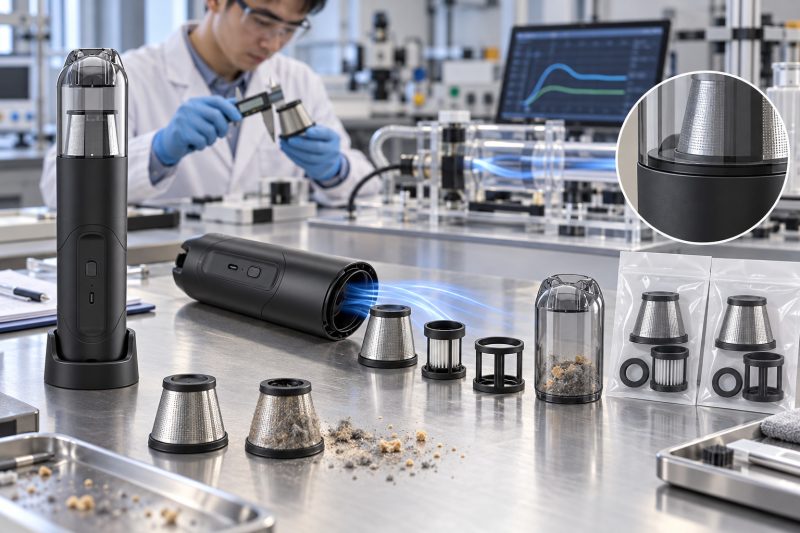
I have worked with automotive accessory wholesalers and importers for years as general manager at Parwatt New Energy. We supply cordless car vacuums and related car-care products. I regularly review samples whose filtration claims looked strong on paper yet lost suction quickly once the filter collected dust, or whose replacement filters were hard to obtain after launch. Our range in the car vacuum cleaner category is evaluated on both clean and dust-loaded performance so partners can judge real filtration design. In this article I explain how to balance filtration, airflow and replacement parts for car vacuums in 2026.
Why a Poor Filter Design Can Reduce Suction and Increase Returns?
The filter sits in the main airflow path. If it restricts air too early, suction at the nozzle falls, the motor works harder and runtime shortens. If the seal around the filter is weak, fine dust bypasses the media and either escapes into the cabin or reaches the motor. Both outcomes generate customer complaints and returns.
A poor filter design reduces suction and increases returns because excessive pressure drop, small effective area or weak sealing lowers usable airflow, raises motor stress and allows dust leakage. Customers then report weak cleaning and short product life.
How Filter Problems Appear in Real Use
I have tested units that delivered good sealed suction when the filter was new and clean. After a short cleaning session with fine dust, airflow dropped sharply and the motor temperature rose. Customers described the vacuum as “strong at first, then weak.”
Clogging happens faster when the effective filter area is small or when there is no useful pre-filter stage. Coarse debris reaches the fine media quickly and blocks the pleats. Cleaning becomes frequent and inconvenient, which raises dissatisfaction.
Bypass leakage is harder for users to see. Dust exits around the filter frame, dust-bin joint or exhaust path. The cabin air feels less clean and the motor may ingest particles that shorten its life. Reviews then mention “dust coming out the back” or early motor failure.
Washable filters create another class of problems when instructions are unclear. Users reinstall a still-damp filter, causing odor or motor risk, or they wash a media type that is not designed for water and permanently damage the structure.
Here is a table that links filter weaknesses to commercial results:
| Filter Weakness | Immediate Effect | Customer Experience | Business Impact |
|---|---|---|---|
| High pressure drop | Lower nozzle airflow | Weak suction | Returns and poor reviews |
| Small effective area | Rapid clogging | Frequent cleaning needed | Dissatisfaction |
| Weak sealing / bypass | Dust leakage | Dirty exhaust air | Complaints and claims |
| No useful pre-filter | Fine media blocks early | Short useful cycle | Higher support load |
| Unclear wash / dry rules | Damp or damaged media | Odor or motor risk | Warranty exposure |
This table reflects the field patterns I discuss with distributors. At Parwatt we treat filter design as a core performance item for every model in the car vacuum cleaner category.
In 2026 customers notice suction fade and dust leakage quickly and share the experience online. Filter design is therefore both a technical and a commercial decision.
The Filtration Claims Buyers Should Not Accept Without Evidence
Packaging and specification sheets often list layer counts, “HEPA-style” language or visual pleat density as proof of high filtration. These claims should not be accepted without evidence. Media appearance is not the same as tested efficiency, and a filter tested in isolation is not the same as whole-vacuum filtration performance.
Filtration claims that buyers should not accept without evidence include layer count, HEPA-style appearance and media-only test results. Real performance requires defined test methods, whole-machine sealing and dust-loaded behavior.
Claims That Need Supporting Data
A genuine high-efficiency claim needs a defined method and result. Simply calling a pleated white filter “HEPA” or “HEPA-type” does not prove that the finished vacuum captures a stated percentage of fine particles. Buyers should ask for the test standard, the efficiency number and whether the test was performed on the media or on the complete machine.
Layer count is easy to market and hard to interpret. More layers do not automatically mean better filtration or better airflow. Media type, fiber structure and total effective area matter more than the number of visible layers.
Color or surface texture is not a performance metric. Darker or thicker-looking media can still have high pressure drop or poor edge sealing.
Media-only laboratory results can look excellent while the assembled vacuum leaks around the frame or dust bin. Whole-machine testing is required to confirm that discharged air actually passes through the intended final filter.
Washable claims also need model-specific evidence. Some constructions tolerate rinsing; others lose structure or efficiency after water exposure. The claim must match the exact filter build and the drying instructions given to the customer.
Here is a table of claims that require evidence:
| Claim Type | Why It Is Incomplete | What to Request Instead |
|---|---|---|
| “HEPA-style” / appearance | No defined efficiency | Test method, efficiency, sample identity |
| High layer count | Layers ≠ performance | Media grade + effective area + pressure drop |
| Media-only lab result | Ignores bypass paths | Whole-vacuum filtration or sealing check |
| “Washable” without limits | Construction may not support it | Exact wash / dry instructions and test |
| Clean-filter suction only | Ignores dust loading | Performance after controlled dust load |
This table keeps evaluation realistic. At Parwatt we require clear filtration and airflow data for products in the car vacuum cleaner category rather than marketing labels alone.
I advise buyers to treat every filtration claim as incomplete until the method, the scope (media vs whole machine) and the dust-loaded behavior are documented.
How to Balance Filtration Efficiency, Airflow and Maintenance
Good filter design balances three goals: capture of fine dust, preservation of usable airflow, and practical maintenance for the user. Media grade, effective filtration area, pleat count, pressure drop, pre-filter structure, sealing method, cleaning difficulty and suction retention after dust loading must be evaluated together.
Balance filtration efficiency, airflow and maintenance by assessing media grade, effective area, pressure drop, pre-filtration, sealing, cleanability and performance after dust loading. Over-emphasizing any single factor produces weak real-world results.
Design Factors That Must Be Weighed Together
Higher-efficiency media captures finer particles but usually raises pressure drop. If the effective area is too small, the vacuum loses suction quickly as dust accumulates. Increasing pleated area can offset some of the restriction and extend the useful cleaning time between maintenance steps.
A pre-filter or coarse stage that captures larger debris before it reaches the fine media protects airflow and lengthens service intervals. Foam, mesh or cyclonic pre-separation can all play this role when correctly sized.
Sealing determines whether the rated media efficiency is delivered in the finished product. The filter frame, dust-bin interface and any secondary exhaust filter must prevent bypass. A high-grade media with poor sealing behaves like a lower-grade system.
Maintenance design affects customer behavior. Filters that are easy to remove, empty, rinse (when allowed) and reinstall correctly are more likely to be kept in good condition. Complex assemblies or unclear drying rules lead to misuse.
Suction retention after controlled dust loading is one of the most useful practical metrics. A filter that looks efficient when clean but collapses in performance after a modest dust load will generate field complaints.
Here is a balance checklist:
- Media grade matched to the product claim
- Effective filtration area sized for the airflow target
- Pressure drop measured clean and after dust load
- Pre-filter or coarse stage to protect fine media
- Reliable sealing against bypass
- Practical removal, cleaning and reinstallation
- Clear wash / dry rules when washability is claimed
- Suction and airflow retention after realistic dust loading
- Motor protection considered in the same design
- User instructions that match the actual construction
At Parwatt we review these factors together when approving filtration systems for the car vacuum cleaner category. Related accessory programs follow the same whole-system view.
I recommend that buyers score candidate filters on both clean performance and dust-loaded performance. The second score often decides which design will survive real ownership.
Why Replacement Filter Availability Is Part of Product Quality
A filter is a wear item. When replacement filters are hard to find, expensive, or incompatible across production batches, customers either run the vacuum with a clogged filter or abandon the product. Standardized part numbers, clear packaging, reasonable retail pricing and a committed supply period extend product life and create aftermarket revenue for brands and distributors.
Replacement filter availability is part of product quality because filters are consumable. Standardized part numbers, ongoing supply, fair pricing and confirmed compatibility keep the vacuum usable and generate recurring sales.
Commercial Value of a Planned Spare-Parts Program
I have seen strong initial sell-through followed by rising complaints once the original filters clogged and replacements were unavailable or slow to ship. Customers treated the vacuum as disposable even though the motor and battery still worked.
A defined filter part number printed on the product, the manual and the spare package prevents wrong orders. Similar-looking filters can differ in height, diameter, sealing lip or internal resistance. Compatibility must be verified, not assumed.
Retail and service packaging should be ready before mass production of the vacuum. Barcodes, language and protective packing affect both e-commerce and store channels.
Pricing of the replacement filter should be acceptable relative to the vacuum’s selling price. An overpriced filter encourages customers to skip maintenance or switch brands for the next purchase.
Supply commitment beyond the first production order protects the brand. Buyers should agree a minimum supply period and a reorder process so that aftermarket demand can be met without emergency air shipments.
Here is a replacement-parts quality checklist:
- Unique, permanent filter part number
- Fit confirmed across production batches
- Retail and service packaging defined
- Target retail price relative to vacuum price
- Minimum supply period agreed
- Reorder lead time and MOQ stated
- Compatibility notes for any related models
- Instructions for installation included
- Forecast process for aftermarket volume
- Traceability between vacuum batches and filter batches
At Parwatt we treat replacement filters as part of the product program for the car vacuum cleaner category. The same planning supports long-term value across our main site.
I advise buyers to approve the replacement filter package at the same time as the vacuum golden sample. Leaving it for later is a common cause of aftermarket gaps.
A Buyer’s Test Plan for Filters and Replacement Parts
A practical test plan checks filtration and bypass, records airflow and suction when the filter is clean and when it is dust-loaded, verifies wash-and-dry cycles where claimed, and confirms consistency across production batches and spare filters. The results become the acceptance standard for mass production.
Test filters for bypass leakage, clean and dust-loaded airflow and suction, wash-dry recovery where applicable, and batch-to-batch consistency of both original and replacement filters. Lock the accepted results into the specification.
Step-by-Step Test Approach
Inspect the filter frame, sealing surfaces and dust-bin interface. Look for gaps that could allow bypass. A simple light or smoke check can reveal obvious leakage paths before quantitative testing.
Measure sealed suction and airflow with a clean filter at the target power setting. Record motor current and housing temperature if possible.
Load the filter with a controlled amount of fine test dust or real mixed debris. Repeat suction and airflow measurements at the same settings. Note how quickly performance falls and whether the motor approaches thermal limits.
If the filter is claimed washable, follow the exact wash and dry instructions. Re-measure performance after complete drying. Check for deformation, media damage or increased pressure drop.
Fit replacement filters from a different production batch or from the proposed spare-parts package. Confirm dimensions, sealing and performance match the original.
Repeat key tests on at least two or three vacuum samples to assess consistency.
Document every result with filter part number, batch identity, battery state and test conditions so the data remain usable for golden-sample approval.
Here is a concise test checklist:
- Visual and sealing inspection for bypass paths
- Clean-filter suction and airflow baseline
- Controlled dust loading and repeat measurements
- Motor load and temperature under restricted airflow
- Wash-dry cycle and post-dry performance (if claimed)
- Dimensional and performance check of spare filters
- Multi-sample consistency review
- Part number and batch recording
- Acceptance limits written into the specification
- Replacement packaging and labeling verified
At Parwatt we use this type of plan when approving filtration systems and spare parts for the car vacuum cleaner category. Complementary products such as those in the car air pump category and car battery charger category follow parallel evidence-based approval methods.
Buyers who complete these tests before mass production reduce the risk that filtration or spare-parts problems appear only after thousands of units are in the field. The test file becomes the commercial reference for both quality and aftermarket supply.
Conclusion
A car vacuum filter should protect the motor, retain fine dust, preserve usable airflow, and remain easy for customers to maintain. At Parwatt we design and validate filtration systems so partners receive balanced performance and reliable spare-parts support. Maximising filtration efficiency without controlling pressure drop can produce impressive specifications but disappointing suction and runtime. Buyers should verify the filter media, effective area, sealing structure, pre-filter system, washability, drying instructions, and performance after dust loading. They should also treat replacement filters as part of the product rather than an optional accessory. Before mass production, confirm the replacement part number, packaging, MOQ, price, compatibility, and supply commitment. A well-designed filtration and spare-parts program can reduce weak-suction complaints, prevent incorrect maintenance, extend product life, and generate recurring aftermarket sales.

--- END ---
Related Posts
Business Ideas

Business Ideas

Business Ideas

Business Ideas


