

When to Use DC Fast Charging vs. Level 2
Aug 20,2026
Choosing the wrong charging level wastes money and leaves drivers unhappy. Sites that install DC fast charging where vehicles stay for hours see low utilization and high costs. Sites that offer only Level 2 where drivers need speed lose customers. At Parwatt I see these mismatches reduce returns on many commercial projects.
Level 2 and DC fast charging serve different needs. Level 2 works best for longer stays at workplaces, multifamily, hotels, and overnight depots. DC fast charging suits short stays on corridors, high-turnover retail, and time-sensitive fleet operations. Matching the technology to real dwell time and grid capacity produces better utilization and lower total cost.
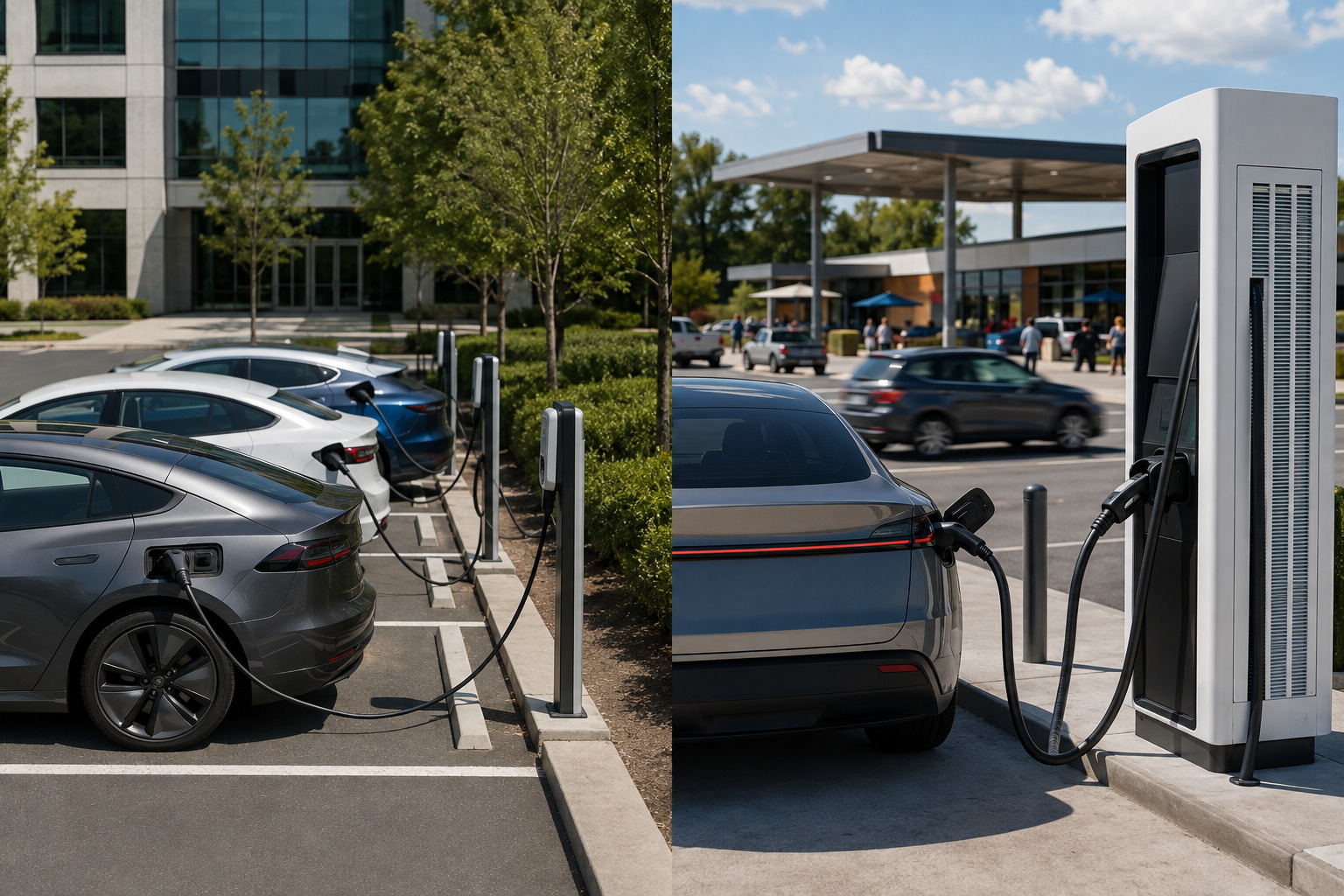
I have worked with charge point operators, real estate developers, and fleet managers for years as general manager at Parwatt New Energy. We supply both Level 2 compatible systems and DC fast chargers, including the FES-D30 DC EV Charger and modular power solutions. I regularly review projects where the wrong power level was chosen first and later had to be corrected at high cost. In this article I explain the real differences between Level 2 and DC fast charging and how to select the right mix for each site in 2026.
Why Choosing the Wrong Charging Level Costs Sites Time, Money, and Utilization?
When the charging speed does not match how long vehicles actually stay, problems appear quickly. Expensive DC fast chargers sit idle at workplaces where cars park all day. Level 2 stations frustrate drivers who need a quick top-up on a highway stop. Electrical upgrades run over budget and utilization stays low. The investment fails to deliver the expected return.
Choosing the wrong charging level creates idle equipment, unnecessary grid upgrades, poor driver experience, and weak utilization. Sites lose both capital efficiency and customer satisfaction when power delivery does not match real dwell patterns.
The Real Cost of a Mismatch
I have visited office parks that installed high-power DC fast chargers because “faster is better.” Employees arrived in the morning, plugged in, and left the vehicles connected until evening. The expensive chargers delivered far less energy per day than a larger number of lower-cost Level 2 units would have. Demand charges still arrived every month.
The opposite error also occurs. Destination or corridor sites that offered only Level 2 saw drivers leave after a short wait because the charging speed could not meet their schedule. Session counts stayed low and the location gained a reputation for slow charging.
Electrical cost is another frequent casualty. DC fast charging often requires new transformers, larger service, and longer utility timelines. When the site did not truly need that speed, the extra capital and delay produced no matching benefit.
Utilization suffers in both directions. Over-powered sites show low energy throughput relative to investment. Under-powered sites show low session counts because drivers avoid them. Either outcome weakens the business case.
Here is a table that shows the consequences of mismatch:
| Mismatch Type | What Happens | Cost or Performance Impact | Typical Site |
|---|---|---|---|
| DCFC at long-dwell location | Chargers under-used | High capital and demand charges for little gain | Workplace, multifamily |
| Level 2 at short-dwell location | Drivers leave unsatisfied | Low utilization and lost traffic | Highway, quick retail |
| Excess electrical capacity | Upgrades far beyond need | Unnecessary capital and time | Any over-specified site |
| Insufficient power for turnover | Queues or abandoned sessions | Poor experience and lower revenue | High-turnover locations |
| No hybrid planning | One-size-fits-all deployment | Missed optimization opportunity | Mixed-use sites |
This table reflects patterns I see across commercial portfolios. At Parwatt we help owners match equipment to actual use, whether that means efficient Level 2 solutions or higher-power systems such as those in our EV Charger Category.
In 2026 the cost of a wrong choice continues to rise. Hardware, electrical work, and driver expectations all make early decisions more consequential. Sites that begin with a clear understanding of dwell time avoid most of these losses.
The Common Traps When Deciding Between Level 2 and DC Fast Charging
Many decision makers fall into the same traps. They assume faster charging is always superior. They ignore how long vehicles actually remain parked. They underestimate the electrical upgrades that DC fast charging requires. They overlook battery health and long-term operating costs. These traps lead to oversized or undersized systems that never perform as hoped.
Common traps include chasing maximum speed without regard to dwell time, under-estimating electrical upgrade costs, ignoring battery and operating-cost differences, and failing to consider a mixed deployment. These errors produce higher capital spend, lower utilization, or both.
Frequent Decision Errors
One widespread trap is the belief that drivers always prefer the fastest possible charge. In reality many drivers are happy to charge more slowly when they are already staying for several hours. Installing DC fast charging in those settings wastes capital and raises demand charges without improving the experience.
Another trap is treating electrical capacity as a secondary issue. DC fast charging frequently triggers transformer upgrades, new service applications, and long utility queues. Owners who discover these requirements late face budget overruns and schedule delays.
Battery considerations are often skipped. Frequent high-power DC sessions create more thermal and electrical stress than regular Level 2 charging. For fleets or workplace vehicles that return daily, the gentler Level 2 profile can support longer battery life and higher residual value.
Operating cost differences receive too little attention. DC fast charging sites face higher energy costs per session when demand charges apply and when utilization is only moderate. Level 2 sites typically run with simpler, lower ongoing costs.
Finally, many projects assume a single technology for the entire site. A hybrid approach—Level 2 for the majority of long-stay users and a smaller number of DC fast units for urgent needs—often delivers better overall results.
Here is a table of the main traps:
| Trap | Why It Occurs | Result | Better Approach |
|---|---|---|---|
| Faster is always better | Marketing focus on speed | Over-investment in DCFC | Match speed to dwell time |
| Electrical cost under-estimated | Focus on charger price only | Budget and schedule overruns | Early load study and utility talk |
| Battery impact ignored | Short-term session view | Higher long-term vehicle cost | Prefer Level 2 for daily use |
| Operating cost overlooked | Capital focus only | Weak ongoing margins | Model energy and demand charges |
| Single-technology assumption | Desire for simplicity | Missed optimization | Consider hybrid deployments |
This table captures the issues I discuss most often with project teams. At Parwatt we supply both Level 2-capable systems and DC fast solutions, including the 30kW Power Module and 40kW Power Module, so owners can choose on the basis of real needs rather than assumptions.
I have seen projects rescued by switching from an all-DCFC plan to a Level 2 majority design once dwell-time data was examined. I have also seen corridor sites succeed only after they added proper DC fast capacity. The trap is usually the failure to start with dwell time and grid reality.
How Level 2 and DC Fast Charging Actually Differ: Speed, Power, Cost & Use Cases
Level 2 and DC fast charging differ in how they deliver power, how quickly they add range, what they cost to install and operate, and which locations they serve best. Understanding these differences is the foundation for correct selection.
Level 2 charging uses the vehicle’s onboard charger and typically delivers 7–19 kW, adding roughly 10–40 miles of range per hour. DC fast charging converts power at the station and can deliver 50–350 kW or more, adding 100–200+ miles in about 30 minutes. Level 2 is lower cost and suits long dwell times; DC fast charging is higher cost and suits short stays.
Technical and Economic Differences
Level 2 charging supplies AC power to the vehicle. The vehicle’s onboard charger converts that AC to DC for the battery. Power levels commonly range from 7 kW to 19 kW depending on the vehicle and the station. A full workday or overnight stay can easily restore the range needed for normal commuting.
DC fast charging performs the AC-to-DC conversion inside the station. High-power DC is sent directly to the battery. Power levels start around 50 kW and extend well above 150 kW or 350 kW on newer equipment. A short stop can restore a large fraction of the battery’s capacity.
Installation cost follows the power level. Level 2 hardware and electrical work are comparatively modest and often fit within existing 208 V or 240 V service. DC fast charging usually requires higher-capacity service, larger switchgear, possible transformer upgrades, and more extensive civil work.
Operating cost also diverges. Level 2 sites face lower demand-charge exposure and simpler energy management. DC fast charging sites must actively manage peaks or accept higher monthly utility bills. Driver pricing is correspondingly higher for DC fast sessions in most markets.
Battery impact differs as well. Regular Level 2 charging is gentler on the pack. Frequent high-power DC sessions generate more heat and can accelerate degradation if thermal management is not excellent. For vehicles that charge daily, Level 2 is usually the healthier long-term choice.
Here is a side-by-side technical summary:
| Factor | Level 2 | DC Fast Charging |
|---|---|---|
| Power delivery | AC to vehicle onboard charger | DC from station to battery |
| Typical power | 7–19 kW | 50–350+ kW |
| Range added | 10–40 miles per hour | 100–200+ miles in ~30 minutes |
| Best dwell time | Several hours | Under 30–60 minutes |
| Installation cost | Lower | Significantly higher |
| Operating cost exposure | Lower demand charges | Higher demand-charge risk |
| Battery stress | Lower for daily use | Higher if used frequently |
This summary guides initial technology selection. At Parwatt we offer solutions across both categories so sites can match equipment to their specific dwell and power conditions. You can review options in the EV Charger Category.
I recommend that every project begin with measured or realistically estimated dwell times before any power-level decision is locked. The technical differences are clear; the correct application depends on how long the vehicles will actually remain connected.
Side-by-Side Comparison: Which Option Fits Workplaces, Retail, Fleets & Corridors
Different site types have characteristic dwell times, turnover rates, and grid constraints. Workplaces, multifamily, and hotels usually favor Level 2. Highway corridors and high-turnover retail often need DC fast charging. Fleets may use either or both depending on route patterns and depot dwell. A clear comparison by site type prevents costly mismatches.
Workplaces, multifamily housing, and hotels typically achieve the best results with Level 2 charging because vehicles stay for hours. Highway corridors and high-turnover retail benefit from DC fast charging. Fleets succeed with depot Level 2 for overnight needs and selective DC fast charging for en-route requirements.
Fit by Common Site Categories
Workplaces and office parks see vehicles arrive in the morning and leave in the evening. Dwell times of six to ten hours are common. Level 2 charging restores commuting range at low capital and operating cost. DC fast charging adds little extra value for most employees and raises demand charges unnecessarily.
Multifamily residential properties and hotels show similar long dwell patterns. Overnight or multi-hour stays make Level 2 the economical and battery-friendly choice. Guests and residents expect convenient charging rather than ultra-rapid sessions.
Retail locations vary. Destination retail and grocery stores with longer shopping visits can support Level 2 or a mix. Quick-service and convenience locations with short stops usually need DC fast charging to match the brief dwell window and keep stalls turning over.
Highway corridors and travel centers require speed. Drivers stop for short periods and expect significant range restoration. DC fast charging is the appropriate technology; Level 2 cannot meet the time constraint.
Fleet depots with overnight parking are natural Level 2 environments. Vehicles have many hours to charge at lower power and lower cost. Fleets with short depot turns or long daily routes may add DC fast charging for opportunity charging or mid-route top-ups.
Here is a practical fit comparison:
| Site Type | Typical Dwell | Preferred Technology | Primary Reason |
|---|---|---|---|
| Workplace / office | 6–10 hours | Level 2 | Cost and battery health |
| Multifamily / hotel | Overnight or long stay | Level 2 | Economical full recharge |
| Grocery / destination retail | 1–3 hours | Level 2 or hybrid | Match shopping time |
| Quick-service / convenience | 15–45 minutes | DC fast | Short stay requires speed |
| Highway corridor | 20–40 minutes | DC fast | Range restoration in limited time |
| Fleet depot (overnight) | 8–14 hours | Level 2 | Lowest energy and infrastructure cost |
| Fleet (high-turnover or long route) | Short or variable | Mix or DC fast | Operational flexibility |
This comparison helps owners avoid one-size-fits-all decisions. At Parwatt we see the highest utilization when technology matches the dwell pattern of the specific site. Our hardware range supports both pure and hybrid designs.
I have reviewed workplace sites that switched from planned DC fast charging to Level 2 and immediately improved both cost and employee satisfaction. I have also reviewed corridor sites that only became viable after proper DC fast capacity was installed. Site type and dwell time remain the most reliable guides.
How to Choose and Deploy the Right Mix for Your Site
Correct selection begins with a clear picture of dwell times, vehicle turnover, and available electrical capacity. Most long-dwell sites should prioritize Level 2. Short-dwell or high-turnover sites should prioritize DC fast charging. Many locations benefit from a deliberate mix. A simple decision framework and phased deployment keep capital efficient and utilization high.
Choose the right charging mix by measuring dwell time and turnover, assessing electrical capacity, prioritizing Level 2 for long stays and DC fast charging for short stays, and considering hybrid designs where both needs exist. Deploy in phases and adjust on the basis of real utilization data.
Practical Decision and Deployment Steps
Measure or realistically estimate how long vehicles stay. Use parking data, employee schedules, customer visit lengths, or fleet return patterns. Dwell time is the single strongest predictor of the correct technology.
Assess electrical capacity early. Determine how much power is available without major upgrades and how much additional capacity would cost in money and time. Load management can often stretch existing capacity further.
Apply a simple decision rule. If most vehicles stay two hours or longer, begin with Level 2. If most vehicles stay under one hour and need significant range, plan for DC fast charging. If the site serves both patterns, design a hybrid layout.
Right-size the number of ports. Long-dwell Level 2 sites often need more ports at lower power. Short-dwell DC fast sites need fewer ports at higher power but higher turnover.
Incorporate load management from the start. Dynamic power sharing protects the electrical service and reduces demand charges regardless of technology choice.
Phase the installation when possible. Begin with the highest-confidence use case, measure actual utilization and dwell, then add capacity or the second technology on the basis of data.
Here is a concise decision and action list:
- Collect dwell-time and turnover data for the specific site.
- Complete an electrical capacity and upgrade-cost assessment.
- Select Level 2 for long-dwell use cases and DC fast for short-dwell needs.
- Consider a hybrid layout when both patterns are present.
- Apply load management to control peaks and protect capacity.
- Standardize on reliable, controllable hardware.
- Phase deployment and expand on the basis of measured results.
- Monitor utilization, energy cost, and driver feedback continuously.
At Parwatt we help owners apply this framework with hardware that supports both Level 2 and DC fast requirements. Our power modules and complete chargers, including the Battery Buffered Ultra Rapid EV Charger, give sites the flexibility to match real needs. Further reading on system selection is available in our article on Electric Vehicle Charging and our detailed comparison of AC vs DC EV Charging.
Sites that follow these steps avoid the most expensive mismatches. They invest capital where it produces utilization and driver satisfaction rather than where marketing pressure or assumptions would have led them.
Conclusion
Level 2 and DC fast charging each solve different problems. Level 2 delivers cost-effective, reliable charging for longer dwell times—workplaces, multifamily, hotels, and overnight fleet depots—while DC fast charging enables rapid turnaround for highway corridors, high-turnover retail, and time-sensitive fleet operations. At Parwatt we supply solutions across both categories so owners can match technology to real conditions. The right choice is driven by how long vehicles stay, available electrical capacity, and the experience you want to deliver. Many successful sites combine both: Level 2 for everyday volume and selective DC fast charging for speed-critical needs. Match the technology to real dwell patterns and grid realities, and your charging infrastructure will serve users efficiently without unnecessary capital or operating cost.

--- END ---
Related Posts
Business Ideas

Business Ideas

Business Ideas

Business Ideas


