

EV Charging Strategies for Multi-Unit Dwellings: A Practical Guide
Aug 24,2026
Multi-unit dwellings face unique barriers to EV charging that single-family homes never encounter. Residents cannot simply install a private charger. Shared parking, limited electrical capacity, and multiple decision makers turn every project into a coordination challenge. At Parwatt I see these complications delay or block charging access for many apartment and condominium residents.
EV charging strategies for multi-unit dwellings require careful planning around parking type, electrical capacity, ownership structure, and resident demand. Shared Level 2 systems, assigned-space charging, EV-ready infrastructure, and smart load management can all work, but the right model depends on the specific property. In 2026 successful MUD projects start with the building’s real constraints rather than a generic charger count.
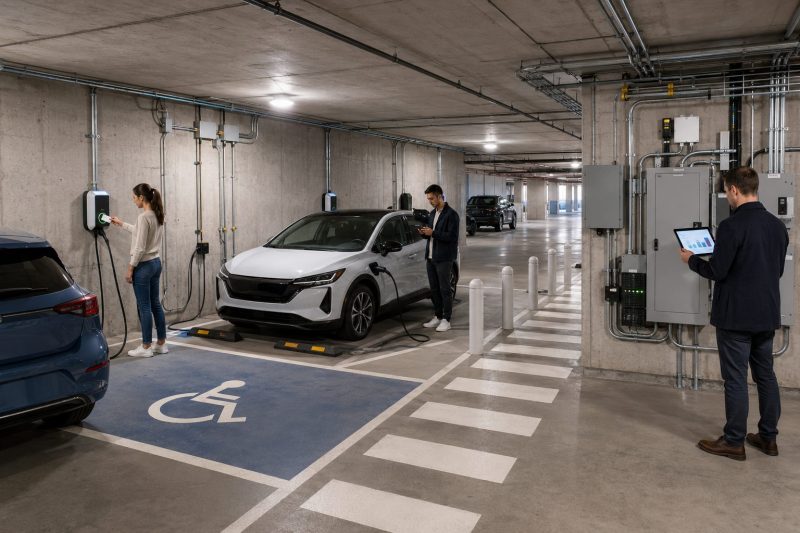
I have worked with property managers, condominium boards, and charging operators for years as general manager at Parwatt New Energy. We supply chargers and power modules used in multifamily settings. I regularly review projects where early assumptions about parking or power capacity created expensive redesigns later. Our equipment, including solutions in the EV Charger Category, is designed to support the shared and managed use that most multi-unit dwellings need. In this article I explain the practical strategies that help MUD communities deliver reliable charging without unnecessary cost or conflict.
Why EV Charging Is More Complicated in Multi-Unit Dwellings?
Residents of apartments and condominiums cannot treat charging the same way single-family homeowners do. Many lack a dedicated parking space they control. Even when a space is assigned, the resident rarely has authority to modify the building’s electrical system. Property owners, tenants, homeowners associations, and management companies must all agree on cost, access, and rules. These layers make every decision slower and more complex.
EV charging is more complicated in multi-unit dwellings because residents often share parking, cannot independently alter electrical infrastructure, and must navigate decisions among owners, tenants, property managers, and associations. Fixed versus shared spaces, distance from electrical rooms, and cost-allocation rules all increase project difficulty.
The Structural Barriers Unique to MUDs
I have visited properties where residents wanted charging yet could not move forward for months. The parking spaces were shared, so no single resident could claim a permanent station. The electrical room sat far from the garage, making conduit runs expensive. The condominium board required a formal vote, and tenants had no direct voice in the capital decision.
Assigned-space buildings face different issues. A resident may control a stall yet still need building approval for any electrical work. Metering and billing become complicated when the charger draws from a house meter rather than an individual unit meter.
Shared parking areas require clear rules on who can use the stations, how long a vehicle may remain connected, and what happens when demand exceeds supply. Without those rules, a few vehicles can block access for everyone else.
Older buildings add further constraints. Electrical capacity may be limited, panels may lack space for new breakers, and the physical path for new conduit may be obstructed by existing utilities or structural elements.
Here is a table that shows the main complications:
| Complication | Why It Appears in MUDs | Practical Effect | Who Must Coordinate |
|---|---|---|---|
| Shared or unassigned parking | Common in apartments and some condos | No permanent personal charger | Management and residents |
| Limited resident authority | Electrical systems are common property | Individual installation rarely allowed | Owners, HOA, or landlord |
| Multiple decision makers | Owners, tenants, managers, boards | Slow approval and conflicting priorities | All stakeholders |
| Distance from electrical capacity | Garages often far from main panels | High conduit and labor cost | Electrical contractor and owner |
| Billing and access control | Shared meters or house power | Need for authentication and cost recovery | Operator and management |
This table reflects the reality I encounter on most multifamily projects. At Parwatt we design equipment that supports networked access control and load management so these operational issues can be handled cleanly once the physical installation is complete.
In 2026 the number of EV drivers living in multi-unit dwellings continues to rise. Properties that treat MUD charging as a simple smaller version of home charging consistently underestimate the coordination and design work required.
The Planning Mistakes That Make MUD Charging More Expensive
Several early mistakes regularly drive costs higher than necessary. Property teams choose a charger quantity before surveying actual resident demand. They budget only for hardware and overlook conduit, trenching, networking, metering, and ongoing maintenance. They assume every space needs a dedicated high-power circuit. They proceed without clarifying ownership, permitting, accessible-space requirements, or electricity cost recovery. These errors produce redesigns, change orders, and delayed occupancy of the stations.
Planning mistakes that raise MUD charging costs include setting charger counts without demand data, budgeting only hardware while ignoring infrastructure and operating expenses, assuming dedicated high-power circuits for every stall, and failing to resolve ownership, permitting, accessibility, and billing rules early.
Costly Assumptions That Appear Repeatedly
One common mistake is deciding the number of chargers before any resident survey. A property may install far more ports than near-term demand supports, tying up capital in under-used equipment. Or it may install too few and face immediate complaints and waiting lists. Demand data from current residents and wait-list interest provide a far better starting point.
Another frequent error is treating the charger price as the main cost. In multi-unit settings the electrical infrastructure—conduit, wiring, panel upgrades, and possible trenching—often exceeds the hardware cost. Network fees, payment systems, and maintenance contracts add further ongoing expense that must be planned from the beginning.
Some projects assume every parking space should receive its own full-power circuit. That approach quickly exhausts electrical capacity and triggers expensive service upgrades. Shared power through load management can serve more vehicles at lower infrastructure cost when overnight dwell times are long.
Legal and administrative items are easy to postpone. Questions of who owns the equipment, who pays for electricity, how accessible spaces will be handled, and what permits are required should be answered before detailed design begins. Late discovery of these issues produces delays and redesign costs.
Here is a table of the main planning traps:
| Mistake | Why It Happens | Cost Consequence | Prevention |
|---|---|---|---|
| Charger count without demand data | Desire for a quick decision | Over- or under-building | Resident survey first |
| Hardware-only budget | Focus on visible equipment cost | Surprise infrastructure expenses | Full scope including conduit and soft costs |
| Dedicated circuit for every stall | Simple but inefficient design | Premature electrical upgrades | Evaluate power sharing |
| Unclear ownership and billing | Avoidance of difficult conversations | Later disputes and redesign | Resolve rules early |
| Late permitting and accessibility review | Treated as final-step items | Schedule delays and change orders | Include in initial planning |
This table captures the issues that most often inflate MUD project budgets. At Parwatt we encourage property teams to complete demand and electrical assessments before selecting hardware such as our 30kW Power Module or 40kW Power Module. Early clarity protects both schedule and cost.
I have reviewed projects that required major electrical redesign after the initial charger quantity was already approved. The extra cost and delay could have been avoided with a simple load study and resident survey at the start. Planning discipline is the most effective cost-control tool available to MUD communities.
How to Choose the Right Charging Model for Your Property
No single charging model fits every multi-unit dwelling. The best approach depends on whether parking spaces are assigned or shared, how long vehicles remain parked, how electricity will be paid, and how much control the property wants to retain. Dedicated assigned-space charging, shared networked stations, public-access ports, and hybrid combinations each serve different building types.
The right charging model for a multi-unit dwelling depends on the parking arrangement, typical dwell time, billing preferences, and management capacity. Assigned-space Level 2 charging, shared networked stations with access control, and hybrid designs can all succeed when matched to the property’s real conditions.
Matching Model to Parking and Use Patterns
Buildings with assigned parking spaces can support resident-specific chargers. Each interested resident receives a station at or near their stall, often connected to a dedicated account for billing. This model feels closest to home charging and reduces daily competition for ports. It works best when electrical capacity and conduit paths can support multiple individual circuits or managed power sharing.
Buildings with shared or unassigned parking usually need networked shared stations. Drivers authenticate with a card, app, or code. Reservations, time limits, and idle fees help keep stations available. Load management distributes power so more vehicles can charge overnight without overloading the service.
Some properties add a limited number of publicly accessible ports. These can serve visitors, short-term renters, or the broader neighborhood while generating additional revenue. Public ports require clearer pricing, payment systems, and sometimes different accessibility or signage standards.
Hybrid designs combine elements. A core set of assigned or reserved stations serves regular EV residents, while a smaller shared pool handles overflow and guests. This approach balances certainty for frequent users with flexibility for others.
Level 1 charging can still play a role in very capacity-constrained buildings or for plug-in hybrids with low daily mileage. Most pure battery electric vehicles benefit from Level 2, especially when overnight dwell times are long.
Here is a comparison of common models:
| Model | Best Parking Type | Access Method | Billing Approach | Main Advantage |
|---|---|---|---|---|
| Assigned-space Level 2 | Dedicated resident stalls | Resident-specific | Individual account or unit meter | Predictable personal access |
| Shared networked Level 2 | Common or unassigned parking | App, RFID, or code | Session-based or subscription | Serves more residents per port |
| Public-access ports | Visitor or mixed parking | Open or network app | Public pricing | Additional revenue and flexibility |
| Hybrid | Mix of assigned and shared | Combined rules | Mixed | Balances certainty and capacity |
| Managed low-power / Level 1 | Highly constrained electrical service | Shared or assigned | Session or flat fee | Minimal infrastructure demand |
This comparison helps property teams narrow options quickly. At Parwatt we supply hardware that supports both assigned and shared configurations, including networked systems that enable authentication and load control. You can review suitable equipment in the EV Charger Category.
I have seen assigned-space models create high resident satisfaction in condominium buildings with stable ownership. I have also seen shared networked systems serve apartment communities effectively when rules and load management are clear. The parking structure should drive the model choice, not the other way around.
How Smart Design Controls Cost and Supports Future Expansion
Installing the maximum number of chargers on day one is rarely the most economical path. Smart design uses EV-ready infrastructure, power sharing, dynamic load management, phased port installation, user authentication, and automated billing to keep initial costs lower while preserving the ability to add capacity later. Properties that plan for growth avoid repeated construction disruption and higher future expenses.
Smart design controls MUD charging costs through EV-ready conduit and panel capacity, power sharing, dynamic load management, phased installation of ports, and networked authentication and billing. These measures reduce upfront investment while leaving clear pathways for future expansion as EV adoption grows.
Design Choices That Protect Both Budget and Flexibility
EV-ready work installs the expensive or disruptive elements first—conduit, raceways, panel capacity, and communication pathways—while deferring the actual charging ports. When demand rises, new stations can be added with far less construction impact and cost.
Power sharing and dynamic load management allow several vehicles to charge on a circuit that could not support all of them at full power simultaneously. Overnight, when most MUD vehicles remain parked for many hours, the system can distribute available capacity so every connected vehicle still receives adequate energy by morning.
Phased installation matches capital outlay to real demand. A property may begin with a modest number of ports, gather utilization data, and expand only when wait lists or session counts justify additional hardware.
Networked authentication and automated billing remove the need for manual tracking of electricity use. Residents or guests identify themselves, sessions are recorded, and costs are allocated according to the property’s chosen rules. This reduces administrative burden and disputes.
Future panel and transformer capacity can be reserved even if it is not fully used at the start. The incremental cost of a larger panel or additional breaker space during initial work is usually far lower than a later service upgrade.
Here is a structured view of cost-control and expansion measures:
| Design Measure | Immediate Benefit | Future Benefit |
|---|---|---|
| EV-ready conduit and pathways | Lower cost per future port | Fast, low-disruption expansion |
| Dynamic load management | More vehicles on existing capacity | Delayed or avoided service upgrades |
| Phased port installation | Capital matched to current demand | Data-driven growth |
| Networked authentication & billing | Automated cost recovery | Scalable administration |
| Reserved panel / service capacity | Modest extra cost now | Avoided major upgrade later |
These measures work together. At Parwatt our power modules and chargers, including options such as the Battery Buffered Ultra Rapid EV Charger, are designed to operate under managed load conditions so properties can implement power sharing with confidence. Additional background on system design appears in our article on Electric Vehicle Charging.
I have compared properties that installed full capacity on day one with those that used an EV-ready plus phased approach. The phased properties almost always spent less overall and experienced fewer resident complaints during construction. Planning for expansion from the beginning is one of the highest-leverage decisions a MUD can make.
A Step-by-Step Roadmap for Launching a Successful MUD Charging Project
A successful multi-unit dwelling charging project follows a clear sequence. It begins with resident demand and parking analysis, moves through electrical and utility assessment, clarifies ownership and operating rules, selects equipment and contractors, completes installation, and establishes ongoing management and expansion policies. Skipping steps usually creates cost or access problems later.
Launch a successful MUD charging project by surveying demand, analyzing parking and ownership, completing an electrical assessment, engaging the utility and incentive programs, defining ownership and billing rules, selecting equipment and contractors, installing and commissioning, and setting clear operating and expansion policies.
Practical Sequence That Reduces Risk
Start with a resident survey. Ask about current EV ownership, planned purchases, daily mileage, home-charging access, and willingness to pay for charging. The results guide both the initial number of ports and the preferred access model.
Map the parking arrangement and legal structure. Determine which spaces are assigned, which are shared, who controls them, and what approvals are required from owners, the HOA, or the landlord.
Commission a professional electrical assessment. Identify available capacity, panel space, feasible conduit routes, and the cost of any required upgrades. This study prevents later surprises.
Contact the utility early. Ask about available make-ready support, rate options for multifamily charging, interconnection requirements, and any planned service improvements.
Identify incentive programs. Federal, state, local, and utility funding can significantly reduce net cost. Application timing and eligibility rules vary, so early research is essential.
Decide ownership and operating model. Clarify who will own the equipment, who will maintain it, how electricity will be paid, and how residents or guests will be charged or authorized.
Select equipment and a qualified contractor experienced with multifamily installations. Prioritize networked Level 2 systems that support load management and authentication for most shared-parking properties.
Complete permitting, installation, and commissioning. Test access control, billing, and load-management functions before opening the stations to residents.
Establish operating rules and an expansion plan. Define time limits, idle policies, maintenance responsibility, and the conditions under which additional ports will be added.
Here is a concise roadmap:
- Survey current and near-term resident EV demand.
- Document parking types, ownership, and approval requirements.
- Perform a detailed electrical capacity and routing study.
- Engage the utility on rates, make-ready, and interconnection.
- Research and apply for applicable incentives.
- Define equipment ownership, maintenance, and billing rules.
- Choose networked, load-manageable Level 2 hardware and an experienced contractor.
- Complete installation, testing, and resident communication.
- Set usage policies and a clear trigger for future expansion.
- Monitor utilization and adjust rules as needed.
At Parwatt we support property teams with hardware that fits this sequenced approach. Our chargers and power modules are selected for the reliability and control that shared multifamily environments require. Further reading on technology choices is available in our comparison of AC vs DC EV Charging.
Properties that follow the full sequence consistently deliver systems that residents actually use, that recover costs fairly, and that can grow without repeated major construction. The roadmap turns a complex project into a manageable set of decisions.
Conclusion
A successful multi-unit dwelling EV charging project begins with the property’s parking arrangement, electrical capacity, resident demand, and decision-making structure—not with the selection of a charger. At Parwatt we design chargers and power modules to support the shared, managed, and expandable systems that most MUD communities need. Property owners and managers should determine who will use the stations, where vehicles remain parked, how electricity and operating costs will be allocated, and how future demand will be accommodated. Shared Level 2 charging, assigned-space installations, EV-ready infrastructure, and networked load management can all be effective, but no single model suits every building. By coordinating early with residents, utilities, qualified electrical professionals, charging providers, and incentive programs, MUD communities can control installation costs, improve access, and build a system that can expand as EV adoption grows.

--- END ---
Related Posts


Business Ideas

11kW vs. 22kW Home EV Chargers: Which One Should You Choose in 2026?
October 21, 2026

Business Ideas

Business Ideas
