

Sourcing Portable Tire Inflators from China: A 2026 B2B Buyer’s Guide
Sep 07,2026
Portable tire inflators look simple, yet small differences in speed, accuracy, heat control, and battery life create large gaps in real performance. Buyers who judge only by appearance or maximum PSI often face returns and complaints. At Parwatt I see these gaps raise after-sales costs for wholesale partners every season.
Sourcing portable tire inflators from China requires verifying inflation speed, pressure accuracy, duty cycle, heat management, and battery performance under consistent test conditions. In 2026 buyers who start with clear specifications, test multiple samples, and confirm compliance reduce quality disputes and select configurations that fit their real customers.
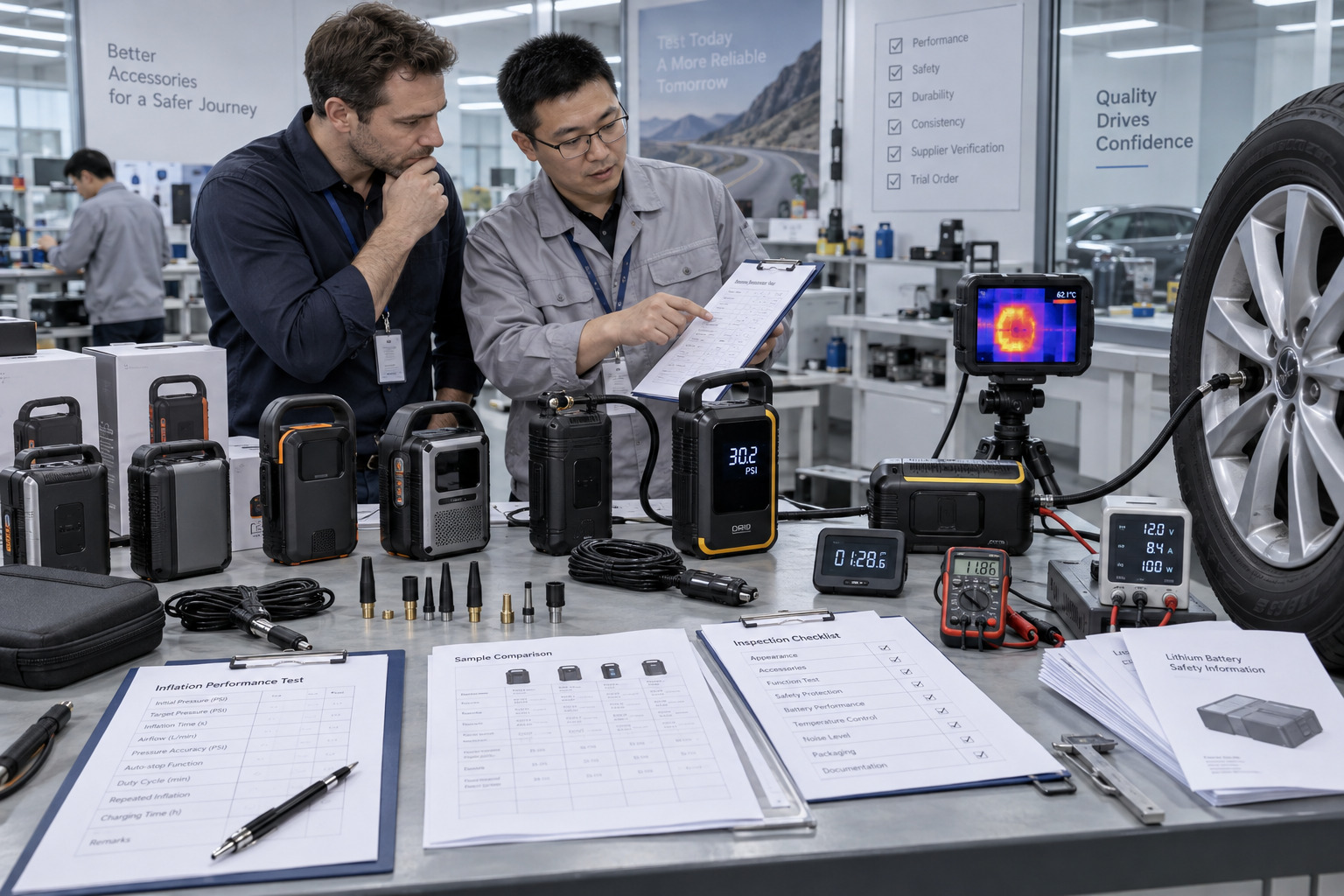
I have worked with automotive accessory wholesalers and importers for years as general manager at Parwatt New Energy. We supply portable tire inflators and related car-care products alongside our charging solutions. I regularly review orders where buyers focused on the highest PSI claim or the lowest unit price and later received products that overheated, lost accuracy, or failed to complete repeated inflations. Our range in the car air pump category is developed with measurable performance so partners can compare results fairly. In this article I explain how B2B buyers can source reliable portable tire inflators from China and avoid the most common pitfalls in 2026.
Why Portable Tire Inflators Are More Difficult to Source Than They Look?
Many inflators share similar shapes and digital displays. The real differences appear only when the product is used. Inflation speed, pressure accuracy, continuous working time, heat buildup, and battery behavior vary widely. A unit that looks capable on a desk may slow down, overshoot the target pressure, or shut off after one or two tires. These gaps turn into customer complaints and warranty costs.
Portable tire inflators are difficult to source because products that look alike can differ sharply in inflation speed, pressure accuracy, heat management, duty cycle, and battery performance. Maximum PSI alone does not predict real-world results.
The Hidden Performance Gaps
I have tested samples that claimed high maximum pressure yet took far longer than expected to raise a standard passenger tire from 25 PSI to 35 PSI. The compressor delivered pressure, but airflow was low. The headline PSI number looked strong while the practical task felt slow.
Heat is another frequent problem. A compact unit may complete the first tire quickly and then lose speed or trigger thermal protection on the second or third tire. Buyers who only test a single inflation miss this limitation.
Pressure accuracy and auto-stop behavior also vary. Some units stop close to the set value. Others overshoot or display readings that drift once the compressor is hot. Drivers who rely on the built-in gauge can end up with over- or under-inflated tires.
For cordless models, battery voltage drop reduces performance as the charge declines. A unit that works well at full charge may struggle later in the day. Runtime claims measured under light load do not always match repeated high-load use.
Here is a table that shows the gaps that appearance cannot reveal:
| Performance Area | What Looks Similar | What Actually Differs | Buyer Risk |
|---|---|---|---|
| Inflation speed | Same max PSI claim | Airflow and time to target | Slow real-world use |
| Pressure control | Digital display | Accuracy and overshoot | Incorrect tire pressure |
| Heat management | Compact size | Duty cycle and throttling | Failure on multiple tires |
| Battery behavior | Stated capacity | Voltage sag under load | Fading performance |
| Continuous work | Single-cycle demo | Repeated inflation ability | Thermal shutdown |
This table reflects the differences I see most often when comparing supplier samples. At Parwatt we measure these factors consistently across the products in our car air pump category so partners receive usable performance data.
In 2026 the market remains full of similar-looking units. Buyers who treat maximum PSI or casing design as the main decision criteria consistently underestimate after-sales risk.
The Specification Claims B2B Buyers Should Never Accept at Face Value
Suppliers commonly highlight maximum PSI, battery capacity, or motor power. These figures are easy to print and hard to compare without test conditions. Buyers who accept them without verification often discover later that inflation time, auto-stop accuracy, or thermal behavior falls short of expectations.
Specification claims that buyers should never accept at face value include maximum PSI without airflow or time data, battery capacity without load testing, and motor power without duty-cycle results. Clear test conditions are required for meaningful comparison.
Claims That Hide Real Limitations
Maximum PSI indicates the highest pressure the unit can reach, not how quickly it inflates a typical car tire. Most passenger tires operate well below the maximum printed on many inflators. Time required to move from a starting pressure to a target pressure is far more relevant for everyday use.
Battery capacity in mAh or Wh is often quoted without stating the load. A pack that supports long LED-light runtime may still sag quickly under compressor load. Claims measured in a low-power accessory mode overstate inflation performance.
Motor power or peak current figures do not reveal thermal limits. A unit may draw high power for a short burst and then reduce output or shut down to protect itself. Continuous or repeated-use data are needed.
Auto-stop accuracy is frequently omitted. Buyers should know how close the unit stops to the set pressure and whether that accuracy holds after the compressor has warmed up.
Test conditions themselves are rarely disclosed. Tire size, starting pressure, ambient temperature, hose length, and whether the result comes from the first or a later cycle all change the numbers. Without these details, supplier data cannot be compared.
Here is a table of claims that require verification:
| Claim | Why It Is Incomplete | What to Request Instead |
|---|---|---|
| Maximum PSI | Does not show speed | Time from X PSI to Y PSI on a defined tire |
| Battery capacity | Load not stated | Runtime under continuous inflation load |
| Motor power | Ignores heat limits | Duty cycle and thermal behavior |
| “Accurate auto-stop” | No tolerance given | Measured overshoot at several set points |
| Unstated test method | Prevents comparison | Full conditions: tire, pressures, temperature, cycle |
This table helps buyers push past marketing language. At Parwatt we supply performance data with defined conditions for the inflators in our car air pump category and related accessories so partners can evaluate products on equal terms.
I have seen buyers rank units by maximum PSI and later receive complaints about slow inflation. Requesting time-to-pressure data under a standard test changes the ranking quickly.
How to Evaluate Chinese Tire Inflator Suppliers and Product Samples
Supplier evaluation and sample testing must work together. Buyers should confirm the factory’s identity, production capacity, quality system, key component sources, and certification files. Samples from short-listed makers should then be tested under identical conditions using the same tire, starting pressure, and ambient temperature.
Evaluate suppliers by verifying factory identity, capacity, quality controls, component sources, and certifications. Test multiple samples under the same tire, pressure, and temperature conditions to compare inflation speed, accuracy, heat, and battery behavior.
Supplier Checks and Sample Protocol
Confirm that the company you are dealing with is the actual manufacturer or an authorized exporter with clear factory access. Request business licenses, export records, and, where possible, a video or on-site view of the production line and aging test area.
Review quality-system documents and incoming inspection practices for motors, gauges, and battery cells. Ask how defective batches are isolated and how traceability is maintained.
For cordless models, examine cell brand or specification, protection-board design, and charge-discharge test records. Lithium transport documents such as UN 38.3 related evidence should be available.
Certifications must match the target markets. Electrical safety, EMC, and any local marking requirements should be confirmed with valid files rather than logo claims alone.
Once suppliers are short-listed, test samples side by side. Use the same tire size, the same starting and target pressures, and the same ambient temperature. Record time to pressure, final gauge reading versus a calibrated reference, temperature rise, and behavior on a second and third consecutive inflation.
For cordless units, repeat key tests at mid and low battery states. Note any automatic shut-off, pressure overshoot, and recovery after cooling.
Here is a practical evaluation sequence:
- Verify factory identity and production capacity
- Review quality-system and component-source controls
- Collect certification and lithium-transport files
- Define a standard test tire and pressure points
- Measure time-to-pressure on multiple samples
- Compare displayed pressure with a reference gauge
- Run consecutive inflations to check heat and duty cycle
- Test cordless units at different battery levels
- Record noise, hose quality, and accessory fit
- Rank samples against the written specification
At Parwatt we apply these checks when developing products for our partners. The same discipline supports the inflators and related items in our car air pump category and complementary lines such as car battery chargers.
I recommend that buyers prepare the test protocol before samples arrive. A written method prevents later arguments about whether the results are fair.
How to Select the Right Configuration for Your Market and Sales Channel
The best inflator configuration depends on the customer and channel rather than the longest feature list. Cordless models prioritize portability. 12V corded models avoid battery dependence. Units with power-bank or jump-starter functions add everyday or emergency utility but increase cost, weight, and quality-control complexity. Matching the configuration to the intended use improves sell-through and reduces mismatch returns.
Select the inflator configuration according to the target customer and channel. Cordless suits portability-focused retail and e-commerce. 12V corded suits simple vehicle-powered use. Multi-function models serve broader emergency needs but require stricter quality control.
Matching Configuration to Use Case
Cordless inflators appeal to drivers who want to carry a compact unit in the trunk or glove area and use it without finding a power outlet. They fit e-commerce, lifestyle retail, and gift channels. Battery performance, charge time, and thermal behavior under repeated use become critical.
12V corded inflators plug into the vehicle socket and run as long as power is available. They suit price-sensitive retail, fleet users, and drivers who prefer not to manage a rechargeable pack. Cable quality and connector durability matter more than battery claims.
Models that combine inflation with a power bank add daily utility for phones and small devices. This can increase perceived value in consumer channels yet adds battery-management and certification requirements.
Jump-starter combinations serve roadside emergency positioning. They attract higher price points and broader emergency kits but introduce greater weight, higher cell capacity, and more complex safety and transport rules. Quality control and after-sales support must be correspondingly stronger.
Regional power habits and retail channels further guide the mix. Markets with strong online convenience demand often absorb more cordless units. Markets that emphasize simple, low-cost tools may favor 12V models. Commercial or fleet buyers may need higher duty-cycle products.
Here is a configuration guide:
| Configuration | Primary Advantage | Best Channels | Key Risks to Manage |
|---|---|---|---|
| Cordless only | Portability | E-commerce, lifestyle, gift | Battery fade, heat, transport docs |
| 12V corded | Continuous power, lower cost | Mass retail, fleet | Cable and connector durability |
| Cordless + power bank | Extra daily utility | Consumer retail | Added battery complexity |
| Inflator + jump starter | Emergency positioning | Roadside and premium kits | Weight, safety, higher QC demand |
| Mixed assortment | Channel coverage | Multi-channel wholesale | Clear positioning per SKU |
This guide keeps assortment decisions practical. At Parwatt we support partners with options across these configurations within the car air pump category and related car-care products shown on our main site.
I advise buyers to map each proposed SKU to a primary customer and channel before ordering. The exercise quickly shows whether the feature list matches real demand.
From Golden Sample to Trial Order: A Safer Sourcing Workflow
A controlled workflow reduces the jump from sample to mass production. Buyers should lock a written specification and acceptance criteria, approve a golden sample, place a limited trial order, perform pre-shipment inspection, and expand volume only after reviewing returns, inflation performance, and end-user feedback.
Move from golden sample to trial order by fixing the specification, approving a reference sample, running a controlled pilot shipment, inspecting before dispatch, and scaling only after field data confirm consistency. This sequence protects quality and commercial results.
Steps That Protect the Order
Write a clear specification that includes target inflation time on a defined tire, pressure accuracy tolerance, maximum acceptable temperature rise, duty-cycle expectation, battery performance (for cordless), accessory list, labeling, and packaging requirements. This document becomes the reference for all later checks.
Approve a golden sample that meets the specification. Sign or otherwise record the sample so both parties share the same physical reference. Keep the sample under controlled storage.
Confirm all certifications and, for cordless models, the complete lithium transport file before production begins. Missing documents create shipping delays that are expensive to solve after the goods are ready.
Place a trial order large enough to test production consistency yet small enough to limit risk. Conduct pre-production and pre-shipment inspections against the golden sample and written specification.
After the trial goods reach the market, track return reasons, customer comments on speed and accuracy, and any thermal or battery complaints. Use the data to decide whether to enlarge the order, adjust the specification, or change supplier.
Maintain the same specification and inspection criteria for subsequent orders so quality does not drift.
Here is a concise sourcing workflow:
- Define measurable performance and acceptance criteria
- Short-list and verify suppliers with factory and quality evidence
- Test multiple samples under identical conditions
- Approve and record a golden sample
- Confirm certifications and lithium transport documents
- Place a limited trial order
- Perform pre-shipment inspection against the golden sample
- Monitor returns and field performance
- Expand volume only after data confirm stability
- Keep the specification and quality agreement active for future orders
At Parwatt we follow this disciplined path when supplying inflators and related accessories to wholesale partners. The same process supports products in our car air pump category and complementary lines such as car vacuum cleaners. Further details are available across our main catalog.
Buyers who treat the first bulk order as a controlled test rather than a full commitment consistently achieve lower dispute rates and more stable long-term supply. The workflow itself becomes a competitive advantage.
Conclusion
Sourcing portable tire inflators from China should begin with measurable performance requirements rather than appearance or maximum PSI alone. At Parwatt we verify inflation speed, accuracy, duty cycle, and battery behavior so the products we supply meet practical expectations. Buyers need to verify inflation speed, pressure accuracy, airflow, duty cycle, heat management, battery performance, accessories, and market-specific compliance. Samples should be tested under the same conditions and compared against an approved specification sheet. For cordless models, battery documentation and transport compliance require particular attention. Once the supplier and golden sample are approved, a controlled trial order provides a safer way to evaluate production consistency, packaging durability, and customer response. This evidence-based process helps B2B buyers reduce quality disputes while selecting a product configuration that genuinely fits their customers and sales channels.

--- END ---
Related Posts


Business Ideas

Business Ideas
