

Suction Pressure vs. Airflow vs. Motor Power: Which Vacuum Specification Matters Most?
Sep 02,2026
Vacuum power specifications are easy to misunderstand. Suppliers use Pa, kPa, CFM, L/s, air watts, and motor watts to describe performance, yet these units measure different things. Buyers often treat a high number as proof of strong cleaning ability. At Parwatt I see this confusion lead to poor product choices and higher returns.
Suction pressure, airflow, and motor power measure different aspects of vacuum performance. Pressure helps overcome resistance and loosen debris. Airflow carries that debris into the dust cup. Motor wattage only shows electrical input. In 2026 the balance of pressure and airflow at the working nozzle, verified by real pickup tests, matters more than any single headline figure.
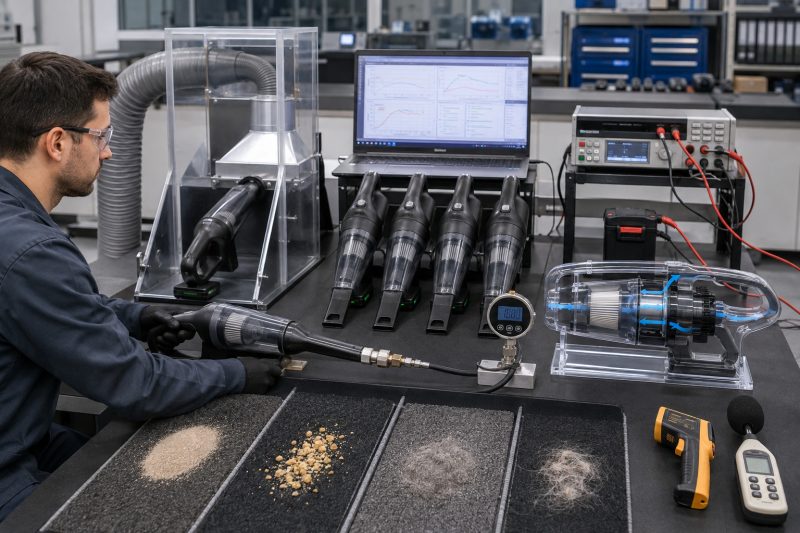
I have worked with automotive accessory wholesalers and B2B buyers for years as general manager at Parwatt New Energy. We supply cordless car vacuums and related car-care products. I regularly review specifications where a high Pa or high wattage figure looked impressive yet real cleaning results were only average. Our products in the car vacuum cleaner category are evaluated on the complete system so partners receive balanced performance. In this article I explain what each specification actually measures and how buyers can compare vacuums more reliably in 2026.
Why Vacuum Power Specifications Are So Easy to Misunderstand?
Suppliers present different units as if they all describe “suction power.” Pa and kPa measure pressure. CFM and L/s measure airflow volume. Air watts attempt to combine pressure and airflow. Motor watts show how much electricity the motor consumes. These quantities are related but not interchangeable. A high value in one unit does not automatically mean strong real-world cleaning.
Vacuum power specifications are easy to misunderstand because Pa, airflow units, air watts, and motor watts measure different physical quantities. Buyers who treat them as equivalent often overestimate cleaning ability and select products that under-perform in actual use.
The Confusion Created by Mixed Units
I have compared product sheets that listed high motor wattage next to a moderate Pa figure and presented both as evidence of strong suction. The wattage only told how much power the motor drew from the battery or the wall. It said nothing about how efficiently that power was turned into useful air movement at the nozzle.
Pressure and airflow serve different purposes. High static pressure helps the vacuum pull air through a narrow gap or lift heavier particles. High airflow moves a larger volume of air and carries loose dust and crumbs more effectively. A machine strong in one and weak in the other will clean some debris well and struggle with other types.
Test conditions add another layer of confusion. One supplier measures pressure at the motor inlet under sealed conditions. Another measures at the nozzle with a partially open inlet. The numbers cannot be compared directly, yet they often appear side by side in buyer evaluations.
Cordless car vacuums introduce further variables. Battery voltage drops during use, filters load with dust, and attachments change the air path. A specification recorded at full charge with a clean filter overstates the performance a user will experience later in the cleaning session.
Here is a table that shows why the units are not interchangeable:
| Specification | What It Measures | What It Does Not Show | Common Misreading |
|---|---|---|---|
| Pa / kPa | Pressure difference | Airflow volume | “Higher Pa always cleans better” |
| CFM / L/s | Air volume moved | Ability to overcome resistance | “Higher flow is always stronger” |
| Motor watts | Electrical power input | Efficiency or output at nozzle | “Higher watts equal stronger suction” |
| Air watts | Combined pressure and flow estimate | Exact test conditions | “AW figures are always comparable” |
This table reflects the misunderstandings I encounter most often. At Parwatt we measure both pressure and airflow under consistent conditions for the units in our car vacuum cleaner category so the data remain useful for comparison.
In 2026 many listings still lead with a single large number. Buyers who stop at that number consistently miss the system-level differences that determine real cleaning results.
The Specification Comparisons That Can Mislead Buyers
Several common comparison habits produce misleading conclusions. Buyers compare Pa values taken at different points in the air path. They treat input wattage as if it were suction output. They ignore the difference between peak and sustained performance. They place parameters from robot vacuums, handheld car vacuums, and full-size household machines on the same scale. These practices hide important performance gaps.
Misleading comparisons include matching Pa readings from different test locations, treating motor watts as cleaning power, ignoring peak-versus-sustained differences, and comparing dissimilar vacuum types on the same scale. Consistent methods and context are required for valid conclusions.
Habits That Distort the Ranking
One frequent error is accepting Pa figures without confirming where they were measured. Pressure at the motor inlet is almost always higher than pressure at the end of a hose or nozzle. A supplier that reports the motor value gains an apparent advantage that disappears once both units are measured at the working end.
Another error is ranking products by motor wattage. A higher-wattage motor can waste more energy as heat and noise. A lower-wattage motor with a more efficient fan and better seals can deliver stronger performance at the nozzle.
Peak values create a further distortion. Many claims reflect a brief maximum at the start of a run. Sustained values after the motor and battery have stabilized are lower and more representative of actual use. Buyers who never request the time and condition of the measurement receive an incomplete picture.
Cross-category comparisons add noise. A robot vacuum, a compact cordless car vacuum, and a corded upright are designed for different tasks and constraints. Their Pa or airflow numbers are not meant to be ranked against one another.
Here is a table of comparison traps:
| Trap | Why It Misleads | Better Approach |
|---|---|---|
| Different Pa measurement points | Motor inlet vs nozzle values differ | Measure all samples at the same point |
| Motor watts as performance rank | Input is not output | Focus on pressure and airflow at nozzle |
| Peak-only figures | Overstates continuous use | Request sustained readings |
| Mixing vacuum categories | Design goals differ | Compare only similar product types |
| Ignoring battery or filter state | Conditions change performance | Standardize charge and filter condition |
This table helps buyers filter supplier data more carefully. At Parwatt we keep test conditions consistent across samples so partners can trust the relative ranking of products in our car vacuum cleaner range and related lines such as car air pumps.
I have re-tested groups of samples after standardizing the measurement point and battery state. The order of performance often changed once the data were placed on a common basis. Clean comparisons prevent costly selection mistakes.
What Suction Pressure, Airflow and Motor Power Actually Measure
Suction pressure, airflow, and motor power describe different parts of the system. Pressure indicates the vacuum’s ability to overcome resistance and loosen embedded or heavier debris. Airflow indicates how effectively the vacuum transports that debris through the nozzle and into the dust container. Motor power indicates electrical energy consumed. Air watts attempt to combine pressure and airflow into a single output estimate, yet still require known test conditions.
Suction pressure measures the ability to overcome resistance and dislodge debris. Airflow measures the volume of air that carries debris into the dust cup. Motor power measures electrical input only. Understanding each quantity prevents buyers from equating a high number in one unit with overall cleaning strength.
The Physical Meaning of Each Specification
Suction pressure, expressed in Pa or kPa, is the difference between atmospheric pressure and the pressure inside the vacuum’s air path. Higher pressure helps the machine pull air through a narrow crevice tool, lift sand from carpet fibers, or continue working as the filter begins to load. It is especially useful when resistance is high.
Airflow, expressed in CFM or liters per second, is the volume of air moved in a given time. Higher airflow carries loose dust, crumbs, and larger particles more quickly into the dust cup. It is critical for open-area cleaning and for moving debris that has already been loosened.
Motor wattage is the rate of electrical energy consumption. It sets an upper limit on how much power is available, yet efficiency losses in the motor, fan, seals, and filters determine how much of that power becomes useful suction at the nozzle. Two motors with the same wattage can produce very different cleaning results.
Air watts combine pressure and airflow into an estimate of air power. The figure is more informative than input watts alone, but only when the test setup is known. Different measurement locations or restrictions produce different air-watt values for the same machine.
Here is a clear breakdown of the three core quantities:
| Quantity | Typical Units | Main Cleaning Contribution | Limitation |
|---|---|---|---|
| Suction pressure | Pa, kPa | Overcomes resistance, loosens debris | Does not show how much air moves |
| Airflow | CFM, L/s | Transports debris to the dust cup | Does not show ability to overcome restriction |
| Motor power | Watts | Supplies electrical energy | Ignores efficiency and system losses |
| Air watts | AW | Estimates useful air power | Requires known test conditions |
This breakdown keeps the specifications in their proper roles. At Parwatt we record both pressure and airflow when evaluating units so the balance is visible to partners who source from our car vacuum cleaner category.
I advise buyers to ask for the measurement location and battery state whenever any of these figures are quoted. Without that context the numbers remain difficult to interpret.
Why Complete Vacuum Design Matters More Than One Big Number
A high pressure or airflow figure can still produce disappointing cleaning if the rest of the system is weak. Air-path sealing, impeller efficiency, nozzle geometry, filter resistance, dust-cup design, battery discharge capability, thermal management, and accessories all influence the performance that reaches the cleaning surface. Strong overall design balances these elements rather than maximizing one specification.
Complete vacuum design matters more than any single large number because seals, impeller efficiency, nozzle size, filter loading, battery behavior, heat control, and accessories determine how much of the generated pressure and airflow actually cleans the surface. Balanced engineering outperforms isolated peak claims.
System Factors That Change Real Results
Sealing and air-path design decide whether pressure generated by the fan reaches the nozzle. Leaks around the dust cup, filter cover, or hose connections waste performance. Smooth internal channels preserve it.
Impeller and motor matching determine how efficiently electrical power becomes air power. A well-matched brushless system can maintain output longer and with less heat than a less efficient combination.
Nozzle area and shape affect both pressure and contact with the surface. A narrow tool raises velocity and helps with crevices. A wider nozzle covers area faster but may lower pressure. The best choice depends on the intended task.
Filter resistance rises as dust accumulates. A filter that loads quickly or has high initial restriction reduces airflow even while static pressure at the motor remains high. Easy-to-clean or higher-capacity filters help maintain performance during a full cleaning session.
Battery discharge characteristics control how long the motor can run at effective power. Cells that sag under load or a conservative protection circuit cause earlier reduction in suction. Thermal limits can further throttle output to protect the motor or battery.
Accessories complete the system. A soft brush, crevice tool, or flexible hose that fits the vehicle interior determines whether the available suction can reach the places users actually need to clean.
Here is a list of design elements that often decide the ranking:
- Air-path sealing and internal geometry
- Impeller efficiency and motor matching
- Nozzle size and contact design
- Filter type, capacity, and loading behavior
- Dust-cup volume and emptying convenience
- Battery cell quality and discharge stability
- Thermal management under continuous load
- Accessory fit for real vehicle tasks
At Parwatt we evaluate these system elements together when selecting products for our catalog. The same disciplined approach is applied across our car vacuum cleaner range and complementary accessories shown on our main site.
I have ranked samples that shared similar headline figures yet finished far apart once sealing, filter loading, and battery stability were taken into account. The complete design view consistently predicts customer satisfaction more accurately than any isolated specification.
How B2B Buyers Should Compare Vacuum Performance
Reliable comparison requires a controlled process. Buyers should standardize battery state, operating mode, filter condition, and nozzle, then measure static pressure and open airflow, record performance under added resistance, run weighed debris-pickup tests, and assess runtime, temperature rise, and noise. The accepted values should be written into the purchase specification and golden-sample record.
B2B buyers should compare vacuum performance by standardizing test conditions, measuring pressure and airflow at the working point, running controlled debris-pickup trials, recording runtime and heat, and locking the accepted results into the purchase agreement. Consistent methods turn specifications into usable decisions.
A Practical Comparison Sequence
Charge all samples to the same level and fit clean filters of the production type. Attach the same nozzle or test adapter for every measurement.
Measure static pressure at the defined working point. Record the value at the start of the run and after a set period of continuous operation. Repeat at mid-battery and near cut-off if the product is cordless.
Measure open airflow under the same setup where equipment allows. The combination of pressure and airflow gives a clearer picture than either value alone.
Add controlled resistance or partially load the filter and repeat key measurements. This reveals how the vacuum behaves as conditions become more realistic.
Conduct weighed debris-pickup tests. Distribute a fixed mass of sand, crumbs, or hair on a consistent surface. Vacuum for a fixed time with the same technique. Calculate the percentage recovered. Repeat for each sample.
Record runtime to automatic shut-off in each mode and note temperature at the motor and battery areas. Excessive heat or short runtime limits practical use even when short-term suction is strong.
Compare results across at least two or three samples of each model. High variation signals process-control risks that will appear in bulk production.
Write the accepted pressure, airflow, pickup, runtime, and noise values into the golden sample and the purchase specification. These numbers become the reference for incoming inspection.
Here is a concise comparison checklist:
- Standardize charge level, filter, mode, and nozzle
- Measure static pressure at start and after continuous running
- Measure airflow under the same conditions
- Repeat key tests at mid and low battery
- Run weighed sand, crumb, and hair pickup trials
- Calculate recovery percentages with identical technique
- Record runtime to cut-off and temperature rise
- Compare multiple samples of each model
- Lock accepted values into golden sample and purchase agreement
At Parwatt we follow this sequence when approving products for partners. The same standards support the quality of units supplied through our car vacuum cleaner category and related car-care lines such as car battery chargers. Further details are available across our main catalog.
Buyers who adopt a written, repeatable method consistently select products that perform as expected once they reach the market. The process reduces returns and protects the commercial relationship with the supplier.
Conclusion
No single specification can fully predict how well a vacuum cleaner will perform. At Parwatt we evaluate pressure, airflow, and complete system behavior so the products we supply meet practical cleaning needs. Suction pressure helps the machine overcome resistance and loosen embedded debris, while airflow transports that debris through the nozzle and into the dust container. Motor wattage only describes electrical input and does not show how efficiently the complete machine converts energy into useful suction. Buyers should therefore prioritize the balance between pressure and airflow at the working nozzle, supported by controlled debris-pickup, runtime and filter-loading tests. For cordless car vacuums, sustained performance under realistic resistance is more valuable than the largest isolated number on a specification sheet.

--- END ---
Related Posts


Business Ideas

Business Ideas
