

Car Battery Charger Wholesale Pricing: What Determines the Final Cost?
Sep 24,2026
Similar-looking battery chargers can carry very different wholesale prices. Two units may list the same voltage and current yet differ in internal components, charging algorithm, output stability, heat control, safety protection and certification scope. At Parwatt I see buyers focus only on the unit price and later face higher warranty and support costs.
Wholesale price is driven by continuous output capability, charging intelligence, component quality, thermal design, protections, cables, clamps, certification and order terms. In 2026 the best decision is the configuration that meets the required performance and compliance at the lowest realistic landed and warranty-adjusted cost.
I have worked with automotive accessory wholesalers and importers for years as general manager at Parwatt New Energy. We supply car battery chargers and support OEM and private-label programs. I regularly review quotations where a low unit price omitted critical accessories, used peak rather than continuous current, or excluded certification and tooling costs. Our range in the car battery charger category is priced according to verified performance and compliance so partners can compare offers fairly. In this article I explain what determines the final wholesale cost of a car battery charger and how buyers can request comparable quotations in 2026.
Why Similar-Looking Battery Chargers Can Have Very Different Prices?
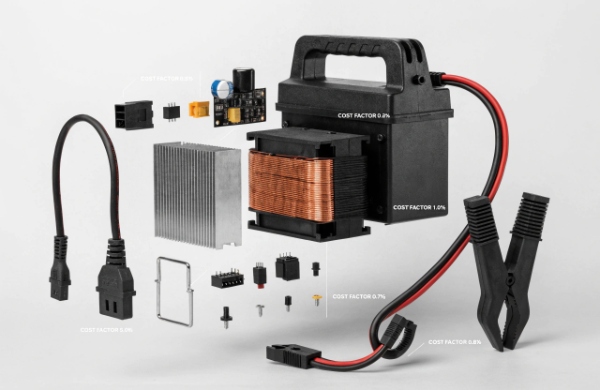
External appearance and a shared amp rating do not determine manufacturing cost. Inside the enclosure the transformer or inductor size, semiconductor ratings, capacitor quality, PCB layout, thermal materials and protection circuits can differ substantially. Firmware complexity, supported chemistries and certification scope add further cost layers. Two chargers that look alike on a table can therefore sit in very different price bands.
Similar-looking chargers can have very different prices because continuous current capacity, component grade, thermal design, charging algorithm, protections and certification create large cost differences that are invisible from the outside.
Where the Hidden Cost Differences Sit
I have opened units that shared the same claimed current yet used power devices with very different temperature and current margins. The lower-cost design ran hotter and relied on early fold-back, while the higher-cost design sustained output with lower temperature rise.
Magnetic components scale with sustained power. A charger that must deliver higher continuous current needs a larger transformer or inductor, more copper and better core material. These parts dominate the bill of materials for higher-output models.
Charging intelligence adds sensing hardware and firmware engineering. A multi-stage, multi-chemistry charger requires accurate voltage and current measurement, temperature compensation and validated stage transitions. Each additional chemistry profile increases validation work.
Safety and EMC compliance introduce both component and testing cost. Approved insulation systems, certified cord sets, and full safety and emissions testing are not free. Markets that demand NRTL, PSE or KC documentation raise the fixed cost further.
Cables, clamps and packaging are often treated as afterthoughts. Longer or heavier-gauge cables, higher-current clamps and retail-ready packaging can move the quotation by a noticeable amount.
Here is a table of hidden cost drivers:
| Cost Driver | Low-Cost Approach | Higher-Cost Approach | Field Impact |
|---|---|---|---|
| Power stage | Minimal derating | Higher-rated devices + thermal margin | Heat and longevity |
| Magnetics | Small core / light copper | Sized for continuous current | Sustained output |
| Firmware | Basic or single profile | Multi-stage, multi-chemistry | Charge quality |
| Protections | Minimal or fuse-only | Full electronic + thermal | Safety and claims |
| Cables / clamps | Short, light gauge | Rated length and section | Voltage drop and heat |
| Certification | Limited or none | Full target-market scope | Market access |
This table shows why a pure amp-rating comparison fails. At Parwatt we price chargers in our car battery charger category according to the verified continuous capability and compliance scope.
In 2026 buyers who still rank offers only by headline current consistently underestimate total cost of ownership. Visible sameness hides real differences.
The Low-Price Quotation Traps B2B Buyers Should Avoid
Low quotations often look attractive until the missing elements appear. Buyers sometimes compare prices under different Incoterms, accept peak or marketing current instead of continuous ratings, ignore accessory specifications, or fail to confirm whether certification, packaging, tooling and development fees are included. These traps make the cheapest offer the most expensive once all costs are counted.
Low-price quotation traps include mixing Incoterms, accepting peak current claims, ignoring cable and clamp specs, and overlooking certification, tooling and packaging costs. Fair comparison requires identical commercial and technical scope.
Traps That Distort the Real Price
Different Incoterms shift large cost blocks. An EXW price and a DDP price cannot be ranked against each other without adjusting for freight, insurance, duty and local delivery. Buyers who ignore the term systematically mis-rank suppliers.
Peak or “max” current is frequently quoted while continuous or rated current is lower. A charger that can touch a high number for a few seconds may not sustain the current needed for real charging. Quotations must state the continuous rating under defined conditions.
Accessory scope is easy to overlook. A quotation may include a short light-gauge cable and basic clamps while another includes a longer heavy-gauge set and higher-grade jaws. The unit prices look different because the hardware delivered is different.
Certification and testing fees may be excluded. When the buyer later needs CE documentation, NRTL evaluation or PSE/KC work, the extra cost appears as a surprise. Tooling, firmware customization and packaging plate charges behave the same way.
Warranty and spare-part terms also affect true cost. A slightly higher unit price with clearer warranty and available spare clamps may produce lower total cost than a cheaper unit with weak after-sales support.
Here is a table of common quotation traps:
| Trap | Why It Misleads | What to Require Instead |
|---|---|---|
| Mixed Incoterms | Different cost responsibilities | Same term for every offer |
| Peak vs continuous current | Overstates usable output | Verified continuous rating |
| Unspecified cables / clamps | Hidden performance and cost gap | Length, gauge, clamp rating |
| Excluded certification | Later mandatory cost | Explicit inclusion or separate line |
| Hidden tooling / development | Fixed costs appear later | One-time charges listed |
| Vague warranty | Support cost unknown | Clear term and coverage |
This table keeps commercial comparison honest. At Parwatt we present scope and commercial terms clearly for products in our car battery charger category so partners can evaluate offers on the same basis.
I advise buyers to reject any quotation that does not state continuous current, accessory list and certification status. Incomplete offers cannot be ranked safely.
The Technical and Commercial Factors That Determine Wholesale Price
Wholesale price is the sum of technical content and commercial conditions. Output power and continuous current, charging stages and chemistry support, 12V/24V capability, component grade, protection circuits, enclosure and thermal design, cables and clamps, certification scope and order quantity all move the number.
Technical factors such as continuous current, charging intelligence, component quality, thermal design and protections, together with commercial factors such as certification, accessories, customization and volume, determine the final wholesale price.
Breaking Down the Price Drivers
Continuous output current sets the size of the power stage and magnetics. Each step up in sustained amperage raises material and thermal-management cost.
Charging stages and chemistry profiles add sensing, firmware and validation. A basic lead-acid program costs less than a multi-chemistry design that includes AGM, GEL and LiFePO₄ with correct voltage limits and disabled functions where needed.
Dual-voltage (12V/24V) capability requires additional sensing, power-path design and testing of both modes. The extra coverage is valuable for mixed fleets but is not free.
Component grade and derating influence both cost and warranty risk. Higher-temperature capacitors, better semiconductors and improved insulation raise the bill of materials yet usually lower field failures.
Protection circuits—reverse polarity, short-circuit, overvoltage, overtemperature and abnormal-battery detection—require hardware and firmware. More complete and better-validated protection increases cost and reduces claim exposure.
Enclosure, thermal design and industrial design affect both tooling and unit cost. Metal or higher-grade plastic housings, fans or larger heatsinks, and custom shapes all add expense.
Cables, clamps, plugs and packaging are variable. Longer or heavier cables, higher-current clamps, market-specific plugs and retail packaging change the delivered cost.
Certification and order quantity introduce fixed and semi-fixed costs. Testing and certification are amortized across volume; small orders carry a higher per-unit burden. Customization of firmware, labels or housings adds further fixed charges.
Here is a structured factor list:
| Factor Category | Specific Drivers | Price Direction |
|---|---|---|
| Output capability | Continuous current, duty cycle | Higher with sustained power |
| Intelligence | Stages, multi-chemistry, dual voltage | Higher with more profiles |
| Internal quality | Component grade, thermal design | Higher with better margins |
| Protections | Full electronic + thermal set | Higher with complete coverage |
| Accessories | Cable, clamp, plug, case | Variable with specification |
| Compliance | Safety, EMC, market marks | Higher with broader scope |
| Commercial | Volume, tooling, customization | Lower unit cost at higher volume |
This breakdown helps buyers see where money is being spent. At Parwatt we can show how each factor contributes for chargers in our car battery charger category.
I recommend that buyers mark which factors are mandatory for their market and which are optional. Mandatory items should never be the place to cut cost.
How to Request Quotations That Can Be Compared Fairly
Fair comparison starts with a single RFQ that every supplier answers. The request should lock input and output ratings, continuous current, battery capacity range, chemistries, accessories, target markets, required certifications, packaging, quantities, Incoterms and warranty expectations. Only then can price differences be attributed to real content rather than to missing scope.
Request quotations with a unified RFQ that fixes ratings, continuous current, chemistries, accessories, markets, certifications, packaging, volume and commercial terms. Identical scope makes price differences meaningful.
Building a Comparable RFQ
State the nominal system voltage (12V, 24V or dual) and the required continuous charging current under defined conditions. Avoid peak or marketing numbers.
List the battery chemistries that must be supported and any that must be excluded. Ask for the voltage set points of each mode.
Specify cable length, conductor size, clamp type and rating, and AC plug type for each target market.
Name the destination markets and the certifications or conformity documents required for each. Ask whether the costs are included or quoted separately.
Define packaging: retail box, manual languages, labels, barcode and outer carton requirements.
Give target annual volume and the quantity breaks for which prices are needed. State the Incoterm clearly.
Require warranty period and a short description of what is covered. Ask for any one-time tooling, firmware or artwork charges as separate lines.
Request a simple open-book or itemized cost structure when the project is large enough to justify it. Even a high-level split between electronics, magnetics, accessories and compliance helps comparison.
Here is an RFQ content checklist:
- Nominal voltage and continuous current rating
- Supported and excluded battery chemistries
- Cable length, gauge and clamp specification
- AC plug and cord requirements by market
- Target markets and required certifications
- Packaging, manual and labeling scope
- Quantity tiers and Incoterm
- Warranty period and coverage summary
- One-time tooling / development charges
- Lead time and payment terms
At Parwatt we respond to structured RFQs with clear scope boundaries for products in our car battery charger category. The same clarity supports related programs on our main site.
I advise buyers to send the identical RFQ to every potential supplier and to reject incomplete replies. Only complete answers belong in the final comparison table.
How to Reduce Cost Without Increasing Warranty Risk
Cost can be reduced without weakening the product. The safer levers are mature platforms, standard enclosures, conventional accessories, order consolidation and simpler packaging. Cutting protection circuits, undersizing cables, or allowing undocumented component substitutions usually raises warranty cost more than it saves on the unit price.
Reduce cost by using mature platforms, standard housings and accessories, consolidated volumes and simpler packaging. Preserve critical protections, qualified components, necessary certifications and production testing so warranty risk does not rise.
Safe Cost-Reduction Levers
Adopt an existing, field-proven platform instead of a fully custom design. Shared tooling and already-validated firmware lower both development cost and technical risk.
Choose standard enclosure sizes and colors whenever brand requirements allow. Custom molds and special textures add cost that rarely improves charging performance.
Keep accessories conventional: widely used clamp styles, standard cable lengths and common plug types. Exotic connectors or extreme lengths should be reserved for genuine application needs.
Consolidate annual volume into fewer larger orders or fewer SKUs. Higher quantities improve amortization of testing, tooling and setup charges.
Simplify packaging where the channel permits. Bulk or semi-retail packs cost less than fully printed gift boxes when the sales environment does not require them.
Preserve the elements that protect field reliability: adequate component derating, complete protection functions, correct cable and clamp ratings, locked BOM, and end-of-line testing. These items are poor places to save money.
Avoid last-minute component substitutions. Any change to critical parts should be reviewed for performance and compliance impact before it is accepted.
Here is a safe-reduction checklist:
- Prefer mature, already-validated platforms
- Use standard enclosures and colors when possible
- Specify conventional cables, clamps and plugs
- Consolidate volume across fewer SKUs or larger lots
- Simplify packaging to channel requirements
- Keep full protection set and thermal margins
- Maintain locked BOM and change control
- Retain necessary certifications and production tests
- Measure savings against expected warranty cost
- Document every accepted cost trade-off
At Parwatt we help partners apply these levers while protecting reliability for chargers in our car battery charger category. Complementary products such as those in the car air pump category follow the same cost-versus-risk logic.
Buyers who cut only the non-critical items keep both the purchase price and the claim rate under control. That balance is the real target of wholesale cost management.
Conclusion
The wholesale price of a car battery charger is determined by far more than voltage and advertised amperage. At Parwatt we price according to verified continuous performance, compliance scope and total configuration so partners can compare offers on substance. Charging technology, component quality, thermal design, protection functions, cables, clamps, certification, customization and order terms all affect the final quotation. Buyers should first define the application and mandatory specifications, then request itemized quotations under identical commercial conditions. The best purchasing decision is not necessarily the lowest unit price, but the configuration that delivers the required performance and compliance with the lowest realistic landed and warranty-adjusted cost.

--- END ---
Related Posts
Business Ideas

Industry News

Business Ideas

Business Ideas


