

Tire Inflator Duty Cycle and Overheating: A Reliability Testing Guide
Oct 13,2026
Fast inflation can hide a serious overheating problem. Some portable inflators complete the first tire quickly, yet slow down, trigger thermal protection, or damage the motor, piston seals or battery when several tires are inflated in sequence. At Parwatt I see these thermal weaknesses create returns and warranty claims after the product has already launched.
Duty cycle and overheating must be tested under real tire loads, not only by maximum PSI or a single fast inflation. In 2026 B2B buyers who measure consecutive-cycle time, temperature rise, current draw and recovery behavior select inflators that remain reliable in actual use.
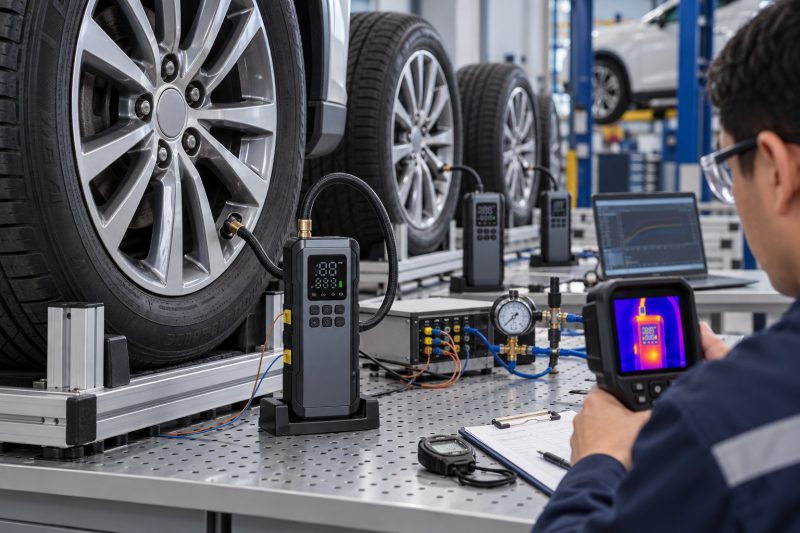
I have worked with automotive accessory wholesalers and importers for years as general manager at Parwatt New Energy. We supply portable tire inflators and related car-care products. I regularly review samples that look strong on a single-tire demonstration yet overheat or lose airflow during repeated use. Our range in the car air pump category is evaluated with consecutive-load and thermal tests so partners can compare real duty-cycle performance. In this article I explain how to test tire inflator duty cycle and overheating before mass production in 2026.
Why Fast Inflation Can Hide a Serious Overheating Problem?
A single quick inflation does not prove that an inflator can handle real roadside or garage work. Heat builds in the motor, cylinder, seals and battery as work continues. When the design cannot reject that heat, airflow falls, inflation time stretches, thermal protection trips, or internal parts are damaged. Customers then experience a product that “worked once and then failed.”
Fast inflation can hide overheating because heat accumulates across consecutive tires. Performance decline, protection shutdowns and component damage appear only under repeated load, not in a one-time demonstration.
How Thermal Problems Appear After the First Tire
I have timed units that inflated a standard passenger-car tire from 25 to 32 PSI in a competitive time on the first attempt. On the third or fourth tire the same unit took noticeably longer, drew higher current and became too hot to hold comfortably. Some entered thermal protection and refused to restart until they cooled.
Piston seals and valves are sensitive to sustained high temperature. Once they soften or wear, the inflator may still run but deliver less air per stroke. The customer sees longer fill times and assumes the product is low quality.
Cordless models add battery heat and voltage sag. As the pack warms and voltage drops, motor speed falls and the thermal problem compounds. A unit that performed well at full charge can struggle at mid charge under the same tire load.
Hose and connector heating is sometimes overlooked. Restricted flow or poor contact raises local temperature and can deform fittings during long runs.
Here is a table that links hidden thermal weakness to field outcomes:
| Early Observation | What It Hides | Field Result | Business Impact |
|---|---|---|---|
| Fast first inflation | Heat build-up on later cycles | Slowdown / shutdown | Returns and poor reviews |
| High max PSI on display | Low airflow near target pressure | Long fill times | Customer disappointment |
| Short demo only | No consecutive-load data | Seal or motor damage | Warranty claims |
| Full-charge only test | Mid/low battery weakness | Inconsistent performance | Support tickets |
| No temperature record | Unknown thermal margin | Unpredictable protection trips | Lost confidence |
This table reflects the claim patterns I discuss with distributors. At Parwatt we require consecutive-tire thermal data for products in the car air pump category.
In 2026 customers expect a portable inflator to finish more than one tire without drama. Thermal design is therefore a core reliability issue, not a secondary specification.
The Duty-Cycle and Maximum-PSI Claims Buyers Often Misread
Duty-cycle percentages and maximum PSI figures are easy to quote and easy to misread. A 100% duty-cycle claim or a high PSI number means little unless the test pressure, ambient temperature, run time, cooling time and tire size are stated. Numbers generated under different conditions cannot be compared directly.
Duty-cycle and maximum-PSI claims are often misread when test pressure, temperature, duration and cooling requirements are omitted. Meaningful comparison requires the full condition set behind every number.
Why Headline Numbers Mislead
Duty cycle is commonly expressed as a percentage of operating time versus total time. Without the pressure at which it was measured and the length of the test window, the percentage cannot be translated into real multi-tire work. One product’s 100% claim may allow a defined run time at a moderate pressure; another’s claim may rest on a different pressure and duration.
Maximum PSI shows the highest pressure the unit can reach or at which it will shut off. It does not show how much airflow remains as pressure rises. An inflator can display a high number while delivering very little air near that pressure, making high-PSI work slow and thermally stressful.
Ambient temperature changes results. A unit tested in a cool laboratory may overheat faster in a warm vehicle cabin or summer roadside environment.
Tire size and starting pressure change the work per cycle. Claims based on a small tire or a high starting pressure look faster and cooler than the same unit working on a larger tire from a lower pressure.
Cooling time is frequently omitted. A product that needs long rest periods after each tire has a low practical duty cycle for users who need to finish four tires in one session.
Here is a table of claims that need full conditions:
| Claim Type | Missing Information | Why Comparison Fails | What to Require |
|---|---|---|---|
| Duty-cycle % | Pressure, time window, ambient | Percentages not equivalent | Full test definition |
| 100% duty cycle | Actual allowed run time | Not unlimited operation | Stated run / rest limits |
| Maximum PSI | Airflow at working pressure | Reach ≠ useful flow | Time-to-pressure at target |
| Single-tire time | Tire size and start PSI | Different work content | Standardized tire protocol |
| No cooling data | Rest requirements | Overstates continuous use | Measured recovery time |
This table keeps specification review disciplined. At Parwatt we publish condition-linked performance data for inflators in the car air pump category so partners can compare units fairly.
I advise buyers to reject any duty-cycle or PSI claim that arrives without its test conditions. Incomplete numbers cannot support a reliability decision.
How to Test Thermal Performance Under Real Inflation Loads
Thermal performance must be measured while the inflator does real work. Buyers should use a defined tire, run consecutive inflation cycles, and record time, approximate flow behavior, housing and cylinder temperatures, current, battery voltage, stop events and recovery time after thermal protection.
Test thermal performance with consecutive inflations on a standardized tire. Record cycle time, temperatures, current, voltage, protection events and cooling recovery. Real load reveals heat problems that no-load or single-cycle tests miss.
Practical Thermal Test Method
Select a representative tire and fix the starting and target pressures. Common passenger-car values such as 25 PSI to 32 or 35 PSI make results comparable across samples.
Prepare the inflator at a stated battery state or stable 12V supply. Record ambient temperature.
Inflate to the target, timing the cycle and noting final pressure accuracy. Immediately measure accessible temperatures on the housing, cylinder area, hose near the outlet and battery pack if cordless.
Without long rest, repeat the same inflation on the same tire or an identical tire. Continue for a planned number of cycles or until thermal protection activates.
Log current draw and battery voltage at the start and end of each cycle. Rising current and falling voltage often accompany heat build-up.
If protection trips, record the temperatures at trip, the time to automatic or manual recovery, and the performance of the next cycle after recovery.
Compare first-cycle time with later-cycle times. A large increase indicates thermal derating or mechanical efficiency loss.
Perform the sequence at full charge and again at mid or lower charge for cordless models.
Here is a thermal test checklist:
- Standardized tire, start PSI and target PSI
- Ambient temperature recorded
- Cycle time and pressure accuracy per run
- Housing, cylinder, hose and battery temperatures
- Current and voltage at start and end of cycles
- Number of consecutive cycles completed
- Thermal protection trigger point and recovery time
- Performance after recovery
- Full-charge and reduced-charge sequences
- Written record linked to sample identity
At Parwatt we use consecutive-load thermal testing when qualifying products for the car air pump category. Related electrical products such as those in the car battery charger category follow similar evidence-based methods.
I recommend that buyers run the same protocol on every candidate. Side-by-side data make thermal ranking objective.
What Separates Emergency Inflators from Heavy-Duty Models
Emergency inflators are designed for occasional top-ups and infrequent roadside use. Heavy-duty models must sustain higher thermal loads, maintain useful airflow at higher pressures, use heat-resistant hoses and fittings, support longer duty, and often provide more serviceable construction. The two categories should not be judged by the same expectations.
Emergency inflators suit occasional top-ups; heavy-duty models need stronger heat rejection, stable high-pressure flow, durable hoses, sustained power delivery and serviceable parts. Duty-cycle testing should match the intended category.
Category Differences That Matter
Emergency units prioritize compact size, low weight and low cost. They can deliver acceptable single-tire or limited multi-tire performance when heat is allowed to dissipate between uses. Forcing them into continuous multi-tire or high-PSI work exposes their thermal limits.
Heavy-duty portable or workshop-oriented inflators use larger heat sinks, better airflow around the compressor, higher-grade seals and hoses rated for elevated temperature. They maintain more stable inflation times across consecutive cycles and recover more predictably after protection events.
Power source expectations differ. Emergency cordless units must be judged at realistic states of charge. Heavy-duty models may rely on vehicle 12V or dual power and should be tested under sustained electrical load without excessive voltage drop in the supply cable.
Serviceability becomes more important as duty increases. Replaceable hose assemblies, accessible filters or service kits reduce lifetime cost for users who inflate frequently.
Positioning must stay honest. Selling an emergency-class unit into a multi-tire daily-use channel creates exactly the overheating claims this guide aims to prevent.
Here is a category comparison:
| Aspect | Emergency Inflator | Heavy-Duty Inflator | Testing Emphasis |
|---|---|---|---|
| Typical use | Occasional top-up | Multiple tires / frequent use | Match test severity to claim |
| Thermal design | Basic | Higher capacity heat rejection | Consecutive-cycle temperature |
| High-PSI airflow | Often limited | More sustained | Time-to-pressure near target |
| Hose / fittings | Light duty | Heat-resistant materials | Temperature and durability |
| Power expectation | Short runs, full charge | Sustained delivery | Mid-charge and long-run tests |
| Service parts | Limited | More replaceable items | Parts availability check |
This comparison keeps assortment decisions realistic. At Parwatt we position inflators in the car air pump category according to verified duty capability rather than peak PSI alone.
I advise buyers to write the intended use case on the RFQ. The use case decides whether an emergency or heavy-duty thermal standard applies.
A Pre-Production Reliability Test for B2B Buyers
Before mass production, buyers should run a structured reliability sequence on multiple samples. The sequence includes full-charge, mid-charge and low-charge runs where applicable, several consecutive inflation cycles, controlled cooling intervals, checks of thermal protection, cable and connector condition, pressure accuracy and batch consistency against the golden sample.
Pre-production reliability testing must cover multiple battery states, consecutive inflation cycles, thermal protection behavior, pressure accuracy and sample consistency. Results must match the locked golden sample before volume release.
Complete Pre-Production Sequence
Approve a golden sample only after it has passed the full consecutive-load thermal protocol at the agreed tire and pressure points.
Test at least two additional production-intent samples with the same protocol. Large variation between samples signals process risk.
For cordless models, repeat key sequences at mid and low state of charge. Record any early protection trips or excessive time increase.
Include intentional long runs that approach or trigger thermal protection. Confirm that shutdown is orderly, that surfaces do not present an immediate burn hazard beyond expected hot areas, and that the unit restarts correctly after the stated cooling period.
Inspect the hose, connectors and clamps after the hot sequence for softening, deformation or electrical issues.
Verify auto-stop accuracy at the beginning and end of the hot sequence. Heat and voltage sag should not push final pressure outside the agreed tolerance.
Document every result with sample identity, ambient temperature, battery state and cycle number. Compare all data to the golden-sample record.
Freeze the BOM, firmware (if any), hose specification and critical compressor components so production units remain within the tested thermal envelope.
Here is a pre-production reliability checklist:
- Golden sample passed full consecutive-load protocol
- Additional samples tested for consistency
- Full, mid and low charge sequences (cordless)
- Thermal protection trigger and recovery confirmed
- Hose, connector and clamp condition after heat
- Pressure accuracy at start and after heat build-up
- Current and voltage trends recorded
- Data compared to golden-sample limits
- BOM and critical parts locked
- Production inspection plan includes spot thermal or loaded checks
At Parwatt we close inflator projects with this type of reliability gate before volume production. The same discipline supports products in the car air pump category and complementary lines on our main site, including car vacuum cleaners and car battery chargers.
Buyers who require this sequence before mass production catch thermal weaknesses while the quantity at risk is still small. The test file becomes the commercial protection for both performance claims and warranty exposure.
Conclusion
A reliable tire inflator must do more than reach a high maximum PSI or complete one impressive inflation test. At Parwatt we measure consecutive-load behavior and thermal limits so the products we supply perform as users expect. Buyers should evaluate how long it can operate at a defined pressure and ambient temperature, how quickly heat accumulates, whether airflow declines between consecutive tires, and how safely the product responds when its thermal limit is reached. Duty-cycle claims are meaningful only when the operating and cooling conditions are clearly stated. Before mass production, distributors should test several units under realistic tire loads, repeat the sequence at different battery levels, and compare results with the approved golden sample. This approach reveals thermal weaknesses that a short no-load demonstration or single-tire test may completely miss.

--- END ---
Related Posts
Industry News

Business Ideas

Business Ideas

Business Ideas


