

How to Choose Tire Inflators for Cars, SUVs, Pickups, Motorcycles and Bicycles
Oct 14,2026
One universal tire inflator rarely performs well for every vehicle. Cars, SUVs, pickups, motorcycles and bicycles differ in tire volume, target pressure, valve type, use frequency and the need for consecutive inflation. A single model struggles to be fast, portable and low-cost at the same time. At Parwatt I see distributors face returns and slow movers when one product is expected to cover every application.
Tire inflators should be chosen by vehicle type rather than maximum PSI alone. Compact cordless models suit bicycles, motorcycles and emergency top-ups. Mainstream 12V models cover most passenger cars. Higher-flow, longer-duty models serve SUVs and pickups. In 2026 a focused three-tier range reduces misuse and improves customer satisfaction.
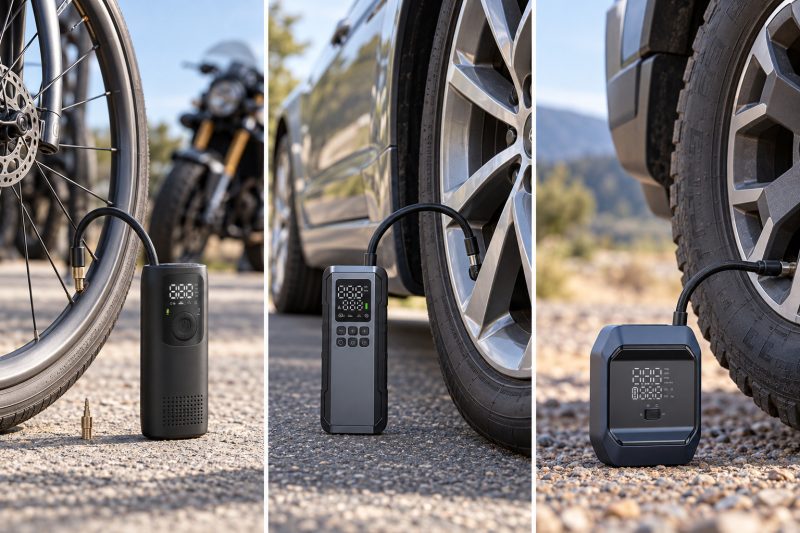
I have worked with automotive accessory wholesalers and importers for years as general manager at Parwatt New Energy. We supply portable tire inflators and related car-care products. I regularly review assortments where a compact unit was sold for large pickup tires or where a high-PSI claim was treated as proof of universal suitability. Our range in the car air pump category is positioned by real application so partners can match products to vehicles. In this article I explain how to choose tire inflators for cars, SUVs, pickups, motorcycles and bicycles in 2026.
Why One Universal Tire Inflator Rarely Performs Well for Every Vehicle?
Different vehicles place different demands on an inflator. A bicycle tire holds little air but may need high pressure and precise control. A large pickup tire holds much more air and needs sustained airflow and thermal capacity. Motorcycle valves can be awkward to reach. Passenger cars sit between these extremes and usually need convenient power and accurate auto-stop. One product cannot optimise for all of these conditions without compromises that disappoint someone.
One universal inflator rarely performs well for every vehicle because tire volume, target pressure, valve access, duty cycle and power expectations differ. Matching the inflator to the vehicle avoids slow fills, overheating and poor user experience.
How Vehicle Differences Create Performance Gaps
I have timed compact cordless units that topped up a car tire acceptably yet took far too long on a large SUV tire. Heat built up quickly and thermal protection stopped the job before all four tires were finished.
High-pressure bicycle use exposes another gap. An inflator that reaches a high maximum PSI on a large tire may overshoot or control poorly on a small-volume bicycle tire. Fine resolution and a suitable valve head matter more than raw power.
Motorcycle wheels often place the valve in a tight location. A short or stiff hose and a bulky chuck make connection difficult even when airflow is adequate.
Power source expectations also diverge. Car owners often accept a 12V plug-in unit stored in the trunk. Bicycle and motorcycle users more often want a fully cordless device they can carry to the vehicle.
Here is a table that shows why universal claims fail:
| Vehicle Type | Main Demand | Weakness of “Universal” Compact Unit | Result |
|---|---|---|---|
| Passenger car | Convenient top-up | Usually acceptable | Baseline use |
| SUV / pickup | High air volume, consecutive tires | Slow fill, overheating | Frustration and returns |
| Motorcycle | Valve access, moderate volume | Hose / chuck fit issues | Difficult operation |
| Bicycle | High PSI, low volume, Presta | Poor control or wrong valve | Overshoot or no fit |
| Mixed fleet | All of the above | Compromised on every axis | Confused assortment |
This table reflects the application problems I discuss with distributors. At Parwatt we position models in the car air pump category by vehicle need rather than by a single headline PSI.
In 2026 customers expect the product to match the vehicle they own. Clear application limits protect both sell-through and brand reputation.
The Maximum-PSI Mistake That Leads Buyers to the Wrong Product
Maximum PSI only states the upper pressure the unit can reach or at which it will stop. It does not state how fast the inflator delivers air at the pressures users actually need. Large tires depend on loaded airflow and duty cycle. Bicycles depend on high-pressure accuracy and valve compatibility. Choosing by maximum PSI alone leads to the wrong product.
The maximum-PSI mistake is treating the highest number as proof of overall performance. Loaded airflow, inflation time, duty cycle and pressure control matter more for real vehicle use.
Why Maximum PSI Misleads Selection
A unit can display a high shut-off pressure while moving very little air near that pressure. Inflation time then becomes long and thermal load rises. For SUV and pickup tires the practical question is how long it takes to add the required air volume, not whether the gauge can show a high number.
For passenger cars the working range is usually moderate. A mainstream inflator with good airflow in the 30–40 PSI region will feel faster and more reliable than a high-PSI unit with weak flow.
For bicycles the target pressure may be high, yet the air volume is small. Accuracy, resolution and a proper Presta or dual-head connector matter more than peak flow. Overshoot on a small tire is a common complaint when control is coarse.
Duty cycle remains independent of maximum PSI. A high-PSI emergency unit may still overheat when asked to fill several large tires in sequence.
Marketing that ranks products only by maximum PSI pushes buyers toward numbers that do not match their dominant vehicle mix.
Here is a table of PSI-related mistakes:
| Mistake | Why It Fails | Better Metric |
|---|---|---|
| Highest PSI = best product | Ignores airflow and duty | Time-to-pressure on target tire |
| High PSI for large tires | Flow may collapse near target | Loaded airflow / consecutive times |
| High PSI for bicycles | Control and valve matter more | Accuracy + Presta compatibility |
| PSI without duty data | Overheating risk hidden | Consecutive-cycle thermal test |
| One PSI claim for all vehicles | Different work content | Vehicle-specific validation |
This table keeps specification review focused on real work. At Parwatt we report inflation times under defined conditions for products in the car air pump category rather than relying on maximum PSI alone.
I advise buyers to ask for time-to-pressure on a stated tire and pressure interval. That single request filters out many unsuitable models.
How to Match Airflow, Pressure and Power Source to Each Vehicle
Each vehicle class has a practical combination of airflow need, working pressure, power source and handling requirements. Passenger cars accept compact cordless or 12V models. SUVs and pickups need higher airflow and longer continuous operation. Motorcycles and bicycles prioritise size, pressure control, hose angle and valve interface.
Match airflow, working pressure and power source to the vehicle. Cars need convenient portable performance. SUVs and pickups need sustained flow and thermal capacity. Motorcycles and bicycles need compact size, accurate control and correct valve adapters.
Application-by-Application Matching
Passenger cars and similar light vehicles are served well by mainstream portable inflators. Priorities include easy storage, 12V or battery power, accurate auto-stop, adequate hose and cable length, and acceptable time for routine top-ups. Emergency portability often matters more than long continuous duty.
SUVs and pickups have larger tire volumes. Inflation time and heat build-up increase, especially when four tires are serviced in one session. Higher airflow, stronger duty cycle, robust power delivery (including direct-to-battery options where appropriate) and better thermal management become important.
Motorcycles need moderate air volume but often difficult valve access. A flexible hose, compact chuck and stable base help. Pressure accuracy remains important because many motorcycle tires run at specific recommended pressures.
Bicycles combine high target pressure with very small air volume. Presta valves are common and require a proper adapter or dual-compatible head. Fine pressure control and a clear display reduce the risk of overshoot. Cordless convenience is highly valued.
Power source should follow use pattern. Trunk-stored car units can rely on 12V. Carry-along bicycle and motorcycle use favors cordless. Heavy intermittent work on large vehicles may favor 12V or dual-power designs with stronger cables.
Here is a matching guide:
| Vehicle | Airflow Priority | Pressure Focus | Preferred Power | Key Handling Need |
|---|---|---|---|---|
| Passenger car | Moderate | Accuracy at 30–40 PSI | 12V or cordless | Compact storage |
| SUV / pickup | High, sustained | Working range more than peak | 12V / direct battery | Thermal capacity |
| Motorcycle | Moderate | Accurate set pressure | Cordless preferred | Valve access / hose |
| Bicycle | Low volume | High PSI + fine control | Cordless | Presta adapter |
| Mixed light use | Balanced | Auto-stop reliability | Dual or 12V | Clear instructions |
This guide keeps product selection practical. At Parwatt we align models in the car air pump category with these application differences.
I recommend that buyers list the dominant vehicles in their sales region before finalising the range. The list usually points to a clear primary model and limited secondary options.
Which Inflator Models Should Distributors Include in Their Range
A practical wholesale range uses three tiers: a compact cordless model for bicycles, motorcycles and emergency top-ups; a mainstream 12V model for everyday passenger cars; and a higher-flow, longer-duty model for SUVs, pickups and repeated use. Adapters and accessories extend compatibility without multiplying core SKUs.
Distributors should build a three-tier range: compact cordless, mainstream 12V, and higher-flow heavy-duty. Adapters expand valve and accessory use while each tier stays honest about its vehicle limits.
Building a Clear Three-Tier Assortment
The compact cordless tier focuses on portability and ease of use. It serves bicycle and motorcycle owners and provides emergency top-up capability for cars when convenience matters more than absolute speed. Presta adapters and a clear pressure display are important in this tier.
The mainstream 12V tier covers the largest volume of passenger-car owners. It should offer reliable auto-stop, adequate hose and power-cord length, solid clamp or chuck quality, and proven inflation times on common car tires. This tier usually delivers the best balance of price and sell-through.
The heavy-duty or high-flow tier targets SUVs, pickups and users who inflate multiple tires regularly. It needs stronger airflow, better thermal behaviour, robust cables and a duty cycle that survives consecutive fills. Direct-to-battery connection can be an advantage in this tier.
Accessories should be planned as extenders, not as substitutes for airflow. Presta adapters, ball needles and multi-head chucks increase usefulness. They cannot fix an inflator that is thermally or volumetrically undersized for large tires.
Packaging and web content must state the intended vehicle class for each tier. Clear limits reduce mis-purchase and return rates.
Here is a tier summary:
| Tier | Primary Vehicles | Core Strengths | Accessory Focus |
|---|---|---|---|
| Compact cordless | Bicycle, motorcycle, emergency car | Portability, ease | Presta / dual head |
| Mainstream 12V | Passenger cars | Balance of speed and cost | Solid chuck, hose length |
| High-flow / heavy-duty | SUV, pickup, frequent use | Sustained airflow, duty cycle | Robust cable, extra heads |
| Optional dual-power | Mixed users | Flexibility | Clear mode instructions |
This structure limits SKU count while covering real demand. At Parwatt we support tiered assortments within the car air pump category so partners can stock by application.
I advise distributors to resist adding overlapping models that differ only by minor cosmetic features. Clarity of tier beats depth of near-duplicates.
A Vehicle-Based Test Plan Before Approving Your Product Mix
Before approving the mix, test each candidate on representative tires from the target vehicle classes. Measure time within defined pressure intervals, temperature rise, pressure accuracy, battery or power behaviour, consecutive-cycle capability and valve-connection convenience. Results should confirm that each tier performs where it will be sold.
Approve the product mix with vehicle-based testing: representative car, SUV, pickup, motorcycle and bicycle tires; timed pressure intervals; thermal and power behaviour; accuracy; and connector practicality. Match each model to the vehicles it actually serves.
Test Sequence by Vehicle Class
Define a standard pressure interval for each class—for example a common top-up range for cars and SUVs, a higher target for bicycles, and the manufacturer-recommended range for motorcycles.
Use one or more representative tires per class. Keep starting pressure, target pressure and ambient conditions consistent across samples.
Time each inflation and record final pressure versus a calibrated gauge. Note any overshoot or undershoot.
For multi-tire scenarios, run consecutive cycles on large tires and record time increase and surface temperatures.
For cordless models, repeat key tests at mid charge to expose voltage-sag effects.
Check valve connection on motorcycle and bicycle wheels. Confirm that Presta adapters seal reliably and that the hose angle allows practical attachment.
Document hose reach and stability of the unit during operation so users can inflate without constant readjustment.
Compare all results with the intended tier claims. A compact cordless model that cannot reasonably top up a car tire may still be valid for bicycles, but it should not be marketed as a universal car solution.
Lock the accepted performance ranges into the specification and packaging claims for each model.
Here is a vehicle-based test checklist:
- Representative tires for car, SUV/pickup, motorcycle, bicycle
- Defined start and target pressures per class
- Timed inflations and gauge accuracy checks
- Consecutive cycles on large tires with temperature notes
- Mid-charge runs for cordless units
- Presta and angled-valve connection trials
- Hose reach and unit stability observation
- Results mapped to tier positioning
- Claims adjusted to match measured capability
- Golden-sample data archived for production control
At Parwatt we validate application fit with this type of vehicle-based testing for products in the car air pump category. Complementary accessories and related products are available on our main site, including car vacuum cleaners and car battery chargers.
Distributors who test by vehicle class before ordering avoid both over-promising and under-serving their customers. The test file becomes the reference that keeps the assortment honest and commercially effective.
Conclusion
Distributors should build their tire inflator range around vehicle requirements rather than maximum PSI alone. At Parwatt we position inflators by real application so partners can offer clear choices. A compact cordless model may be ideal for bicycle, motorcycle and emergency top-up use, while a mainstream 12V inflator can cover most passenger cars. Larger SUV and pickup tires require stronger airflow, a suitable duty cycle, reliable power delivery and better thermal management. Valve compatibility, hose reach, pressure accuracy and auto-stop control become particularly important for motorcycles and bicycles. Instead of advertising one model as suitable for everything, distributors should define clear application limits and validate each product on representative tires. A focused three-tier assortment can improve customer selection, reduce misuse and provide broader market coverage without creating unnecessary SKUs.

--- END ---
Related Posts
Business Ideas

Business Ideas

Business Ideas

Business Ideas


