

OEM vs. ODM vs. Private Label Car Accessories: Which Sourcing Model Is Right for Your Business?
Oct 15,2026
Choosing the wrong sourcing model can cost more than the product itself. Development fees can run out of control, launch dates can slip, MOQs can become too high, products can lack differentiation, and disputes can arise over molds, designs or certifications. At Parwatt I see brands and distributors face these problems when the sourcing model is selected without a clear commercial plan.
OEM, ODM and private label are different combinations of development responsibility, speed, customization and intellectual-property control. In 2026 the right model depends on your budget, timeline, internal capability and need for differentiation—not on a single universal ranking.
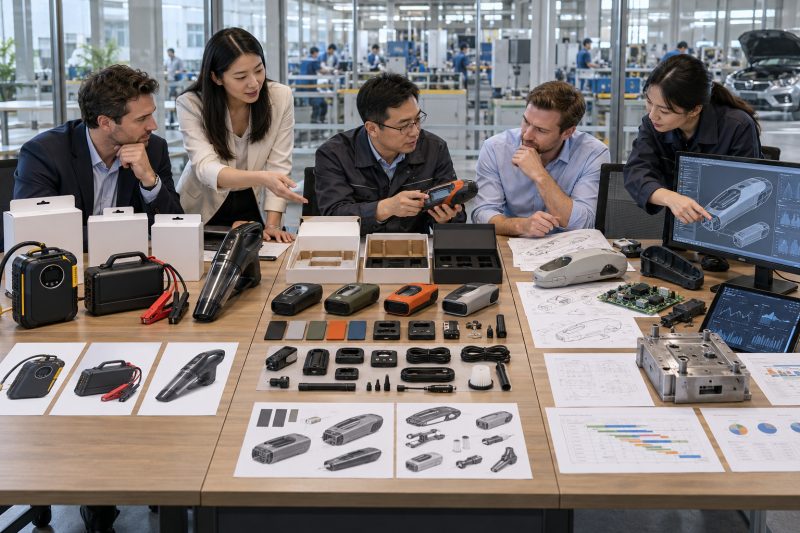
I have worked with car-accessory importers, brand owners and distributors for years as general manager at Parwatt New Energy. We support private-label, ODM and OEM programs across products such as car battery chargers, tire inflators and car vacuums. I regularly review projects where a buyer expected full design ownership from a simple logo change, or where an OEM timeline was planned without realistic engineering resources. Our work across the car battery charger category, car air pump category and car vacuum cleaner category follows clear model definitions so partners know what they control. In this article I explain how to choose among OEM, ODM and private label for car accessories in 2026.
Why Choosing the Wrong Sourcing Model Can Cost More Than the Product Itself?
The sourcing model decides who pays for development, who owns the design and tooling, how fast the product can launch, and how easy it is to change suppliers later. A mismatch creates delayed launches, unexpected fees, inventory risk and weak differentiation. In serious cases it also creates legal arguments over who may use the molds, firmware or test reports.
Choosing the wrong sourcing model costs more than the unit price because it affects development spend, launch timing, MOQ, differentiation and ownership of molds, designs and certifications.
How Model Mismatches Create Commercial Damage
I have seen buyers commit to full OEM development before they had confirmed demand. Tooling and certification costs were spent on a product that later needed major changes. The financial loss exceeded any unit-price saving.
Other buyers assumed that adding a logo to an existing product gave them exclusive rights. When the same platform appeared under another brand, their margin and positioning were damaged.
MOQ problems appear when a buyer selects a model that requires high minimum volumes while their channel can only absorb smaller trial quantities. Excess stock then ties up cash and increases the cost of later corrections.
Certification and test-report ownership is frequently overlooked. If the reports remain in the manufacturer’s name and cannot be transferred, moving production later becomes expensive and slow.
Timeline pressure pushes some buyers into the wrong model. They need speed yet choose a full OEM path that requires new tooling and validation. The launch slips and competitors occupy the shelf space first.
Here is a table that links wrong model choice to commercial cost:
| Wrong Choice | Typical Result | Extra Cost Type |
|---|---|---|
| OEM before demand is proven | Tooling and development spent early | Fixed development loss |
| Logo-only treated as exclusive OEM | Same product sold to others | Margin and brand damage |
| High-MOQ model for small channel | Excess inventory | Cash and storage cost |
| Unclear report / mold ownership | Hard to switch factories | Switching and retest cost |
| OEM path under tight timeline | Launch delay | Lost sales window |
This table reflects the expensive patterns I discuss with partners. At Parwatt we help buyers align the sourcing model with their real stage of business growth.
In 2026 competition in car accessories is fast. The cost of a mismatched model is paid in time and optionality, not only in unit price.
The Common Misunderstandings About OEM, ODM and Private Label
Many misunderstandings come from treating the three terms as simple quality grades or from assuming that a logo change equals full ownership. Buyers sometimes equate ODM with private label, call any customised product “OEM,” or sign contracts that never define design rights, mold rights, exclusivity or change authority.
Common misunderstandings include treating ODM and private label as identical, assuming a logo makes a project OEM, and leaving design, mold, exclusivity and change rights undefined in the contract.
Clarifying the Three Models
Private label usually means the buyer applies its brand and packaging to an existing product. Development work is minimal. Speed is high and MOQ is often lower. Differentiation is limited because similar goods may be available to other customers.
ODM means the manufacturer provides the core design or platform. The buyer may request changes to colour, accessories, interface, firmware functions, packaging or selected components. The manufacturer often retains ownership of the underlying design unless the contract says otherwise.
OEM means the buyer controls the product specification. The factory builds to the buyer’s requirements. This model supports stronger differentiation and deeper control, but it requires clearer specifications, more validation, higher development investment and usually higher MOQ.
A private-label product can be based on an ODM platform. The branding arrangement and the design-ownership arrangement are related but not identical. Contracts must address both.
Exclusivity is a separate commercial term. Custom colour or packaging does not automatically create exclusive sales rights for a region or channel.
Here is a clarification table:
| Term | What It Usually Means | What It Does Not Automatically Mean |
|---|---|---|
| Private label | Brand + packaging on existing product | Exclusive design ownership |
| ODM | Manufacturer-based design with buyer modifications | Full buyer ownership of core design |
| OEM | Buyer-controlled specification and design direction | Lowest cost or fastest launch |
| Logo customisation | Visual branding | OEM status or exclusivity |
| Contract silence on IP | Ambiguity | Buyer-friendly default rights |
This table prevents category confusion. At Parwatt we define the model in writing before development or artwork begins for any program linked to our main site.
I advise buyers to stop using the three labels alone and instead write the intended rights and responsibilities in plain language. Clear language prevents later disputes.
How to Choose the Right Model for Your Budget, Timeline and Market
The right model depends on internal engineering capability, available budget, first-order quantity, required launch speed, target retail price, certification needs and the importance of differentiation. Mapping these factors against the three models produces a practical decision rather than a theoretical preference.
Choose the sourcing model by matching budget, timeline, capability, MOQ tolerance, certification needs and differentiation goals. Private label favours speed and low risk; ODM balances modification and speed; OEM favours control when the brand can support development.
Decision Factors That Matter
If the team has little engineering resource and needs to test demand quickly, private label is usually the rational start. It minimises development cost and shortens time to shelf.
If the team wants visible differences—colour, interface, accessories, firmware features—without owning a full new platform, ODM is often the efficient middle path. Modifications must still be scoped carefully so cost and timeline remain controlled.
If proprietary performance, distinctive structure or long-term exclusive control is central to the brand, OEM becomes appropriate. The buyer must then supply or approve detailed requirements, validation standards and change-control rules.
Budget and MOQ tolerance must be honest. OEM tooling and certification can exceed the cost of the first inventory. Buyers who cannot absorb that fixed cost should not begin on a full OEM path.
Certification strategy influences the choice. When the buyer needs reports and approvals in its own name, the contract and the model must support that outcome. When existing manufacturer reports can be used, private label or ODM may be faster.
Target market positioning also matters. A value channel may not pay for heavy OEM differentiation. A premium channel may require it.
Here is a decision guide:
| Business Situation | More Suitable Model | Reason |
|---|---|---|
| Fast market test, limited budget | Private label | Lowest development load |
| Need moderate differentiation quickly | ODM | Modify existing platform |
| Strong own specification / unique design | OEM | Maximum control |
| Low first-order quantity | Private label or light ODM | Lower MOQ barrier |
| Reports must be in buyer’s name | OEM or negotiated ODM | Documentation ownership |
| Premium exclusive positioning | OEM or exclusive ODM | Differentiation and rights |
This guide keeps the choice commercial. At Parwatt we walk partners through the same factors when planning programs for chargers, inflators and vacuums.
I recommend that buyers score each factor before talking about unit price. The model decision should lead the quotation request, not follow it.
What You Really Control Under Each Sourcing Model
Control differs across design, structure, components, firmware, molds, packaging, certification files, ability to move factories and sales exclusivity. Understanding these differences prevents buyers from assuming rights they have not actually secured.
Control under each model differs for product design, core structure, components, firmware, molds, packaging, certification documents, factory transfer rights and sales exclusivity. Contracts must list these rights item by item.
Control Comparison Across Models
Under private label the buyer typically controls branding and packaging artwork. Core design, molds and primary certifications usually remain with the manufacturer. Switching factories may require starting over with a similar open platform.
Under ODM the buyer may control selected modifications, cosmetic options and packaging. The manufacturer often retains the platform design and tooling unless the agreement assigns specific rights. Firmware changes may be possible, yet source-code ownership is frequently retained by the developer unless negotiated.
Under OEM the buyer has the strongest claim to specification control and, when properly contracted, to drawings, tooling ownership and documentation. Even then, each item should be listed: industrial design, mechanical drawings, PCB layout, firmware, apps, molds, test reports and future improvements.
Sales exclusivity is independent of the technical model. It must be defined by territory, channel and duration, with clear performance conditions if exclusivity is granted.
The right to transfer production to another factory is one of the most important commercial protections. Without it, a buyer can remain dependent on a single source even after investing in development.
Here is a control matrix:
| Control Item | Private Label | ODM | OEM (when contracted) |
|---|---|---|---|
| Brand / packaging | Buyer | Buyer | Buyer |
| Core product design | Manufacturer | Usually manufacturer | Buyer-directed |
| Molds / tooling | Manufacturer | Often manufacturer | Buyer-owned if paid and assigned |
| Firmware / software | Manufacturer | Shared / negotiated | Buyer rights if assigned |
| Certification files | Often manufacturer | Negotiated | Buyer or dual use if agreed |
| Factory transfer | Limited | Limited unless agreed | Stronger if rights assigned |
| Sales exclusivity | Only if contracted | Only if contracted | Only if contracted |
This matrix shows why a single “IP belongs to buyer” sentence is insufficient. At Parwatt we separate these rights in project agreements so both sides understand the boundaries.
I advise buyers to attach a rights schedule to every development or private-label contract. The schedule prevents later reinterpretation.
A Practical Process for Moving from Private Label to ODM or OEM
Many successful car-accessory brands follow a staged path. They begin with private-label products to validate demand, move to ODM modifications on proven platforms, and invest in OEM only when sales data justify the development cost. Contracts should lock intellectual-property terms, change management and quality standards at each stage.
Move from private label to ODM or OEM in stages: validate demand with mature products, modify proven platforms through ODM, then invest in OEM when volume and differentiation justify the cost. Lock IP, change control and quality requirements in writing at every step.
A Staged Commercial Path
Start with one or two private-label items that already have stable production and known certification paths. Use them to test channel response, price acceptance and return patterns.
Analyse the data. Identify which functions, accessories or appearance elements customers value enough to pay for. Avoid redesigning features that did not influence sales.
Introduce ODM changes on the successful platforms—colour, interface, accessory kits, firmware options or packaging structures. Keep the core mechanism stable so technical risk remains controlled.
When a product line shows sustained volume and clear competitive pressure, evaluate OEM development. Prepare a detailed requirement specification, validation plan, budget for tooling and certification, and a realistic timeline.
At each stage update the contract: ownership of new tooling, treatment of derived designs, notification rules for component or firmware changes, quality targets, audit rights and exit conditions.
Protect continuity by requiring notice before discontinuation of a platform you still sell, and by securing the right to purchase remaining materials or transfer production when rights allow.
Do not run large OEM investments in parallel with unproven market hypotheses. Sequencing reduces the chance that fixed costs are stranded.
Here is a staged-process checklist:
- Private-label launch to test demand
- Sales, return and price data reviewed
- ODM modifications scoped on proven models
- Rights and exclusivity updated in the contract
- OEM considered only after volume justification
- Full requirement and validation plan for OEM
- Tooling and documentation ownership defined
- Change-notification and quality clauses enforced
- Exit and transfer rights agreed
- Portfolio reviewed periodically against market results
At Parwatt we support partners across this progression for products in our car battery charger category, car air pump category and car vacuum cleaner category. Further program options are available through our main site.
Buyers who stage their sourcing model invest development money where the market has already spoken. That discipline protects both cash and strategic flexibility.
Conclusion
OEM, ODM, and private label are not simply three quality levels. At Parwatt we help partners select the model that fits their commercial stage so development effort and control remain balanced. They represent different combinations of development responsibility, investment, speed, customization, and intellectual-property control. Private label is often the lowest-risk option for testing demand, while ODM allows buyers to modify an existing manufacturer-developed platform. OEM is more suitable when a brand has its own specifications and needs meaningful product differentiation. Before selecting a model, buyers should define who owns the design, tooling, firmware, test reports, packaging artwork, and future improvements. They should also confirm MOQ, development fees, certification responsibilities, exclusivity, change-notification rules, and exit rights in writing. The best sourcing model is the one that supports the brand’s current commercial stage without limiting its future growth.

--- END ---
Related Posts
Business Ideas

Business Ideas

Business Ideas

Business Ideas


