

How Can You Really Make Money from an EV Charging Station Business in 2026? (Realistic Guide)
May 27,2026
Thinking about starting an EV charging station business but worried about high costs and slow returns? You face real risks if you jump in without a solid plan.
Smart operators make good profits in 2026 by choosing the right locations, using multiple revenue streams, and picking reliable equipment. They reach healthy utilization rates and control ongoing costs for steady income.
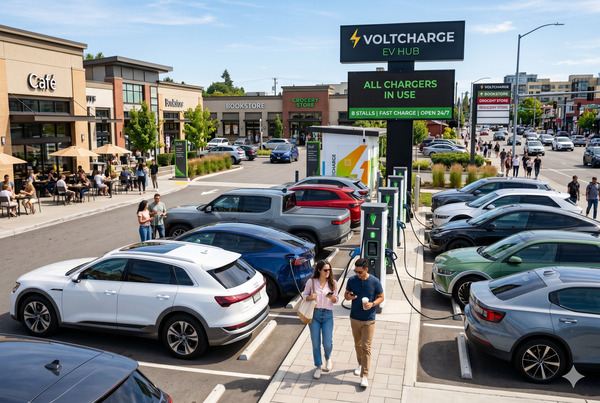
This realistic guide shows the common traps, practical steps, and proven strategies that actually work for Charge Point Operators and investors right now.
Why Most People Still Lose Money in the EV Charging Business in 2026
You invest thousands in chargers but watch utilization stay low while bills keep coming.
Many new operators lose money because they underestimate real-world challenges. High upfront costs, low station usage, and tough competition eat into profits faster than expected.
I have spoken with many potential partners who thought building stations would bring quick cash. As Jacky Huang, General Manager at Parwatt, I see the same patterns repeat. Fleet operators and real estate developers often learn the hard way that hardware alone does not guarantee success.
Here are the biggest reasons people lose money:
- High initial investment with slow payback.
- Low utilization rates below 15%.
- Intense competition in popular areas.
- Unexpected maintenance and downtime costs.
- Poor energy management that raises electricity bills.
These issues hit hard in 2026 even as EV numbers grow. Location choices matter more than ever. A station in a quiet spot might see only a few sessions per day while high-traffic areas perform much better.
Consider these common cases. A new CPO installs several units near existing competitors and struggles to attract drivers. A real estate developer adds chargers to a property but forgets marketing and sees tenants ignore them. Fleet operators buy cheap equipment that breaks often and creates expensive repairs.
We can compare key factors here:
| Factor | Poor Performance | Impact on Profits |
|---|---|---|
| Utilization Rate | Under 10-15% | Losses or very slow ROI |
| Location Choice | Low traffic areas | Few customers daily |
| Equipment Quality | Cheap unreliable units | High repair costs |
| Operating Costs | No smart monitoring | High electricity and downtime |
| Revenue Strategy | Only charging fees | Missed extra income streams |
At Parwatt we help customers avoid these traps from day one. Our battery-buffered ultra-rapid EV charger reduces grid stress and keeps stations running reliably. The E-Station 120 mobile battery-buffered EV charging power station gives flexible deployment options for testing locations before full commitment.
Understanding these pain points helps you build a stronger foundation. Many operators who succeed treat this as a full business, not just an equipment purchase. They focus on user experience and smart operations from the start.
The Most Common Myths and Mistakes in EV Charging Station Investments
You hear stories of easy passive income from EV chargers but reality often differs.
Many myths lead investors down the wrong path. They buy hardware without a full plan and end up disappointed with the results.
One big myth says you can set up stations and earn money with little effort. Another claims any location works if you install fast chargers. I have seen these assumptions cause real losses for new entrants.
Here are frequent mistakes I discuss with partners:
- Ignoring ongoing operational costs.
- Focusing only on hardware price instead of total ownership cost.
- Skipping detailed site analysis and utilization forecasts.
- Underestimating the importance of software and monitoring.
- Failing to build multiple revenue streams beyond charging fees.
These errors create problems that compound over time. For example, without remote monitoring you miss small issues that turn into expensive downtime. Poor site selection means your stations sit idle while competitors nearby stay busy.
A useful comparison table:
| Myth or Mistake | Reality in 2026 | Better Approach |
|---|---|---|
| "Build it and they come" | Needs active marketing | Combine with partnerships |
| Cheap hardware saves money | Leads to higher long-term costs | Invest in reliable equipment |
| One revenue source enough | Limits profitability | Add ads, data, and services |
| Location does not matter much | Determines success | Prioritize high-traffic spots |
| Government incentives cover everything | Only part of the picture | Plan full financial model |
At Parwatt we emphasize complete solutions. Check our FES-D30 DC EV charger and Meta mobile EV charger with battery for dependable performance that lowers maintenance headaches. Our blog on electric vehicle charging shares more practical insights for operators.
Avoiding these myths and mistakes positions you for real success. Smart investors learn from others and build detailed plans before spending.
How to Actually Make Money with EV Charging Stations: A Practical 2026 Framework
You want clear steps that turn your investment into steady profits.
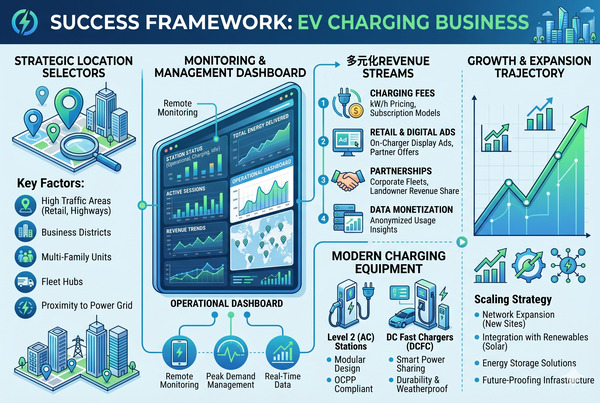
Successful operators follow a practical framework that covers location, equipment, operations, and revenue. They aim for 25% or higher utilization and control every cost.
Start with smart site selection in high-traffic areas like shopping centers, workplaces, apartments, and highways. Then choose reliable chargers with smart features for remote management. Set competitive pricing and market your stations effectively.
Key revenue streams include:
- Charging fees based on kWh or time.
- Advertising on screens or nearby displays.
- Partnerships with local retailers for bundled offers.
- Data sales or energy management services.
- Government incentives and carbon credits.
Here is a practical framework table:
| Step | Actions to Take | Expected Benefit |
|---|---|---|
| Site Selection | Analyze traffic and competition | Higher utilization rates |
| Equipment Choice | Pick smart, reliable chargers | Lower downtime and maintenance |
| Pricing Strategy | Use dynamic pricing tools | Maximize revenue per session |
| Marketing & Partnerships | Team up with businesses | More drivers and extra income |
| Monitoring & Optimization | Use remote software | Quick issue resolution |
In 2026 operators who reach 30-50% utilization see strong returns. Payback periods often fall between 2 to 5 years with good execution. Fleet operators benefit from dedicated stations that reduce vehicle downtime. Real estate developers increase property value and tenant satisfaction.
I worked with a retail chain that added our chargers and saw customer dwell time increase. Sales rose as drivers stayed longer. Our 30kW power module and 40kW power module help scale efficiently while managing grid demands.
Read our Level 2 vs Level 3 charging article to understand power options that affect profitability. The charge EV faster home vs public post also gives useful context for mixed-use strategies.
This framework works for different scales. Small operators start with a few units while larger CPOs build networks. Focus on user convenience and reliability to stand out from competitors.
Why Smart Operators Choose TOPEX / Our Solutions for Higher Returns
You need equipment you can trust to protect your investment and maximize uptime.
Smart operators pick solutions that deliver reliability, smart features, and low maintenance. These choices directly improve utilization and reduce costs over time.
Parwatt chargers stand out because of robust build quality and advanced capabilities. They support OCPP for easy integration and remote monitoring that helps you manage stations from anywhere.
Benefits our customers report:
- High reliability with minimal downtime.
- Smart energy management for lower electricity costs.
- Easy scalability as your business grows.
- Strong support and fast issue resolution.
- Future-ready features for 2026 and beyond.
We compare options in this table:
| Feature | Standard Equipment | Parwatt Solutions |
|---|---|---|
| Reliability | Frequent repairs | Low maintenance design |
| Monitoring | Basic or none | Full remote access |
| Scalability | Limited | Easy expansion |
| Energy Efficiency | Higher operating costs | Optimized load balancing |
| User Experience | Average | Fast, convenient charging |
Our EP02 portable EV charger with display and EC01 wall charger give flexible options for different business models. Partners in hospitality and retail love how these units attract more customers while staying easy to operate.
Energy utilities and government projects appreciate our certified, compliant equipment. Automotive OEMs and wholesalers find our solutions help them offer reliable white-label options. The combination of quality hardware and smart software creates better returns than basic setups.
I have seen operators switch to our systems and notice immediate improvements in uptime and customer feedback. That reliability translates into higher utilization and stronger profits year after year.
Ready to Build a Profitable EV Charging Business in 2026?
You now understand the real path to success in this growing market.
Take action by assessing your locations, reviewing equipment options, and building a complete business plan. Small smart steps today lead to strong returns tomorrow.
Do not leave profitability to chance. Focus on execution and the right partners.
Conclusion
The EV charging station business in 2026 offers real opportunities, but it is not a passive “set it and forget it” investment. Success depends on smart location selection, diversified revenue streams, operational efficiency, and choosing reliable equipment. Many new entrants fail because they underestimate ongoing costs and overestimate utilization. However, operators who treat it as a serious business — focusing on user experience, energy management, and strategic partnerships — are seeing healthy returns. With the right strategy and partners, EV charging can become a stable, scalable income source. The key is moving beyond hardware and building a complete, user-centric solution.
Get Your 2026 EV Charging Station Profitability Assessment
Chat with Our EV Charging Expert on WhatsApp
Site Selection • Revenue Optimization • Equipment Strategy

--- END ---
Related Posts


Business Ideas

Industry News
