

Level 2 vs. Level 3 Charging: What’s the Difference?
Mar 18,2026
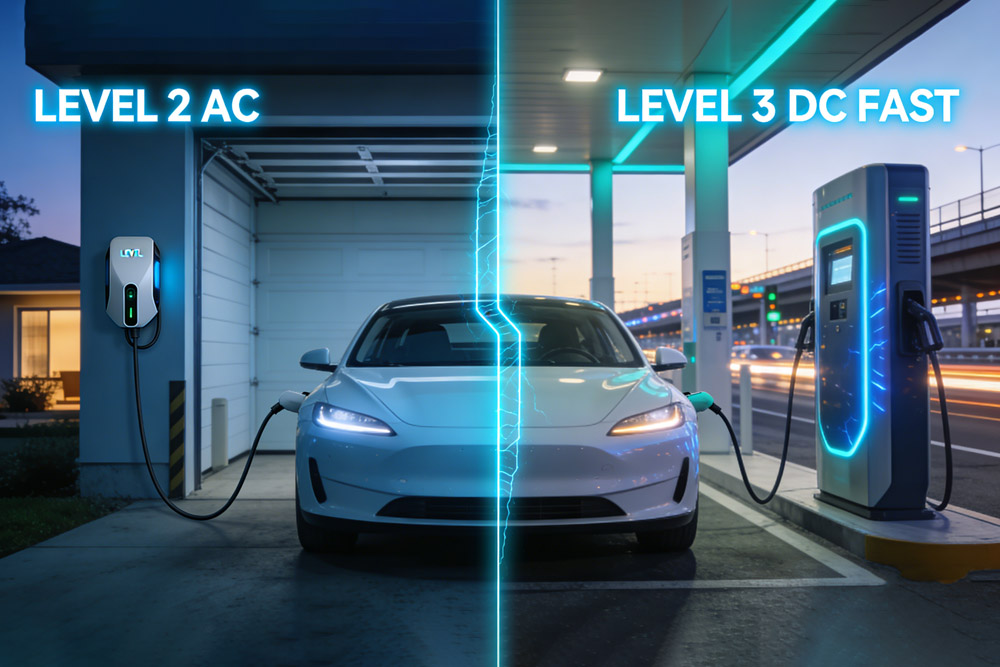
As electric vehicles continue to gain popularity globally, charging infrastructure has become an indispensable part of daily travel.Among the various charging methods, Level 2 and Level 3 charging have attracted significant attention due to their balance of convenience and charging speed. While both aim to charge electric vehicle batteries, they differ in their operation and applicable scenarios.
Understanding the similarities and differences between Level 2 and Level 3 charging helps drivers, owners, and fleet operators make informed decisions regarding the installation, use, and long-term planning of charging facilities.
What Do Charging Levels Mean?
Electric vehicle charging levels are classified based on the type of current used and the power delivered to the vehicle.
Level 2 charging uses alternating current (AC), whose voltage is typically higher than that of a standard household outlet. The AC-to-DC conversion is completed inside the vehicle via an onboard charger.
Level 3 charging, often referred to as DC fast charging, directly supplies direct current (DC) to the vehicle’s battery. Because no onboard charger is required, Level 3 charging systems can output energy at a much higher power output.
Both charging levels are widely used, but they are suitable for different usage scenarios and environments.
Charging Speed and Power Output
One of the most noticeable differences between Level 2 and Level 3 charging is charging speed.
Level 2 chargers generally deliver power in the range of 3 kW to around 19 kW, depending on the equipment and the vehicle’s onboard charger capacity.
In practical terms, this usually adds a moderate amount of driving range per hour of charging. This makes Level 2 charging well suited for situations where a vehicle is parked for several hours, such as overnight charging or during a workday.
Level 3 chargers operate at much higher power levels, commonly starting around 50 kW and extending well beyond that for newer systems.Because of this, they can restore a significant portion of a battery’s charge in a relatively short period of time. Many vehicles can reach around 70–80% state of charge in under an hour when conditions are optimal.
Typical Installation Locations
The technical requirements of each charging level influence where they are most commonly installed.
Level 2 chargers are frequently found in residential settings, apartment complexes, office parking areas, retail locations, and public parking facilities. Their electrical requirements are manageable in many buildings, making them a practical option for shared or private use.
Level 3 chargers are usually installed in locations designed for short stops and quick turnaround. These include transportation corridors, fleet depots, and dedicated charging hubs. Because of their higher power demand, they require more substantial electrical infrastructure and careful site planning.
Infrastructure and Installation Considerations
Installing a charging station involves more than simply placing hardware on a wall or pedestal.
Level 2 installations typically require access to a suitable electrical circuit and may involve panel upgrades depending on the site. Installation complexity can vary, but it is generally manageable for many commercial and residential properties.
Level 3 installations are significantly more complex. They often involve high-capacity electrical connections, potential transformer upgrades, and coordination with utility providers. As a result, Level 3 chargers are usually deployed by commercial operators, municipalities, or organizations managing large vehicle fleets.
Connector Types and Vehicle Compatibility
Connector standards are another key factor when comparing Level 2 and Level 3 charging.
Level 2 charging commonly uses standardized AC connectors designed for broad compatibility across EV models. Many vehicles support these connectors directly, while others may use adapters.
Level 3 charging involves multiple DC connector standards, depending on vehicle design and regional practices. Vehicles are typically equipped to support one or more DC fast charging formats, and compatibility should always be confirmed before use.
Cost Differences Between Level 2 and Level 3 Charging
Charging cost is influenced by equipment, energy delivery rate, and operational overhead.
Level 2 charging tends to have lower operating costs, especially in private or workplace settings. Since charging sessions last longer but use less power at a time, costs are often predictable and easier to manage.
Level 3 charging generally comes with higher per-session costs due to the equipment investment and the demand for rapid energy delivery. However, the time saved can be valuable in scenarios where vehicle availability matters more than charging duration.
Impact on Battery Health
Battery longevity is a common concern among EV owners.
- Level 2 charging is considered gentler on batteries because it delivers power at a slower, more controlled rate.
- Level 3 charging, while safe for vehicles designed to support it, places more thermal and electrical stress on the battery.
Most modern EVs are equipped with battery management systems that regulate charging speed to minimize wear.
Level 2 vs. Level 3 Charging: Key Differences
| Feature | Level 2 Charging | Level 3 Charging (DC Fast) |
| Power Source | 240V AC | High-voltage DC (typically 400V–900V) |
| Charging Speed | Adds roughly 10–60 miles of range per hour | Can deliver about 100–250+ miles of range in around 30 minutes |
| Typical Installation Cost | Moderate, commonly ranging from $3,500 to $15,000 per port | Significantly higher, often from $18,000 to $350,000+ per port |
| Typical Use Case | Long-duration parking, such as offices, apartments, hotels, and workplaces | Short-stop locations, including highways, shopping centres, transit hubs, and fleet depots |
| Utility Requirements | May require a standard electrical panel or service upgrades | Often requires substantial grid capacity upgrades and coordination with utilities |
| Operating Costs | Lower electricity demand and more predictable operating expenses | Higher power demand and increased operating costs due to demand charges |
| Maintenance Needs | Relatively simple equipment with low ongoing maintenance | More complex systems that require regular servicing and specialised support |
| User Experience | Well-suited for routine, daily charging while parked for extended periods | Designed for drivers or fleets needing rapid turnaround and minimal downtime |
Choosing the Right Charging Level
Rather than competing, Level 2 and Level 3 charging complement each other.
- Level 2 charging fits well into daily routines where vehicles are parked for extended periods.
- Level 3 charging supports rapid energy replenishment when time is limited or vehicle utilization is high.
A balanced charging strategy often involves access to both, depending on driving habits and operational needs.
Conclusion
Level 2 and Level 3 charging cater to different needs in the electric vehicle (EV) charging sector. Level 2 charging supports stable daily charging at home, workplace, and long-term parking locations, while Level 3 charging (DC fast charging) is designed for short-term charging, aiming to help drivers significantly increase their driving range in a shorter time.
By comparing charging speed, site power requirements, operating costs, and battery performance, EV owners and charging station operators can choose the solution best suited to their vehicle’s actual usage.
Parwatt New Energy positions itself as a one-stop EV charging provider, offering charging equipment, cloud management capabilities, and end-to-end services. Its products have passed the common international certification framework tests. Please feel free to contact us for more information.
FAQs
Q Why does charging slow down near the end?As an EV battery fills, charging speed naturally decreases to manage heat and protect battery longevity. This behavior is common with both Level 2 and Level 3 charging, but it is especially noticeable with fast charging.
Q Can a Level 3 charger be installed at a private residence?
In most cases, Level 3 chargers are not practical for residential installation due to their power requirements and infrastructure demands. Level 2 charging remains the more realistic option for home use.
Q Can every EV use Level 3 charging?
Not all EVs support DC fast charging. Some entry-level or earlier models are limited to AC charging only. Checking vehicle specifications is essential before relying on Level 3 stations.
Q Should fast charging be avoided?
Fast charging does not need to be avoided entirely, but many drivers choose to rely on Level 2 charging for daily use and reserve Level 3 charging for longer trips or time-sensitive situations.

--- END ---
Related Posts


Industry News

Business Ideas
