A vehicle’s 12-volt system is responsible for cranking the engine. Beyond starting the car, the battery serves as an energy reservoir, acting as a crucial backup power supply whenever the alternator cannot deliver enough electricity.
Because of this, ensuring your battery is fully charged is vital, whether you are starting your car for the tenth time today or firing it up for the first time after it has been parked for a week.
To keep a battery in peak condition, car owners rely on two essential tools: battery chargers and battery maintainers.
Both devices plug into a standard household outlet to replenish the battery’s charge, supporting the work of the vehicle’s alternator. This guide will explore the key differences between these two devices and help you determine which one is right for your specific needs.
What Is a Car Battery Charger?
A car battery charger is designed to restore power to a discharged or dead battery.
It supplies electrical current directly to the battery, allowing it to recharge and regain enough power to start the vehicle again.
Depending on the charger model, charging rates may range from a few amps to over 25 amps for faster charging applications. Battery chargers are commonly used when a battery has lost a significant amount of charge and needs to be brought back to an operational level.
Common Situations Where You Need a Battery Charger
- Your vehicle won’t start due to a dead battery
- The headlights or interior lights were left on
- The battery has been deeply discharged
- Cold weather reduced battery performance
- You need a fast recharge before driving
A quality battery charger can help get you back on the road quickly while safely restoring battery capacity.
When using the battery charger, please follow these steps:
Ensure the vehicle is turned off.
- Connect the charger’s red (positive) clip to the positive terminal of the battery and the black (negative) clip to the negative terminal.
- If your charger has multiple charging modes, select the appropriate mode.
- Plug in the charger and let it run until the battery is fully charged.
- Unplug and disconnect the charger in reverse order—first disconnect the black clip, then disconnect the red clip.
What Is a Battery Maintainer? What Is a Battery Maintainer?
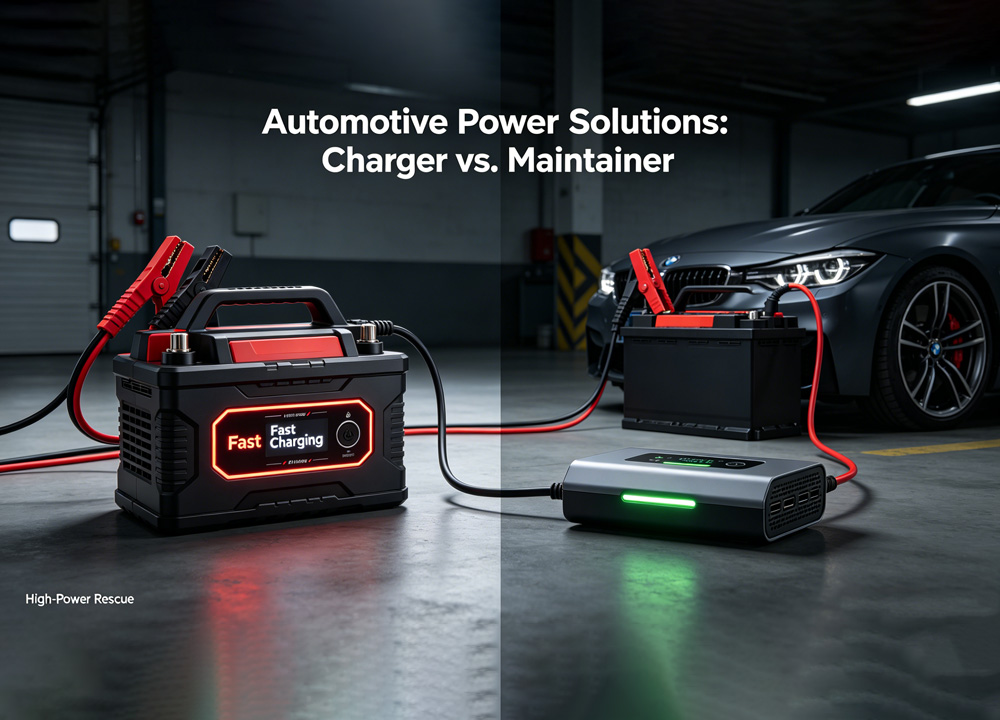
A battery maintainer is designed to keep a battery at its optimal charge level over extended periods of inactivity.
Unlike a charger, a maintainer delivers a very low charging current and automatically adjusts output to prevent overcharging. It continuously monitors battery voltage and only supplies power when necessary. This helps offset the natural self-discharge that occurs when a vehicle sits unused.
Common Situations Where You Need a Battery Maintainer
- Seasonal vehicles stored for months
- Classic cars and collector vehicles
- Motorcycles and ATVs
- RVs and boats
- Vehicles used only occasionally
- Winter vehicle storage
For long-term storage, a maintainer is usually the safest way to preserve battery health and ensure reliable starting when the vehicle is needed again.
When using the battery maintainer, please follow these steps:
Ensure the vehicle is turned off.
- Connect the maintainer’s red (positive) clip to the positive terminal of the battery and the black (negative) clip to the negative terminal.
- Insert the maintenance program.
- The maintainer will automatically monitor the battery’s state of charge and provide trickle charging as needed.
- Keep the maintainer connected while the vehicle is stored.
- To remove it, first unplug the connector and disconnect the black terminal, then disconnect the red terminal.
Battery Charger vs. Battery Maintainer: Key Differences
| Feature | Battery Charger | Battery Maintainer |
| Primary Purpose | Recharge a dead or low battery | Maintain battery charge during storage |
| Charging Speed | Fast charging | Slow, automatic maintenance charging |
| Output Current | Typically 2A–25A+ | Usually 2A or less |
| Best For | Recovering discharged batteries | Long-term battery care |
| Overcharge Protection | Depends on model | Built-in automatic protection |
| Vehicle Storage Use | Not ideal for continuous connection | Designed for long-term connection |
The biggest difference comes down to recovery versus preservation.
- If your battery is already dead, you need a charger.
- If your battery is healthy but your vehicle sits unused for long periods, a maintainer is usually the better choice.
How to Choose the Right Car Battery Charger?
When shopping for a battery charger, consider the following factors:
Battery Type
Different batteries require different charging profiles.
Common battery types include:
- Standard Lead-Acid
- AGM (Absorbent Glass Mat)
- Gel Batteries
- EFB Batteries
- Lithium Batteries
Always choose a charger compatible with your battery technology.
Charging Amperage
Higher amperage chargers provide faster charging.
Typical recommendations include:
| Charger Output | Recommended Use |
| 2A | Battery maintenance and motorcycles |
| 4A–8A | Everyday passenger vehicles |
| 10A–15A | Faster charging for cars and SUVs |
| 25A+ | Professional workshop applications |
Safety Features
Look for chargers that include:
- Overcharge protection
- Short-circuit protection
- Reverse polarity protection
- Spark-proof connections
- Temperature compensation
These features help protect both the battery and the vehicle’s electrical system.
Signs Your Car Battery Needs Charging
You may need a battery charger if you notice:
- Slow engine cranking
- Dim headlights
- Clicking sounds when starting
- Dashboard battery warning light
- Vehicle sitting unused for extended periods
Addressing battery issues early can help prevent unexpected breakdowns and extend battery life.
Find the Right Battery Charger at Parwatt Parts
Whether you need to recover a dead battery, maintain a vehicle during storage, or protect your battery investment year-round, choosing the right charging solution is essential.
Parwatt Parts offers a wide selection of automotive battery chargers designed for passenger cars, trucks, motorcycles, recreational vehicles, and more. From compact smart chargers for everyday drivers to higher-capacity charging solutions for professional applications, you’ll find reliable products to keep your batteries performing at their best.
Browse our collection of car battery chargers and discover the right solution for your vehicle’s charging and maintenance needs.