

The Role of Software in Optimizing Charger Uptime
Aug 05,2026
Charger downtime quietly erodes operator revenue and driver confidence. Faults, connectivity drops, and software glitches make real availability far lower than reported numbers. Failed sessions and slow repairs damage both income and trust. At Parwatt I see these problems limit network performance every month.
Software is the main tool for raising EV charger uptime. Real-time monitoring, automated alerts, remote resets, diagnostics, and predictive maintenance let operators find and fix issues faster than hardware-only or reactive approaches. In 2026 strong charging management software turns availability into a controllable operational result rather than a matter of luck.
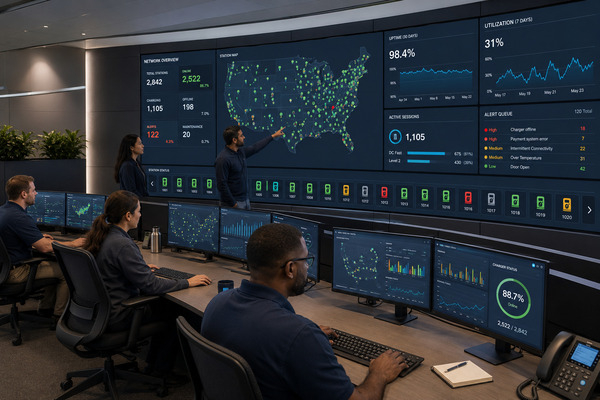
I have worked with charge point operators and fleet managers for years as general manager at Parwatt New Energy. We supply DC chargers and power modules that must stay online in real commercial conditions. I regularly review networks where hardware is solid yet uptime still suffers because issues are discovered late and fixed only after a technician arrives. Our chargers such as the FES-D30 DC EV Charger and modular systems are built to work with modern management platforms because hardware alone cannot deliver the availability operators now need. In this article I explain the role of software in optimizing charger uptime and how operators can use it effectively in 2026.
Why Charger Downtime Is Quietly Destroying Operator Revenue and Driver Trust?
When chargers sit offline or fail to start sessions, revenue stops and drivers leave frustrated. Many networks report high uptime on paper while real session success rates stay lower. Connectivity problems, software faults, and slow detection keep stations unavailable longer than necessary. The gap between reported and usable uptime costs money and damages reputation.
Charger downtime reduces revenue, lowers session success rates, and erodes driver trust. Software-related faults and late detection often make actual availability much lower than official figures. Operators who cannot see and fix problems quickly lose both income and long-term user confidence.
The Hidden Cost of Unavailable Chargers
I have examined performance data from networks that looked healthy in monthly summaries yet delivered frequent failed sessions. Drivers arrived, the charger appeared ready, and then the session would not start. Connectivity drops, OCPP communication errors, or minor firmware glitches were the usual causes. Each failed attempt represented lost revenue and a driver who might not return.
Revenue impact is direct. Every hour a high-power charger is offline is an hour that cannot generate income. Across a network the cumulative loss becomes large. Demand charges and fixed site costs continue even when the charger is not working, so the margin on the remaining sessions shrinks.
Driver trust declines quickly. Public and workplace users expect reliable charging. When stations fail repeatedly, users switch to other networks or avoid the location. Fleet operators face even higher stakes because delayed charging disrupts schedules and raises operating costs.
Funding and compliance requirements add further pressure. Programs that set high uptime targets, such as 97 percent thresholds, require accurate measurement and documented reasons for any excluded downtime. Networks without strong software struggle to prove compliance and risk losing incentives.
Here is a table that shows how downtime damages the business:
| Impact Area | What Happens | Business Consequence | Who Notices First |
|---|---|---|---|
| Lost sessions | Charger cannot start or complete charging | Immediate revenue reduction | Network operators |
| Low session success rate | Drivers experience failed attempts | Reduced utilization and repeat use | End users and site hosts |
| Slow fault detection | Problems remain open for hours or days | Extended outages and higher repair cost | Maintenance teams |
| Compliance gaps | Inaccurate or incomplete uptime data | Risk to incentive payments | Finance and compliance staff |
| Reputation damage | Users share negative experiences | Long-term loss of traffic | Marketing and retention teams |
This table reflects patterns I see when reviewing under-performing sites. At Parwatt we design our hardware, including the 30kW Power Module and 40kW Power Module, to support continuous communication so software can keep the network visible and controllable.
In 2026 the cost of downtime continues to rise as utilization increases and funding rules tighten. Operators who treat uptime as a pure hardware issue miss the larger software-driven opportunity to protect both revenue and trust.
The Costly Traps of Relying Only on Hardware or Reactive Maintenance
Many operators still focus mainly on hardware quality and wait for faults to appear before acting. They rely on periodic site visits and manual checks. They lack real-time visibility and remote control. These habits leave software-related problems open longer than necessary and keep operating costs high.
Common traps include depending only on hardware reliability, using reactive maintenance after failures occur, operating without continuous monitoring, and ignoring the software layer of faults. These approaches delay detection, increase truck rolls, and prevent networks from reaching high uptime levels.
Why Reactive Approaches Fall Short
One frequent trap is the belief that better hardware automatically delivers high uptime. Quality hardware is essential, yet many outages come from connectivity drops, configuration issues, firmware glitches, or backend communication problems. Hardware cannot fix those on its own.
Reactive maintenance creates long mean times to resolution. A fault is noticed only when a driver complains or a technician happens to visit. By then the charger may have been offline for hours. The repair still requires a physical trip in most cases.
Lack of real-time monitoring leaves operators blind. Without continuous status data they cannot distinguish a temporary communication glitch from a serious hardware failure. They also cannot prove uptime accurately for compliance or internal reporting.
Some teams treat software as only a billing or customer-facing tool. They under-invest in diagnostic, alerting, and remote-control features. The result is a network that looks modern on the surface yet still depends on slow manual processes for reliability.
Here is a table of the most common operational traps:
| Trap | Why It Continues | Result | Better Direction |
|---|---|---|---|
| Hardware-only focus | Easier to specify and purchase | Software faults stay invisible | Treat software as a core uptime tool |
| Reactive maintenance | Familiar and low daily effort | Long outages and repeated truck rolls | Shift to continuous monitoring and remote action |
| No real-time visibility | Cost or integration concerns | Late detection and poor reporting | Deploy always-on status monitoring |
| Ignoring software-layer issues | View software as secondary | Recurring connectivity and control failures | Address software health with equal priority |
| Manual processes at scale | Works for small networks | Headcount rises with network size | Automate detection and first response |
This table captures the patterns I encounter in network reviews. At Parwatt we encourage operators to pair our chargers with capable management platforms. Our equipment, including solutions in the EV Charger Category, is designed for reliable communication so software can do its job.
I have seen networks that invested heavily in hardware yet still delivered mediocre uptime because every fault required a person to notice and travel to the site. The shift to software-enabled operations usually produces faster results than another round of hardware upgrades alone.
How EV Charging Management Software Actually Improves Uptime in Practice
Charging management software improves uptime by giving operators continuous visibility and the ability to act remotely. It detects problems early, classifies them, triggers alerts, and in many cases allows remote recovery. Predictive features further reduce unplanned downtime by identifying risks before they become failures.
EV charging management software raises uptime through real-time monitoring, automated alerts, remote commands, fault classification, and predictive maintenance. These capabilities shorten the time from problem appearance to resolution and often eliminate the need for an immediate site visit.
Practical Software Functions That Protect Availability
Real-time monitoring shows the status of every charger continuously. Operators see whether a unit is online, charging, faulted, or offline. Changes in status generate immediate alerts so the team can respond before drivers are affected.
Remote commands allow many issues to be cleared without travel. A simple restart, connector reset, or configuration refresh often restores service. When the problem is software or communication related, the fix can happen in minutes instead of hours.
Automated diagnostics and fault classification help the team understand the root cause quickly. The system can distinguish a temporary network drop from a persistent hardware fault and recommend the next step. This reduces guesswork and unnecessary truck rolls.
Predictive maintenance uses historical session data, OCPP logs, and performance trends to flag chargers that are likely to develop problems. Early intervention prevents full failures and spreads maintenance work more evenly.
Here is a structured view of the main software capabilities:
| Software Capability | How It Improves Uptime | Typical Result |
|---|---|---|
| Real-time status monitoring | Problems become visible immediately | Faster detection |
| Automated alerts | Right people are notified at once | Shorter response time |
| Remote reset and control | Many faults cleared without travel | Fewer truck rolls |
| Fault classification | Root cause identified more accurately | Better first-time fix rate |
| Predictive analytics | Issues addressed before failure | Lower unplanned downtime |
| Standardized reporting | Accurate uptime and exclusion tracking | Easier compliance |
This table shows how software turns raw data into operational action. At Parwatt our chargers are built to communicate reliably with management platforms so these functions can operate effectively. Products such as the Battery Buffered Ultra Rapid EV Charger support the continuous data exchange that modern software requires.
I have reviewed networks before and after they activated strong remote-management features. Mean time to resolution dropped. The percentage of faults resolved without a site visit rose. Drivers experienced fewer failed attempts. The software did not replace hardware maintenance, yet it dramatically reduced the impact of the most common software and connectivity issues.
Automation also helps teams scale. A small operations group can oversee a much larger network when routine detection and first response are handled by the platform. Headcount no longer needs to grow in direct proportion to the number of chargers.
Software-Driven Uptime vs Traditional Approaches: Measurable Gains in Reliability and Cost
Networks that rely on software-driven processes achieve higher availability, better session success rates, and lower operating costs than those that depend mainly on hardware quality and reactive visits. The differences appear in uptime percentages, truck-roll volume, compliance readiness, and daily operational effort.
Software-driven uptime management delivers higher availability, fewer failed sessions, reduced truck rolls, and stronger compliance reporting compared with traditional reactive approaches. Operators gain both better reliability and lower cost per charger over time.
Clear Differences in Results
Traditional approaches discover many faults only after a driver reports them or a technician visits. Software-driven networks surface the same faults within minutes through monitoring and alerts. The time the charger spends unavailable shrinks.
Truck rolls decline because a large share of connectivity and software issues can be cleared remotely. Field teams focus on genuine hardware problems instead of routine resets. Travel cost and technician time fall.
Session success rates improve because chargers are more likely to be healthy when a driver arrives. Fewer failed attempts mean higher utilization of the installed hardware and better driver satisfaction.
Compliance becomes practical. Accurate, automated uptime calculation and standardized tagging of excluded events (grid outages, vandalism, and similar) allow operators to meet and document high availability targets required by funding programs.
Here is a comparison of the two approaches:
| Performance Area | Traditional Reactive Approach | Software-Driven Approach | Practical Gain |
|---|---|---|---|
| Fault detection time | Hours to days | Minutes | Much shorter outages |
| Resolution method | Mostly physical visits | Remote first, visit if needed | 70%+ fewer truck rolls in some cases |
| Session success rate | Lower due to hidden faults | Higher due to continuous health checks | Better revenue and user experience |
| Uptime reporting | Manual or incomplete | Automated and auditable | Easier funding compliance |
| Team scalability | Headcount rises with network size | Software handles routine work | Lower cost per charger |
This table summarizes results I have seen across different operator maturity levels. At Parwatt we support the software-driven model by ensuring our hardware, including options in the EV Charger Category, maintains stable communication for monitoring and remote action. Additional system guidance appears in our article on Electric Vehicle Charging.
The financial case is straightforward. Higher uptime protects revenue. Fewer truck rolls reduce operating expense. Better compliance protects incentive income. The combined effect improves the return on the entire charging investment.
How Operators Can Choose and Deploy Software to Maximize Charger Uptime Starting Today
Improving uptime with software begins with selecting a capable platform and then putting basic monitoring, alerting, and remote-control processes into daily use. Operators who start with clear requirements and disciplined deployment see measurable gains without waiting for a complete network redesign.
Select OCPP-compatible software with strong monitoring, remote control, automated diagnostics, and reporting features. Establish alert and remote-recovery processes, use data to guide maintenance, and verify that uptime measurement meets compliance needs. These steps raise availability while controlling operating cost.
Practical Selection and Deployment Steps
Begin by defining the outcomes you need. Typical targets include higher uptime percentage, fewer truck rolls, faster fault resolution, and clean compliance reports. These goals guide the feature checklist.
Choose a platform that is hardware-agnostic and supports open protocols such as OCPP. Confirm that it provides real-time status, configurable alerts, remote commands, fault classification, and exportable uptime data. Predictive or AI-assisted features add further value when the network is large enough to benefit from trend analysis.
Integrate the software with the existing charger fleet. Ensure reliable connectivity so status data flows continuously. Test remote reset and configuration functions on a small group of chargers before wider use.
Create simple operating procedures. Decide who receives alerts, how quickly they must respond, and when a remote attempt should give way to a site visit. Clear rules prevent both slow response and unnecessary travel.
Use the data. Review daily or weekly summaries of faults, resolution times, and repeat issues. Adjust maintenance schedules and charger configurations based on what the software reveals.
Here is a short action list for operators:
- Define target uptime, truck-roll, and reporting goals.
- Select an OCPP-compatible platform with monitoring, remote control, and diagnostics.
- Verify that the software can produce compliant uptime reports.
- Connect chargers and test remote recovery functions.
- Set alert rules and response procedures for the operations team.
- Review performance data regularly and refine processes.
- Expand predictive features as the network and data volume grow.
At Parwatt we help operators select hardware that works cleanly with modern management platforms. Our chargers and power modules are designed for stable remote communication so software can deliver its full uptime benefit. You can explore suitable equipment in the EV Charger Category and review related topics in our comparison of AC vs DC EV Charging.
Starting with these steps turns software from a passive reporting tool into an active reliability engine. Networks that make the shift achieve higher availability, lower operating cost, and a better experience for every driver who relies on the chargers.
Conclusion
Hardware gets chargers into the ground, but software keeps them working. In 2026, charger uptime is no longer a hardware-only metric—it is a software-orchestrated outcome. At Parwatt we design our chargers and power modules to support the continuous visibility and remote control that modern management platforms require. Real-time monitoring, automated diagnostics, remote recovery, predictive maintenance, and intelligent alerting turn reactive firefighting into proactive reliability management. Operators who treat charging management software as a core uptime engine rather than a billing add-on achieve higher availability, lower operating costs, better driver experiences, and stronger compliance with funding requirements. The difference between a 90% and a 97%+ network is increasingly decided in the software layer.

--- END ---
Related Posts
Business Ideas

Business Ideas

Business Ideas

Business Ideas


