

Why Battery Charger Warranty Claims Rise: Common Failures and Supplier Fixes
Sep 29,2026
Battery charger warranty claims can rise after a successful launch. Samples that worked in small quantities may later show heat, contact, firmware or assembly problems once volume grows and real environments expand. At Parwatt I see these delayed failures turn early success into rising return rates for distributors.
Warranty claims rise when design margins, production consistency or application matching prove insufficient under real use. In 2026 buyers who separate true hardware failures from battery and user issues, then demand root-cause fixes from suppliers, keep claim rates under control.
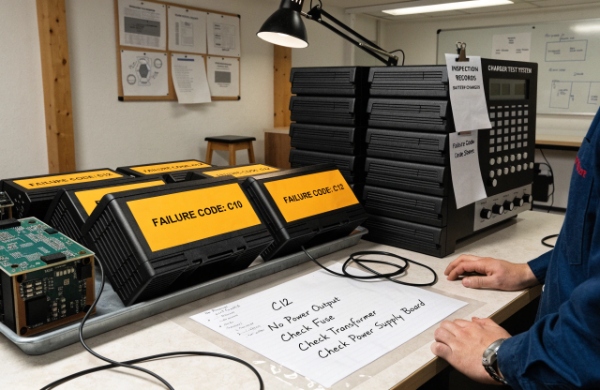
I have worked with automotive accessory distributors and importers for years as general manager at Parwatt New Energy. We supply car battery chargers and support partners when field claims appear. I regularly review cases where early sales looked healthy yet claims climbed after several months as thermal, cable or firmware weaknesses emerged. Our work in the car battery charger category emphasizes design validation and closed-loop corrective action so partners can respond quickly. In this article I explain why warranty claims rise, which failures are most common, and how suppliers should fix them in 2026.
Why Battery Charger Warranty Claims Can Rise After a Successful Launch?
A successful sample and a smooth first production run do not guarantee long-term field reliability. As sales volume increases, units meet wider temperature ranges, older batteries, longer duty cycles and more varied user behavior. Small margins in component rating, soldering, cable quality or firmware timing then appear as intermittent charging, overheating or early shutdown. Claims rise even though the original sample performed well.
Warranty claims can rise after launch because volume production and real environments expose thermal, contact, firmware and assembly weaknesses that limited samples did not reveal. Early success does not automatically equal long-term reliability.
How Problems Surface After the Launch Window
I have traced claim spikes to component substitutions made after the golden sample was approved. A capacitor or MOSFET with lower temperature rating entered production and failed after months of normal use.
Thermal design that was adequate in short laboratory runs proved marginal when users charged multiple batteries in sequence or operated the unit in a warm garage. Output current dropped or the charger shut down, generating “stops charging” complaints.
Cable and clamp issues often appear later. Crimping that passed a quick pull test loosened under repeated connection cycles. Contact resistance rose, local heating occurred, and customers reported weak charging or melted insulation.
Firmware edge cases also emerge with volume. Batteries at unusual states of charge or with higher internal resistance triggered unexpected timeouts or mode errors that the original test matrix had not covered.
Here is a table that links launch-stage gaps to later claims:
| Launch-Stage Gap | What Remains Hidden | Typical Later Claim | Root Area |
|---|---|---|---|
| Limited thermal testing | Heat under repeated cycles | Overheat / early shutdown | Design margin |
| Unlocked or substituted parts | Lower-rated components | Premature failure | Supply control |
| Short cable/clamp validation | Wear after many connections | Intermittent charge / heat | Accessories |
| Narrow firmware test matrix | Edge battery conditions | False faults / wrong mode | Software |
| Minimal aging / burn-in | Early-life infant mortality | Dead on arrival or early fail | Production test |
This table reflects the patterns I see when claim rates climb months after launch. At Parwatt we extend validation and lock configurations for chargers in our car battery charger category to reduce these delayed exposures.
In 2026 online reviews and platform metrics make rising claims visible quickly. Preventing the rise is far cheaper than managing it after the product is widely distributed.
The Mistake of Treating Every Customer Complaint as a Charger Failure
Not every “will not charge” complaint is a defective charger. Damaged or sulfated batteries, incorrect chemistry selection, low AC input, reverse connection, blown vehicle fuses or unclear instructions can all produce the same customer report. Treating every return as a hardware failure hides the true root cause and prevents effective correction.
Treating every complaint as a charger failure is a mistake because many no-charge reports originate from the battery, the installation, the power source or user settings. Claims must be classified before engineering action begins.
Why Classification Must Come First
I have tested returned chargers that performed to specification once connected to a known-good battery and correct input power. The original complaint had been caused by a failed battery or by the user selecting the wrong mode.
Reverse-polarity connection or a blown in-line fuse can stop charging without any permanent damage to the charger. If the unit is simply logged as “defective,” the supplier never learns that clearer labeling or a stronger user warning could have prevented the return.
Low AC voltage or extension-cord voltage drop can keep a charger from starting bulk charge. The customer sees no activity and assumes the product is dead.
Unclear instructions lead users to expect overnight full recovery from a deeply discharged or damaged battery. When the charger correctly refuses to proceed or times out, the event is recorded as a failure.
Here is a table of complaint sources that are not necessarily charger defects:
| Customer Report | Possible Non-Charger Cause | Check Before Counting as Failure |
|---|---|---|
| No charge | Damaged / sulfated battery | Test with known-good battery |
| No charge | Wrong chemistry mode | Verify selected mode vs battery |
| No charge | Reverse polarity or blown fuse | Inspect connection and fuse |
| No charge | Low AC input or long extension | Measure input voltage at unit |
| Stops early | Battery will not accept charge | Confirm battery accepts current |
| Confusing lights | Instruction or indicator clarity | Review manual and label text |
This table keeps analysis honest. At Parwatt we require returned units to be re-tested under documented conditions before they are accepted as confirmed hardware failures for products in our car battery charger category.
I advise distributors to create a short triage checklist for every return. The checklist separates battery, installation and user issues from true product defects and dramatically improves the quality of the data sent to the supplier.
The Most Common Charger Failures and Their Root Causes
When hardware is genuinely at fault, certain failure modes appear repeatedly. Intermittent charging, low output, abnormal heat, early shutdown, incorrect mode recognition, fuse damage, cable or clamp heating, and display or button faults each point to specific design, component or process weaknesses.
The most common charger failures include intermittent output, insufficient current, excess heat, premature stop, mode errors, fuse events, cable/clamp heating and interface faults. Each symptom maps to identifiable root causes in design, materials or assembly.
Symptom-to-Cause Mapping
Intermittent charging often traces to marginal solder joints, cracked vias, loose connectors or thermal expansion that opens a contact as the unit warms. Vibration during shipping can also convert a weak joint into an intermittent one.
Low output current may result from incorrect current sensing, transformed or inductor saturation, thermal fold-back that activates too early, or firmware limits that do not match the claimed rating.
Abnormal heating points to undersized power components, inadequate heatsinking, blocked airflow, excessive contact resistance in cables or clamps, or prolonged high-current operation beyond the intended duty cycle.
Early or unexpected shutdown can be caused by over-sensitive temperature thresholds, software timeouts that do not suit real battery acceptance curves, or protection circuits that trip on normal inrush or noise.
Mode recognition errors appear when voltage thresholds for chemistry detection are poorly set or when the user interface allows easy mis-selection without clear feedback.
Fuse damage may be the correct response to a real external fault, or it may indicate that the fuse rating or type is poorly matched to the charger’s surge and protection behavior.
Cable and clamp heating is almost always a resistance problem: insufficient conductor cross-section, weak crimps, corroded or low-pressure jaws, or undersized connectors.
Display or button faults frequently originate in membrane switches, moisture ingress, or connector reliability between the interface and the main board.
Here is a failure-mode summary:
| Symptom | Frequent Root Causes | Primary Area to Investigate |
|---|---|---|
| Intermittent charge | Solder joints, connectors, thermal cycling | PCB assembly and mechanical |
| Low / unstable output | Sensing error, thermal fold-back, firmware limit | Power stage and calibration |
| Excess heat | Component rating, heatsink, cable resistance | Thermal design and accessories |
| Early shutdown | Temp threshold, timeout, noise tripping | Firmware and protection tuning |
| Wrong mode / no start | Detection thresholds, UI clarity | Firmware and labeling |
| Fuse opens | Surge, external short, fuse selection | Protection coordination |
| Cable / clamp heat | Gauge, crimp, contact force | Output accessory design |
| Display / key failure | Switch quality, moisture, interconnect | Interface and sealing |
This mapping guides efficient laboratory analysis. At Parwatt we use structured failure coding when investigating returns for chargers in our car battery charger category.
I recommend that every significant claim be assigned both a customer symptom code and an engineering root-cause code. The two-layer record is what makes later Pareto analysis possible.
What Suppliers Should Change in Design, Production and Testing
Once recurring root causes are known, suppliers must change design margins, production controls and test coverage. Component derating, thermal design, PCB and solder quality, cable specifications, firmware validation, aging tests, charging-curve verification and protection tests all form part of an effective corrective response.
Suppliers should improve component derating, thermal design, assembly quality, cable and clamp ratings, firmware validation and production testing. Final inspection alone cannot compensate for weak design or process control.
Corrective Actions That Reduce Field Failures
Increase component derating on power semiconductors, capacitors and magnetics so that temperature and voltage stress remain within safe limits under worst-case ambient and duty cycle.
Improve thermal paths: better heatsink contact, improved airflow, or revised layout that moves heat away from sensitive parts. Validate with consecutive-cycle temperature rise tests on the finished configuration.
Raise PCB and soldering standards. Require controlled solder profiles, adequate copper for high-current paths, and inspection methods that catch cold joints and insufficient wetting.
Specify output cables and clamps by measured voltage drop and temperature rise at rated current, not by appearance. Include crimp strength and repeated-connection durability in the approval.
Lock firmware versions and expand the validation matrix to include deeply discharged batteries, high-temperature operation, and boundary input voltages. Record curves for every chemistry mode.
Introduce or strengthen aging / burn-in for early-life failures. Even a short powered burn-in at elevated temperature can catch many infant-mortality defects before shipment.
Verify complete charging curves and all protection functions at end-of-line on a statistically valid sample. Relying only on a quick voltage check leaves algorithm and protection faults undetected.
Here is a corrective-action focus list:
- Increase power-component derating and thermal margin
- Validate temperature rise under repeated rated cycles
- Control PCB copper, solder profile and joint quality
- Specify cables and clamps by electrical and thermal performance
- Expand firmware test coverage and lock versions
- Add aging / burn-in for early failure screening
- Perform end-of-line curve and protection verification
- Freeze BOM and require approval for any substitution
- Trace every production batch to its test records
- Re-qualify after any critical design or process change
At Parwatt we apply these measures when corrective action is required on chargers in our car battery charger category. Related quality disciplines also support products such as those in the car air pump category.
I tell suppliers that the goal is not a one-time repair of returned units but a permanent reduction in the failure rate of future batches. Design and process changes are what deliver that reduction.
How to Build a Closed-Loop Warranty and Corrective-Action System
A closed-loop system turns warranty data into permanent improvement. Distributors and suppliers must share common failure codes, retain batch traceability, analyze returned samples, rank causes with Pareto analysis, implement corrective actions through 8D or CAPA methods, and then monitor claim rates from the corrected batches separately.
Build a closed-loop system with unified failure codes, batch traceability, returned-sample analysis, Pareto ranking and verified corrective actions. Monitor post-correction claim rates to confirm that the fix worked.
Elements of an Effective Loop
Agree a short list of customer symptom codes and engineering root-cause codes. Every material return is tagged with both so that data can be sorted and ranked.
Require batch or date-code traceability on every charger. Without it, a recurring defect cannot be linked to a specific component lot or process period.
Establish a routine for returning representative failed samples to the supplier for laboratory analysis. Photos and customer descriptions help, yet physical units are usually necessary for root-cause confirmation.
At regular intervals, produce a Pareto ranking of confirmed root causes. Focus corrective resources on the few causes that generate the majority of claims.
For each major cause, run a formal corrective-action process: root-cause verification, corrective and preventive actions, implementation on pilot production, and effectiveness check.
After the fix is released, track claim rates from the new batches separately from the old population. Only a clear drop in the new-batch rate proves that the action worked.
Share the summary data between distributor and supplier so both sides see the same trends and priorities.
Here is a closed-loop checklist:
- Unified symptom and root-cause coding
- Batch / date-code traceability on every unit
- Structured return of samples for analysis
- Periodic Pareto ranking of confirmed causes
- Formal 8D or CAPA for top issues
- Pilot verification before full rollout
- Separate claim-rate tracking for corrected batches
- Shared dashboards or regular review meetings
- Update of test plans and specifications after each fix
- Escalation rule when claim rate exceeds an agreed threshold
At Parwatt we operate this type of closed loop with our distribution partners. The same discipline is applied across the car battery charger category and supports continuous improvement for related products on our main site.
Distributors who insist on coded data, traceability and verified corrective action receive fewer repeated claims. The loop converts warranty cost into engineering knowledge and, ultimately, into a more reliable product.
Conclusion
Rising warranty claims do not always mean that every returned charger is defective, but they always indicate that something in the product, instructions, application matching or quality-control system needs attention. At Parwatt we treat claim data as a signal for structured analysis and permanent correction. Distributors should separate confirmed hardware failures from battery problems, installation errors and no-fault-found returns. Suppliers must then connect each recurring symptom to a measurable root cause and corrective action. A closed-loop process covering return data, engineering analysis, production traceability and post-correction monitoring is more effective than simply replacing units or increasing final inspection.

--- END ---
Related Posts
Business Ideas

Business Ideas

Business Ideas

Business Ideas


