

Type 1 vs. Type 2 vs. NACS EV Connectors: Which AC Charging Plug Do You Need?
Oct 30,2026
The wrong EV connector can make a compatible charger unusable. Power rating and installation quality do not help if the plug does not match the vehicle inlet. At Parwatt I see returns and delayed installations when buyers choose by brand reputation or charger kilowatts alone and skip the physical interface.
The right AC charging connector is set by the vehicle inlet and regional standard—not by the charger’s advertised power. Type 1/J1772 remains common in North America, Type 2 dominates Europe, and NACS is expanding under SAE J3400. Confirm the exact inlet, AC limit and local supply before you buy.
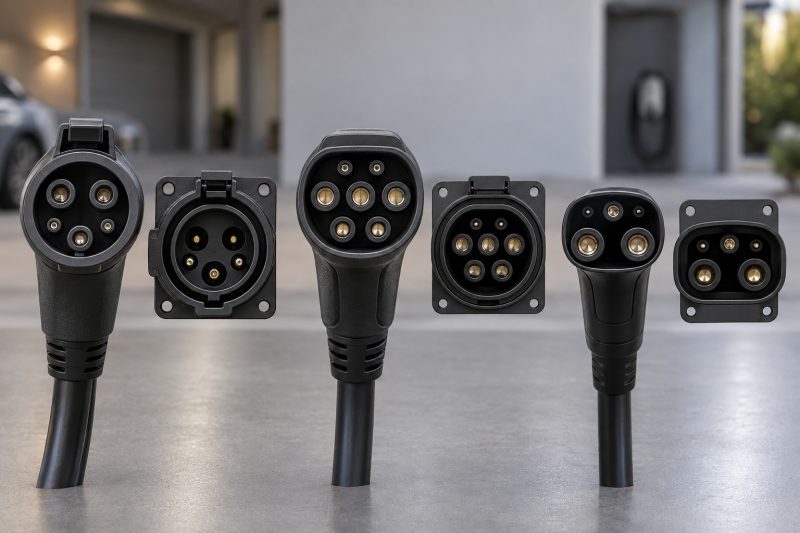
I have worked with charge point operators, fleet managers and home EV users for years as general manager at Parwatt New Energy. We supply EV charging equipment and power modules used in residential and commercial projects. I regularly help buyers avoid connector mismatches that leave a new wallbox sitting unused. Our guidance for products in the EV Charger Category always starts with the vehicle inlet and the maximum AC power the car can accept. In this article I explain how Type 1, Type 2 and NACS connectors differ and how to choose the correct AC plug in 2026.
Why the Wrong EV Connector Can Make a Compatible Charger Unusable?
A charger can be correctly rated and properly installed yet still fail at the vehicle. If the plug shape and pin layout do not match the inlet, the session cannot start. Adapters sometimes bridge the gap, but they add cost, another connection point and possible approval limits. The result is delay, extra expense or a product that goes back to the seller.
The wrong connector makes a charger unusable when the plug cannot mate with the vehicle inlet. Correct power and installation do not overcome a physical interface mismatch.
How Mismatches Appear in Real Projects
I have reviewed home installations where a Type 2 cable was ordered for a North American J1772 vehicle. The wallbox was fine. The cable was not. The owner waited for a replacement before the first overnight session could run.
Public and workplace sites show the same pattern. A driver arrives with the wrong cable or finds only the opposite connector on the pedestal. Time is lost, and confidence in the site drops.
Cross-border purchases increase the risk. A vehicle built for one market may carry a different inlet from the same model sold elsewhere. Relying on brand name alone is not enough.
Adapters can restore function when they are approved and correctly rated. They cannot create a charging mode the vehicle or the station does not support. An AC-only adapter will not unlock DC capability that is missing from the inlet.
Here is a table that links connector error to practical impact:
| Situation | Wrong Choice | Result |
|---|---|---|
| Home wallbox purchase | Cable standard ≠ vehicle inlet | Cannot connect; delay or return |
| Travel between regions | Assumed universal plug | Site unusable without adapter |
| Fleet mixed vehicles | Single connector type ordered | Some cars excluded |
| Adapter assumed universal | Unapproved or wrong direction | Session fails or is limited |
| Brand-only selection | Model year / market ignored | Unexpected inlet on delivery |
This table reflects the failures I discuss with customers of equipment from the EV Charger Category.
In 2026 the first specification line on any AC charger order should still be the vehicle inlet type and region.
The Connector Mistakes EV Owners and Buyers Commonly Make
Buyers often confuse AC and DC interfaces, select by automaker name alone, ignore model year and sales market, and assume the plug shape controls charging speed. These mistakes produce incompatible hardware and incorrect expectations about power.
Common mistakes include mixing AC with DC connectors, choosing only by brand, overlooking year and market, and treating connector style as a speed guarantee.
Mistakes That Create Compatibility Trouble
One frequent mistake is treating every large vehicle inlet as the same. CCS combinations add DC pins to an AC base. The AC portion may still be Type 1 or Type 2, but the full inlet is not interchangeable with a pure AC plug.
Another mistake is assuming one brand always uses one connector. During the North American transition, the same manufacturer may ship J1772 on older stock and NACS on newer builds. Model year and market must be checked.
Some buyers believe a “better” connector automatically means faster AC charging. Speed is set by supply, charger output, cable rating and the onboard charger. The plug only has to carry the current safely.
Regional assumptions also fail. A European Type 2 driver who moves to North America cannot rely on the same cable. The reverse is equally true.
Unverified adapters are a final trap. A mechanically fitting piece does not guarantee correct signalling, current rating or manufacturer approval. Using the wrong adapter can prevent charging or void support.
Here is a table of frequent mistakes:
| Mistake | Why It Misleads | Better Check |
|---|---|---|
| Brand = connector | Transition and market variants exist | Exact model year and region |
| AC and DC treated as one | Different pins and protocols | Identify AC vs DC need |
| Plug shape = speed | Power limits sit elsewhere | Vehicle AC max and circuit |
| Any adapter will work | Signalling and rating matter | Approved, correctly rated only |
| One cable for every country | Standards differ by region | Match local infrastructure |
This table keeps purchasing disciplined. At Parwatt we ask for inlet type and vehicle AC limit before recommending any unit related to the FES-D30 DC EV Charger or residential AC products.
I advise photographing the vehicle inlet and reading the AC specification line in the manual before placing an order.
How Type 1, Type 2 and NACS Connectors Actually Differ
Type 1 (SAE J1772), Type 2 (Mennekes) and NACS (SAE J3400) differ in pin layout, typical markets, AC phase support and how DC fast charging is added. None of them alone guarantees a particular kilowatt figure.
Type 1/J1772 is a five-pin single-phase AC interface common in North America. Type 2 is a seven-pin interface widely used in Europe for single- and three-phase AC. NACS is a compact interface standardised as SAE J3400 that can carry both AC and DC.
Core Differences That Matter for AC Use
Type 1, known as SAE J1772, uses five pins and is associated with Level 1 and Level 2 AC charging in North America. It remains widespread on non-Tesla vehicles and on a large installed base of AC equipment.
Type 2 uses seven pins and is the standard AC connector across Europe and many other markets. It can support single-phase or three-phase AC depending on the station, cable and vehicle. The same physical connector family appears in CCS2 when DC pins are added.
NACS, now published as SAE J3400, is a compact connector that can handle AC charging and DC fast charging through one vehicle interface. On J1772 vehicles, DC is typically added through a larger CCS1 combination inlet. NACS integrates those functions differently.
Control signalling and proximity detection differ in detail among the families. Equipment and cables must follow the matching standard so the vehicle and charger can authorise current safely.
Power capability is not fixed by the plastic shape. A Type 2 cable on a limited single-phase supply may deliver less than a Type 1 cable on a strong 240 V circuit. Always read the electrical ratings together with the connector type.
Here is a comparison summary:
| Feature | Type 1 / J1772 | Type 2 | NACS / SAE J3400 |
|---|---|---|---|
| Typical pins (AC) | 5 | 7 | Compact multi-function |
| Main AC markets | North America | Europe and others | Expanding in North America |
| AC phases | Primarily single-phase | Single- or three-phase | AC supported per design |
| DC fast path | Usually CCS1 combo | Usually CCS2 combo | Same inlet family for DC |
| Selection key | Vehicle inlet + region | Vehicle inlet + region | Model year + market |
This summary keeps the standards distinct. At Parwatt we treat connector family as a first filter when configuring systems that may later include higher-power stages such as the 30kW Power Module or 40kW Power Module.
I recommend matching the cable and inlet before discussing peak kilowatts. The physical interface is the gate that everything else must pass.
Which Connector Is Right for Your Vehicle, Country and Charging Setup?
North American buyers must account for the ongoing J1772-to-NACS transition and confirm the exact model year. European buyers normally need Type 2 for AC. Cross-border purchases require a fresh check of the vehicle socket, local grid and cable offered with the charger.
Choose the connector by vehicle inlet, sales region and model year. North America is mixed between J1772 and NACS; Europe centres on Type 2. Verify the car, the local supply and any adapter need before purchase.
Region and Vehicle Guidance
In North America, many existing vehicles and Level 2 stations still use J1772. Newer models from a growing list of automakers ship with native NACS. The same brand can appear in both camps depending on year. Always confirm the inlet on the specific car you will charge.
In Europe and in markets that follow the same AC convention, Type 2 is the default for home and public AC charging. Three-phase capability is common where the building supply supports it, but the connector alone does not create three-phase power.
Imported or grey-market vehicles need special care. The inlet may not match local public infrastructure. An approved adapter may be required, or a dedicated home cable may be the safer path.
Fleets that operate mixed connector types should standardise depot equipment carefully or maintain clearly labelled adapters. A single connector policy only works when every vehicle truly shares the same inlet.
Home setups should prioritise a fixed cable or a clearly marked socket that matches the household vehicle. Guests with a different inlet will need their own cable or an approved adapter.
Here is a region-oriented guide:
| Context | Usual AC Connector | Extra Check |
|---|---|---|
| North America, older / many non-Tesla | Type 1 / J1772 | Exact model year |
| North America, newer NACS models | NACS / SAE J3400 | Station and cable support |
| Europe and aligned markets | Type 2 | Single- vs three-phase supply |
| Mixed fleet | Depends on each vehicle | Labelled adapters or dual equipment |
| Imported vehicle | May differ from local norm | Approved adapter path |
This guide keeps selection tied to geography and the actual car. At Parwatt we apply the same checks when supporting international customers through the EV Charger Category.
I advise treating “brand” as a hint only. The inlet photo and the VIN or order specification decide the connector.
A Compatibility Checklist Before Buying an AC EV Charger
A short checklist prevents most connector problems. Confirm the vehicle brand, model year and sales region. Identify the vehicle-side inlet. Record the maximum AC charging power and whether the car uses single-phase or three-phase. Decide whether an approved adapter is acceptable. Only then select the charger and cable.
Before buying, confirm vehicle year and region, vehicle inlet type, maximum AC power, phase support and any approved adapter need. These details lock connector compatibility.
Steps That Avoid Returns and Delays
Photograph the vehicle inlet and compare it with official Type 1, Type 2 and NACS outlines. If the shape is unclear, use the owner’s manual or the manufacturer’s charging guide for that exact model year.
Write down the maximum AC charging rate. This number, not the connector, sets the useful wallbox power.
Confirm the home or site supply: voltage, available current and single-phase or three-phase service. The cable and charger must be rated for those conditions.
Ask the seller to state the connector standard on the quotation in plain language: J1772, Type 2 or NACS/SAE J3400. Avoid vague descriptions such as “universal cable.”
If an adapter is proposed, obtain the manufacturer approval status, current rating and AC-only or AC/DC scope. Reject unlisted adapters for daily home use.
For public charging, check whether your regular networks present the matching plug or require a tethered adapter. Plan the home cable independently of public assumptions.
Keep the vehicle documentation with the charger records so a future replacement cable is ordered correctly.
Here is a pre-purchase checklist:
- Vehicle brand, model year and market confirmed
- Vehicle inlet type identified (photo or manual)
- Maximum AC charging power recorded
- Single-phase or three-phase capability noted
- Site voltage and available current checked
- Charger and cable standard stated in writing
- Approved adapter path verified if needed
- Outdoor rating and certification confirmed
- Installation and cable length planned
- Records retained for future cable replacement
At Parwatt we encourage this sequence for every residential and light-commercial order. Further reading on charging technology is available in our articles on Electric Vehicle Charging and AC vs DC EV Charging. Product options and specifications can be reviewed on our main site and within the EV Charger Category, including higher-power platforms such as the Battery Buffered Ultra Rapid EV Charger.
Buyers who complete the checklist receive a charger that plugs in on the first attempt and delivers the power the vehicle can actually accept.
Conclusion
The right AC charging connector is determined primarily by the vehicle inlet and regional charging standard—not by the charger’s advertised power alone. At Parwatt we match connector family to the exact vehicle and market so installations work on day one. Type 1/J1772 remains widely used for North American AC charging, while Type 2 is the established choice across Europe and many other markets. NACS, standardized through SAE J3400, is expanding across North America, but connector availability still varies by automaker, model year and charging equipment. Before purchasing a home charger, confirm the exact vehicle inlet, maximum AC charging rate, local electrical supply and whether a safe, approved adapter is required. Checking these details prevents compatibility problems and ensures that the charger can deliver the power the vehicle is actually capable of accepting.

--- END ---
Related Posts
Business Ideas

Level 1 vs Level 2 EV Charging: What Buyers Should Check Before Ordering
November 20, 2026
Business Ideas

Company News

Industry News


