

Car Battery Chargers vs Maintainers: A Wholesale Product Range Guide
Nov 16,2026
One battery charger cannot serve every customer. Stored vehicles need low-current maintenance. Everyday drivers need recovery from a depleted battery. Workshops need higher current, multi-voltage options and fast turnaround. At Parwatt I see distributors stock a single power class and then face either slow-moving high-end units or gaps in the range that send buyers elsewhere.
Modern smart chargers and maintainers often overlap. Some chargers finish multi-stage charging and then enter a controlled maintenance mode. Wholesale ranges should be built around real applications—storage, everyday recovery, higher-output service and professional 12V/24V use—rather than product names alone.
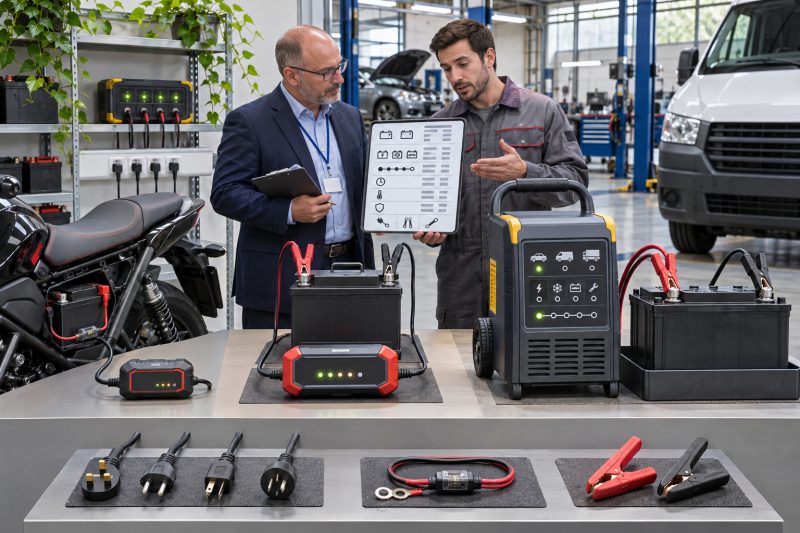
I have worked with automotive importers, distributors and workshop buyers for years as general manager at Parwatt New Energy. We supply battery-care and related electrical products used by retail, e-commerce and professional channels. I regularly review assortments where a “one size fits all” charger created returns, safety questions or missed sales. Our planning for products in the car battery charger category and across our main site starts with the job the customer needs done. In this article I explain how to structure a wholesale range of car battery chargers and maintainers in 2026.
Why One Battery Charger Cannot Serve Every Customer?
Different users have different time horizons and power needs. A motorcycle stored for months needs a gentle, long-term connection. A family car with a flat battery needs a controlled recovery charge. A busy workshop needs higher continuous output and clear status information. A single amperage or feature set leaves at least one of these groups poorly served.
One charger cannot serve every customer because storage, everyday recovery and workshop turnaround demand different currents, connection times and interfaces. A narrow range creates either excess inventory or coverage gaps.
How Application Gaps Appear
I have seen retail buyers return a high-output charger because it was too aggressive for a small motorcycle battery. The product was not defective. It was simply the wrong tool for that user.
Workshop managers face the opposite problem. A 1 A maintainer that is ideal for a collector car takes too long to restore a deeply discharged truck battery. The bay stays occupied and labour cost rises.
E-commerce listings that present every automatic unit as a universal solution create mismatched expectations. Customers who need only storage maintenance receive a unit optimised for recovery, or the reverse.
Seasonal demand adds another layer. Winter brings more recovery charges. Summer storage of motorcycles and leisure vehicles raises demand for true maintainers. A balanced range covers both peaks.
Commercial and fleet users often need 12 V and 24 V capability in one workshop. A purely 12 V retail range cannot serve that channel without additional SKUs.
Here is a product-type view that maps use to customer:
| Product Type | Core Purpose | Typical Customers | Buying Focus |
|---|---|---|---|
| Low-current maintainer | Hold charge during storage | Collectors, motorcycles, seasonal vehicles | Maintenance logic, long connection, ring terminals |
| Compact smart charger/maintainer | Daily charge plus maintenance | Private owners, auto retail, e-commerce | Auto operation, 3–5 A, multi-stage |
| Mid-power smart charger | Restore clearly depleted batteries | DIY users, light fleets, small workshops | 5–10 A, chemistry modes, thermal control |
| 12V/24V charger | Cars and commercial vehicles | Truck fleets, service providers | Voltage selection, capacity range, error protection |
| Professional workshop charger | Fast turnaround and diagnostic support | Repair shops, dealers, fleet workshops | High continuous output, cooling, robust clamps, display |
| Multi-bank maintainer | Maintain several batteries at once | Warehouses, showrooms, fleets, dealers | Independent channels, fault isolation, per-channel status |
This table keeps assortment planning tied to real jobs. At Parwatt we use the same application logic when advising partners on the car battery charger category.
In 2026 the profitable range is the one that covers the main jobs without duplicating nearly identical SKUs.
The Product-Selection Mistakes That Create Returns and Safety Risks
Buyers sometimes treat any trickle unit as a smart maintainer, assume every automatic charger can stay connected indefinitely, judge only by maximum amps, apply lead-acid repair modes to LiFePO4, or ignore plug type, certification and market voltage. These mistakes drive returns and safety complaints.
Selection mistakes include treating basic trickle chargers as smart maintainers, assuming unlimited connection time, ignoring capacity limits, using lead-acid modes on lithium, and overlooking plugs, certification and target-market voltage.
Mistakes That Hurt the Range
A traditional trickle charger may keep delivering current without properly monitoring battery state. A true smart maintainer reduces, pauses or restarts according to a defined voltage strategy. Labelling every low-current unit as a maintainer creates overcharge risk and warranty disputes.
Many smart chargers do move into a maintenance phase after absorption. That does not mean every model is approved for continuous connection. The manual must state the allowed connection policy.
Maximum current alone does not define the product. A 10 A unit may be wrong for a small AGM motorcycle battery and slow for a large commercial battery that a workshop needs to recover quickly. Capacity range and chemistry profiles matter more than the peak number on the box.
Desulfation or repair modes designed for lead-acid can damage LiFePO4 batteries. Multi-chemistry products need clear, separate profiles and user guidance that prevents wrong-mode selection.
Market compliance is often checked too late. Input voltage, plug shape, language on the manual and certification marks must match the destination country. A technically good charger still fails if it cannot be sold legally.
Here is a risk-focused checklist of mistakes:
| Mistake | Commercial or Safety Result | Better Practice |
|---|---|---|
| Trickle = smart maintainer | Overcharge risk, returns | Verify control logic and connection policy |
| Any auto unit stays connected forever | Warranty and heat issues | Read explicit long-term connection rules |
| Max amps only | Wrong size for battery | Match current to capacity and turnaround |
| Lead-acid mode on LiFePO4 | Battery damage, claims | Separate chemistry profiles and clear UI |
| Wrong plug or missing certification | Blocked sales, recalls | Confirm market electrical and approval requirements |
This checklist reduces avoidable claims. At Parwatt we require chemistry and connection statements to be explicit on specifications for products offered through our main site.
I advise rejecting any quotation that cannot state permitted connection time and supported battery types in writing.
How Chargers and Maintainers Differ in Real Applications
The core difference is the intended task. A charger restores a significantly discharged battery. A maintainer monitors a charged or lightly discharged battery and supplies small amounts of energy during storage. Modern smart units can do both in sequence, but only when the design and the instructions allow it.
Chargers restore depleted batteries. Maintainers hold charge during storage. Smart units may combine both functions by completing multi-stage charging and then entering a controlled maintenance mode—if the manufacturer permits extended connection.
Practical Differences That Drive SKU Choice
Output current sets turnaround time. Low-current maintainers are efficient for storage. They are inefficient for workshop recovery of a deeply discharged battery.
Completion behaviour matters. After absorption, some units stop, some monitor voltage and some enter a float or pulsed maintenance mode. Buyers must know which behaviour they are selling.
Connection hardware differs by use. Storage customers prefer fused ring terminals that stay on the vehicle. Workshops need durable clamps, longer leads and clear displays.
Chemistry coverage must be explicit. Flooded, AGM, GEL, EFB and LiFePO4 often need different voltage limits. A single generic curve is a risk, not a feature.
User interface quality affects returns. Clear mode selection reduces the chance that a retail customer applies the wrong profile.
Here is a comparison of roles:
| Aspect | Typical Maintainer | Typical Recovery Charger | Smart Charger/Maintainer |
|---|---|---|---|
| Main job | Hold charge in storage | Restore depleted battery | Charge then maintain |
| Current level | Low (often under 2 A) | Higher (application-dependent) | Medium, then low in maintenance |
| Connection time | Designed for long periods | Session-based | Only if manual allows |
| Best accessories | Ring terminals, quick connectors | Robust clamps | Both options preferred |
| Primary risk if misused | Too slow for recovery | Over-aggressive on small batteries | Wrong chemistry mode |
This comparison supports honest product descriptions. At Parwatt we separate storage-focused and recovery-focused messaging even when a platform can perform both roles, including items in the car battery charger category.
I recommend that every SKU card states the primary job in one line: storage, everyday recovery, workshop recovery or multi-bank maintenance.
Which Charger Features Are Worth Prioritizing for Each Sales Channel?
E-commerce and retail favour automatic operation and simple choices. Seasonal and collector customers need reliable maintenance modes and ring-terminal kits. Workshops and fleets need higher current, 12 V/24 V selection, durable hardware and, in some cases, multi-bank or power-supply functions.
Prioritise automatic, simple smart units for retail and e-commerce; dependable maintenance and ring terminals for storage users; higher current, multi-voltage and robust accessories for workshops and fleets.
Channel-Oriented Feature Priorities
Retail and online shoppers often want one button or fully automatic recognition. Clear packaging that states chemistry support and whether long-term connection is allowed reduces returns.
Motorcycle, classic-car and seasonal-vehicle buyers value low-current maintenance, weather-resistant leads and permanent ring terminals. A quick-connect system that stays on the vehicle improves repeat use.
Light DIY and small-workshop users benefit from 5–10 A class units with explicit AGM and lithium modes and basic thermal management.
Commercial workshops and fleets prioritise continuous output, cooling, heavy clamps, long cables, readable displays and 12 V/24 V flexibility. Multi-bank systems help showrooms and depots that store many vehicles.
Accessories should match the channel. Retail kits that omit ring terminals miss storage sales. Workshop units with fragile clamps generate service complaints.
Training and documentation also differ. Retail needs simple pictograms. Professional channels need full charging curves and protection behaviour descriptions.
Here is a practical wholesale tier plan:
| Product Tier | Suggested Specification Direction | Main Application |
|---|---|---|
| Entry maintainer | 0.8–1.5 A, 6 V/12 V lead-acid | Motorcycles, small vehicles, seasonal storage |
| Core retail model | 4–5 A, 12 V, lead-acid/AGM/LiFePO4 options | Mainstream cars, e-commerce and retail |
| Higher-output model | 8–10 A, 12 V, multi-stage smart | SUVs, light commercial, deeper recovery |
| Commercial model | 12 V/24 V, 15–25 A | Trucks, fleets, repair workshops |
| Multi-bank model | 2–10 independent maintenance channels | Showrooms, warehouses, multi-vehicle management |
These current bands are for assortment planning only. Final battery capacity and charge time must follow the tested product data and the user manual. At Parwatt we help partners map similar tiers across the car battery charger category and related electrical accessories on our main site.
I advise launching with one strong SKU per tier rather than several near-duplicates. Depth of stock matters more than a long catalogue of similar units.
How to Build and Test a Lower-Risk Wholesale Range
Build the range around applications, not feature lists. Validate charging curves, output accuracy, temperature rise, protection functions and chemistry compatibility. Keep the first order focused, then expand only after return rates, average order value and channel feedback support more SKUs.
Build 3–5 application tiers, test curves and protections thoroughly, limit initial SKUs, and expand only when sell-through and return data justify additional models.
From Sample to Stable Assortment
Define the jobs you must cover: storage maintenance, everyday smart charge/maintain, higher-output recovery, commercial 12 V/24 V and optional multi-bank. Assign one primary SKU to each job.
Request full charging-curve data for every chemistry claimed on the packaging. Verify transitions from bulk to absorption to maintenance or stop.
Measure output voltage and current at each stage against the specification. Check behaviour on a deeply discharged battery and on a full battery.
Confirm safety protections: reverse polarity, short circuit, over-voltage, over-current and over-temperature. Record recovery behaviour after a fault.
Run thermal tests at rated load. Note enclosure, cable and clamp temperatures under continuous operation.
Inspect accessories and user interface. Ring terminals, fuses, clamp quality and mode clarity all affect real-world satisfaction and claims.
Align plugs, manuals and certifications with the target market before ordering packaging.
Place a controlled trial order. Track returns by reason code: wrong application, chemistry confusion, quality, or documentation.
Expand or adjust the range only after the trial data is clear.
Here is a sample test checklist buyers should complete:
| Test Item | What Buyers Should Confirm |
|---|---|
| Output accuracy | Voltage and current at each stage match specification |
| Charging stages | Pre-charge, bulk, absorption and maintenance transitions are correct |
| Full-charge behaviour | Stop, monitor or proper maintenance mode after full charge |
| Chemistry profiles | Separate curves for flooded, AGM, GEL, EFB and LiFePO4 as claimed |
| Low-voltage recovery | Deeply discharged batteries are detected and started safely |
| Safety protection | Reverse, short, over-voltage, over-current and over-temperature |
| Thermal performance | Enclosure, cable and internal rise under continuous full load |
| Accessories | Clamps, ring terminals, extension leads and fuses |
| User interface | Mode selection is clear and reduces wrong-mode use |
| Market compliance | Input voltage, plug, manual language and certifications |
| Packaging claims | Current, capacity, chemistry and maintenance statements are accurate |
| Warranty | Rules for long connection, wrong mode and battery failure are clear |
This checklist turns subjective samples into documented decisions. At Parwatt we welcome the same test discipline for products supplied through the car battery charger category and complementary categories such as the car air pump category when distributors build broader workshop ranges on our main site.
I recommend freezing the approved sample, firmware and accessory list before the first bulk shipment. Uncontrolled changes are a common source of later quality drift.
Conclusion
A profitable wholesale battery-care range should be built around customer applications rather than the assumption that every charger performs the same job. At Parwatt we help distributors define storage, everyday recovery, higher-output and professional tiers so the assortment stays focused and sellable. Low-current maintainers are suited to stored or infrequently used vehicles, while higher-output chargers are needed to restore significantly discharged batteries. Modern smart chargers may combine both functions by completing a multi-stage charge and then moving into a controlled maintenance mode. Distributors should therefore compare charging logic, battery-capacity range, chemistry compatibility, safety protection and permitted connection time—not just maximum amperage. A focused range covering storage, everyday charging, higher-output recovery and professional 12V/24V applications can serve most channels without creating unnecessary SKU duplication.

--- END ---
Related Posts
Business Ideas

Level 1 vs Level 2 EV Charging: What Buyers Should Check Before Ordering
November 20, 2026
Industry News

Company News

Company News


