

Level 1 vs Level 2 EV Charging: What Buyers Should Check Before Ordering
Nov 20,2026
A Level 2 label does not tell buyers whether an EV charging product matches the site, vehicles, or installation requirements.
For North American applications, Level 1 generally uses 120V AC, while Level 2 uses 208V or 240V AC. Buyers should first confirm available power, required energy delivery, vehicle compatibility, and installation conditions. The charging level alone does not establish charging speed, connector compatibility, or market approval.
For EV charging importers and distributors, these checks determine which products belong in the range and what customers need before installation. I would resolve five purchasing questions before comparing quotations.
1. Does the Charging Level Match the Available Electrical Supply?
A product selected around its maximum kilowatt rating may deliver less power—or be unsuitable—at the intended site.
Confirm voltage, frequency, supply configuration, available circuit capacity, and permitted charging current. Treat Level 1 and Level 2 as North American AC charging categories, not universal names for portable and wall-mounted products.
Start with the Supply, Not the Housing
The U.S. Department of Energy’s Alternative Fuels Data Center describes Level 1 as 120V AC charging and Level 2 as charging through 208V or 240V service.
Both supply AC electricity to the vehicle. The vehicle’s onboard charger converts it to DC for the traction battery. Neither category is DC fast charging.
Portable equipment can support Level 2, and a wall-mounted enclosure does not independently establish the charging level. Some products support more than one input arrangement, but buyers must verify the documented configuration and accessories.
For distributors, the first specification should identify the actual electrical version. “North American model” is insufficient without input ratings, connection method, and installation instructions.
Also avoid transferring the terminology directly to another market. A European three-phase AC product needs assessment against that market’s electrical system, connectors, and requirements.
| First comparison | Level 1 | Level 2 |
|---|---|---|
| Typical North American supply | 120V AC | 208V or 240V AC |
| Power conversion | Vehicle’s onboard charger | Vehicle’s onboard charger |
| Equipment format | Verify the proposed product | Verify the proposed product |
| Purchasing priority | Suitability of available circuit | Site capacity and configured current |
Compare Ratings at the Actual Voltage
At the same current, a 208V installation supplies less power than a 240V installation.
For example, 32A corresponds to approximately 6.7kW at 208V and 7.7kW at 240V. These are calculated AC input-power values, not guaranteed rates of energy entering the battery.
Ask the supplier whether advertised power assumes 240V. Confirm operation at the intended voltage, including any current limits or temperature-related reduction.
A distributor selling into residential and commercial channels should make this distinction visible. Otherwise, customers may interpret normal operation at 208V as failure to achieve the advertised rating.
2. How Much Energy Must the Product Deliver During Parking?
“Faster charging” has little purchasing value until buyers know the energy requirement and available charging window.
Estimate the energy customers need to replace between trips, then compare it with usable charging time. Include charging losses, vehicle limits, temperature, and any shared-power restrictions before selecting equipment.
Define the Required Outcome in Kilowatt-Hours
Kilowatts, or kW, describe power. Kilowatt-hours, or kWh, describe energy. Buyers need both to assess an application.
For a hypothetical planning example, replacing 12kWh during ten hours of parking requires an average of 1.2kW reaching the battery. The supply must provide more than that because charging involves losses.
This calculation is an initial screening tool. It does not establish that a particular Level 1 product will meet the requirement under every condition.
Ask customers about typical daily energy use, arrival charge, departure time, and occasional higher-use days. Battery capacity alone does not describe what must be replenished during every session.
Long parking periods and modest replenishment needs may support Level 1. Shorter windows or greater energy requirements may justify Level 2.
I would avoid promising a universal number of miles added per hour. Vehicle efficiency and operating conditions vary, so an energy-based assessment gives the distributor a clearer basis for selection.
Check the Vehicle’s AC Charging Limit
The equipment’s maximum rating is only one limit. The vehicle’s onboard charger may accept less power than the equipment can offer.
The EPA’s charging guidance explains that a vehicle’s AC charging capability can limit the benefit of higher-rated equipment.
For a distributor, this changes how an upgrade should be sold. Higher output may support other vehicles or future applications, but it should not be described as an immediate speed improvement for every customer.
Shared charging introduces another constraint. If equipment divides available power among vehicles, assess the allocation method and expected simultaneous use.
Request an application estimate that identifies these assumptions. A maximum-power label cannot substitute for an assessment of whether vehicles receive the required energy before departure.
3. Which Vehicle Connector and Product Configuration Are Required?
The charging level and the vehicle connector answer different questions.
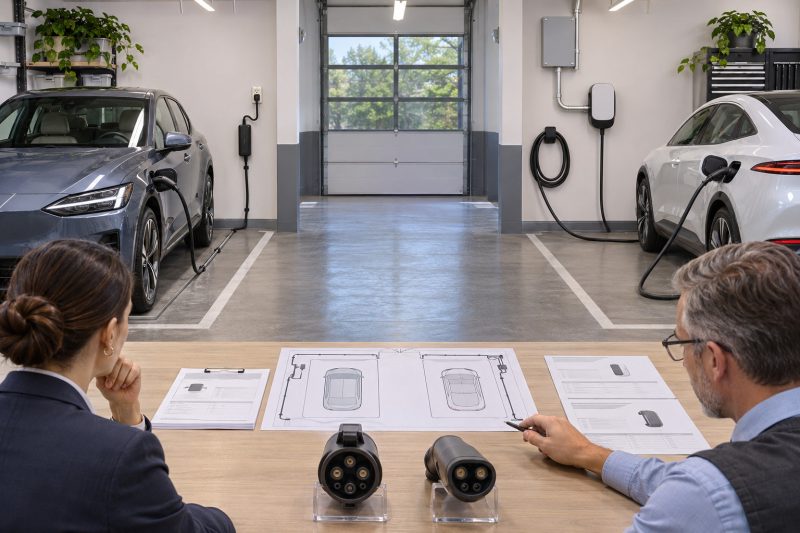
Specify the intended vehicles, AC connector, input connection, cable configuration, and any adapter requirements separately. Physical fit alone does not establish an approved charging arrangement.
Separate the Two Ends of the Product
A plug-connected EV charging product has an electrical-supply connection and a vehicle connection. Buyers should name both in the enquiry.
On the vehicle side, SAE J1772 and SAE J3400/NACS are important North American interfaces. Transport Canada’s connector compatibility guidance identifies both families for AC Level 1 and Level 2 charging.
Do not infer connector compatibility from “Level 2” or from an automaker’s name alone. Confirm the target model, model year, inlet, and manufacturer instructions.
An adapter also needs application-specific verification. An adapter intended for DC charging does not automatically support AC charging, even where connector shapes appear related.
Ask who supplies any adapter, what its ratings are, and whether the vehicle and equipment manufacturers permit the combination.
Review Cable Reach and Configuration Control
Cable length should suit the parking arrangement without creating tension or unnecessary obstruction. Consider different vehicle inlet locations, mounting positions, and accessible routes.
A longer cable may solve a reach problem while adding weight and storage requirements. Ask about handling at the intended temperature and the proposed connector holder.
For dual-voltage equipment, verify approved input accessories and how the product establishes the permitted current. Do not assume a generic plug adapter changes the equipment’s rating or installation requirements.
Keep every proposed configuration identifiable. The quoted connector, cable, input plug, and relevant software version should correspond to the sample and supporting documentation.
This matters commercially because apparently minor variations can create separate inventory positions. Define which configurations deserve stock and which require individual confirmation before sale.
4. What Installation and Approval Evidence Must Buyers Obtain?
An available outlet or spare panel space does not establish that a site can support EV charging.
Have a qualified installer assess electrical capacity and the applicable local requirements. Separately verify the exact product’s certification, installation instructions, and environmental suitability for its destination market.
Treat Circuit Capacity as a Site Question
EV charging can draw current for extended periods. Circuit design must account for that load, the equipment configuration, and the locally adopted electrical code.
U.S. DOE guidance illustrates a common arrangement: 32A charging on a 40A circuit. This is an example, not a complete installation design or a universal instruction for every product and jurisdiction.
Ask the installer to establish the allowable charging current, wiring, overcurrent protection, connection method, and any required service or panel work.
For Level 1, an existing household outlet still needs assessment. Its condition, circuit loading, grounding, and suitability for prolonged use matter.
For Level 2, compare hardwired and plug-connected options against the actual installation. A receptacle, installation hardware, or other required work may be outside the equipment quotation.
If load management is proposed, verify the operating method, required accessories, approved configuration, and response when communication fails. An app-based current setting is not automatically a complete site-capacity management system.
Verify the Complete Product’s Approval
Ask for certification details that can be checked with the issuing organization. Match the listed model and configuration to the proposed product.
UL 2594’s published scope concerns AC EV supply equipment for vehicles with onboard charging. Mentioning that standard does not prove that a product is certified to it.
A test report, component approval, certification mark, and complete-product listing are different forms of information. Confirm what each supplied document actually covers.
| Evidence to obtain | Purchasing check |
|---|---|
| Certification record | Exact model, scope, issuer, and destination market |
| Installation manual | Connection method and electrical requirements |
| Environmental information | Intended location and exposure limitations |
| Site assessment | Available capacity and necessary installation work |
| Configuration details | Agreement between quotation, sample, and documentation |
Requirements differ between the United States and Canada, and local authorities may impose additional conditions. Resolve acceptance before committing to inventory for a defined market.
5. How Should Distributors Compare Quotations and Validate Samples?
A lower equipment price may cover a different installation arrangement, connector package, or operating service.
Compare quotations against one defined application and configuration. Separate hardware, installation-related items, software costs, and support obligations, then validate the product behavior that matters to the intended customer.
Make the Quotation Scope Comparable
For home-charging distribution, identify which functions customers actually need. Scheduling may be useful, while a commercial payment platform may add unnecessary complexity.
For workplace or shared parking applications, clarify authorization, usage records, network requirements, and any subscription charges. Level 2 does not itself imply these capabilities.
If a supplier proposes Open Charge Point Protocol, or OCPP, support, request the version, supported functions, and evidence of operation with the intended platform. A protocol name alone does not establish complete interoperability.
Ask whether essential charging functions continue without internet access and what happens after a power interruption.
| Quotation area | Detail to confirm |
|---|---|
| Hardware | Input version, current rating, connector, and cable |
| Installation package | Mounting parts, input accessories, and exclusions |
| Connectivity | Required services, accounts, and recurring charges |
| Support | Warranty terms, troubleshooting, and replacement process |
| Commercial terms | Quantity, packaging, trade term, and named location |
Test the Intended Configuration
Use a qualified installation and representative vehicles for sample evaluation. Record supply voltage, configured current, vehicle details, and relevant operating conditions.
Check session startup, stable operation, scheduled charging where specified, and recovery after a normal interruption. Verify indications and user instructions against observed behavior.
If power sharing or remote management is required, test those functions in the proposed system. Do not infer them from a successful standalone charging session.
Retain the approved sample details and require proposed changes to be identified before bulk supply.
Use PARWATT’s EV charging category to identify candidates for model-specific review. For a purchasing enquiry, contact PARWATT with your destination market, available electrical supply, target vehicles and connector, and required energy-delivery window.
Conclusion
Choose Level 1 or Level 2 around site capacity and charging needs. Confirm vehicle fit, installation acceptance, and the complete configuration before ordering.

--- END ---
Prev: How Distributors Can Build a Battery Charger Product Range That Matches Customer Demand
Already the latest article
Related Posts
Business Ideas

Level 1 vs Level 2 EV Charging: What Buyers Should Check Before Ordering
November 20, 2026
Business Ideas

Company News

Company News


