

How to Compare Car Vacuum Suppliers Beyond Suction Power Claims
Nov 13,2026
The highest Pa number does not guarantee the best car vacuum. Static suction is only one part of performance. Inlet design, airflow, filter resistance, sealing and accessories all change real cleaning results. At Parwatt I see buyers rank suppliers by a single laboratory peak and then face weak pickup, short runtime or inconsistent production batches.
A higher Pa figure alone does not prove cleaning ability or stable mass production. Buyers should test sealed suction, airflow, debris recovery, runtime, noise and temperature under identical conditions, and approve suppliers that can control motors, cells, filters, seals and accessories across repeat orders.
I have worked with automotive importers, distributors and private-label buyers for years as general manager at Parwatt New Energy. We supply vehicle-care products including cordless car vacuums and related accessories. I regularly review sourcing decisions where an impressive Pa claim hid poor airflow, rapid filter clogging or large sample-to-batch differences. Our work in the car vacuum cleaner category and across our main site starts with repeatable tests and controlled bills of materials. In this article I explain how to compare car vacuum suppliers beyond suction power claims in 2026.
Why the Highest Pa Number Does Not Guarantee the Best Car Vacuum?
Sealed suction measures pressure difference under a defined condition. It does not automatically show how well the vacuum lifts sand from carpet, pulls crumbs from seat crevices or keeps performance as the filter loads and the battery voltage falls. A strong peak on a blocked port can still produce weak real cleaning if airflow, sealing or nozzle design are poor.
The highest Pa number does not guarantee the best car vacuum because pressure, airflow, nozzle design, filtration and battery state all shape real debris removal. Laboratory peaks are not the same as sustained cleaning in a vehicle interior.
Why Peak Pressure Misleads
I have compared samples with similar advertised Pa values that behaved very differently on the same car seat and floor mat. One recovered most of a measured sand load. The other left a clear residue. The difference came from airflow path, brush design and seal quality, not from the brochure number.
Measurement point changes the result. Readings taken at the motor inlet, dust-cup inlet or nozzle end are not interchangeable. Without a stated method, supplier figures cannot be ranked.
Power mode and battery state also change the number. A maximum-mode, full-charge reading can look strong while standard-mode performance at mid-discharge is mediocre. Users spend most of their time in the latter condition.
Filter condition is another gap. A clean filter in a lab test does not represent a partially loaded filter after several interior cleanings. Restriction rises and both airflow and effective pickup fall.
Accessories can erase a good host reading. A narrow crevice tool with a sharp bend or a poorly sealed hose joint reduces the performance that reaches the cleaning surface.
Here is a performance view that keeps Pa in context:
| Factor | What It Influences | Risk If Ignored |
|---|---|---|
| Sealed suction | Pressure capability | Over-ranking blocked-port peaks |
| Airflow | Transport of loosened debris | Weak pickup despite high Pa |
| Nozzle and seals | Delivery of performance to the surface | Host data better than real use |
| Filter load | Sustained airflow | Fast fade after short use |
| Battery state | Power available over the session | Strong start, weak finish |
This table reflects the gaps I discuss with buyers of products in the car vacuum cleaner category.
In 2026 a supplier comparison that stops at Pa is incomplete. Real cleaning and production stability must be measured.
The Supplier Claims Buyers Should Never Accept Without Test Conditions
Buyers should not accept Pa data without measurement location and test mode. They should not compare figures produced with different instruments or methods, test only full-charge samples, or ignore filter loading, low battery, temperature rise and accessory losses. Claims without conditions are marketing, not evidence.
Never accept suction claims without test conditions. Require measurement point, mode, battery state, filter condition and sample count. Full-charge peaks alone hide fade, heat and accessory losses.
Claims That Need Immediate Qualification
A Pa number without a stated port, gauge and sealing method cannot be compared with another supplier’s number. Ask for the full method before ranking.
Unit confusion is common. Pa, kPa and other air data are sometimes mixed with motor wattage or brush speed. Only like-for-like air measurements belong in the same table.
Single-sample demonstrations are risky. One carefully prepared unit can differ from the next five off the line. Request multiple samples and a stated tolerance.
Full-charge-only tests miss suction fade. Record performance at high, mid and low battery states under the same nozzle and filter condition.
Filter status must be controlled. A brand-new filter favours the sample. A standardised dust load or a second measurement after controlled fouling shows sustained behaviour.
Accessory claims need separate tests. Crevice tools, brushes and hoses should be measured on the same debris tasks, not assumed equal because the host Pa looks high.
Here is a claim-verification list:
| Claim Type | Missing Condition to Challenge | What to Request |
|---|---|---|
| Peak Pa | Port, instrument, seal method | Full test method and photos |
| “Strong suction” | Airflow and pickup data | Airflow plus debris recovery |
| Long runtime | Power mode and fade | Runtime with performance at intervals |
| HEPA or fine filtration | System leakage and pressure loss | Filtration plus seal check |
| Accessory power | Tool-level pickup | Crevice and brush task results |
This list keeps negotiations factual. At Parwatt we require method disclosure before any performance comparison for items linked to the car vacuum cleaner category and our main site.
I advise pausing any ranking exercise until at least two suppliers are tested with the same written method.
How to Compare Samples Using Repeatable Performance Tests
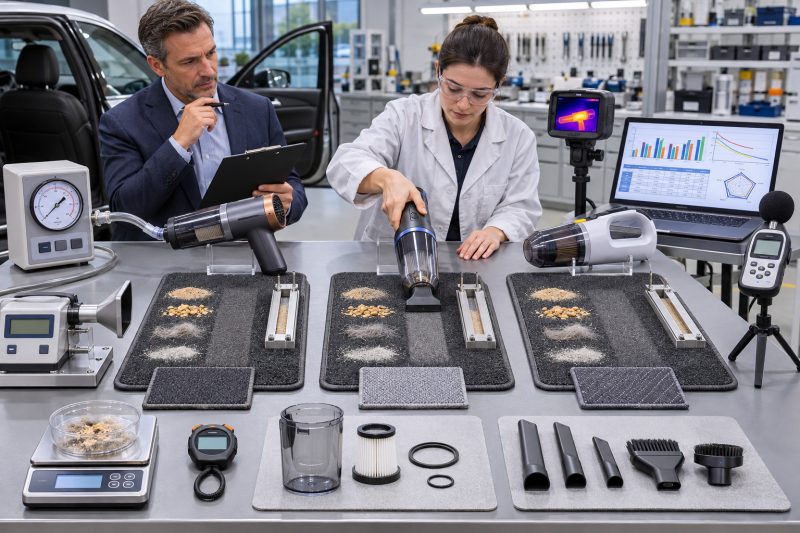
Compare samples only under matched battery state, power mode, filter, nozzle and environment. Measure sealed suction, airflow, debris recovery, runtime, noise and temperature rise. Use sand, crumbs, hair and fixed-width crevices to simulate real automotive cleaning tasks.
Use identical conditions for every sample. Measure sealed suction, airflow, weighted debris recovery, runtime, suction fade, noise and temperature, and include crevice and accessory tasks that match car interiors.
A Practical Test Protocol
Charge all samples according to the same rule and rest them for a fixed period before testing. Label power modes clearly so “standard” and “max” are not mixed.
Measure sealed suction with the same interface and instrument. Record the value and the exact configuration.
Measure airflow at the same physical position. Pressure and airflow together explain more than either figure alone.
Prepare fixed weights of sand, crumb-type debris and hair. Spread them on the same surfaces with the same pattern. Vacuum for a fixed time or number of passes and weigh the recovered material.
Build a simple crevice fixture with fixed width and depth. Time recovery from that fixture to compare seat and console gap performance.
Run continuous runtime tests in each claimed mode until automatic stop. Note remaining performance at mid-point and near cut-off.
Log temperature on motor housing, battery area and exhaust. Excessive rise predicts early protection trips and short service life.
Measure noise at a fixed distance in a consistent environment. Large outliers often signal mechanical or assembly issues.
Check dust-bin removal, emptying and resealing. A high-performing host that makes a mess when emptied still fails the user.
Here is a sample performance test matrix:
| Test Item | Recommended Method | Buying Meaning |
|---|---|---|
| Sealed suction | Same interface and instrument for static vacuum | Pressure ability; not a substitute for cleaning tests |
| Airflow | Record flow at the same nozzle or port | Ability to carry dust and debris |
| Debris pickup | Weigh recovery of fixed sand, crumb and hair loads | Real cleaning effectiveness |
| Crevice cleaning | Fixed-width and depth gap test | Seat and console gap performance |
| Runtime | Continuous run in each mode to auto-stop | Validates endurance claims |
| Suction fade | Performance at full, mid and low battery | Battery drop impact on cleaning |
| Temperature rise | Motor, battery, exhaust and charge-port temperatures | Continuous-use reliability |
| Noise | dBA at fixed distance and environment | User experience and batch anomalies |
| Filtration | Fine-dust leak, seal integrity, filter restriction | Exhaust cleanliness and sustained suction |
| Dust-bin usability | Removal, emptying and cleaning | Secondary mess and user satisfaction |
| Attachment performance | Crevice tool, brush and hose tested separately | Prevents host data from hiding tool design issues |
| Charging behaviour | Charge time, protection events, interface temperature | Battery and charging-system reliability |
This matrix turns subjective demos into comparable data. At Parwatt we apply the same structure when validating products for the car vacuum cleaner category.
I recommend scoring each sample on a simple weighted sheet so a single strong Pa result cannot dominate the decision.
What Separates a Reliable Manufacturer from a Strong Sample Seller
A reliable manufacturer provides test methods, batch records, critical component specifications, BOM control and change notification. It can show that production units keep the same motor, cells, filter, seals, charging solution and accessories as the approved sample. A strong sample seller optimises one unit for the meeting and cannot prove the next shipment will match.
Reliable manufacturers control the motor, battery, BMS, filter, seals and accessories across batches and share methods, tolerances and change control. Strong sample sellers optimise one unit without production evidence.
Evidence That Shows Real Capability
Ask for the written suction and airflow method used in the factory. Suppliers who cannot describe their own test cannot control it.
Request outgoing inspection data for motor current, suction or airflow, and safety checks. Empty assurances are not records.
Review the battery pack: cell brand or model, series-parallel structure, watt-hour rating and BMS protections. Unspecified cells are a common source of runtime drift.
Confirm filter part numbers, materials and whether replacements will remain available. Filtration is both a performance part and a spare-part business item.
Inspect seal design at the dust bin, filter holder and hose joints. Small geometry changes between sample and mass production often explain later suction complaints.
Require change-control language. Critical parts should not switch silently between orders.
Evaluate packaging and accessory consistency. Missing brushes or altered hose stiffness change the product the customer receives.
Here is a weighted supplier scorecard buyers can adapt:
| Evaluation Dimension | Suggested Weight | What to Verify |
|---|---|---|
| Verified performance | 25% | Suction, airflow, debris recovery, runtime, temperature rise |
| Production consistency | 20% | Multi-sample spread, batch records, finished-goods tests |
| Battery and motor system | 15% | Cells, BMS, motor type, thermal design |
| Filtration and spare parts | 10% | Filter grade, cleaning method, replacement supply |
| Quality control | 10% | Incoming, in-process, final, ageing and AQL inspection |
| Compliance documents | 10% | Target-market tests, certifications, lithium transport files |
| OEM execution | 5% | Logo, colour, packaging and manual accuracy |
| Warranty support | 5% | Claim rules, spare parts, repair and failure analysis |
Weights can shift by channel. E-commerce may raise runtime, packaging and after-sales weight. Professional detailing channels may raise sustained performance, capacity and spare-parts weight. At Parwatt we encourage written scorecards for any supplier comparison linked to our main site and the car vacuum cleaner category.
I advise disqualifying suppliers who refuse multi-sample testing or cannot name critical component sources.
How to Approve the Supplier Before Placing a Bulk Order
Approve the supplier with a weighted scorecard, a locked golden sample, stated tolerances, AQL and inspection methods, spare-parts commitment and warranty rules. Run a small pilot order and compare multiple production units with the golden sample before any large shipment.
Approve suppliers through scored evidence, a golden sample, tolerance limits, inspection plans and a pilot lot that proves production matches the approved sample—not through one prepared demonstration unit.
Gate Steps Before Volume
Complete the performance matrix on at least three samples per short-listed supplier. Enter the results into the weighted scorecard.
Select the winning configuration and freeze a golden sample that includes all accessories, labels and packaging.
Lock the critical BOM items in the purchase contract: motor, battery pack, BMS, filter, seals, dust bin, accessories, housing material and performance tolerances.
Agree incoming, in-process and final inspection points, including AQL levels and the handling of borderline results.
Define spare-part list and lead times for filters and key wear items. A vacuum without replacement filters becomes a disposable product in the customer’s eyes.
State warranty coverage, exclusions and the process for batch-level failures. Require failure analysis, not only replacement shipping.
Place a pilot quantity built on the mass-production line. Test pilot units with the same method used on the golden sample.
Release bulk volume only when pilot results stay inside the agreed tolerance band.
Here are critical specifications that should be locked in the contract:
| Part or Specification | Content to Lock |
|---|---|
| Motor | Model, type, rated power and supplier |
| Battery pack | Cell model, series-parallel structure, Wh and BMS |
| Charging system | Input, charge time, interface and protections |
| Filter | Material, size, layers, washability and replacement code |
| Seals | Material, dimensions and critical seal locations |
| Dust bin | Effective volume, material and latch design |
| Accessories | Quantity, dimensions, materials and interfaces |
| Housing | Plastic material, colour, weight and surface finish |
| Packaging | Internal fixation, accessory placement, manual and barcode |
| Performance tolerance | Ranges for suction, airflow, runtime, noise and temperature rise |
This lock list protects the approved performance. At Parwatt we treat golden-sample and BOM control as standard practice for the car vacuum cleaner category and related categories such as the car air pump category and car battery charger category when partners source broader vehicle-care ranges through our main site.
I recommend holding the golden sample in a sealed condition with photos and test data attached. Future disputes then refer to the same physical reference.
Conclusion
Comparing car vacuum suppliers requires more than ranking their advertised suction figures. At Parwatt we help buyers measure real pickup, runtime and production control so purchasing decisions rest on evidence rather than one marketing number. Pressure, airflow, nozzle design, filtration, battery condition and sealing all influence how well a vacuum removes real debris from vehicle interiors. Buyers should therefore test samples under identical conditions and measure pickup performance, runtime, suction fade, temperature, noise and usability alongside suction pressure. Supplier capability is equally important: the factory must be able to control the motor, battery cells, BMS, filters, seals and accessories throughout repeat production. By approving a documented test method, golden sample, controlled BOM and inspection plan before ordering, importers can select suppliers based on repeatable product performance rather than one impressive marketing number.

--- END ---
Related Posts
Business Ideas

Level 1 vs Level 2 EV Charging: What Buyers Should Check Before Ordering
November 20, 2026
Business Ideas

Company News

Business Ideas


