

Dynamic Load Balancing for Home EV Charging: How It Works and Do You Need It?
Nov 10,2026
Home EV charging can overload a limited electrical supply. The car draws continuous power for hours. When the oven, heat pump, air conditioner or water heater runs at the same time, total demand can approach the main service limit. At Parwatt I see breakers trip and installations delayed when this overlap is ignored.
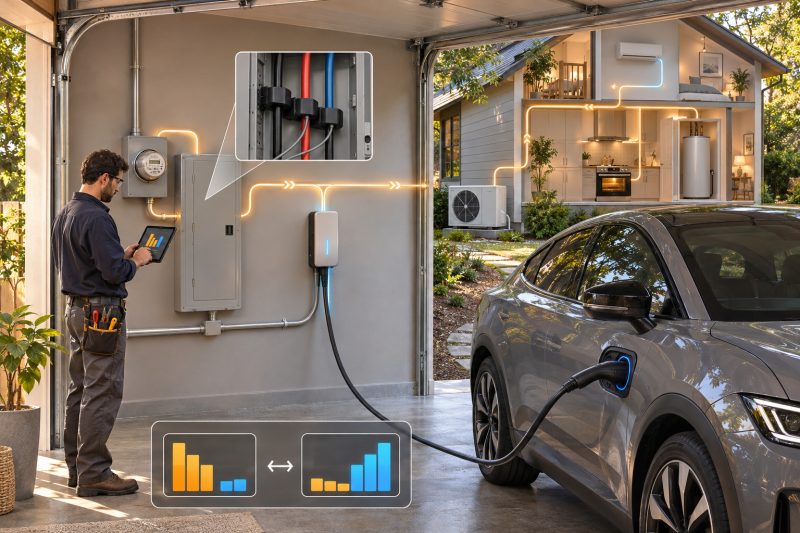
Dynamic load balancing adjusts EV charging power to the capacity left at the property. When household demand rises, the charger reduces current. When other loads fall, charging can increase again. It is valuable for constrained supplies, high-power appliances, multi-EV homes and sites that want to avoid an expensive upgrade.
I have worked with residential installers, fleet managers and home EV users for years as general manager at Parwatt New Energy. We supply EV charging equipment and power modules used in home and commercial projects. I regularly help owners decide whether a fixed current limit is enough or whether dynamic load balancing is worth adding. Our guidance for products in the EV Charger Category always starts with a realistic load assessment of the property. In this article I explain how dynamic load balancing works for home EV charging and when you actually need it in 2026.
Why Home EV Charging Can Overload a Limited Electrical Supply?
EV charging is a long-duration load. Unlike a kettle that runs for minutes, a Level 2 session can draw high current for several hours. When other large appliances operate in the same window, the sum can exceed the main breaker or the agreed supply capacity. The result is a trip, a forced reduction in charging, or a project that requires a costly service upgrade.
Home EV charging can overload a limited supply because it adds continuous high power on top of existing household peaks. Simultaneous use of heating, cooking and charging pushes total demand toward the service limit.
How Overlaps Create Problems
I have reviewed homes where the EV charged without issue late at night, then the main breaker tripped when the owner started cooking after work with the charger still running. The wallbox was not faulty. The service simply could not support both loads at full output.
Heat pumps and electric water heaters create similar peaks. In cold weather they may run for long periods that overlap with the evening charging window. The electrical design must account for that coincidence.
Older panels with limited spare capacity leave little headroom. Adding a 32 A or 40 A continuous EV load without measurement or control is a common reason installations fail inspection or need redesign.
Multi-EV households multiply the risk. Two vehicles charging at once on an unmanaged supply can exceed limits that one vehicle would respect.
Future electrification adds further pressure. Induction cooking, more heat pumps and a second car all increase the chance of overlapping peaks.
Here is a table that links common loads to overload risk:
| Household Load | Typical Behaviour | Risk with EV Charging |
|---|---|---|
| Oven / hob | High short peaks | Evening trip when charging |
| Heat pump | Long winter runs | Sustained high total demand |
| Electric water heater | Recovery after use | Overlap with overnight charge |
| Second EV | Parallel session | Double continuous load |
| Limited main breaker | Fixed ceiling | No spare capacity for peaks |
This table reflects the patterns I discuss with residential customers of equipment from the EV Charger Category.
In 2026 a simple “is there a free breaker slot?” question is not enough. The continuous and coincident load picture decides whether control is required.
The Load-Management Terms Homeowners Often Confuse
Homeowners often mix up fixed current limits, dynamic load balancing, multi-charger power sharing, scheduled charging and solar prioritisation. Buying the wrong function leaves the real problem unsolved or adds cost without benefit.
Common confusion mixes fixed limits, dynamic balancing, power sharing between chargers, timers and solar priority. Each solves a different problem and should be selected on purpose.
Clearing the Definitions
A fixed current limit permanently caps the charger at a chosen amperage. It is simple and predictable. It does not increase power when the house is quiet.
Dynamic load balancing measures total property demand and adjusts EV current up or down so the sum stays under a set limit. It uses spare capacity when available and protects the service when other loads rise.
Power sharing among multiple chargers divides a dedicated EV capacity between two or more vehicles. It may or may not include whole-home measurement. Some systems offer both whole-home balancing and multi-outlet sharing.
Scheduled charging moves the session to off-peak hours. It reduces cost and can avoid evening peaks, but it does not react to unexpected appliance use during the scheduled window.
Solar prioritisation directs surplus PV generation to the vehicle. It optimises energy source rather than protecting the main breaker from overload.
Here is a clarification table:
| Term | What It Does | What It Does Not Do |
|---|---|---|
| Fixed current limit | Permanent max amps | Use spare capacity dynamically |
| Dynamic load balancing | Adjusts EV power to remaining capacity | Replace a full service upgrade in every case |
| Multi-charger power sharing | Splits EV capacity between cars | Always measure whole-home load |
| Scheduled charging | Times the session | React to live appliance peaks |
| Solar priority | Prefers PV energy | Guarantee overload protection |
This table prevents mismatched purchases. At Parwatt we define the required function clearly before recommending any unit related to the FES-D30 DC EV Charger or residential AC products.
I advise writing the problem you want to solve in one sentence. The correct term usually becomes obvious.
How Dynamic Load Balancing Measures and Adjusts Charging Power
Dynamic load balancing needs a live reading of total household consumption. Current transformers, a compatible smart meter or an energy-management gateway provide that reading. The control system compares total demand with a configured limit and then raises, lowers or pauses EV charging current within the limits of the circuit, the charger and the vehicle.
Dynamic load balancing measures total property load through sensors or a meter interface, then automatically adjusts EV charging current so the sum stays within the allowed capacity.
The Control Loop in Practice
Sensors or a meter interface report the power or current drawn by the whole property. The measurement point is normally at the main incoming supply so every major load is visible.
The controller subtracts a safety margin and the non-EV load from the allowed capacity. The remainder becomes the maximum current the EV charger may use at that moment.
When the oven or heat pump starts, measured demand rises. The controller reduces the EV allowance. The vehicle follows the new lower limit. When the appliance stops, the allowance can increase again.
Communication between the meter path and the charger must be reliable. Wired and wireless options both exist. Compatibility between brands and models should be confirmed before purchase.
A minimum charging current and a fail-safe behaviour are part of a sound design. If measurement is lost, the system should fall back to a safe fixed limit or stop charging rather than assume unlimited capacity.
The vehicle and the cable still impose their own ceilings. Dynamic control cannot push more current than the onboard charger or the circuit rating allows.
Here is a simplified process table:
| Step | Action | Result |
|---|---|---|
| Measure | Read total property load | Live demand known |
| Compare | Demand vs configured limit | Spare capacity calculated |
| Adjust | Raise or lower EV current | Total stays within limit |
| Recover | Increase EV when loads fall | Faster charging when possible |
| Fail-safe | Loss of measurement | Safe fixed limit or stop |
This process is the core of whole-home dynamic balancing. At Parwatt we treat measurement quality and fail-safe behaviour as essential when systems may later scale toward commercial platforms using the 30kW Power Module or 40kW Power Module.
I recommend asking the installer to demonstrate a live reduction when a large appliance is switched on. Seeing the current drop confirms the loop works.
When Dynamic Load Balancing Is Worth the Additional Cost
Dynamic load balancing is worth the cost when electrical capacity is tight, high-power appliances frequently overlap with charging, the charger is 11 kW or 22 kW, more than one EV is present, or the alternative is a major service upgrade. Homes with large spare capacity and modest charging needs may not require it.
Dynamic load balancing is worth the cost for constrained supplies, frequent high appliance loads, higher-power chargers, multi-EV homes and sites seeking to avoid or postpone a service upgrade.
Situations That Favour Dynamic Control
A panel that is already close to its limit cannot absorb a full extra 32 A or 40 A continuous load at peak times. Dynamic control lets the EV use high power only when the rest of the house is quiet.
Households with heat pumps, electric cooking and EV charging on the same evening schedule see frequent coincidence of loads. Fixed limits waste capacity at night; dynamic control recovers it.
Higher-power wallboxes create larger steps in demand. The ability to throttle them protects the main breaker without permanently restricting overnight recovery.
Two-car homes benefit twice. Whole-home balancing protects the service, and multi-outlet sharing can divide the remaining EV allowance between vehicles.
Solar and battery systems often include energy management already. Adding EV control into the same logic improves self-consumption and still respects the grid connection limit.
Conversely, a home with a large modern service, a single low-mileage EV and a mild climate may run a fixed 16 A or 24 A limit with no practical problems. Dynamic hardware would add cost without changing daily results.
Here is a value guide:
| Situation | Dynamic Balancing Value | Typical Alternative |
|---|---|---|
| Limited main capacity | High | Service upgrade or low fixed limit |
| Heat pump + EV evenings | High | Fixed limit sized for coincidence |
| 11 kW / 22 kW wallbox | High | Conservative fixed current |
| Two or more EVs | High | Shared fixed pool or upgrade |
| Large spare capacity, one EV | Lower | Simple fixed limit |
| Solar / storage already managed | Medium–high | Integrate EV into existing EMS |
This guide keeps spending aligned with need. At Parwatt we help households weigh the same factors before selecting equipment from the EV Charger Category.
I advise obtaining a load calculation first. The numbers usually show whether dynamic control is justified.
What to Check Before Installing a Load-Balanced EV Charger
Before installation, complete a household load assessment. Confirm that the charger, sensors and meter interface are compatible. Verify single-phase or three-phase configuration, communication method, minimum charging current and the safe behaviour if measurement is lost.
Before installing, assess household load, confirm hardware compatibility, verify phase setup, communication path, minimum current and fail-safe behaviour when measurement fails.
Pre-Installation Checks
Ask a qualified electrician for a load calculation and a clear statement of the maximum continuous EV current the property can support with and without dynamic control.
List the exact charger model, current-transformer or meter interface, and any energy-management gateway. Confirm they are approved to work together at the required phase count.
Decide the measurement point. Whole-home protection needs sensing at the main incoming supply, not only on the EV branch.
Test or specify the communication path. Wired links avoid wireless dropouts; wireless links need reliable coverage at the meter and charger locations.
Set the minimum current the vehicle will accept and the action taken if data is lost. A safe fixed fallback or a controlled stop is preferable to uncontrolled full power.
Document the configured site limit, CT ratios and any solar or battery interactions so future service work does not undo the protection.
After commissioning, run a live test with a large appliance switched on and confirm that EV current falls as expected and recovers later.
Here is a pre-install checklist:
- Written load assessment completed
- Charger and measurement hardware compatibility confirmed
- Single-phase or three-phase design matched
- Main-supply measurement point defined
- Communication method verified
- Minimum EV current and fail-safe set
- Site capacity limit documented
- Live appliance test planned after install
- User settings for schedules and limits recorded
- Qualified installer and certification retained
At Parwatt we encourage this sequence for every residential project that uses load control. Further reading on charging technology is available in our articles on Electric Vehicle Charging and AC vs DC EV Charging. Product options and specifications can be reviewed on our main site and within the EV Charger Category, including higher-power platforms such as the Battery Buffered Ultra Rapid EV Charger.
Installations that complete the checklist protect the service while still giving the vehicle as much power as the house can safely spare.
Conclusion
Dynamic load balancing allows a home EV charger to use available electrical capacity without pushing the property beyond a defined supply or circuit limit. At Parwatt we match control strategy to real load data so households avoid both nuisance trips and unnecessary upgrades. When household demand rises, the system reduces the vehicle’s charging current; when other appliances switch off, it can increase charging again. It is particularly valuable for homes with limited electrical capacity, multiple high-power appliances, solar or battery systems, or more than one EV. However, it is not essential for every installation. If a load calculation confirms that the existing supply can comfortably support the charger at full output, a correctly configured fixed current limit may be sufficient. A qualified installer should assess the property and verify that the charger, monitoring hardware and control system are compatible before installation.

--- END ---
Related Posts
Business Ideas

Level 1 vs Level 2 EV Charging: What Buyers Should Check Before Ordering
November 20, 2026
Business Ideas

Company News

Company News


