

Battery Charger vs Maintainer vs Jump Starter: Which Product Does Your Range Need?
Nov 17,2026
Similar-looking battery products can solve very different problems. Stocking the wrong category creates confusing listings, unsuitable purchases, and avoidable returns.
Choose a battery charger for recharging, a maintainer for managing charge during storage, and a jump starter for short-duration starting assistance. A charger may also provide maintenance. Build your range around customer applications, then verify compatibility, operating limits, and evidence for each claimed function.
For automotive accessory importers and distributors, the decision starts with the job customers need to complete. I would compare these categories through their function, sales application, technical specification, sample performance, and ownership requirements.
1. What Does Each Product Actually Do?
The category name should tell customers what outcome to expect, but supplier descriptions sometimes blur the boundaries.
A charger replenishes battery energy over time. A maintainer manages charge during extended connection under specified conditions. A jump starter supplies temporary starting assistance; it does not normally perform a complete battery recharge.
Separate the Three Customer Outcomes
A battery charger transfers energy from a power source into a compatible battery using a defined charging process. For the mains-powered automotive chargers discussed here, customers need access to a suitable electrical supply.
A maintainer focuses on keeping a compatible battery charged during periods of inactivity. Depending on its design, it may use regulated float charging, monitored charging cycles, or another documented method.
These functions overlap. A charger with a suitable maintenance program can cover both recharging and storage applications. Equally, a low-output maintainer may recharge some batteries, but its capacity limits and charging time can make it unsuitable for the customer’s intended recovery task.
A portable jump starter addresses a different moment: the engine needs starting assistance now. It commonly uses an internal battery to deliver a short burst of current.
NOCO’s GB40 support information, for example, explicitly distinguishes jump-starting from battery charging. This illustrates the functional boundary; its specifications do not apply to other products.
| Product | Main customer objective | Key limitation to explain |
|---|---|---|
| Battery charger | Recharge a compatible battery | Requires charging time and suitable power |
| Battery maintainer | Manage charge during inactivity | Maintenance capacity may exceed recharge capacity |
| Portable jump starter | Assist engine starting | Does not normally recharge the vehicle battery fully |
| Charger with maintenance | Recharge and support storage | Both functions need documented approval |
Check Combined Functions Individually
I would treat “three-in-one” as a list of claims requiring separate evidence. A USB power-bank output does not establish automotive battery-charging capability.
Some workshop chargers include a dedicated engine-start mode. That does not mean every charger can assist cranking. Likewise, a product advertised as a booster may use a different operating method from a conventional high-current jump starter.
Ask the supplier to define what happens electrically in each mode and what the user must do. Clear functional boundaries make category pages, packaging, and staff recommendations easier to understand.
2. Which Customer Application Should Lead Your Range?
A complete-looking catalogue can still miss the application that drives your customers’ purchases.
Prioritize the category that fits your existing sales channel. Storage customers need maintenance, planned battery care needs charging, and roadside emergency customers need portable starting assistance. Add complementary products when demand supports a separate role.
Start with the Purchase Trigger
For a distributor serving garages and automotive tool retailers, a charger may be the logical starting point. Customers can plan the task, connect the equipment, and allow time for charging.
A seasonal vehicle channel creates a different requirement. Motorcycle, classic-car, and recreational vehicle customers may be more interested in maintaining an already charged battery during inactivity. Convenient connections and understandable maintenance instructions can matter more than maximum output.
A roadside accessory channel may prioritize jump starters because customers want starting assistance away from mains power. However, the product must remain ready after storage, and users need clear instructions for recharging its internal battery.
These are planning examples, not predictions of which category will sell fastest. I would review enquiries, retailer feedback, search terms, and existing return reasons before choosing the first stock-keeping units.
Give Every Model a Distinct Role
A useful range can begin with a charger that covers a documented maintenance application, then add a jump starter for emergency demand. Another channel may justify a dedicated small-battery maintainer before a higher-output charger.
The important question is whether each model serves a different, identifiable need.
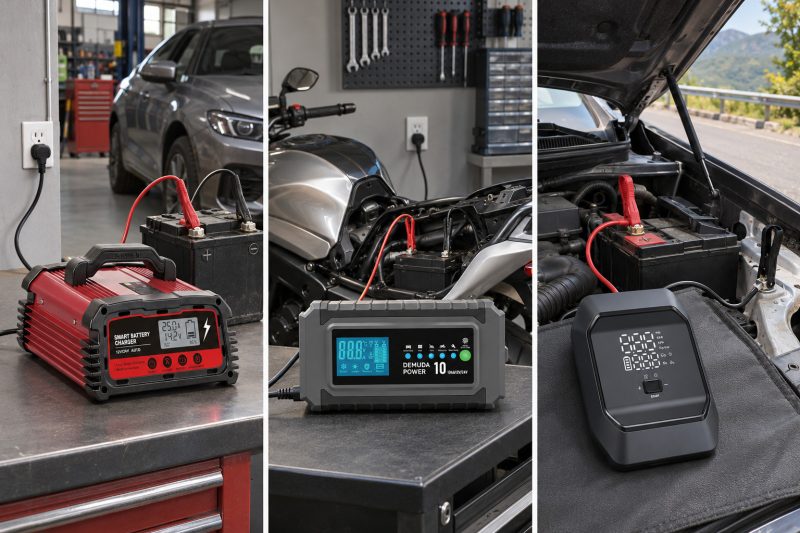
I suggest writing one purchase sentence for every proposed model: “This product is for customers who need…” If two models produce the same sentence, identify a meaningful difference in battery coverage, charging time, accessories, or application.
Do not rely on casing colour or a larger display to justify another inventory position. A clear role gives sales teams a reason to recommend the product and helps buyers evaluate whether the additional stock is worthwhile.
3. Which Specifications Should Buyers Compare?
Current, capacity, and engine-size claims describe different things across these categories.
Compare charger output against battery charging requirements, maintainer capability against the storage application, and jump-starter performance against documented starting conditions. Do not rank all three products by the largest advertised amp figure.
Match Charging Specifications to the Battery
For chargers and maintainers, establish battery chemistry, nominal voltage, supported capacity, charging profile, and temperature limits. Separate the stated recharging range from the maintenance range where the supplier gives different values.
A device may maintain a larger battery than it can recharge within the customer’s required time. Ask how those ranges were determined and what initial state of charge was assumed.
Output current also needs context. Determine whether the quoted figure is a maximum, a selectable setting, or an output available only under certain conditions. Charging current can change during the charging process, so dividing battery capacity by the headline current does not establish a complete charging time.
Chemistry support must be explicit. AGM is a lead-acid battery construction; LiFePO4 is lithium iron phosphate. A shared nominal voltage does not make their charging requirements interchangeable.
NOCO’s GENIUS2 documentation illustrates why mode-level checking matters: it identifies separate battery modes and specific conditions for lithium use.
Ask How Starting Performance Was Established
For jump starters, request the vehicle voltage, supported battery chemistry, engine application, temperature, initial pack charge, crank duration, and rest interval between attempts.
Peak current alone does not describe sustained starting performance. A useful comparison needs the measurement method and conditions behind the number.
Also separate the jump starter’s internal battery chemistry from the chemistry of the vehicle battery it supports. A lithium-powered jump starter is not automatically suitable for jump-starting a lithium vehicle battery.
| Specification area | Evidence to request |
|---|---|
| Charger output | Voltage/current profile and operating conditions |
| Maintenance capability | Control method, supported batteries, and restrictions |
| Starting performance | Test method, duration, temperature, and application |
| Battery compatibility | Mode-specific chemistry and voltage requirements |
| Internal pack capacity | Watt-hours and rated voltage behind capacity figures |
For internal battery capacity, request watt-hours alongside any amp-hour figure. Amp-hours stated at different voltages cannot be compared directly as stored energy. Keep USB output ratings separate from automotive starting specifications.
4. How Should Samples Be Evaluated Before Approval?
A successful demonstration can leave the most important purchasing questions unanswered.
Test each product against its intended role using agreed conditions. Observe charger completion, maintainer behavior after full charge, and repeatable jump-start performance within the manufacturer’s instructions. Record the exact sample configuration.
Use a Different Acceptance Plan for Each Function
For a charger, select a serviceable battery within the declared range and document its initial condition. Record voltage, current, temperature, mode, and charging progression. Continue beyond the full-charge indication to establish what the charger does next.
For a maintainer, focus on the extended-connection behavior. Confirm the expected control sequence, permitted supervision arrangements, and response to a normal interruption of mains power.
Where the intended application includes vehicle standby loads, agree whether testing should include those loads. A disconnected battery test may not represent an installed vehicle’s storage conditions.
For a jump starter, agree on representative vehicles and controlled conditions before the demonstration. Record the pack’s initial charge, ambient temperature, vehicle battery condition, and starting attempts.
Follow the specified cranking and cooling intervals. Do not create abnormal conditions or use an override function simply to obtain a successful demonstration.
| Product | Sample evaluation focus | Approval question |
|---|---|---|
| Charger | Charging sequence and completion | Does operation match the declared profile? |
| Maintainer | Behavior after full charge | Does it support the intended storage arrangement? |
| Jump starter | Starting attempts under defined conditions | Is the advertised application supported? |
| Combined product | Each function separately | Do all claimed functions meet acceptance criteria? |
Link Results to the Production Specification
I would retain the approved sample’s model identification, hardware revision, relevant firmware details, cables, clamps, and manual revision.
Ask the supplier how changes will be communicated. A different clamp assembly or charging program may affect the approved application even when the enclosure remains identical.
One successful sample test is useful application evidence. It does not establish every protection function, production consistency, or market compliance requirement.
Request model-specific supporting reports where appropriate, and use qualified personnel for fault or safety testing. If a result is unclear, resolve the test conditions and acceptance criteria before approving bulk production.
5. What Changes in Landed Cost and After-Sales Support?
Similar purchase prices can hide different freight requirements, accessory costs, and support work.
Compare the complete saleable package and ownership requirements. Chargers need suitable electrical and battery instructions; maintainers need storage guidance; battery-powered jump starters also require internal-pack care and transport review.
Compare the Complete Quotation Scope
For chargers, check the mains plug, input rating, lead lengths, clamps, selected modes, instructions, and packaging. For maintainers, determine whether the intended installation needs an eyelet lead, quick connector, fuse, or other specified accessory.
For jump starters, confirm what recharges the internal battery. An included cable does not necessarily mean an adapter is included. Check the required input and whether the proposed package enables the customer to recharge the unit as described.
Lithium-powered jump starters also need transport planning. IATA’s battery transport resources provide guidance for air shipments. Obtain the applicable UN 38.3 test summary and confirm classification, packaging, documentation, and carrier requirements for the actual product and shipment.
Do not assume that a safety data sheet alone establishes transport compliance. Equally, transport documentation does not replace the destination market’s product conformity assessment.
Prepare Support Around the Product’s Real Limitations
A charger complaint may involve the wrong mode, an unsupported battery, or a charging time expectation that the specification never promised.
A maintainer complaint may involve unsuitable storage conditions or a load outside the approved application. A jump starter complaint may involve an undercharged internal pack, unsupported vehicle, poor connection, or operation outside temperature limits.
Your support process should collect those facts before deciding whether the product is defective. Confirm warranty terms, required evidence, and handling arrangements before placing the order.
For range planning, use PARWATT’s car battery charger category to identify candidates for model-specific review. To discuss requirements, contact PARWATT with your target market, main customer application, battery chemistry and voltage, and estimated quantity.
Conclusion
Choose products by customer task, verify each claimed function, and approve distinct roles before expanding the range. Compare the complete package alongside technical evidence.

--- END ---
Related Posts
Business Ideas

Level 1 vs Level 2 EV Charging: What Buyers Should Check Before Ordering
November 20, 2026
Business Ideas

Company News

Company News


