

12V vs. 24V Battery Chargers: A Wholesale Product Mix Guide
Sep 17,2026
Stocking the wrong charger voltage leads to lost sales and returns. Many passenger cars use 12V systems, yet trucks, buses and some commercial equipment need 24V. When the product mix does not match local vehicles, buyers face stockouts, slow movers and incorrect purchases. At Parwatt I see these mismatches reduce wholesale margins every season.
A focused 12V range serves most passenger cars and light vehicles, while 24V models support trucks, buses and selected commercial applications. Dual-voltage chargers can broaden coverage when both modes are verified. In 2026 wholesale buyers should match voltage, current and chemistry to the real vehicle fleet rather than relying on labels alone.
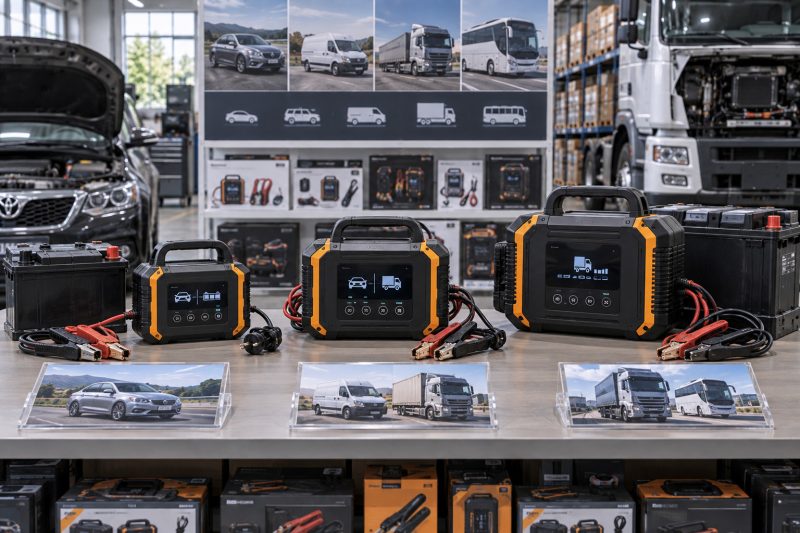
I have worked with automotive accessory wholesalers and importers for years as general manager at Parwatt New Energy. We supply car battery chargers and related products. I regularly review assortments where buyers over-stocked 24V units in passenger-car markets or under-stocked them in commercial regions and later faced either excess inventory or lost orders. Our range in the car battery charger category includes both 12V and 24V options so partners can build a practical mix. In this article I explain how to choose between 12V and 24V battery chargers and how to build a profitable wholesale assortment in 2026.
Why Stocking the Wrong Charger Voltage Leads to Lost Sales and Returns?
The local vehicle fleet determines which charger voltages sell. In most consumer markets 12V systems dominate passenger cars, motorcycles and light vans. In commercial and industrial areas 24V systems appear on trucks, buses, agricultural machines and some marine equipment. When the stocked range does not match this reality, popular voltages sell out while the wrong voltages sit on shelves or generate returns from mismatched purchases.
Stocking the wrong voltage leads to lost sales and returns because the product mix no longer matches the vehicles customers actually own. 12V demand is usually broader, yet 24V demand is real in commercial segments. A mismatched assortment creates both stockouts and slow movers.
How Voltage Mismatches Appear in Practice
I have seen distributors in passenger-car heavy regions carry too many 24V chargers. The units moved slowly, occupied warehouse space and eventually required discounting. At the same time, higher-current 12V models ran out during peak seasons.
In fleet and workshop channels the opposite problem appears. Customers ask for 24V chargers for trucks and buses. If the assortment contains only 12V consumer models, orders are lost to competitors who stock the correct voltage.
Incorrect purchases also generate returns. A customer who buys a 12V charger for a 24V system discovers it cannot charge the battery bank properly and sends the unit back. Clear labeling and sales guidance reduce these errors, yet the underlying assortment must still offer the right options.
Seasonal and regional differences further complicate planning. Agricultural areas may show stronger 24V demand during harvest periods. Urban retail may remain almost entirely 12V. A static national mix rarely fits every location.
Here is a table that shows the commercial impact of voltage mismatches:
| Mismatch Type | Typical Result | Customer / Channel Effect | Business Impact |
|---|---|---|---|
| Too few 12V models | Stockouts in consumer channels | Lost sales to competitors | Lower revenue |
| Too many 24V models in car markets | Slow inventory turns | Discounting pressure | Reduced margin |
| No 24V for fleets / workshops | Unfilled commercial orders | Customers switch suppliers | Lost accounts |
| Unclear voltage labeling | Wrong purchases | Returns and complaints | Higher support cost |
| No dual-voltage option | Forced to stock more SKUs | Inventory complexity | Higher carrying cost |
This table reflects patterns I observe across wholesale accounts. At Parwatt we help partners align the voltage mix with real vehicle data so products in our car battery charger category move efficiently.
In 2026 accurate assortment planning remains one of the simplest ways to improve both sell-through and return rates. Voltage must follow the fleet, not the other way around.
The 12V and 24V Assumptions That Commonly Mislead Buyers
Several common assumptions distort voltage decisions. Buyers sometimes treat the nominal 12V or 24V label as the exact charging voltage. Others assume every 24V charger is more powerful, or believe a 12V charger can properly charge a complete 24V battery bank. These assumptions lead to incorrect product selection and application errors.
Assumptions that mislead buyers include treating nominal voltage as exact output, assuming 24V always means higher power, and believing a 12V charger can charge a full 24V bank. Real selection requires charging curves, current ratings and chemistry profiles.
Assumptions That Need Correction
Nominal system voltage is not the charger’s operating voltage. A 12V battery at rest may sit near 12.6–12.8 V. The charger must raise its output above that level to push current into the battery. A 24V system requires a correspondingly higher profile. Comparing only the “12V” or “24V” label ignores the actual charge voltages.
Power is determined by current and voltage together. A low-current 24V maintainer delivers less power than a high-current 12V workshop charger. Voltage alone does not indicate charging speed or suitability for large batteries.
A standard 12V charger should not be connected across a series 24V battery bank. Its voltage is normally too low to charge the bank correctly. In some cases the individual 12V batteries can be charged separately if the system is safely isolated and the equipment manufacturer allows it, yet this is not a substitute for a proper 24V charger.
Automatic dual-voltage detection is convenient but not infallible. Deeply discharged batteries can present voltages that fall outside the expected recognition window. Buyers must test detection behavior with low-voltage batteries, not only with healthy ones.
Chemistry and capacity range remain critical regardless of voltage. A 12V LiFePO₄ profile is different from a 12V flooded profile. The same distinction applies at 24V.
Here is a table of misleading assumptions:
| Assumption | Why It Is Incomplete | Better Evaluation |
|---|---|---|
| “12V” or “24V” is the output voltage | Nominal system ≠ charge voltage | Review full charging curve |
| 24V is always more powerful | Power = voltage × current | Compare rated current and duty cycle |
| 12V charger works on 24V bank | Voltage normally insufficient | Use proper 24V or dual-voltage unit |
| Auto detection always works | Deep discharge can confuse algorithms | Test with low-voltage batteries |
| Voltage decides the application | Capacity and chemistry also matter | Match current and profile to battery |
This table helps buyers avoid simple numerical comparisons. At Parwatt we document complete charge profiles for both 12V and 24V models in our car battery charger category so partners can evaluate real capability.
I have corrected assortment plans that were based only on voltage labels. Once current, chemistry and vehicle type were added to the analysis, the recommended mix changed significantly. Evidence beats assumption.
How to Match Charger Voltage, Current and Chemistry to Each Market
Different markets need different combinations of system voltage, charging current, battery capacity and chemistry. Passenger cars and motorcycles are mostly 12V. Light commercial vehicles may be either 12V or 24V. Heavy trucks, buses and agricultural machines more often use 24V. Workshops and fleets need higher current and robust duty cycles. Matching these variables produces a practical product range.
Match charger voltage, current and chemistry to the target market. Passenger cars and motorcycles need 12V ranges; trucks, buses and agricultural equipment often need 24V; workshops need higher current and durable construction. Chemistry profiles must still fit the batteries in use.
Market-by-Market Matching
Passenger-car and light-vehicle retail focuses on 12V chargers. Compact maintainers and mid-current models cover most starting batteries. AGM and flooded profiles are commonly required; LiFePO₄ options are growing in some markets.
Motorcycle and powersport channels also center on 12V but at lower currents. Overcharge protection and smaller capacity ranges become more important.
Light commercial vans and pickups may use either 12V or 24V depending on the region and model. Buyers serving mixed fleets often need both voltages or reliable dual-voltage units.
Heavy trucks, buses and coaches are the core 24V market. Higher-capacity batteries and more frequent deep cycling favor robust 24V chargers with adequate current and thermal performance.
Agricultural and construction equipment frequently use 24V systems. Duty cycle and environmental protection matter because the chargers may operate in demanding conditions.
Marine applications can be either voltage. Deep-cycle batteries and longer maintenance periods influence the choice of float or storage behavior.
Workshops and fleet maintenance bays need higher-current models, clear indication, and the ability to handle varied battery conditions repeatedly. Both 12V and 24V versions are often required.
Here is a market-matching guide:
| Market Segment | Typical System Voltage | Current Emphasis | Chemistry Notes |
|---|---|---|---|
| Passenger cars | 12V | Low to mid | Flooded, AGM, growing LiFePO₄ |
| Motorcycles / powersport | 12V | Low | Smaller capacity, tight control |
| Light commercial | 12V or 24V | Mid | Confirm vehicle specification |
| Heavy trucks / buses | 24V | Mid to high | Robust duty cycle |
| Agriculture / construction | Often 24V | Mid to high | Environmental durability |
| Marine | 12V or 24V | Application-dependent | Deep-cycle profiles |
| Workshops / fleets | Both | Higher current | Multi-chemistry preferred |
This guide keeps assortment decisions grounded in real vehicles. At Parwatt we support partners with both voltages and multiple current ratings inside the car battery charger category.
I recommend that buyers list the main vehicle types in their sales region before choosing models. The list quickly shows whether 24V depth is needed or whether a strong 12V range is sufficient.
When a Dual-Voltage Charger Is Better Than Two Separate Models
Dual-voltage chargers that support both 12V and 24V can improve coverage without doubling the number of SKUs. They are attractive for mixed fleets, workshops and distributors who want fewer line items. The benefits appear only when both voltage modes deliver full, verified performance and when mode selection or detection is reliable.
Dual-voltage chargers can improve market coverage and inventory efficiency when both 12V and 24V modes are fully tested. They also add complexity in detection, mode selection and quality control. Verification of each mode is required.
Advantages and Conditions for Success
The main advantage is broader application coverage with one model. A workshop that services both cars and light trucks can keep one dual-voltage unit instead of two separate chargers. Distributors can reduce SKU count while still answering mixed inquiries.
Inventory and logistics become simpler. Fewer part numbers mean easier forecasting, less safety stock and lower risk of obsolete versions.
Customer convenience increases when the same unit can be moved between different vehicles. Clear indication of the selected voltage prevents mistakes.
These benefits depend on thorough testing. Buyers must confirm that the 12V mode and the 24V mode each deliver the claimed current, follow the correct charging curve, and control temperature properly. A dual-voltage label is not proof that both modes are equally capable.
Automatic detection should be tested with batteries at normal and low states of charge. Deeply discharged batteries can present voltages that confuse simple detection algorithms. Manual selection with clear indication is often more reliable.
User instructions must make the voltage choice obvious. Incorrect connection of a dual-voltage charger still risks under- or over-voltage application if the mode is wrong.
Here is a comparison of separate versus dual-voltage approaches:
| Aspect | Separate 12V + 24V Models | Dual-Voltage Model | Implication |
|---|---|---|---|
| Coverage | Requires two SKUs | One SKU covers both | Lower inventory complexity |
| Performance verification | Each model tested once | Both modes must be tested | More validation work |
| Detection / selection | Fixed voltage | Auto or manual selection | Error-proofing needed |
| Cost per unit | Usually lower each | Usually higher | Price positioning check |
| Workshop flexibility | Two tools | One tool | Convenience advantage |
This comparison keeps expectations realistic. At Parwatt we evaluate dual-voltage designs carefully and test each mode independently before release. Partners can review available options in the car battery charger category.
I advise buyers to treat dual-voltage units as a distinct class. They can simplify the assortment when both modes are proven, but they should not be assumed equal to two dedicated chargers without evidence.
How to Build a Profitable 12V and 24V Wholesale Assortment
A profitable assortment starts with a strong 12V core for the mass market, adds targeted 24V or dual-voltage models for commercial and professional customers, and then adjusts quantities according to sales data, inquiries and local vehicle information. Voltage, current, chemistry and duty cycle should all be considered together.
Build the assortment around a solid 12V range for passenger and light vehicles, add 24V or dual-voltage models for commercial demand, and refine the mix with sell-through, inquiry and fleet data. Match current and chemistry to the batteries customers actually use.
Practical Assortment Construction Steps
Map the main vehicle types and battery systems in the target region. Use registration data, customer surveys or sales history to estimate the share of 12V versus 24V demand.
Construct a 12V core that covers the most common capacities and chemistries. Include at least one compact maintainer and one higher-current model for larger starting batteries.
Add 24V coverage according to commercial density. In regions with many trucks, buses or agricultural machines, dedicated 24V chargers or proven dual-voltage units become necessary. In pure passenger-car markets a minimal 24V presence may be enough.
Decide whether dual-voltage models can replace some separate SKUs. Only include them after both modes have passed full performance and thermal testing.
Set initial quantities according to expected turn rates. Keep deeper stock in the high-velocity 12V models and leaner stock in specialized 24V units until demand is confirmed.
Track sell-through, stockouts, customer inquiries and return reasons by voltage and current rating. Adjust the mix at regular intervals.
Maintain clear product information so sales teams and retailers can guide customers to the correct voltage. Incorrect recommendations create returns even when the assortment itself is balanced.
Here is a practical assortment-building checklist:
- Map local vehicle voltages and battery types
- Build a complete 12V core for mass-market demand
- Add 24V depth according to commercial fleet presence
- Evaluate dual-voltage models only after full dual-mode testing
- Match current ratings to typical battery capacities
- Include required chemistry profiles (flooded, AGM, LiFePO₄ as needed)
- Set initial stock ratios from expected turn rates
- Monitor sales, inquiries and returns by voltage
- Adjust quantities and SKUs with real data
- Keep sales guidance clear to prevent wrong purchases
At Parwatt we support this data-driven approach with both 12V and 24V chargers and with the test evidence needed for confident selection. Partners can explore the range in the car battery charger category and complementary products on our main site. Related accessories such as car air pumps and car vacuum cleaners often share the same wholesale channels.
Buyers who construct the mix from vehicle reality and then refine it with sales data consistently achieve higher turns and lower return rates. The assortment becomes a commercial asset rather than a source of chronic imbalance.
Conclusion
The right wholesale assortment should reflect the vehicles, battery capacities and customer types in the target market. At Parwatt we supply both 12V and 24V chargers so partners can match real demand. A focused 12V range can serve many passenger cars, motorcycles and light vehicles, while 24V products become more important for trucks, buses, agricultural machinery and selected marine or industrial applications. Dual-voltage chargers can broaden coverage without doubling the SKU count, but only when both modes deliver verified charging performance. Buyers should compare voltage, current, battery chemistry, capacity range and duty cycle—not voltage labels alone—before finalizing their product mix.

--- END ---
Related Posts
Industry News

Business Ideas

Business Ideas

Business Ideas


