

Car Battery Charger Safety: Essential Protections for B2B Buyers
Sep 16,2026
Missing safety protections on a car battery charger create problems that go far beyond product returns. A failed protection can damage the battery, harm vehicle electronics, overheat the charger, or in serious cases start a fire. Customers then claim compensation and public reviews damage the brand. At Parwatt I see these risks turn into costly after-sales issues for wholesale buyers.
A safe car battery charger needs verified reverse-polarity, short-circuit, overcurrent, overvoltage, overtemperature and abnormal-battery protection. Packaging icons alone are not enough. In 2026 B2B buyers who test each function under controlled conditions reduce returns, protect end users and keep unverified claims out of the market.
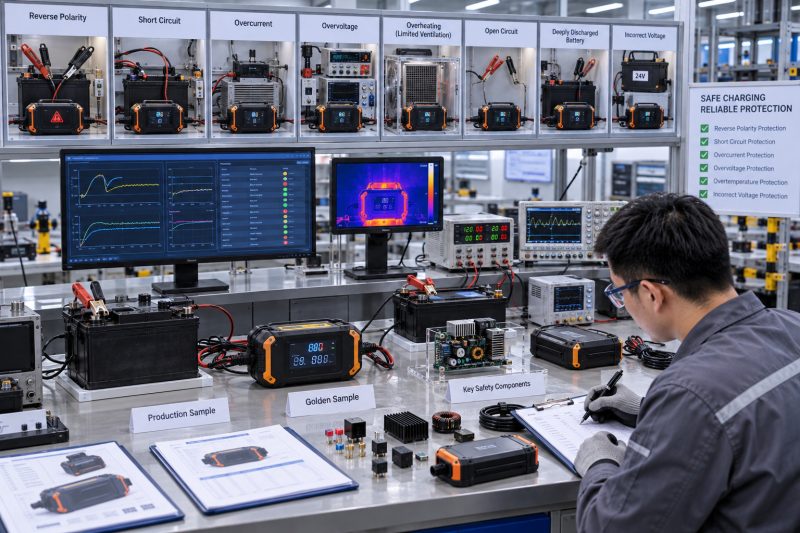
I have worked with automotive accessory wholesalers and importers for years as general manager at Parwatt New Energy. We supply car battery chargers and related products. I regularly review samples whose packaging listed many protection functions yet failed to respond correctly when the clamps were reversed or the output was shorted. Our range in the car battery charger category is designed and tested so each claimed protection works as stated. In this article I explain the essential safety protections B2B buyers should require and how to verify them in 2026.
Why Missing Safety Protections Create More Than a Product-Return Problem?
When a protection function fails, the damage can spread beyond the charger itself. Reverse connection can stress vehicle electronics. Uncontrolled current can overheat cables and batteries. Thermal runaway or enclosure melting creates fire risk. These events generate customer claims, insurance questions and lasting reputation damage that a simple return cannot fix.
Missing safety protections create more than returns because they can damage batteries, vehicle systems and the charger itself. Overheating, fire risk and customer claims follow. Verified protections protect both the end user and the seller’s brand.
How Protection Failures Escalate
I have examined field returns where reverse-polarity connection produced sparks and damaged the charger’s output stage. The customer blamed the product even though the clamps had been attached incorrectly. Without clear protection and indication, the incident became a warranty claim and a negative review.
Short-circuit or overload events without proper limiting can melt insulation or open internal tracks. The charger may continue to draw current or become unsafe to handle. In a vehicle storage area the heat can affect nearby materials.
Overcharge without proper voltage regulation raises battery temperature and pressure. Sealed batteries can vent; in extreme cases thermal events occur. Customers associate the failure with the charger brand regardless of battery age or condition.
Reputation damage travels quickly online. A single incident involving smoke or fire can affect an entire product line and the distributor’s other listings.
Here is a table that shows how failures escalate:
| Missing or Failed Protection | Immediate Result | Possible Escalation | Commercial Impact |
|---|---|---|---|
| Reverse polarity | Sparking, component stress | Vehicle electronics damage | Claims and poor reviews |
| Short-circuit / overcurrent | Excess heat, melted parts | Fire risk in enclosed space | Safety complaints, recalls risk |
| Overvoltage / overcharge | Battery heat and gassing | Battery damage or thermal event | Warranty and reputation loss |
| Overtemperature | Continued high temperature | Enclosure deformation or fire | Serious incident reports |
| No abnormal-battery detection | Charging unsafe batteries | Unpredictable behavior | Support burden and returns |
This table reflects the serious cases I discuss with partners. At Parwatt we treat each protection as a functional requirement for every unit in our car battery charger category.
In 2026 end users and platforms pay more attention to safety incidents. Unverified protection claims are no longer a low-risk marketing choice.
The Safety Claims Buyers Should Never Accept Without Test Evidence
Packaging often lists reverse-polarity, short-circuit, overcharge, overheat and spark-proof functions together. The presence of the icons does not prove that each function works, responds in time, or recovers safely. A fuse, a software current limit and flame-retardant plastic are different layers; none replaces the others. Buyers must demand test evidence for each claim.
Safety claims should never be accepted without test evidence. Icons on the packaging do not prove functional performance. Fuses, electronic limiting and material ratings must be verified separately under controlled fault conditions.
Claims That Require Independent Proof
I have tested chargers that claimed reverse-polarity protection yet continued to draw current or failed to give a clear warning when the clamps were swapped. The protection existed only as a label.
Short-circuit claims are sometimes supported only by a fuse that opens after significant energy has already flowed. Electronic limiting that reacts faster is a different and usually preferable behavior. Both approaches should be described and tested.
Overcharge protection depends on the charging algorithm. A simple timer does not adapt to different battery capacities or states of charge. Voltage- and current-based stage control with proper termination is required.
Thermal protection may be claimed while the sensor is poorly placed or the shutdown threshold is set too high. Restricted-ventilation testing often reveals temperatures that packaging never mentions.
Material claims such as flame-retardant enclosures are useful but do not replace functional electrical protection. All layers must work together.
Here is a table of claims that need evidence:
| Claim on Packaging | Why It Is Insufficient Alone | What to Verify |
|---|---|---|
| Reverse-polarity protection | May be fuse-only or poorly indicated | Output blocked + clear warning + safe recovery |
| Short-circuit protection | Fuse reaction may be slow | Fast electronic limit or safe disconnect |
| Overcharge protection | Timer may not suit all batteries | Voltage/current regulation and stage control |
| Overheat protection | Sensor location and threshold unknown | Shutdown before unsafe temperature |
| Spark-proof / soft start | Vague without method | Controlled connection behavior |
| Flame-retardant case | Material rating only | Combined with functional protections |
This table helps buyers reject unsupported marketing. At Parwatt we provide functional test descriptions for the protections used in our car battery charger category.
I advise buyers to treat every icon as a hypothesis that must be proven on the sample. Evidence turns a claim into a reliable feature.
The Essential Protection Functions Every Charger Should Include
A practical safety set covers the faults most likely to occur in real use. Reverse-polarity, short-circuit, overcurrent, overvoltage, overcharge, overtemperature, spark suppression and abnormal-battery detection form the core. Depending on the product, low-temperature charging control and overtime protection should also be confirmed.
Essential protections include reverse-polarity, short-circuit, overcurrent, overvoltage, overcharge, overtemperature, spark suppression and abnormal-battery detection. Low-temperature control and overtime protection should be added where the application requires them.
Core Functions and What They Must Achieve
Reverse-polarity protection must prevent charging current when the clamps are connected incorrectly. The preferred behavior is to block the output and show a clear indication. After the clamps are corrected, normal operation should resume without damage.
Short-circuit protection must limit or disconnect the output when the clamps touch or an external short appears. The reaction should be fast enough to avoid excessive energy release.
Overcurrent or overload protection covers sustained current above the rated value. It may use electronic limiting, fold-back, or shutdown.
Overvoltage and overcharge protection rely on accurate voltage regulation and correct stage transitions. The charger must not continue high-voltage charging after the battery has reached the intended end-of-charge condition.
Overtemperature protection monitors critical components or the enclosure and reduces power or shuts down before temperatures become unsafe. Recovery should occur only after cooling and under defined conditions.
Spark suppression or soft-start behavior reduces arcing when clamps are connected to a live battery. This protects both the user and the connector surfaces.
Abnormal-battery detection covers open circuit, reverse battery, severely sulfated or shorted cells, wrong system voltage and failure to reach expected voltage within a time limit. Each condition should produce a distinguishable indication.
Additional functions such as low-temperature charge inhibit (especially for lithium profiles) and overall charge timeout further reduce risk.
Here is a summary of essential protections:
| Protection | Primary Purpose | Preferred Behavior |
|---|---|---|
| Reverse polarity | Block incorrect connection | Output off + clear warning + safe recovery |
| Short-circuit | Limit energy into a short | Fast limit or disconnect |
| Overcurrent | Protect against sustained overload | Current limit or shutdown |
| Overvoltage / overcharge | Prevent excess battery voltage | Accurate regulation and stage end |
| Overtemperature | Prevent unsafe heat | Derate or shut down, controlled recovery |
| Spark suppression | Reduce connection arcing | Controlled engagement |
| Abnormal battery | Detect unsafe or unsuitable loads | Distinct fault indication + safe state |
| Timeout / low-temp (as needed) | Limit extreme conditions | Defined inhibit or termination |
This set forms a practical minimum for most automotive chargers. At Parwatt we implement and test these functions on the products in our car battery charger category.
I recommend that buyers list the required protections in the product specification before samples are requested. The list becomes the basis for later testing.
How to Test Charger Protection Before Approving Production
Protection claims must be proven under controlled fault conditions. Buyers should simulate reverse polarity, output short-circuit, restricted ventilation, input variation and abnormal battery states in a safe laboratory setting. For each test they record the trigger condition, response time, indication, recovery method and whether the charger still meets performance specifications afterward.
Test each protection under controlled conditions that simulate reverse polarity, short-circuit, overheating, input faults and abnormal batteries. Record trigger point, response, indication, recovery and post-test performance. Laboratory methods are required; casual field trials are not sufficient.
Controlled Test Methods
Reverse-polarity testing is performed with the input powered and the output clamps deliberately reversed on a suitable battery or load. Confirm that current is blocked, a warning is shown, and normal operation resumes after correct connection without component damage.
Short-circuit testing requires proper laboratory equipment and containment. The output is shorted under controlled conditions while current and temperature are monitored. The charger should limit or disconnect quickly and safely.
Overtemperature testing can use rated load combined with restricted airflow or elevated ambient temperature. Record temperatures at critical components and the enclosure. Confirm that derating or shutdown occurs before unsafe levels and that recovery follows the stated rule.
Abnormal-battery tests include open-circuit output, deeply discharged batteries, batteries that will not accept charge, and incorrect system voltage. Each case should produce a clear, distinct indication and a safe output state.
Input-side checks cover undervoltage, overvoltage and, where relevant, surge behavior according to the target market’s expectations.
After each fault test, verify that the charger can still perform a normal charge cycle within specification. Protection must not leave the unit permanently degraded.
All tests should be documented with equipment identification, environmental conditions and results so the golden sample and later production units can be compared against the same standard.
Here is a practical test outline:
- Reverse-polarity connection and recovery
- Controlled output short-circuit response
- Overcurrent / overload behavior
- Restricted-ventilation thermal test
- Open-circuit and no-battery detection
- Deeply discharged and non-accepting battery response
- Incorrect system voltage handling
- Input voltage boundary checks
- Post-fault performance verification
- Full written record for each sample
At Parwatt we perform these controlled tests when approving chargers for production. The same discipline supports the safety of units in our car battery charger category and related products such as those in the car air pump category.
I advise buyers to require the supplier’s own test protocol and then repeat the critical items independently. Side-by-side evidence is the strongest basis for approval.
Turn Safety Requirements into a Repeatable Quality-Control Checklist
Safety requirements only protect the business when they are written into the purchase specification and checked at every stage from golden sample to bulk shipment. Component ratings, firmware version, protection test results, labeling and certification documents should be part of a repeatable checklist used at sample approval, pre-production and outgoing inspection.
Turn safety requirements into a repeatable checklist that covers standards, critical components, firmware, protection tests, labeling and certifications. Apply the same checklist at golden-sample, pre-production and bulk-inspection stages to prevent drift.
Building and Using the Checklist
Start with the applicable safety expectations for the destination markets and the product class. List the required protections and the pass criteria for each.
Identify critical components: input and output fuses or equivalent protection devices, power semiconductors, current sensors, temperature sensors, and enclosure material ratings. Record approved manufacturer and part numbers where relevant.
Lock the firmware or control-software version that has passed the protection tests. Any change must trigger re-validation of the affected functions.
Include the exact protection test methods and acceptance limits in the specification. The golden sample must pass every item and the record must be archived.
At pre-production or first-article inspection, repeat the full protection suite on units drawn from the process. Differences from the golden sample must be resolved before volume production.
During mass production, include protection sampling in the outgoing quality plan. Use the same methods and equipment types so results remain comparable.
Verify that labels, manuals and packaging correctly describe the protections and any user actions required after a fault. Misleading or missing information creates support problems even when the hardware works.
Keep certification reports matched to the exact model and electrical configuration being purchased. A certificate for a similar but different version is not sufficient.
Here is a quality-control checklist summary:
- Required protections and pass criteria listed in the specification
- Critical component list and approved sources
- Firmware / software version locked after validation
- Golden-sample protection test record archived
- Full re-test at pre-production / first article
- Outgoing sampling of key protections
- Label and manual accuracy check
- Certification documents matched to exact model
- Change-control rule for any hardware or firmware update
- Field-return analysis fed back into the checklist
At Parwatt we use this closed-loop approach for every charger we supply. Partners can rely on the same disciplined process across our car battery charger category and complementary lines. Further product information is available on our main catalog.
When the identical safety requirements are enforced from sample to shipment, protection performance remains consistent. That consistency is what keeps both customers and the business safe.
Conclusion
A safe car battery charger needs more than a long list of protection icons on its packaging. At Parwatt we design, test and document each protection function so the products we supply respond correctly to real faults. Each function should respond correctly to a defined fault without creating a new hazard or damaging the product. B2B buyers should verify reverse-polarity, short-circuit, overcurrent, overvoltage, overtemperature and abnormal-battery behavior under controlled conditions. They should also confirm battery-chemistry compatibility, charging timeouts, component ratings and market-specific certification requirements. Turning these requirements into measurable approval criteria helps reduce returns, protect end users and prevent unverified safety claims from reaching the market.

--- END ---
Related Posts
Business Ideas

Business Ideas

Business Ideas

Business Ideas


