

Battery Charger Compatibility: AGM, GEL, Flooded and LiFePO₄ Explained
Sep 15,2026
Battery chemistry mismatches create returns and safety risks for charger sellers. The wrong charging curve can leave a battery undercharged, overcharged, overheated, or permanently damaged. Customers then leave poor reviews and demand refunds. At Parwatt I see these compatibility problems raise after-sales costs for wholesale buyers every season.
A charger is not truly compatible with AGM, GEL, flooded and LiFePO₄ batteries simply because all four names appear on the packaging. Each mode must use the correct voltage, stage logic and protection settings. In 2026 B2B buyers who verify complete charging curves and clear instructions reduce returns and protect product reputation.
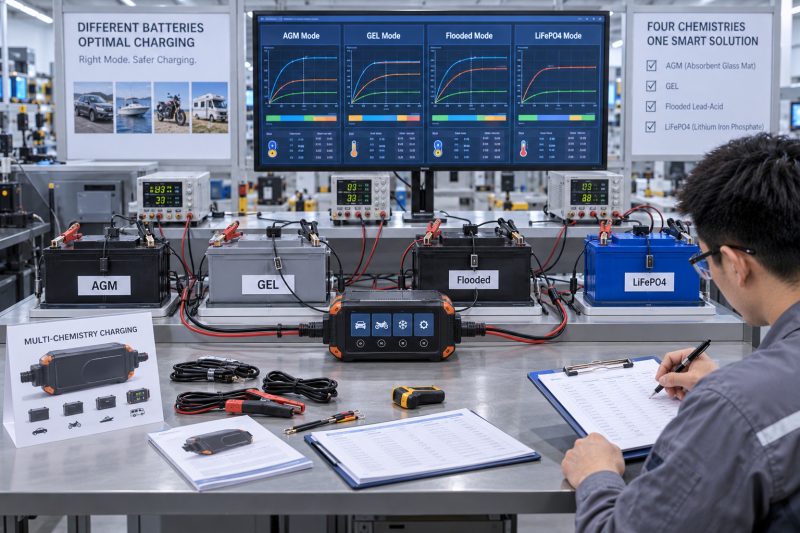
I have worked with automotive accessory wholesalers and importers for years as general manager at Parwatt New Energy. We supply car battery chargers and related products. I regularly review multi-chemistry chargers whose labels listed every common battery type yet applied unsuitable voltages or maintenance modes in practice. Our range in the car battery charger category is developed with clearly defined profiles for each supported chemistry so partners can sell with confidence. In this article I explain how charging requirements differ across AGM, GEL, flooded and LiFePO₄ batteries and how B2B buyers should verify compatibility in 2026.
Why Battery Chemistry Mismatches Lead to Returns and Safety Risks?
Each battery chemistry has its own preferred voltage limits, stage behavior and temperature rules. When a charger applies the wrong profile, the battery may not reach full charge, may overheat, may trigger its internal protection, or may lose capacity over time. These problems appear as customer complaints, returns and, in serious cases, safety incidents.
Chemistry mismatches lead to returns and safety risks because incorrect voltage, float behavior or recovery modes can undercharge, overcharge or overheat the battery. The resulting poor performance and perceived product failure drive negative reviews and warranty costs.
How Mismatches Appear in Real Use
I have examined returned chargers that left AGM batteries only partially charged because the absorption voltage was set too low. Drivers noticed weak starting and blamed the charger.
In other cases a GEL battery received a higher voltage intended for flooded batteries. Gas pockets formed in the gel, capacity dropped, and the customer reported that the battery “went bad” after using the charger.
LiFePO₄ batteries charged with a lead-acid float or desulfation program can be pushed outside their safe window. The battery management system may disconnect, or the cells may be stressed. Customers describe the charger as incompatible or unsafe.
Temperature-related errors add further risk. Charging a LiFePO₄ battery at low temperature without proper protection can cause permanent damage. A charger that does not check temperature or coordinate with the battery’s BMS leaves the user exposed.
Here is a table that links mismatch types to commercial outcomes:
| Mismatch Type | Typical Result | Customer Reaction | Business Impact |
|---|---|---|---|
| Low absorption voltage | Incomplete charge | Weak starting power | Returns and poor reviews |
| Excessive voltage on GEL | Gas pockets, capacity loss | “Battery ruined” | Warranty claims |
| Lead-acid float on LiFePO₄ | Stress or BMS disconnect | “Incompatible / unsafe” | Support tickets and refunds |
| Missing low-temperature protection | Cell damage risk | Safety concerns | Reputation damage |
| Unclear mode selection | Wrong profile applied | Product blamed | Higher return rate |
This table reflects the complaint patterns I discuss with distributors. At Parwatt we treat chemistry-specific profiles as a core requirement for every multi-mode charger in our car battery charger category.
In 2026 more vehicles and aftermarket batteries use AGM or LiFePO₄. Compatibility errors are discovered faster and shared more widely. Clear, verified profiles protect both the seller and the end user.
The “Universal Compatibility” Claims B2B Buyers Should Question
Many chargers list AGM, GEL, flooded and LiFePO₄ on the packaging or in the manual. Buyers sometimes accept the list as proof of true multi-chemistry capability. Without checking the actual voltage set points, stage logic, temperature behavior and restricted functions for each mode, the claim remains unverified and risky.
“Universal compatibility” claims should be questioned when they rely only on chemistry names on the packaging. Buyers must verify the real voltage, stage sequence, temperature control and disabled functions for every advertised mode.
Why Label Lists Are Not Enough
I have reviewed products that offered a single lead-acid program and simply labeled it as suitable for flooded, AGM and GEL. The voltages were a compromise that did not fully satisfy any of the three constructions. Customers with GEL batteries were especially likely to report problems.
Some chargers add a “lithium” button that only raises or lowers the bulk voltage slightly while still applying float or pulse maintenance designed for lead-acid. The mode is not a true LiFePO₄ profile.
Automatic detection claims also need scrutiny. Reliable chemistry detection is difficult. A charger that mis-identifies the battery and applies the wrong program creates the same risks as manual mis-selection.
Repair or recondition functions are frequently left active across all modes. These higher-voltage or pulsed routines may be acceptable for certain flooded batteries under controlled conditions, yet they are unsuitable for sealed AGM, GEL and LiFePO₄ batteries.
Here is a table of claims that require deeper verification:
| Claim | Why It Is Incomplete | What to Verify Instead |
|---|---|---|
| “Works with AGM / GEL / Flooded / LiFePO₄” | Names only | Exact voltage and stage set for each mode |
| Single lead-acid program for all | Compromise voltages | Separate validated profiles |
| “Lithium mode” button | May still use lead-acid logic | Full LiFePO₄ charge curve and disabled functions |
| Automatic chemistry detection | Detection can fail | Behavior on mis-detection and manual override |
| Recondition available in all modes | Unsafe for sealed and lithium | Mode-specific enable / disable rules |
This table helps buyers move past packaging language. At Parwatt we document the exact parameters of every chemistry mode for chargers in our car battery charger category so partners can evaluate true compatibility.
I advise buyers to request the parameter table for each mode before accepting a universal claim. Once the numbers are visible, many “universal” products look far less complete.
How Charging Requirements Differ Across the Four Battery Types
AGM, GEL and flooded batteries are all lead-acid constructions, yet their preferred absorption voltages, float behavior and tolerance for equalization differ. LiFePO₄ is a completely different chemistry and requires its own voltage limits, stage structure and temperature rules. Treating all four as interchangeable creates the mismatches described earlier.
Charging requirements differ across AGM, GEL, flooded and LiFePO₄ batteries in absorption voltage, float or maintenance behavior, equalization or recondition allowance, temperature compensation and low-temperature charging rules. Each chemistry needs its own validated profile.
Key Differences Buyers Must Respect
Flooded lead-acid batteries are generally the most tolerant of higher voltages and can sometimes benefit from controlled equalization to address stratification. Even so, the limits must still follow the battery manufacturer’s recommendations.
AGM batteries are sealed and usually prefer tighter voltage control. Excessive voltage increases gas generation and pressure inside the valve-regulated design. Float voltage must be accurate for long-term connection.
GEL batteries are particularly sensitive to overvoltage. Too high a charge voltage can create permanent voids in the gelled electrolyte and reduce capacity. Aggressive flooded or generic lead-acid programs should not be assumed safe for GEL.
LiFePO₄ batteries require a dedicated profile. Typical charge voltages are different from lead-acid, continuous float is usually unnecessary or undesirable, and equalization or desulfation routines must be disabled. Low-temperature charging protection is critical because charging below the permitted cell temperature can cause damage.
Temperature compensation is standard for lead-acid profiles and should be verified. For LiFePO₄ the charger or the battery BMS must prevent charging when the temperature is too low.
Here is a comparison of the main requirements:
| Parameter | Flooded | AGM | GEL | LiFePO₄ |
|---|---|---|---|---|
| Absorption voltage | Higher range possible | Tighter control | Sensitive to excess | Chemistry-specific lower/higher set |
| Float / maintenance | Commonly used | Required if connected long-term | Required, tightly limited | Generally not required in same way |
| Equalization / recondition | Sometimes used | Usually avoided | Avoid | Must be disabled |
| Temperature compensation | Standard | Standard | Standard | Low-temp charge inhibit critical |
| Overvoltage tolerance | Higher | Moderate | Lower | Managed by BMS + charger limits |
This comparison shows why a single program cannot serve all four types optimally. At Parwatt we implement separate, validated profiles for the chemistries we support in the car battery charger category.
I tell buyers to obtain the battery manufacturer’s recommended charge voltages whenever possible and to check the charger’s mode settings against those values. The exercise quickly reveals gaps in claimed compatibility.
How to Verify Multi-Chemistry Charger Compatibility Before Ordering
Verification requires both documentation and testing. Buyers should request the complete charging curve and parameter set for every advertised mode. Samples should then be tested for correct mode selection, output accuracy, temperature behavior, protection functions and response to incorrect mode choice.
Verify multi-chemistry compatibility by obtaining full charging curves and parameters for each mode, then testing mode selection, voltage accuracy, temperature response, protection functions and behavior under incorrect settings. Documentation plus functional testing is required.
Practical Verification Steps
Request a written parameter table that lists bulk or absorption voltage, float voltage (if used), transition conditions, maximum current, and any special stages for each chemistry mode.
Ask for charging curves or time-series data recorded on representative batteries of each type. The curves should show that the charger follows the claimed profile.
Confirm how the user selects the mode and whether the selection is retained after power loss. Clear indicators reduce the chance of accidental mis-selection.
Test output voltage and current accuracy in each mode with a calibrated meter. Compare the measured values with the documented set points.
Evaluate temperature-related behavior. For lead-acid modes, check compensation if claimed. For LiFePO₄, verify that charging is inhibited or restricted at low temperature and that the system responds safely if the temperature sensor is missing or faulty.
Test protection functions: reverse polarity, short circuit, overvoltage, overtime and overtemperature. Confirm that the charger enters a safe state and signals the fault clearly.
Finally, deliberately select an incorrect mode (for example apply a flooded profile to a LiFePO₄ battery or a lithium profile to a GEL battery in a controlled setting) and observe whether the charger’s limits still prevent immediate damage or whether the instructions clearly warn against the combination.
Here is a verification checklist:
- Parameter table for every chemistry mode
- Charging curves on representative batteries
- Mode-selection method and retention after power loss
- Measured voltage and current accuracy
- Temperature compensation or low-temp inhibit behavior
- Protection function tests
- Response to incorrect mode selection
- Clarity of indicators and fault messages
- Supported voltage and capacity range stated
- Lithium transport and safety documents if applicable
At Parwatt we perform these checks when approving multi-chemistry chargers for our partners. The same disciplined approach is used across the car battery charger category and related products such as those in the car air pump category.
I recommend that buyers keep a simple test record for each sample. The record becomes the reference for the golden sample and for later production inspection.
Build Clear Product Instructions That Prevent End-User Mistakes
Even a correctly engineered multi-chemistry charger can generate returns if the user selects the wrong mode or applies the product outside its intended range. Clear instructions on the product, packaging and manual reduce these mistakes. The instructions should list supported battery types, voltage and capacity limits, mode-selection steps and functions that must not be used with certain chemistries.
Clear product instructions prevent end-user mistakes by stating supported chemistries, voltage and capacity ranges, mode-selection steps and prohibited functions. Good communication lowers returns caused by incorrect operation.
Instruction Content That Reduces Risk
List the exact battery types and system voltages the charger supports. Avoid vague phrases such as “works with most batteries.”
State the recommended capacity range. A charger sized for automotive starting batteries may be unsuitable for very small powersport batteries or very large deep-cycle banks.
Explain how to select each mode and how to confirm the selection. If the charger uses buttons, a display or an app, the steps should be simple and the selected mode should remain visible.
Explicitly warn against using recondition, equalization or desulfation functions on AGM, GEL and LiFePO₄ batteries if those functions exist. Place the warning near the mode description, not only in a distant safety section.
Describe temperature limits, especially low-temperature restrictions for LiFePO₄. Tell the user what the charger will do if the temperature is out of range.
Include a short troubleshooting section that addresses common symptoms such as “charger will not start” or “mode keeps changing” so users can solve simple problems without returning the product.
Keep the language consistent across the packaging, the product label and the manual. Conflicting information creates confusion and support calls.
Here is a practical instruction checklist:
- Supported battery chemistries and voltages listed clearly
- Recommended capacity range stated
- Mode-selection steps illustrated or numbered
- Selected mode visible during operation
- Prohibited functions for sealed and lithium batteries highlighted
- Temperature limits and low-temp behavior described
- Fault indicators explained
- Consistent wording on pack, label and manual
- Simple troubleshooting for common issues
- Contact or support information for remaining questions
At Parwatt we treat instructions as part of the product design for every charger we supply. Clear communication supports the technical work already done on the charging profiles in our car battery charger category and helps partners reduce avoidable returns. Further product information is available on our main catalog.
Buyers who review the instructions with the same care they apply to the charging curves consistently see fewer “user-error” returns. The manual is a quality-control tool, not an afterthought.
Conclusion
A charger is not genuinely compatible with AGM, GEL, flooded and LiFePO₄ batteries simply because all four names appear on its packaging. At Parwatt we define and test chemistry-specific profiles so the products we supply meet real battery requirements. Each selectable mode should use charging parameters appropriate for the battery manufacturer’s requirements. Lead-acid reconditioning, equalization and continuous float behavior may be unsuitable for LiFePO₄, while lithium charging also requires suitable low-temperature protection and coordination with the battery management system. Before approving a multi-chemistry charger, B2B buyers should obtain its complete charging curves, test every advertised mode and verify that its instructions make incorrect selection difficult. Clear compatibility limits can prevent more returns than an unsupported “universal” claim.

--- END ---
Related Posts
Company News

How to Future-Proof Your EV Charging Investment for Long-Term Growth
September 30, 2026
Business Ideas

Why Battery Charger Warranty Claims Rise: Common Failures and Supplier Fixes
September 29, 2026
Business Ideas

Industry News

Car Battery Charger Wholesale Pricing: What Determines the Final Cost?
September 24, 2026
Business Ideas

Business Ideas

Car Battery Charger Certifications: EU, UK, US, Japan and Korea Guide
September 22, 2026