

Corded vs. Cordless Tire Inflators: Which Is Better for Your Target Market?
Sep 10,2026
Choosing the wrong power type for tire inflators can slow sales and raise returns. Corded models may be returned because of short cables or socket problems. Cordless models may disappoint with short runtime or battery fade. At Parwatt I see these mismatches reduce wholesale margins every season.
Corded and cordless tire inflators serve different customers and channels. Corded models offer predictable vehicle power and simpler long-term ownership. Cordless models offer portability and convenience. In 2026 the better choice depends on the target user, and many buyers succeed with a focused mix of both.
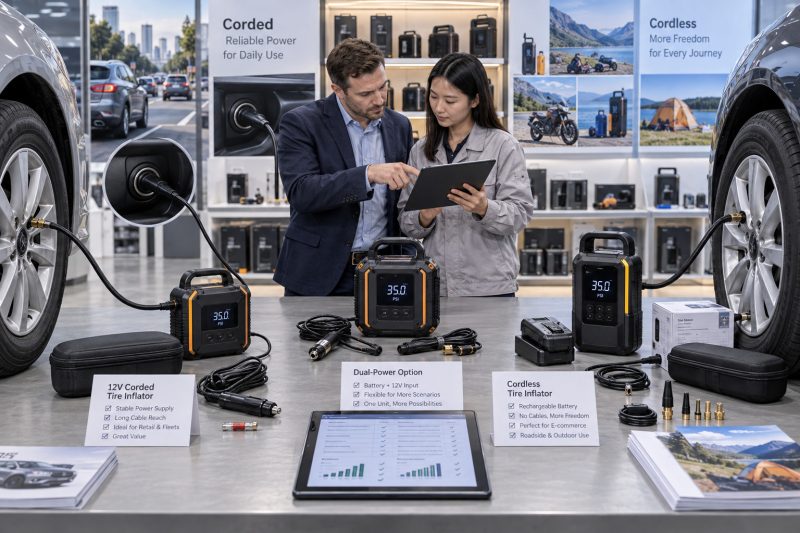
I have worked with automotive accessory wholesalers and importers for years as general manager at Parwatt New Energy. We supply both corded and cordless tire inflators along with related car-care products. I regularly review assortments where buyers favored only one format and later faced either slow sell-through or higher warranty claims. Our range in the car air pump category includes options for different channels so partners can match products to real demand. In this article I explain how to choose between corded and cordless tire inflators for your target market in 2026.
Why Choosing the Wrong Power Type Can Hurt Sales and Increase Returns?
The power source shapes how customers use and judge the product. A corded inflator that cannot reach all four tires or that blows a vehicle fuse creates immediate frustration. A cordless inflator that runs out of power before the job is finished or that loses capacity after storage generates complaints and returns. When the format does not match the user’s situation, both sales velocity and after-sales cost suffer.
The wrong power type hurts sales and raises returns because corded models can fail on cable reach or vehicle power compatibility while cordless models can fail on runtime, battery aging, or charging convenience. Matching format to real use protects margin and reputation.
How Format Mismatches Appear in the Field
I have seen corded units returned because the cable would not reach the far-side tires on larger vehicles or because the plug fit poorly in certain sockets. Customers described the product as “inconvenient” even when inflation performance itself was acceptable.
Cordless units generate a different set of complaints. Drivers who stored the inflator for months found the battery depleted. Others used high mode on multiple tires and watched the unit slow or shut down. Reviews then focused on battery life rather than inflation ability.
Channel placement amplifies the problem. A cordless model pushed into a pure price-sensitive retail channel may look expensive and complex. A basic corded model offered to convenience-focused e-commerce shoppers may look outdated. The same hardware can succeed or fail depending on where it is sold.
After-sales cost also differs. Cordless products carry battery replacement, charging, and transport-documentation burdens. Corded products more often generate cable, plug, and fuse-related support issues. Choosing the wrong mix raises the total cost of supporting the range.
Here is a table that shows the commercial impact:
| Power Type | Common Mismatch | Customer Reaction | Business Result |
|---|---|---|---|
| Corded | Short cable or weak plug | “Cannot reach all tires” | Returns and poor reviews |
| Corded | Socket or fuse problems | “Blows fuse / no power” | Support tickets |
| Cordless | Short high-mode runtime | “Battery dies too fast” | Returns and low ratings |
| Cordless | Storage self-discharge | “Dead when I needed it” | Warranty claims |
| Either | Wrong channel placement | Slow sales | Excess inventory |
This table reflects patterns I observe across wholesale accounts. At Parwatt we help partners align format with channel so products in our car air pump category move with fewer returns.
In 2026 customer expectations continue to split between simple reliability and cordless convenience. Buyers who ignore that split pay for it in inventory and support costs.
The Corded vs. Cordless Assumptions Buyers Often Get Wrong
Several common assumptions distort the comparison. Buyers sometimes believe every corded model is stronger and every cordless model is slower. Others compare only maximum PSI and ignore airflow, inflation time, duty cycle, and real design quality. These assumptions lead to incorrect rankings and poor assortment decisions.
Assumptions that mislead buyers include treating all corded models as more powerful, all cordless models as slower, and maximum PSI as the main performance measure. Real speed and reliability depend on system design, airflow under load, and thermal behavior—not power source alone.
Assumptions That Need Correction
One frequent assumption is that corded automatically means faster inflation. In practice, speed depends on motor, cylinder, airflow under pressure, and thermal design. A well-engineered cordless unit can outpace a weak corded unit on a standard top-up.
The opposite assumption—that cordless is always slower—is equally incomplete. Many cordless models deliver competitive times on passenger-car tires when the battery is healthy and the design is efficient.
Maximum PSI is still over-weighted. Both formats can reach high pressure; the practical difference appears in how quickly they deliver air under load and whether they can sustain output across multiple tires.
Duty-cycle and heat behavior are often ignored. A cordless unit may look strong on the first tire and then throttle. A corded unit may be limited by cable voltage drop or vehicle-socket capacity. Neither limitation is visible in a single peak-PSI claim.
Lifecycle cost is another blind spot. Cordless introduces battery aging and replacement considerations. Corded introduces cable and connector wear. Comparing only the factory price hides these differences.
Here is a table of incorrect assumptions:
| Assumption | Why It Is Incomplete | Better Evaluation |
|---|---|---|
| Corded is always stronger | Ignores design quality | Compare loaded inflation time |
| Cordless is always slower | Ignores efficient systems | Test both under same conditions |
| Max PSI decides the winner | Pressure ≠ speed | Measure time-to-pressure |
| One cycle represents use | Hides heat and voltage effects | Run consecutive tires |
| Unit price = total cost | Ignores battery or cable support | Calculate landed + after-sales cost |
This table helps buyers move past simplistic rankings. At Parwatt we test both formats under identical load conditions so partners can see real differences within our car air pump category.
I have re-tested pairs of corded and cordless samples after standardizing the tire and pressure points. The performance order sometimes reversed once assumptions were replaced by data. Evidence beats assumption.
How to Match Each Inflator Type to Its Ideal Customer and Channel
Each power type fits certain customers and sales channels better than others. Price-sensitive retail and fleet buyers often value simple vehicle-powered operation and lower long-term battery risk. E-commerce, gift, personal-car, and outdoor channels usually value portability, appearance, and freedom from cables. Matching type to customer improves sell-through and reduces mismatch returns.
Match corded inflators to price-sensitive retail, fleets, and emergency-storage users who want predictable vehicle power. Match cordless inflators to portability-focused consumers, e-commerce, outdoor, and lifestyle channels. Correct matching raises sales velocity and lowers support cost.
Customer and Channel Fit
Corded 12V models suit drivers who keep the inflator in the vehicle for occasional use and prefer not to manage charging. They work well in mass retail, value channels, and fleet supply where purchase price and simplicity matter. Cable length, plug quality, and fuse compatibility become the key practical requirements.
Cordless models suit drivers who want to carry a compact unit, use it away from the vehicle, or value a modern, cable-free experience. They fit e-commerce listings, lifestyle retail, gift sets, motorcycle and bicycle users, and outdoor-oriented customers. Battery performance, charge time, and storage behavior become critical.
Regional and channel habits further guide the choice. Markets with strong online convenience demand often absorb more cordless units. Markets that emphasize low price and straightforward operation may favor corded models. Commercial buyers who inflate multiple vehicles may need higher duty-cycle designs regardless of power source.
Clear positioning prevents confusion. A cordless unit sold as a premium convenience product should not be forced into a pure price battle with basic corded models. A corded unit sold for emergency storage should emphasize reliability over portability features.
Here is a matching guide:
| Inflator Type | Ideal Customer | Strongest Channels | Key Success Factors |
|---|---|---|---|
| 12V Corded | Budget and fleet users | Mass retail, fleet supply | Cable reach, plug durability |
| Cordless | Convenience-focused owners | E-commerce, lifestyle, gift | Battery life, portability |
| Dual-power | Users wanting backup options | Premium and multi-use retail | Both modes tested |
| Professional / high-duty | Detailing and heavy use | Trade channels | Continuous performance |
This guide keeps assortment decisions practical. At Parwatt we support partners with both formats inside the car air pump category and complementary products such as those in the car battery charger category.
I recommend mapping every proposed SKU to a primary customer and channel before ordering. The exercise quickly reveals whether the mix is balanced or skewed.
When a Dual-Power Product Can Provide Better Market Coverage
Dual-power inflators that run from an internal battery and also from a 12V vehicle socket can cover more use cases with one SKU. They remain usable when the battery is low and still offer cordless convenience when the battery is charged. The trade-off is higher cost, greater weight, more complex electronics, and tighter quality-control requirements.
Dual-power designs can improve market coverage by combining portability with vehicle-power backup. They also increase cost, weight, electronic complexity, and the need for thorough testing of both operating modes.
Benefits and Added Complexity
The main benefit is reduced “dead product” risk. A driver who finds the battery depleted can still plug into the vehicle and complete the inflation. This backup function is attractive for emergency positioning and for customers who store the unit for long periods.
Dual-power units can also simplify assortment for distributors who want one model that serves both convenience and reliability expectations. Marketing can emphasize flexibility rather than forcing a hard choice between formats.
Complexity rises in several areas. The product must manage battery charging, battery-powered inflation, and 12V-powered inflation. These modes may deliver different performance levels. Buyers must test all modes, not only the more convenient cordless mode.
Weight and size usually increase. Cell capacity, protection circuitry, and the extra power-input hardware add mass that pure cordless or pure corded designs avoid.
Quality control and certification burdens grow. Lithium transport documents, charger safety, and dual-path electrical protection all require attention. After-sales support must cover both battery and cable-related issues.
Here is a comparison of single versus dual-power approaches:
| Aspect | Single-Power (Corded or Cordless) | Dual-Power | Implication |
|---|---|---|---|
| Use flexibility | Limited to one power source | Battery + 12V backup | Wider situation coverage |
| Cost and weight | Lower | Higher | Price and portability trade-off |
| Testing need | One mode | Both modes | More validation work |
| QC and certification | Simpler | More complex | Higher control demand |
| After-sales scope | Narrower | Battery + cable issues | Broader support readiness |
This comparison keeps expectations realistic. At Parwatt we evaluate dual-power designs carefully when they appear in our development pipeline and apply the same rigorous testing used for single-format products in the car air pump category.
I advise buyers to treat dual-power as a distinct product class. It can be a strong solution when the market values backup capability, but only if both modes are proven and the extra cost is accepted by the channel.
Test Both Formats Before Finalizing Your Wholesale Product Mix
A final assortment decision should rest on side-by-side testing and limited trial sales rather than on format preference alone. Buyers should measure inflation speed, pressure accuracy, continuous operating ability, cable practicality, battery runtime, thermal behavior, and projected after-sales cost for representative corded and cordless models. Trial-order data then refine the inventory ratio.
Test both formats under identical conditions and run limited trials before locking the wholesale mix. Measure speed, accuracy, duty cycle, cable or battery practicality, heat, and total cost. Real sell-through and return data should decide the final balance.
From Comparative Testing to Assortment Decisions
Select representative corded and cordless candidates that fit the intended price bands and channels.
Test them on the same tire, the same start and target pressures, and the same ambient conditions. Record time-to-pressure, gauge accuracy, auto-stop behavior, and temperature rise.
For corded models, evaluate cable length, plug fit, voltage drop, and behavior across multiple tires without rest.
For cordless models, measure runtime in the modes customers will actually use, speed at mid and low charge, charge time, and any self-discharge after storage simulation.
Estimate total commercial cost: factory price, freight, any battery-related documentation or restrictions, expected warranty rate, and replacement-part needs.
Place small trial quantities in the target channels. Track sell-through speed, return reasons, and customer comments for each format.
Adjust the mix. Increase the share of the format that moves cleanly and generates fewer problems; reduce or reposition the format that under-performs.
Keep positioning clear so retailers and end users understand which model suits which need.
Here is a practical test-and-mix checklist:
- Choose representative corded and cordless candidates
- Run identical inflation-speed and accuracy tests
- Evaluate cable reach and plug quality on corded units
- Evaluate battery runtime, charge time, and storage behavior on cordless units
- Record thermal performance across consecutive tires
- Calculate landed cost plus expected after-sales cost
- Launch limited trials in the intended channels
- Monitor sell-through, returns, and review themes
- Adjust inventory ratio according to the data
- Re-test any revised specification before scaling
At Parwatt we support this evidence-based approach with both corded and cordless options and with consistent test methods. Partners can explore the available range in the car air pump category and complementary products such as car vacuum cleaners. Further details are available on our main catalog.
Buyers who test both formats and let trial data guide the mix consistently achieve more stable sales and lower support costs. The assortment itself becomes a commercial strength rather than a source of recurring problems.
Conclusion
Neither corded nor cordless tire inflators are automatically better for every market. At Parwatt we supply both formats so partners can match products to real customer needs. Corded models can offer dependable access to vehicle power, simpler inventory management, and fewer battery-aging concerns, making them suitable for price-sensitive retail, fleets, and products stored for occasional emergencies. Cordless models provide easier handling and broader portability, which can support premium e-commerce, outdoor, motorcycle, bicycle, and consumer-lifestyle channels. However, they also introduce battery quality, charging, storage, certification, and warranty considerations. B2B buyers should identify the target user first, test representative products under the same conditions, and calculate total landed and after-sales costs. In many markets, a focused two-model range—or a carefully tested dual-power design—offers a more balanced solution than relying on one format alone.

--- END ---
Related Posts
Business Ideas

Business Ideas

Business Ideas

Industry News


