

Portable Tire Inflator Speed: How Long Should It Take to Inflate a Car Tire?
Sep 11,2026
Portable tire inflator speed claims often look better on the package than they feel on a real car tire. Many “few minutes” promises are measured under conditions that drivers rarely meet. At Parwatt I see these gaps create returns and weak reviews for wholesale buyers every season.
Portable tire inflator speed depends on tire size, starting pressure, target pressure, power state, and heat buildup. For everyday passenger-car top-ups, adding 5–8 PSI in about 1–3 minutes is a useful reference for a capable unit. In 2026 buyers who test under repeatable conditions select products that match real customer expectations.
I have worked with automotive accessory wholesalers and importers for years as general manager at Parwatt New Energy. We supply portable tire inflators and related car-care products. I regularly review samples whose claimed times looked excellent yet slowed on a standard passenger tire or after the first cycle. Our range in the car air pump category is tested with clear time-to-pressure data so partners can compare real speed. In this article I explain what affects inflator speed and how B2B buyers can measure and approve it reliably in 2026.
Why Portable Tire Inflator Speed Claims Often Mislead Buyers?
Packaging and online listings frequently promise fast inflation. The supporting test conditions are rarely shown. When the same unit meets a larger tire, a lower starting pressure, a partial battery, or a second consecutive fill, the time becomes longer. Customers feel the product is slower than advertised and leave negative feedback.
Speed claims often mislead because they are measured under favorable conditions that differ from normal use. Tire volume, starting pressure, power state, and temperature all change the result. Real top-up time under defined conditions is the figure buyers should demand.
Where the Claims Break Down in Practice
I have timed units that claimed very short intervals to a stated pressure. The original test had used a small tire or started from a higher pressure than a typical soft road tire. On a common passenger-car tire starting at 25 PSI, the same product took noticeably longer.
Low battery or voltage drop further extends the time on cordless models. A unit that performs well at full charge can slow once the pack voltage sags under compressor load.
Heat is another frequent cause of disappointment. The first tire may finish inside the claimed window. The second or third tire takes longer as the compressor warms and airflow declines or protection engages.
Drivers also compare different tasks. Adding a few PSI for routine maintenance is far quicker than recovering a tire that is close to flat. Claims that blur these tasks create unrealistic expectations.
Here is a table that shows why claims fail in real use:
| Claim Situation | Typical Test Condition | Real-World Difference | Customer Reaction |
|---|---|---|---|
| Fast time to target PSI | Small tire or high start pressure | Longer on standard car tire | Feels overstated |
| Single-cycle demo | Cold unit, full battery | Slower on later cycles | Speed drops in use |
| Cordless headline time | Maximum charge, light load | Longer at mid or low battery | Runtime disappointment |
| Flat-to-full language | Ideal conditions | Not typical maintenance use | Misleading expectation |
This table reflects the feedback I hear from distributors. At Parwatt we publish time-to-pressure results under defined conditions for products in our car air pump category so the numbers stay meaningful.
In 2026 buyers who still accept isolated speed claims without conditions consistently face higher return rates. Clear, repeatable data protect both the brand and the seller.
What “0–36 PSI in Three Minutes” Does Not Tell You
Many speed claims use a 0–36 PSI or similar interval and a round time such as three minutes. The tire size, true starting pressure, ambient temperature, power state, and whether cooling was allowed are often omitted. Without those details the number cannot be compared across suppliers or trusted for real cars.
A “0–36 PSI in three minutes” claim leaves out tire size, actual starting pressure, temperature, power state, and cooling requirements. These factors can change the measured time dramatically. Buyers must demand the full test setup.
Critical Details Missing from Headline Claims
Tire size and internal volume are the largest variables. A compact spare or small passenger tire reaches the target far sooner than a large SUV or light-truck tire. A claim measured on the smaller tire looks fast yet fails to represent the vehicles many customers drive.
Starting pressure matters. True zero pressure is uncommon on a roadable tire and may indicate damage. Most portable-inflator use begins at 20–30 PSI. A test that starts near zero records a longer interval and may not match the top-up task customers actually perform.
Ambient temperature affects both the compressor and the tire. Cold conditions can reduce performance; very warm conditions can accelerate heat buildup and protection events.
Power state is decisive for cordless units. Full-charge results do not guarantee the same speed at 50 % charge. 12V models can also vary with vehicle voltage and cable losses.
Cooling time is frequently ignored. A claim may reflect only the first cycle. If the unit needs several minutes of rest before the next tire, the practical speed for four tires is much lower.
Here is a table of missing conditions:
| Missing Detail | Effect on Measured Time | Why It Misleads | What to Require |
|---|---|---|---|
| Tire size | Smaller tire = shorter time | Understates real car use | Stated tire specification |
| True start pressure | Artificial low start stretches time | Not typical top-up | Realistic start PSI |
| Ambient temperature | Best-case lab temperature | Ignores weather variation | Stated temperature range |
| Power / battery state | Full charge only | Hides voltage sag | Mid- and low-charge data |
| Cooling interval | Single-cycle result | Overstates continuous use | Consecutive-cycle times |
This table helps buyers interrogate supplier data. At Parwatt we record the full condition set when testing units for our car air pump category and related products.
I have compared two similar “0–36 PSI in X minutes” claims that used completely different tires. Once both were re-tested on the same tire, the ranking reversed. Conditions are not optional details; they are the core of the measurement.
How to Run a Repeatable Tire Inflation Speed Test
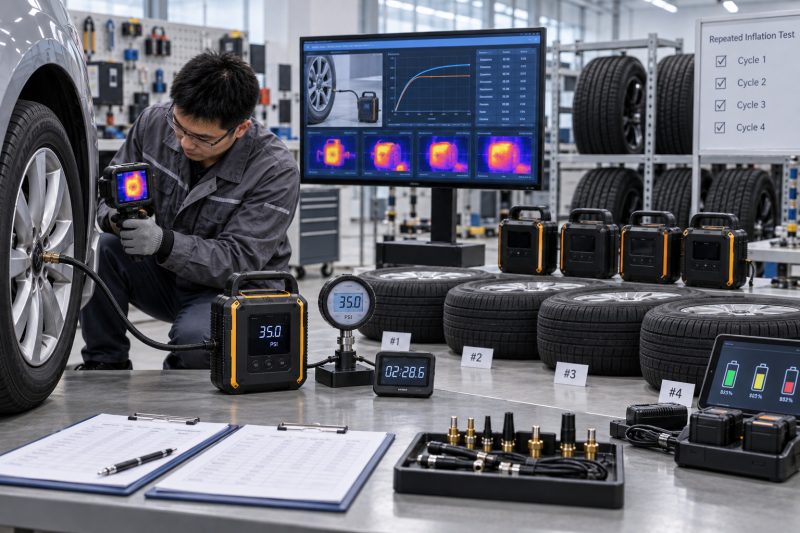
A fair speed test fixes every major variable. Buyers choose one tire size, one starting pressure, one target pressure, a defined temperature range, and a clear power state. They record elapsed time, final pressure versus a reference gauge, and unit temperature. Repeating the cycle shows whether speed holds.
Run a repeatable test by locking tire size, start and target pressures, temperature, and power state. Record time, accuracy, temperature rise, and consecutive-cycle behavior. Identical conditions make sample rankings trustworthy.
Step-by-Step Measurement Method
Select a representative tire that matches the target market—typically a common passenger-car size. Write the size on the test sheet.
Set a realistic starting pressure (for example 25 PSI) and a clear target (for example 32 or 35 PSI). Confirm both with a calibrated reference gauge.
Prepare the inflator: full charge for cordless models or stable voltage for 12V models. Use the standard hose and connector supplied with the unit.
Start the compressor and time until the unit stops or the reference gauge reaches the target. Note the displayed pressure and calculate any overshoot or undershoot.
Record the surface or outlet temperature immediately after the run. If the protocol includes consecutive cycles, wait a fixed cooling interval or run back-to-back according to the planned duty cycle, then repeat the measurement.
For cordless products, perform additional runs at mid-charge and near low-charge states to capture voltage-sag effects.
Log any automatic thermal shutdown, speed loss, or error messages.
Keep every element identical for the next sample so results remain comparable.
Here is a repeatable test checklist:
- Fix tire size and record it
- Set and verify start PSI and target PSI with reference gauge
- Standardize ambient temperature and power state
- Use the same hose and connector type
- Time the inflation to target
- Record displayed vs actual final pressure
- Measure temperature rise
- Repeat for consecutive cycles
- Test cordless units at lower battery levels
- Document every condition on the result sheet
At Parwatt we follow this method when qualifying products for the car air pump category. The same discipline is applied to related accessories such as those in the car battery charger category.
I advise buyers to print the checklist and use it for every sample batch. Consistency is the only way to turn speed claims into reliable data.
What Counts as a Reasonable Inflation Time for Different Vehicles
Reasonable time depends on the vehicle and the task. For ordinary passenger-car maintenance, adding 5–8 PSI in about 1–3 minutes per tire is a practical reference for a capable portable inflator. Larger SUV and light-truck tires need more time because they contain greater air volume. Recovering a very low tire is a different task and cannot be judged by the same benchmark.
A reasonable top-up time for passenger cars is roughly 1–3 minutes to add 5–8 PSI. SUV and light-truck tires take longer. Near-flat recovery is a heavier duty cycle and should be evaluated separately.
Benchmarks by Application
Passenger-car drivers usually correct a moderate loss. A portable unit that adds 5–8 PSI inside one to three minutes feels responsive and convenient. Times significantly longer than this range often generate complaints in consumer reviews.
SUV and light-truck tires hold more air. The same pressure increase requires a larger volume, so even a strong portable inflator will take longer. Buyers targeting these vehicles should set a higher but still practical time expectation and verify heat control across multiple tires.
Completely flat or near-flat recovery is not everyday maintenance. The compressor must move a much larger air volume and may overheat or require rest periods. A compact unit designed for top-ups may not be suitable for repeated full recoveries.
Cordless versus 12V power also influences expectations. Cordless units trade some continuous power for portability; their times should be judged at realistic battery states. 12V units can sustain output longer if the vehicle supply is stable.
Regional climate matters. Very cold or hot conditions can stretch times beyond the laboratory result. Spec sheets should note the temperature range used.
Here is a practical reference table:
| Vehicle / Task | Typical Pressure Change | Reference Time Range | Notes |
|---|---|---|---|
| Passenger-car top-up | +5–8 PSI | Approx. 1–3 minutes | Most common use case |
| SUV / light-truck top-up | +5–8 PSI | Longer than car benchmark | Higher air volume |
| Near-flat recovery | Large volume to target | Substantially longer | May exceed compact duty cycle |
| Consecutive four tires | Repeated top-ups | Watch heat and slowdown | Reveals real practicality |
| Cordless at mid charge | Same pressure change | Often longer than full charge | Voltage sag effect |
This table keeps expectations realistic. At Parwatt we align product positioning with these application differences inside the car air pump category and supporting products on our main site.
I tell buyers to publish or at least internalize a clear time benchmark for their main vehicle type. It becomes the standard against which every sample is judged.
How B2B Buyers Should Approve Inflator Speed Claims
Sample approval should confirm speed under the conditions that matter to customers. Buyers run consecutive inflations, check performance after the unit is warm, verify pressure accuracy and auto-stop behavior, monitor battery consumption on cordless models, and record any required cooling time. The accepted results become part of the golden-sample and purchase specification.
Approve speed claims with consecutive-tire testing, hot-unit checks, accuracy verification, battery-draw measurement, and cooling-time records. Lock the accepted values into the specification so production units can be held to the same standard.
From First Sample to Locked Criteria
Fully prepare each sample and confirm the fixed test conditions: tire, start PSI, target PSI, temperature, and power state.
Perform the first inflation and record time, final pressure accuracy, and temperature.
Immediately or after a defined short interval, run the second, third, and fourth tires if the product is intended for multi-tire use. Note any increase in time, rise in temperature, or activation of thermal protection.
For cordless units, repeat a standard top-up at mid-charge and near low-charge to quantify speed loss.
Measure the difference between the unit’s display and a calibrated reference gauge at the stopping point. Record overshoot or undershoot.
Document charge used (or voltage drop) and any rest time the unit requires before it can repeat the same performance.
Compare at least two or three samples of the same model for consistency.
Write the accepted time ranges, accuracy tolerances, temperature limits, and duty-cycle rules into the golden-sample record and the purchase agreement.
Here is a B2B approval checklist:
- Fix and record all test conditions
- Time the first inflation to target
- Run consecutive cycles and log time changes
- Record temperature after each cycle
- Verify displayed vs reference pressure and overshoot
- Test cordless speed at mid and low battery
- Note any thermal shutdown or required cooling
- Compare multiple samples for consistency
- Lock time, accuracy, and duty-cycle limits into the specification
- Require the same protocol for pre-shipment inspection
At Parwatt we use this checklist when approving inflators for wholesale partners. The same rigorous approach supports products in our car air pump category and complementary lines such as car vacuum cleaners. Further details are available across our main catalog.
Buyers who complete these steps before mass production consistently receive units that meet customer expectations for speed. The checklist turns a vague claim into an enforceable quality standard.
Conclusion
A tire inflator cannot be classified as fast or slow without clearly defined test conditions. At Parwatt we measure speed under controlled, repeatable conditions so the products we supply perform as expected in real use. For routine passenger-car maintenance, adding approximately 5–8 PSI in around 1–3 minutes per tire can provide a useful reference, although the result will vary with tire volume and product design. Restoring a severely underinflated tire requires considerably more time and may exceed the duty cycle of a compact unit. B2B buyers should test samples on the same tire using a controlled starting pressure, target pressure, ambient temperature, and power condition. Multiple consecutive tests are also necessary because heat buildup and battery discharge may reduce later-cycle performance. A repeatable testing protocol produces a more credible sales claim than a best-case time printed without supporting conditions.

--- END ---
Related Posts
Business Ideas

Business Ideas

Business Ideas

Business Ideas


