

Cordless vs 12V Tire Inflators: A Sourcing Guide for Importers
Nov 12,2026
Power source changes more than product convenience. It affects inflation speed, continuous run time, unit cost, transport documents and after-sales risk. At Parwatt I see importers choose the wrong format and then face customers who find a flat battery, a short cord or an overheated motor exactly when they need air.
Cordless and 12V tire inflators serve different users. Cordless units prioritise portability. 12V plug-in units prioritise simpler power and lower cost. Importers should compare working airflow, duty cycle and real inflation time on the same tire—not maximum PSI alone—and build a focused range that covers economy, convenience and higher-demand vehicles.
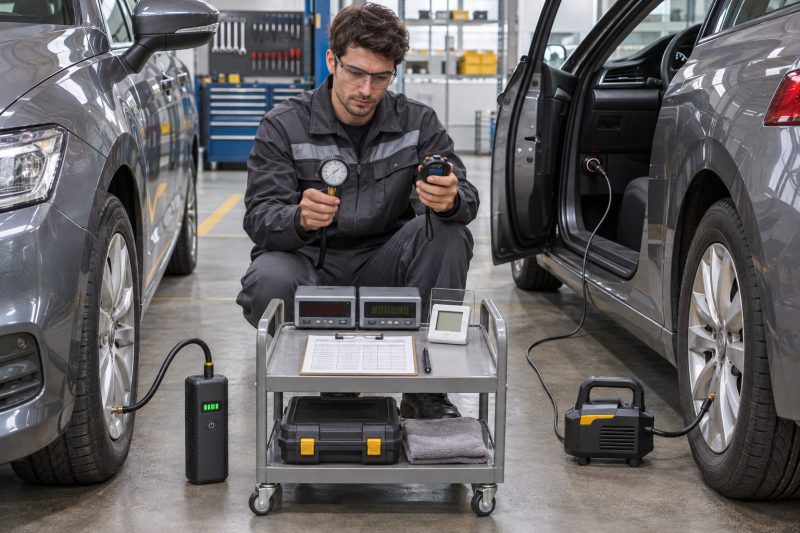
I have worked with automotive importers, distributors and private-label buyers for years as general manager at Parwatt New Energy. We supply portable air products and related vehicle accessories used in retail, e-commerce and workshop channels. I regularly review assortments where maximum PSI claims hid weak airflow, short duty cycles or battery problems. Our planning for products in the car air pump category and across our main site starts with real tire tests and clear power-path limits. In this article I explain how importers should compare cordless and 12V tire inflators in 2026.
Why Power Source Changes More Than Product Convenience?
The power source decides whether the user depends on a charged internal battery or on the vehicle’s 12V system. That choice changes runtime, heat behaviour, logistics paperwork and the most common warranty claims. A format that looks convenient in a showroom can fail in the field if the battery is empty or the cord cannot reach the far tyre.
Power source changes convenience, continuous performance, cost, shipping requirements and after-sales exposure. The wrong choice leaves users without air when the battery is flat or the cord and socket cannot support the motor.
How Power Path Problems Appear
I have seen cordless samples perform well on a full charge and then slow sharply after two or three tyres as voltage dropped and the pack warmed. The maximum PSI figure on the carton had not changed. Real capability had.
12V plug-in units remove the internal pack, yet they introduce another limit. Accessory sockets, fuse ratings, plug contact quality and cable resistance all restrict motor power. A long thin cable can turn a strong motor into a slow inflator at the rear axle.
Cost structures differ. Cordless designs carry cell, BMS and charger cost. 12V designs usually cost less to build but need robust plugs, fuses and strain relief to survive vehicle use.
Logistics differ as well. Built-in lithium packs often require extra transport documentation. Pure 12V units avoid that burden but still need cable and plug quality control.
After-sales patterns split along the same line. Cordless claims often involve cells, charging ports and low-battery cut-offs. 12V claims often involve melted plugs, blown fuses and damaged sockets.
Here is a practical comparison of the two formats:
| Comparison Item | Cordless Inflator | 12V Plug-In Inflator |
|---|---|---|
| Power source | Built-in or removable rechargeable battery | Vehicle 12V accessory socket |
| Main advantage | Flexible use without deploying a power cord | Not dependent on internal battery state of charge |
| Main limitation | Battery discharge, ageing and higher after-sales cost | Must stay near the vehicle; limited by cord length and socket power |
| Typical channel | E-commerce, gift, outdoor and mid-to-premium retail | Auto parts, emergency kits and price-sensitive markets |
| Typical application | Bicycle, motorcycle and passenger-car top-ups | Passenger cars and light roadside emergencies |
| Continuous use | Limited by capacity, voltage drop and heat | Limited by socket current, cable and motor duty cycle |
| Storage concern | Needs periodic recharge | Check cable, plug and fuse |
| Logistics | Lithium transport documents often required | Usually no built-in lithium shipping issue |
| After-sales risk | Cells, BMS, charge port and charger | Plug, fuse, cable and vehicle socket |
| Product cost | Usually higher | Usually lower |
This table keeps commercial and technical differences visible together. At Parwatt we use the same structure when advising buyers on the car air pump category.
In 2026 the power source should be chosen for the target user and channel, not for a single headline specification.
The Specification Mistakes Importers Commonly Make
Importers often compare only maximum PSI, treat battery capacity as runtime, ignore airflow under pressure, skip duty-cycle and temperature testing, and fail to confirm 12V plug current, fuse rating, cable length and whether the hose can reach every tyre. These mistakes produce optimistic listings and disappointing field results.
Specification mistakes include judging only by maximum PSI, equating battery capacity with runtime, overlooking working airflow and duty cycle, and ignoring 12V current draw, fuse, cable length and tyre reach.
Mistakes That Inflate Expectations
Maximum PSI is a poor standalone metric. Most passenger-car tyres operate far below the peak number printed on many inflators. Working airflow at real pressure, inflation time and gauge accuracy matter more.
Battery milliamp-hour ratings do not equal usable runtime. Voltage sag under load, motor efficiency and thermal cut-outs all shorten the practical session. Samples must be tested at more than one state of charge.
Duty cycle is frequently missing from quotations. A unit may stop for cooling while battery capacity remains, or a 12V unit with continuous vehicle power may still need rest periods. Run time, temperature rise and recovery behaviour should be recorded.
12V electrical limits are under-specified. Peak and steady current, minimum supply voltage, plug temperature and fuse rating belong in the data sheet. Motor wattage alone is not enough.
Cable and hose reach determine whether the product can service all four tyres from one socket location. A short kit forces unsafe extension leads or repeated vehicle movement.
Auto-stop tolerance and gauge error are sometimes accepted from the screen without a calibrated reference. Small pressure errors create customer complaints and repeated use cycles.
Here is a risk-focused view of common mistakes:
| Mistake | Field Result | Better Practice |
|---|---|---|
| Max PSI only | Slow real inflation | Time a defined pressure rise on a real tyre |
| mAh = runtime | Early shutdown claims | Test consecutive tyres and low-battery behaviour |
| No duty-cycle data | Overheat stops in use | Record run, rest and temperature rise |
| Ignore 12V current path | Blown fuses, hot plugs | Specify current draw and fuse rating |
| Short hose or cable | Cannot reach far tyres | Measure reach on target vehicle class |
| Unverified gauge | Over- or under-inflation complaints | Compare with calibrated reference gauge |
This list keeps sample evaluation disciplined. At Parwatt we require the same measurements before confirming bulk orders linked to the car air pump category and related products on our main site.
I advise rejecting any quotation that cannot state working pressure, duty cycle and electrical limits in writing.
How Cordless and 12V Inflators Compare in Real Use
Real use separates portability from power-path reliability. Cordless units move freely but depend on charge state and thermal management. 12V units depend on socket quality, cable quality and continuous current capability. Built-in packs, removable tool batteries, cigarette-lighter plugs and battery-clamp leads each create different user experiences.
Cordless inflators prioritise free movement and retail convenience. 12V inflators prioritise independence from internal battery charge. Continuous performance is limited by heat and by the weaker part of each power path.
Use-Case Differences That Matter to Buyers
Portability favours cordless designs for roadside use away from the socket, for bicycles and for quick top-ups in shared parking. The user must keep the pack charged.
Reliability of power favours 12V when the vehicle battery is healthy and the socket is sound. Empty internal packs become irrelevant.
Continuous multi-tyre work exposes thermal limits in both formats. Record how many tyres can be completed before protection trips and how long recovery takes.
Inflation speed should be timed on the same tyre and the same pressure interval. Only then can cordless and 12V models be ranked fairly.
Battery ageing is a cordless-specific cost. Capacity loss over years drives later complaints. 12V after-sales issues cluster around plugs, fuses and cables instead.
Maintenance differs. Cordless fleets need charger and port care. 12V fleets need strain relief, fuse access and plug inspection.
Cost and channel positioning usually follow the power source. Cordless supports higher retail price points. 12V supports promotional and emergency-kit price points.
Here is a use-oriented summary:
| Topic | Cordless Emphasis | 12V Emphasis |
|---|---|---|
| User freedom | High | Limited by cord |
| Dependence on pre-charge | High | Low |
| Typical speed limiter | Battery voltage and heat | Socket, cable and heat |
| Multi-tyre sessions | Plan around capacity and cooling | Plan around duty cycle and socket limits |
| Long-term wear | Cells and BMS | Plug, fuse and cable |
| Natural price band | Mid to premium | Economy to mid |
This summary helps importers assign formats to channels. At Parwatt we map the same differences when building assortments for the car air pump category.
I recommend one controlled tyre test protocol for every sample, regardless of power source. Shared conditions make comparisons honest.
Which Inflator Type Fits Each Market and Sales Channel?
Lightweight cordless models fit portable, gift and e-commerce retail. Price-sensitive auto and emergency channels fit 12V plug-in models. SUVs, pickups and frequent users need higher airflow, longer duty cycle or battery-clamp power. Dual-power designs reduce the risk of a flat internal battery when both modes are truly usable.
Match cordless models to portability-led retail, 12V models to economy and emergency kits, higher-flow or clamp models to larger tyres and frequent use, and dual-power models to users who want both convenience and a fallback.
Channel and Vehicle Guidance
E-commerce shoppers respond to compact cordless units with automatic stop, clear battery indication and simple USB charging. Packaging should set realistic tyre sizes and session counts.
Auto-parts and emergency-kit channels often prefer 12V units with long cords, visible fuses and straightforward digital displays. Lower cost supports higher volume.
SUV and light-truck owners need more air volume per minute and stronger thermal behaviour. A basic compact cordless unit may disappoint on large tyres. Higher-flow 12V or clamp-powered units fit better.
Dual-power products can cover family users who want cordless convenience at home and 12V backup on the road. Both modes must be tested for inflation speed, not only for charging the pack.
Multi-function kits that add lighting, powerbank or jump features suit gift and outdoor assortments. Each extra function needs its own safety and performance check so the core inflator is not compromised.
Workshop and fleet buyers may prefer clamp leads and higher duty cycles over pure cordless convenience. Service use is repetitive and heat-sensitive.
Here is a tier plan for a focused import range:
| Product Tier | Suggested Direction | Primary Target Users |
|---|---|---|
| Entry 12V model | Basic digital display, long power cord, accessible fuse | Price-sensitive passenger-car markets |
| Core cordless model | Auto-stop, USB charging, clear battery status | E-commerce and portability-led retail |
| Dual-power model | Built-in battery plus 12V backup operation | Family users who want reliability and convenience |
| High-flow 12V model | Higher working airflow, longer duty cycle | SUVs, pickups and larger tyres |
| Battery-clamp model | Direct connection to the vehicle battery | Frequent use and light commercial scenarios |
| Multi-function model | Inflate plus light, powerbank or jump functions | Gift, outdoor and emergency kits |
This tier structure covers mainstream demand without excessive SKU overlap. At Parwatt we help importers stabilise similar ladders inside the car air pump category and complementary categories on our main site.
I advise launching with one strong SKU per tier. Depth of quality matters more than a long list of near-identical models.
How to Test Samples and Build a Lower-Risk Product Range
Test every sample on the same tyre, the same start and target pressures and the same ambient temperature. Record inflation time, gauge error, auto-stop deviation, temperature rise, noise and the number of consecutive tyres completed. Build a clear entry 12V, core cordless and higher-performance or dual-power line first, then expand only after sell-through and claim data support more SKUs.
Lower risk by using identical tyre tests, recording time, accuracy, heat and consecutive-tyre counts, and expanding the range only after real sales and warranty data confirm the core tiers.
From Sample Bench to Stable Assortment
Define a reference passenger-car tyre and, if needed, a larger light-truck tyre. Publish the size and the pressure interval in the test file so later samples remain comparable.
Time inflation from the stated start pressure to the target. Repeat with a calibrated gauge beside the product display.
Measure auto-stop tolerance after the motor stops and pressure stabilises. Note any overshoot.
Run consecutive tyres without artificial cooling beyond the manufacturer’s stated duty cycle. Log housing, hose, motor and battery or plug temperatures.
For cordless units, record full-charge runtime, voltage drop and behaviour near cut-off. For 12V units, record peak and steady current, plug temperature and fuse condition.
Check whether the cable and hose combination can reach all four tyres on the target vehicle class without unsafe extensions.
Verify protection events: over-temperature, over-current, low-battery and stalled-motor responses.
Approve packaging claims only when they match the measured interval and tyre size. Maximum PSI alone should not lead the front panel.
Place a controlled trial order. Track returns by reason: slow inflation, accuracy, heat, battery life, plug damage or documentation.
Here is a sample test record sheet:
| Test Item | Recommended Data to Record |
|---|---|
| Test tyre | Size, load range and approximate volume |
| Pressure range | Start pressure and target pressure |
| Inflation time | Actual time to reach target |
| Working airflow | Behaviour under real tyre pressure |
| Gauge accuracy | Screen reading versus calibrated gauge |
| Auto-stop tolerance | Final pressure versus set value after stop |
| Duty cycle | Continuous run time and required cooling time |
| Temperature rise | Housing, hose, motor and battery or plug |
| Consecutive tyres | Number completed in one sequence |
| Cordless runtime | Total run time and voltage drop from full charge |
| 12V current draw | Peak and steady current; plug and fuse temperature |
| Cable and hose reach | Ability to reach all four tyres from the power point |
| Noise and vibration | Operating noise and stability in use |
| Protection behaviour | Over-temperature, over-current, low battery, stall |
| Accessories | Nozzles, ball needle, Presta adapter and storage |
This record turns samples into comparable evidence. At Parwatt we apply the same discipline to products in the car air pump category and to related electrical accessories such as those in the car battery charger category when partners build broader emergency ranges on our main site.
I recommend freezing the approved sample, firmware or control settings, and accessory list before the first bulk shipment. Uncontrolled changes are a frequent source of later claim spikes.
Conclusion
Cordless and 12V tire inflators serve different customers rather than competing as direct substitutes. At Parwatt we help importers compare real airflow, duty cycle and electrical limits so assortments stay honest and sellable. Cordless models provide greater portability and a more convenient retail experience, but their performance depends on battery capacity, state of charge, thermal management and long-term cell quality. Plug-in 12V models remove the internal-battery limitation and usually support a lower retail price, although their performance is constrained by the vehicle socket, current draw, cable length and duty cycle. Importers should compare products using the same tire, pressure range and ambient conditions instead of relying on maximum PSI claims. A focused range combining an economical 12V model, a convenient cordless option and a higher-performance or dual-power model can cover most channels without creating excessive SKU or warranty risk.

--- END ---
Related Posts
Business Ideas

Level 1 vs Level 2 EV Charging: What Buyers Should Check Before Ordering
November 20, 2026
Industry News

Company News

Company News


