

The Business Case for Hospitality and Hotel EV Charging
Aug 17,2026
Hotels without EV charging are quietly losing guests who now treat charging availability as a booking requirement. EV drivers filter properties by this amenity and often choose competitors that offer it. Revenue and reviews suffer. At Parwatt I see this shift affect hospitality properties every season.
EV charging has become a practical business advantage for hotels. Reliable Level 2 charging improves guest satisfaction, increases booking preference, and supports both direct and indirect revenue. In 2026 properties that offer convenient overnight charging capture high-value EV travelers and strengthen loyalty and occupancy.
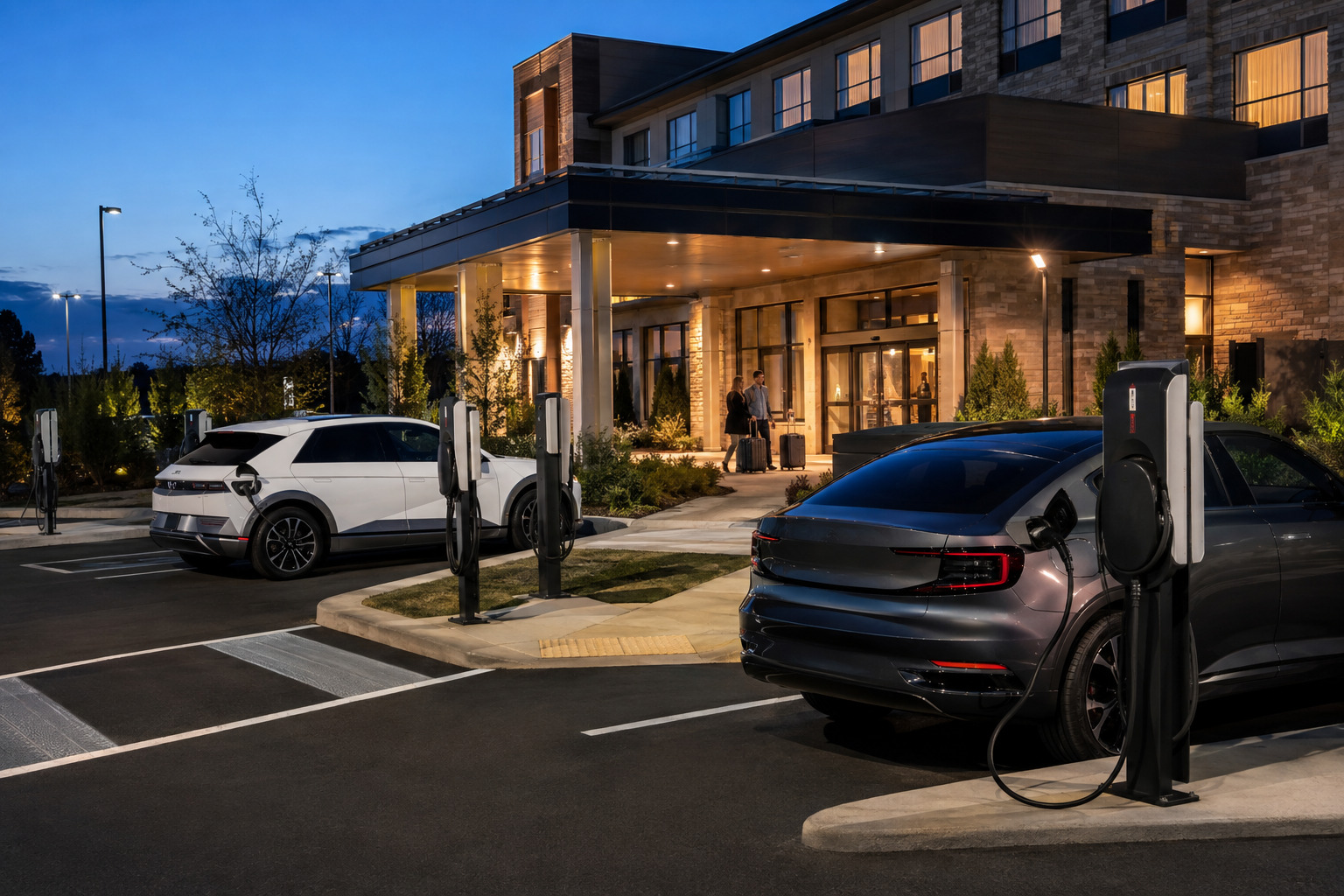
I have worked with hospitality operators, property managers, and charge point partners for years as general manager at Parwatt New Energy. We supply chargers and power modules used at hotels and destination properties. I regularly speak with general managers who first viewed charging as an extra cost and later recognized it as a guest-experience and revenue tool. Our solutions, including equipment in the EV Charger Category, are designed for the reliable overnight performance hotels need. In this article I explain the business case for hotel EV charging and how properties can capture the value in 2026.
Why Hotels Without EV Charging Are Losing Guests and Revenue?
EV drivers increasingly treat charging availability as a basic filter when they book lodging. Properties that lack chargers disappear from consideration or receive lower preference. High-value guests choose competitors, stay shorter, or leave less positive reviews. The revenue impact compounds as EV adoption grows.
Hotels without EV charging lose bookings and guest satisfaction because many EV drivers require or strongly prefer on-site charging. The absence of chargers reduces visibility on booking platforms, shifts demand to equipped competitors, and risks lower ratings from travelers who arrive with range needs.
The Growing Booking Filter
I have reviewed feedback from hotel operators who noticed a clear pattern. Guests contacted the property in advance to ask about charging. When the answer was no, many booked elsewhere. Others arrived, discovered no convenient option, and expressed frustration in reviews or at the front desk.
Booking platforms now commonly allow travelers to filter for EV charging. Properties that do not offer the amenity simply do not appear in those filtered results. The loss is silent yet continuous.
EV travelers often represent higher average spending. They may stay longer when charging is easy, dine on site, and use other hotel services while the vehicle tops up overnight. When they choose a competitor, that secondary spending leaves with them.
Negative reviews related to charging create lasting damage. A single frustrated comment about the lack of chargers or a poorly maintained unit can influence many future booking decisions.
Here is a table that shows how the absence of charging affects hotels:
| Impact Area | What Happens | Business Consequence | Who Notices First |
|---|---|---|---|
| Booking filters | Property excluded from EV searches | Lost visible demand | Revenue and reservations teams |
| Direct guest preference | Drivers choose equipped hotels | Lower occupancy from EV segment | Front desk and management |
| Review sentiment | Complaints about missing or poor charging | Reduced ratings and future bookings | Reputation and marketing |
| Secondary spend | Guests stay elsewhere | Lost food, beverage, and service revenue | F&B and operations |
| Competitive position | Nearby hotels gain the segment | Market-share shift | Ownership and asset managers |
This table reflects patterns reported by hospitality partners. At Parwatt we see stronger guest feedback when hotels install reliable Level 2 systems that match overnight stays. Our hardware is selected for the consistent uptime that protects both guest experience and reviews.
In 2026 the expectation continues to rise. Travelers who have grown used to charging at one hotel begin to assume it should be available at others. Properties that delay installation fall further behind the competitive set.
The Common Traps Hotels Fall Into When Evaluating EV Charging
Many hotels approach charging with assumptions that limit results. They treat it only as a cost. They install the wrong power level for overnight stays. They underestimate ongoing operations and maintenance. They fail to connect charging to booking and loyalty systems. They undervalue the indirect revenue from longer stays and higher satisfaction. These traps produce weak returns even after installation.
Common traps include viewing charging purely as a cost, choosing inappropriate power levels, neglecting operations and uptime, failing to integrate with booking and loyalty tools, and underestimating indirect benefits. These mistakes reduce guest impact and make the investment appear less attractive than it can be.
Mistakes That Weaken the Business Case
One frequent trap is the cost-only frame. When charging is evaluated solely as capital and energy expense, the project competes poorly against other capital needs. Guest-satisfaction gains, booking preference, and secondary spend never enter the calculation.
Power-level mistakes are common. Some properties install DC fast charging because it sounds more advanced, even though most hotel guests stay overnight and need only Level 2. The higher capital and demand charges produce little extra guest value for typical dwell times.
Operations are often under-planned. Chargers that go offline or remain broken for days generate guest complaints. Without clear responsibility for monitoring and repair, the amenity becomes a liability rather than an advantage.
Integration gaps limit visibility. If charging is not listed on booking platforms, mentioned in confirmation emails, or connected to loyalty communications, many guests never learn it exists. Utilization stays lower than the property’s traffic would support.
Indirect benefits are frequently ignored. Longer dwell time, higher on-site spending, improved review scores, and stronger brand perception among eco-conscious travelers all carry value. Models that omit them understate the total return.
Here is a table of the main evaluation traps:
| Trap | Why It Happens | Result | Better Approach |
|---|---|---|---|
| Cost-only view | Facilities budget framing | Project delayed or minimized | Include guest and revenue effects |
| Wrong power level | Assumption that faster is better | Excess capital and demand charges | Match Level 2 to overnight stays |
| Weak operations plan | Focus only on installation | Downtime and guest complaints | Assign monitoring and response |
| No booking or loyalty integration | Treated as pure infrastructure | Low awareness and utilization | List and promote the amenity |
| Indirect benefits ignored | Harder to quantify | Understated business case | Track satisfaction and secondary spend |
This table captures issues I discuss with hotel operators. At Parwatt we help properties select right-sized, reliable equipment such as systems built around our 30kW Power Module and 40kW Power Module so the operational burden stays manageable.
I have seen hotels install chargers and then leave them poorly maintained or unpromoted. Guests who needed them could not find or use them, and the expected benefits never appeared. Avoiding the traps requires treating charging as a guest-facing service rather than a back-of-house utility.
How EV Charging Directly Improves Guest Satisfaction, Bookings and Loyalty
Reliable hotel charging removes a practical worry for EV drivers. Guests arrive knowing they can recharge overnight and leave with sufficient range. Satisfaction scores rise. Booking preference increases. Many travelers become more likely to return or recommend the property. The effect is strongest when the chargers work consistently and are easy to access.
EV charging improves guest satisfaction by eliminating range anxiety during the stay. It increases the likelihood that EV drivers will book the property and can support higher loyalty and repeat visits when the experience is reliable and convenient.
The Guest-Experience Mechanism
EV drivers plan trips around charging availability. When a hotel offers working chargers, the property moves higher on the shortlist. Surveys consistently show large majorities of EV drivers prefer or require charging when selecting lodging. Some are willing to pay more for the assurance.
During the stay the benefit is practical. Guests plug in upon arrival or after evening activities and wake to a vehicle ready for the next leg of travel. The absence of a midday search for public charging improves the overall trip experience.
Satisfaction data reflects the difference. Properties that provide reliable charging receive positive comments about convenience and forward-thinking service. Those that lack it or offer unreliable units receive the opposite feedback.
Loyalty effects appear over time. Travelers who have a smooth charging experience at one property in a brand or group are more likely to seek the same amenity on future trips. Charging becomes part of the expected standard for that brand.
Here is a breakdown of the guest-impact pathway:
| Stage | Guest Experience | Business Effect |
|---|---|---|
| Booking | Filters for or prioritizes charging | Higher conversion among EV drivers |
| Arrival | Easy access to working chargers | Positive first impression |
| During stay | Overnight recharge without extra effort | Higher satisfaction scores |
| Departure | Vehicle ready for next journey | Stronger recommendation likelihood |
| Future trips | Preference for equipped properties | Improved loyalty and repeat bookings |
This pathway explains why the amenity carries weight beyond simple energy delivery. At Parwatt we focus on the reliability that keeps the experience positive. Hardware that stays online protects both the guest rating and the property’s reputation. You can explore suitable solutions in the EV Charger Category.
I have reviewed guest comments that specifically praised hotels for making charging simple and dependable. Those comments often mention the reduction in travel stress. When the chargers work as expected, the amenity becomes an invisible support rather than a point of friction.
Revenue, Differentiation and Sustainability Benefits for Hospitality Properties
Hotel charging supports several forms of value. Properties can collect direct revenue from sessions. They can differentiate themselves on booking platforms and in competitive sets. Some achieve modest room-rate premiums or higher occupancy from the EV segment. Sustainability positioning provides an additional brand benefit among eco-conscious travelers.
Hotel EV charging creates value through direct session revenue, competitive differentiation on booking channels, potential rate and occupancy gains, and stronger sustainability positioning. The combination of guest experience and commercial benefits strengthens the overall business case.
Multiple Layers of Return
Direct revenue is the most visible layer. Hotels can set session fees, include charging in packages, or offer it as a paid premium amenity. While the absolute dollars may be modest compared with room revenue, they offset operating costs and demonstrate that the amenity can contribute positively.
Differentiation is often more powerful. On platforms that allow EV-charging filters, equipped properties appear and unequipped ones do not. In competitive local markets the presence of reliable chargers becomes a clear point of comparison.
Some operators report higher willingness to pay among EV drivers and modest lifts in average rate or occupancy after installation. Results vary by location and market segment, yet the direction is consistently positive when the chargers are dependable and well promoted.
Sustainability benefits support brand perception. Offering EV charging aligns with broader environmental goals, appears in corporate responsibility reporting, and resonates with travelers who consider green practices when choosing hotels. It can also contribute to certification efforts.
Here is a summary of the value layers:
- Direct charging revenue from sessions or packages
- Visibility and preference on booking platforms with EV filters
- Competitive differentiation against unequipped properties
- Potential support for rate integrity or occupancy in the EV segment
- Positive contribution to sustainability narrative and certifications
- Secondary spend from longer or more comfortable stays
At Parwatt we see the strongest overall returns when hotels combine reliable hardware with clear promotion of the amenity. Our systems, including options such as the Battery Buffered Ultra Rapid EV Charger for specific higher-power needs, are chosen by operators who want both uptime and manageable operating costs. Additional context appears in our article on Electric Vehicle Charging.
I have spoken with property managers who initially expected only cost and later found that the combination of guest compliments, booking-platform visibility, and modest session revenue changed their view. The business case becomes clearer once all layers are considered together.
How Hotels Can Build a Practical, Profitable Charging Program
A practical hotel charging program begins with the recognition that most guests need overnight Level 2 charging rather than ultra-rapid sessions. Properties should assess parking layout and electrical capacity, select reliable partners and hardware, set clear pricing and access rules, promote the amenity through booking and loyalty channels, and start with a right-sized pilot that can expand later.
Hotels build effective programs by prioritizing Level 2 for overnight stays, evaluating site and power conditions, partnering for reliable operations, setting transparent pricing, integrating charging into marketing and loyalty tools, and expanding from a measured pilot.
Implementation Steps That Deliver Results
Choose Level 2 as the default for the majority of stalls. Overnight dwell times align perfectly with Level 2 power delivery. Capital cost stays lower, demand charges remain manageable, and battery impact on guest vehicles is minimized. DC fast charging can be added selectively only if the property has a clear short-stay use case.
Conduct a site and electrical assessment. Identify convenient parking locations close to entrances or guest rooms and determine available capacity. Load management can often allow more stalls without major service upgrades.
Select hardware and partners focused on uptime. Hotels need chargers that stay online and a clear process for monitoring and rapid response when issues appear. Guest experience depends on consistency.
Set pricing and access policy in advance. Decide whether charging is free for guests, offered at a modest rate, or bundled into packages. Clear rules prevent confusion and support fair utilization.
Integrate the amenity into guest-facing channels. List charging on the property website, booking platforms, confirmation messages, and loyalty communications. Front-desk staff should be able to direct guests quickly.
Begin with a pilot number of stalls, measure utilization and guest feedback, then expand. This approach controls capital and allows pricing or policy adjustments based on real use.
Here is a concise implementation list:
- Prioritize Level 2 charging matched to overnight stays.
- Assess parking locations and electrical capacity early.
- Choose reliable hardware and define monitoring responsibility.
- Establish clear pricing and guest access rules.
- Promote charging on booking platforms and in guest communications.
- Train staff to assist guests with location and basic use.
- Launch a limited pilot and track utilization plus feedback.
- Expand capacity on the basis of measured demand.
At Parwatt we support hotels with hardware designed for dependable daily operation. Our power modules and complete systems help properties deliver the consistent experience that turns charging into a guest advantage. Further guidance on technology choices is available in our comparison of AC vs DC EV Charging.
Hotels that follow these steps avoid most of the common pitfalls and create a program that guests notice and value. The combination of right-sized technology, operational reliability, and clear promotion produces both satisfaction gains and a stronger commercial result.
Conclusion
EV charging has moved from optional amenity to a measurable driver of guest satisfaction, booking preference, and property competitiveness. At Parwatt we design chargers and power modules for the reliable overnight performance that hotels require. Hotels that offer reliable Level 2 charging for overnight stays meet a growing traveler expectation, reduce range anxiety for road-trip guests, and open new revenue and loyalty opportunities. The strongest business cases combine guest experience gains with practical deployment—right-sized hardware, clear pricing, and dependable uptime. Properties that treat charging as part of the core guest journey rather than a pure infrastructure project position themselves to capture high-value EV travelers and strengthen both occupancy and brand perception.

--- END ---
Related Posts
Business Ideas

Business Ideas

Business Ideas

Business Ideas


