

How Long Does a 7kW Home Charger Take to Charge an EV?
Oct 23,2026
There is no single charging time for every EV on a 7kW home charger. Battery size, starting state of charge, target limit and the vehicle’s maximum AC input all change the result. At Parwatt I see owners expect one fixed number and then feel confused when their car takes longer or shorter than a neighbour’s.
A 7kW home charger typically needs about 6–12 hours for a full charge depending on battery size. Real time is set by the energy you must add, not by the battery’s total capacity alone. For most daily use, overnight charging easily replaces the energy used during the day.
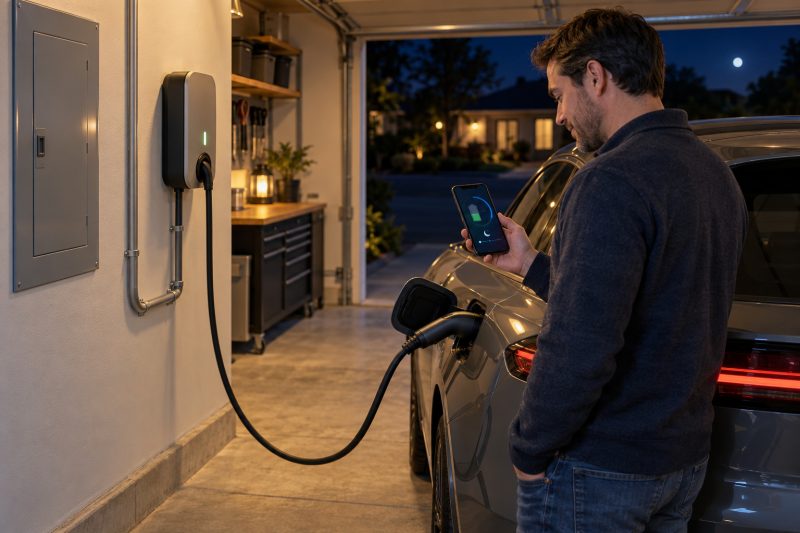
I have worked with residential installers, fleet managers and home EV users for years as general manager at Parwatt New Energy. We supply EV charging equipment and power modules used in home and commercial projects. I regularly answer the same practical question: how long will a 7kW wallbox take on my car? The honest answer always starts with how many kilowatt-hours must be added. Our guidance for products in the EV Charger Category focuses on real energy need and vehicle limits. In this article I explain how to estimate 7kW charging times and how to make overnight charging more efficient in 2026.
Why There Is No Single Charging Time for Every EV?
A 7kW charger delivers power at a fixed maximum rate. The time needed depends on how much energy the battery still requires and on whether the vehicle can accept the full 7kW. A small battery starting at 50% finishes much sooner than a large battery starting near empty. Two cars on the same wallbox can therefore show very different session lengths.
There is no single charging time because battery capacity, starting charge, target limit and the vehicle’s AC acceptance all vary. The same 7kW charger can need a few hours or more than ten hours depending on those factors.
What Changes the Clock
I have compared sessions on the same 7kW unit with different vehicles. A compact EV with a 40kWh battery that started at 40% reached a daily limit of 80% in a few hours. A larger EV with an 80kWh battery that started at 10% needed a full overnight period to approach 100%.
The energy that must be added is the real workload. A 60kWh battery moving from 20% to 80% needs about 36kWh. At a steady 7kW that energy takes a little over five hours before losses. Starting at 10% and aiming for 100% on the same battery needs far more time.
The vehicle’s onboard charger can lower the effective rate. If the car only accepts 3.6kW or 6kW AC, the wallbox cannot force 7kW into it. The session then runs longer than the simple 7kW calculation suggests.
Temperature and battery management also stretch the clock. Cold batteries may accept less power at the start. Near the top of charge the vehicle often reduces current, so the last portion takes longer per kilowatt-hour.
Here is a table that shows why times differ:
| Factor | Effect on Time | Practical Example |
|---|---|---|
| Battery capacity | Larger pack needs more energy | 40kWh vs 80kWh |
| Start SOC | Lower start needs more energy | 10% vs 50% |
| Target limit | 80% finishes sooner than 100% | Daily limit vs full |
| Vehicle AC limit | May be below 7kW | 3.6kW or 11kW car |
| Temperature / taper | Slows start or finish | Cold morning or top-up |
This table reflects the variation I discuss with home users of equipment from the EV Charger Category.
In 2026 the useful question is not “how long for any EV” but “how long for the energy my car needs tonight.”
The Charging-Time Mistakes EV Owners Commonly Make
Owners often divide the full battery capacity by 7 and treat the result as exact. They may also assume the wallbox always delivers a steady 7kW, or ignore the vehicle’s own AC limit, conversion losses and the natural reduction in power near full charge. These mistakes produce expectations the real session cannot meet.
Common charging-time mistakes include dividing full battery capacity by 7, treating the wallbox rating as continuous delivered power, and ignoring vehicle limits, losses and taper near full charge.
Mistakes That Distort Expectations
One frequent mistake is calculating a full 0–100% time for every night. Most drivers only replace the energy used that day. A 60kWh car that used 20kWh needs roughly three hours at 7kW before losses, not the eight or nine hours of a complete empty-to-full cycle.
Another mistake is assuming the charger runs at exactly 7kW from start to finish. Household load management, supply voltage and the vehicle’s request can all reduce the average power. The session then runs longer than the ideal number.
Some owners overlook the vehicle’s maximum AC rate. A car limited to 3.6kW or 6kW will never pull the full 7kW. The wallbox rating becomes irrelevant for speed on that vehicle.
Losses during AC-to-DC conversion and battery conditioning add a further gap. A calculation that ignores them understates the real time by a noticeable margin.
Near the end of charge the battery management system often reduces current. The last 10–20% can take longer per kilowatt-hour than the middle of the session. Linear estimates miss this effect.
Here is a table of common mistakes:
| Mistake | Why It Misleads | Better Approach |
|---|---|---|
| Full capacity ÷ 7 every night | Most nights are partial | Use energy actually needed |
| Assume constant 7kW | Real power may be lower | Measure or allow a margin |
| Ignore vehicle AC limit | Car may accept less | Check onboard charger rating |
| Ignore conversion losses | Ideal time is too short | Add 10–15% margin |
| Ignore top-of-charge taper | Last portion slows | Expect longer final stage |
This table keeps planning realistic. At Parwatt we encourage owners to work from energy needed and vehicle limits when using products related to the FES-D30 DC EV Charger or AC home units.
I advise drivers to write down the kilowatt-hours used each day for a week. That simple record replaces guesswork about overnight time.
How to Calculate Your Estimated 7kW Charging Time
A practical estimate starts with the energy that must be added. Multiply battery capacity by the difference between target and starting percentages. Divide that energy by the lower of the wallbox power and the vehicle’s maximum AC power. Then add a margin for losses and normal power variation.
Estimate 7kW charging time by calculating the kilowatt-hours to add, dividing by the effective power limit, and allowing extra time for losses and taper. The vehicle AC limit can be lower than 7kW.
A Simple Worked Method
First note the usable battery capacity in kWh and the starting and target state of charge. The energy required is capacity × (target − start).
Example: a 60kWh battery from 30% to 80% needs 0.5 × 60 = 30kWh.
Next compare the wallbox rating with the vehicle’s maximum AC charging rate. Use the lower number as the effective power. If the car accepts 7kW or more, use 7kW. If the car accepts only 6kW, use 6kW.
Ideal time is energy ÷ effective power. In the example, 30kWh ÷ 7kW ≈ 4.3 hours.
Add a margin of roughly 10–15% for conversion losses, conditioning and minor power drops. The practical estimate becomes about 4.7–5 hours.
If the session must reach a high percentage, allow extra time for the final taper. The last portion is rarely as fast as the middle.
For overnight planning, check whether the estimated time fits the available hours between arrival and departure. If it does not, raise the starting SOC by charging more on previous days or adjust the target.
Here is a calculation checklist:
- Battery capacity in kWh
- Starting and target percentages
- Energy to add = capacity × (target − start)
- Vehicle maximum AC power
- Effective power = lower of 7kW and vehicle limit
- Ideal hours = energy ÷ effective power
- Add 10–15% for losses and variation
- Extra allowance if target is near 100%
- Compare with available overnight window
At Parwatt we use the same energy-based method when advising residential customers who later expand toward commercial systems built around the 30kW Power Module or 40kW Power Module.
I recommend saving the calculation for your own car in a note on your phone. It becomes a quick reference every time the daily mileage changes.
Typical Charging Times for 40kWh, 60kWh and 80kWh Batteries
Typical times differ clearly with battery size and with the chosen charge window. A 40kWh pack needs less time than an 80kWh pack for the same percentage range. Partial windows such as 20–80% finish much sooner than 10–100% or 0–100%.
Typical 7kW times rise with battery size. Rough full-charge estimates are about 6–7 hours for 40kWh, 8–10 hours for 60kWh and 10–12 hours for 80kWh under ideal conditions. Partial daily windows are substantially shorter.
Illustrative Ranges
For a 40kWh battery, a simple full-capacity calculation at 7kW gives a little under six hours before losses. Real full sessions often fall in the 6–7 hour range. A 20–80% window needs only about 24kWh and can finish in roughly four hours including margin.
For a 60kWh battery, a full ideal calculation is about 8.6 hours. Practical full charges often sit in the 8–10 hour band. A 20–80% window needs about 36kWh and typically takes five to six hours with losses.
For an 80kWh battery, a full ideal calculation is about 11.4 hours. Practical full charges often need 10–12 hours or more. A 20–80% window needs about 48kWh and may take seven to eight hours including margin.
These figures assume the vehicle can accept the full 7kW. If the onboard limit is lower, every interval stretches in proportion.
Daily commuting rarely empties the battery. A driver who uses 15–25kWh per day can often restore that energy in three to four hours at 7kW, which fits easily into an overnight window.
Here is a summary table of approximate times at 7kW (ideal base, then practical range):
| Battery | 20–80% energy | Ideal hours | Practical range | Full charge practical |
|---|---|---|---|---|
| 40kWh | ~24kWh | ~3.4 | ~4 hours | ~6–7 hours |
| 60kWh | ~36kWh | ~5.1 | ~5–6 hours | ~8–10 hours |
| 80kWh | ~48kWh | ~6.9 | ~7–8 hours | ~10–12 hours |
This table gives owners a realistic band rather than a single number. At Parwatt we share similar ranges when discussing home charging before customers consider faster options such as the Battery Buffered Ultra Rapid EV Charger.
I advise treating the table as a guide and then calculating the exact energy for your own start and target percentages.
How to Make Overnight 7kW Charging More Efficient
Overnight efficiency comes from matching the session to real daily use, using off-peak tariffs where available, keeping the cable and inlet in good condition, and avoiding unnecessary 0–100% cycles. Smart scheduling and a sensible daily limit often matter more than pushing every session to the maximum.
Make overnight 7kW charging more efficient by scheduling sessions, using off-peak rates, maintaining clean connections, and replacing only the energy used each day instead of charging from near empty to 100% every night.
Practical Steps That Save Time and Cost
Set a charge schedule in the vehicle or the wallbox so energy is delivered when electricity is cheaper or when the house load is low. The car still finishes by morning, yet the cost per kilowatt-hour falls.
Choose a daily limit that matches your routine. Many drivers use 80% or 90% for ordinary days and reserve 100% for long trips. The session ends sooner and the battery spends less time at high state of charge.
Charge according to distance driven. If the day used only 20% of the battery, a short top-up is enough. Starting every night from a low percentage wastes time and is rarely necessary.
Keep the connector and inlet clean and fully seated. Poor contact can increase resistance, create heat and reduce effective power. A quick visual check before plugging in prevents many slow sessions.
Ensure the wallbox is not being heavily limited by load management unless the household supply requires it. If other large loads run at the same time, the charger may temporarily reduce current. Shifting those loads improves the average charging rate.
In cold weather, precondition the battery when possible so the session can accept higher power sooner. Some vehicles do this automatically when plugged in and scheduled.
Here is an efficiency checklist:
- Schedule charging for off-peak or low-load hours
- Set a daily charge limit suited to normal mileage
- Top up the energy used rather than empty-to-full
- Inspect cable and inlet for dirt or damage
- Avoid unnecessary simultaneous high household loads
- Use preconditioning in cold conditions when available
- Confirm the vehicle is not capped below 7kW by settings
- Record a few sessions to learn your real average rate
- Keep installation and firmware up to date
- Review tariff and schedule a few times per year
At Parwatt we support these habits for residential users of systems in the EV Charger Category. Further background on charging behaviour appears in our articles on Electric Vehicle Charging and AC vs DC EV Charging. Product options are available on our main site.
Owners who treat 7kW charging as a daily top-up rather than a full reset find that overnight windows are more than adequate for normal driving.
Conclusion
A 7kW home charger can typically replenish many EVs overnight, but the actual time depends on how much energy must be added—not simply the battery’s total capacity. At Parwatt we help owners calculate real session length from energy need and vehicle limits so expectations stay accurate. Under ideal conditions, adding 42kWh takes about six hours at 7kW, while real charging may take slightly longer because of conversion losses, temperature, power limitations, and battery-management controls. Check the vehicle’s maximum AC charging rate and calculate the energy required between the starting and target charge levels. For most daily commutes, drivers only need to replace part of the battery, making a 7kW charger a practical home-charging solution.

--- END ---
Prev: Do EV Chargers Stop Automatically When the Battery Is Full?
Already the latest article
Related Posts


Business Ideas

Business Ideas
