

Do EV Chargers Stop Automatically When the Battery Is Full?
Oct 22,2026
Many drivers worry that an EV will keep charging after the battery is full. In normal use the vehicle, the battery management system and the charging equipment work together to stop or sharply reduce power when the selected limit is reached. At Parwatt I still see confusion when the station stays powered or when a session ends earlier than expected.
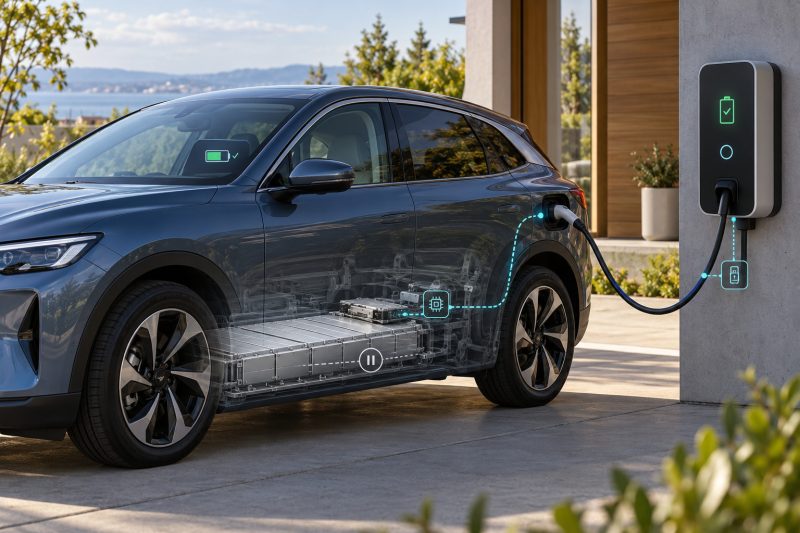
Modern EV charging systems normally stop regular charging power when the battery reaches the limit set by the vehicle. The battery management system makes the key decision. The charger supplies power and protection, then follows the vehicle’s request. After the main charge ends, small standby or preconditioning draws may continue.
I have worked with charge point operators, fleet managers and home users for years as general manager at Parwatt New Energy. We supply EV charging equipment and power modules used in residential and commercial projects. I regularly answer questions about whether charging stops by itself and why a session sometimes ends before 100%. Our guidance for products in the EV Charger Category always starts with vehicle control and correct installation. In this article I explain what happens when an EV reaches its charge limit and how drivers can tell normal behaviour from a real problem in 2026.
What Actually Happens When an EV Reaches Its Charge Limit?
When the battery reaches the limit chosen in the vehicle, normal charging current stops or falls to a very low level. The charging station may still stay powered and keep a communication link with the car. “Charge complete” therefore means the battery is no longer taking regular charging power. It does not always mean the wall unit or the cable is fully dead.
When an EV reaches its charge limit, normal charging stops or drops sharply. The station may remain powered for communication, thermal management or scheduled preconditioning. Stopping charge is not the same as cutting all power to the equipment.
Normal End-of-Charge Behaviour
I have reviewed home and public sessions where the car showed 100% or the driver’s set limit and the energy meter stopped rising. The connector stayed locked and the station display still showed a connected state. This is expected behaviour on most modern systems.
The vehicle reduces its current request as it approaches the target. Near the limit the request falls to zero or to a maintenance level. The charger follows that request and ends the main energy transfer.
After the main charge, the car may draw small amounts of power. Battery temperature control, cabin preconditioning for a departure time, or holding the selected state of charge can all create low-level draws. These are not full-power charging sessions.
Public and workplace stations may also keep the session open for billing or connector lock reasons until the driver ends it or an idle timer expires. The battery itself is already at the limit.
Here is a table that separates battery status from equipment status:
| Observation | What It Usually Means | Driver Action |
|---|---|---|
| Display shows limit reached | Main charge complete | Normal |
| Energy meter no longer rising | No regular charging power | Normal |
| Connector still locked | Session still active for lock or billing | End session if leaving |
| Station still powered | Standby / communication | Normal for most units |
| Small ongoing power draw | Thermal or preconditioning | Normal if brief and low |
This table reflects the end-of-session patterns I explain to users of equipment from the EV Charger Category.
In 2026 most drivers can leave the car connected after the limit is reached without forcing extra energy into the battery. The control logic is designed for that use.
Why the Charger Alone Does Not Decide When the Battery Is Full
The charging station does not decide by itself that the battery is full. The vehicle’s battery management system monitors cell voltage, temperature and state of charge. It decides how much power the battery can safely accept. On AC charging the onboard charger also takes part. On DC fast charging the vehicle and the station negotiate continuously, but the vehicle still sets the critical battery limits.
The charger alone does not decide when the battery is full. The vehicle BMS monitors the battery and controls the power request. AC sessions use the onboard charger; DC sessions use continuous negotiation under vehicle limits.
Where the Decision Authority Sits
I have compared AC and DC sessions on the same vehicle. In both cases the car reduced current as state of charge rose and ended the main transfer at the selected limit. The wallbox or the DC cabinet followed the vehicle’s request.
On AC charging the EVSE advertises the maximum current it can supply. The vehicle requests a value within that limit. The onboard charger converts AC to DC and feeds the battery under BMS supervision. When the BMS says the target is reached, the request drops.
On DC fast charging the external charger supplies regulated DC. The vehicle still sends the voltage and current targets and the stop conditions. The station must respect those limits. If communication fails or a protection trips, either side can end the session.
Because the battery lives inside the car, the BMS is the system that has the cell-level data. A charger without that data cannot safely declare the battery full on its own.
Here is a responsibility summary:
| Charging Type | Who Supplies Power | Who Sets Battery Limit | Who Can Stop the Session |
|---|---|---|---|
| AC Level 2 | EVSE (AC) | Vehicle BMS + onboard charger | Vehicle or EVSE protection |
| DC fast | External DC charger | Vehicle BMS | Vehicle or station protection |
| Charge target | Set in vehicle | Vehicle | Vehicle reaches target |
| Fault / safety | Either side | Protection rules | Either side |
This summary keeps the control roles clear. At Parwatt we design modular systems, including stages such as the 30kW Power Module and 40kW Power Module, so the vehicle request remains the governing signal.
I tell drivers that the car is in charge of the battery decision. The station’s job is to supply power safely inside the limits the car requests.
How the EV, BMS and Charging Station Work Together
A normal session follows a clear sequence. The connector is locked and safety checks run. The vehicle and station establish communication. The vehicle requests current within the allowed limits. Temperature and voltage are monitored throughout. When the target is reached or a fault appears, power transfer stops or falls to a maintenance level.
The EV, BMS and charging station work together through connection checks, current negotiation, continuous monitoring and automatic stop at the target or on fault. Each part has a defined role in the sequence.
Step-by-Step Control Flow
When the plug is inserted and locked, both sides confirm the connection. Protective checks look for insulation problems, grounding issues and basic compatibility.
Communication begins. On AC systems this includes the control signals that set the maximum available current. On DC systems a more detailed digital dialogue exchanges limits, voltage targets and status.
The BMS uses state of charge, cell voltages and temperatures to decide the present request. The station supplies power only up to that request and its own hardware limits.
During the session both sides keep watching for over-temperature, communication loss, residual current events and other faults. Any serious event ends power transfer.
When the selected limit is reached, the vehicle reduces the request to zero or to a very low hold level. The station follows. The connector may stay locked until the driver or the station ends the session.
Scheduled preconditioning or thermal management can start later while the cable is still connected. These draws are separate from the main charge.
Here is a simplified sequence table:
| Stage | Main Action | Controlled By |
|---|---|---|
| Connect and lock | Safety and presence checks | Vehicle + station |
| Handshake | Limits and status exchanged | Vehicle + station |
| Main charge | Current delivered to request | Vehicle request, station supply |
| Monitoring | Temperature, voltage, faults | BMS + station protection |
| Target reached | Request drops or stops | Vehicle BMS |
| Standby / precondition | Low-level draws possible | Vehicle |
| Session end | Connector unlock or idle rule | Driver or station policy |
This sequence is the reason automatic stopping works on compatible, certified systems. At Parwatt we implement the same control principles in products such as the FES-D30 DC EV Charger and related platforms in the EV Charger Category.
I recommend that drivers learn the normal sequence for their own car and station. Familiar patterns make unusual behaviour easier to spot.
Full Battery, Charge Limit or Early Shutdown: How to Tell the Difference
Not every stop means the battery is at 100%. The car may have reached a user-set limit of 80% or 90%. DC fast charging may taper or stop early because of temperature or protective logic. Payment, communication, idle timers or equipment faults can also end a session before the battery target is met.
Full battery, user charge limit and early shutdown are different events. Reaching a set 80% or 90% is normal. DC taper near full is normal. Repeated early stops with errors or heat need investigation.
How to Read the Stop Reason
I have examined sessions that stopped at 80% because the driver had set that daily limit. The system was working correctly. Changing the limit in the vehicle menu restored charging to a higher target on the next session.
Other sessions slowed sharply above 80% on DC fast chargers. Battery temperature and cell balancing often cause this taper. The station was still following the vehicle’s reduced request.
Early stops with error codes are different. Communication loss, residual-current trips, over-temperature on the cable or inlet, payment failure, or station-side faults can all terminate power before the battery limit. The car or the station display usually shows a message.
Timeout or idle policies on public networks can end a session after a fixed period even if the battery is not full. The driver may need to restart or move to another stall.
A stop that occurs with visible heat, burning smell, or repeated breaker trips is not a normal charge-limit event. Charging should not continue until the cause is found.
Here is a comparison of stop types:
| Stop Type | Typical Display | Usual Cause | Driver Response |
|---|---|---|---|
| 100% reached | Full / complete | Battery at absolute limit | Normal |
| User limit reached | 80% or 90% complete | Daily limit setting | Normal or adjust limit |
| DC taper near full | Slow rate, then stop | Temperature / cell logic | Normal for DC |
| Error or fault stop | Error code / fault light | Communication, RCD, heat | Stop use, inspect |
| Payment / idle timeout | Session ended | Network policy | Restart or move |
| Breaker trip | Power lost | Circuit or equipment fault | Do not reset repeatedly |
This comparison helps drivers avoid unnecessary service calls and still catch real faults. At Parwatt we encourage users of our systems, including solutions discussed in Electric Vehicle Charging, to note the exact message and state of charge when a session ends early.
I advise keeping a simple log of unexpected stops. Patterns of heat or repeated codes point to installation or hardware issues rather than normal battery logic.
What Drivers Should Check When Charging Does Not Stop—or Stops Too Soon
When charging seems to continue past the limit, or when it stops far too early, a short checklist separates settings issues from equipment problems. Check the vehicle charge limit and schedule. Read any error messages on the car and the station. Try a careful reconnect. If there is abnormal heat, repeated tripping, or charging that cannot be terminated, stop using the equipment and seek professional inspection.
When charging does not stop or stops too soon, check the vehicle limit and schedule, read error messages, reconnect carefully, and stop use if heat, trips or uncontrolled behaviour appear. Professional inspection is required for persistent faults.
Practical Checks Drivers Can Perform
Open the vehicle charging menu. Confirm the charge limit and any scheduled end time. A limit of 80% explains many “early” stops. A schedule that ends before the battery is full explains others.
Look at both the car screen and the charger display. Note any fault codes, temperature warnings or communication errors. Photograph them if possible before clearing the session.
End the session properly, wait a moment, and reconnect the plug. A one-time communication glitch can look like a permanent stop.
Feel the plug, cable and inlet after a problematic session (carefully). Mild warmth can be normal. Uncomfortable heat, discoloration or soft plastic is not.
Check the home breaker or the site’s protective devices if power was lost. Repeated trips mean the circuit or the equipment needs attention. Continuous resetting is not a solution.
If the car still accepts power after the displayed limit is reached and energy continues to rise at a normal charging rate, stop the session and contact support. That behaviour is outside normal BMS control and should be investigated.
For public DC sessions that end early without an error, try another stall or another network if available. Station-side limits or cooling issues can produce the same symptom as a vehicle limit.
Here is a driver action checklist:
- Confirm charge limit and schedule in the vehicle
- Record any error messages on car and station
- End session and reconnect once
- Check cable, plug and inlet for heat or damage
- Note breaker trips or residual-current events
- Stop use if heat, smell or uncontrolled charging continues
- Seek qualified inspection for repeated faults
- Keep session notes for service discussions
- Prefer certified, compatible equipment only
- Follow both vehicle and charger manuals
At Parwatt we give similar checklists to residential and commercial users of our charging systems. Further technical background appears in our article on AC vs DC EV Charging. Product information and support options are available through the EV Charger Category and our main site.
Drivers who follow the checklist resolve most settings issues themselves and still recognise the minority of cases that need professional work. That balance keeps overnight and public charging both convenient and controlled.
Conclusion
Modern EV charging systems normally stop delivering regular charging power when the battery reaches the limit selected by the vehicle. At Parwatt we design equipment so the vehicle request and electrical protection work together. However, the process is not controlled by the charging station alone. The vehicle’s battery management system monitors the battery and determines how much power it can safely accept, while the EVSE provides power, communication, and electrical protection. After charging ends, the system may remain connected and use small amounts of electricity for standby communication, battery temperature control, or scheduled cabin preconditioning. Drivers should use compatible, properly installed equipment and investigate any repeated early shutdowns, unusual heat, error messages, or charging that continues beyond the selected limit.

--- END ---
Related Posts


Business Ideas

Business Ideas
