

How to Test EV Charger Samples Before a Bulk Order: A Buyer’s Checklist
Nov 06,2026
An EV charger sample should not be approved simply because it connects to one vehicle and starts charging. That test confirms only the most basic function under one set of conditions.
Problems involving cable temperature, protection behavior, vehicle compatibility, energy metering, firmware, network recovery and continuous operation may appear only after longer testing or under controlled abnormal conditions. Smart and commercial chargers also introduce software, cloud and backend dependencies that a short factory demonstration may not reveal.
Before testing begins, the buyer should document the exact sample configuration. This includes its model number, rated power, input voltage, supply phase, connector, cable length, communication hardware, meter, firmware and OCPP version. A standard factory sample cannot validate a customized bulk-order configuration if these details will change later.
The testing process should then combine buyer inspection, functional evaluation, qualified electrical testing, reliability testing and production verification. Once approved, the complete sample must become a controlled reference for mass production.
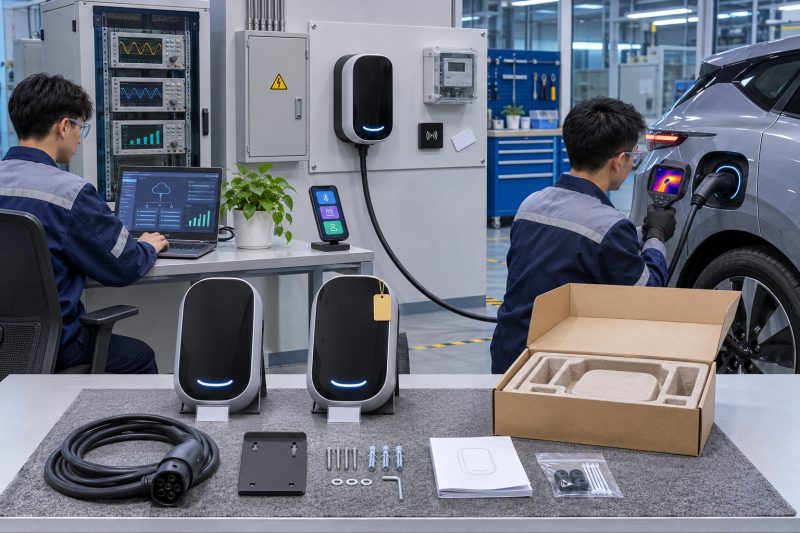
Why “It Charges the Car” Is Not Enough to Approve a Sample
Starting a charging session confirms that the charger and vehicle can communicate under the test conditions. It does not prove that the product will remain stable during an overnight session, operate correctly with other vehicles or respond safely to abnormal conditions.
A short demonstration may fail to reveal:
- Excessive temperature rise in the cable or connector
- Intermittent communication faults
- Incorrect energy metering
- Unstable Wi-Fi or cellular communication
- Failure to recover after a power interruption
- App-account and ownership-transfer problems
- RFID authorization errors
- Inaccurate dynamic load management
- OCPP incompatibility with the buyer’s platform
- Firmware-update failures
- Thermal derating under continuous load
- Cooling problems in high-power equipment
- Packaging damage during transportation
The sample may also differ from the model covered by the supplier’s certificate. A charger can look identical to a certified version while using a different power rating, cable, connector, communication module or internal protection arrangement.
Five levels of EV charger sample testing
| Testing level | Recommended checks | Suitable personnel |
|---|---|---|
| Buyer inspection | Model, label, appearance, dimensions, accessories, packaging, instructions and app language | Purchasing or product team |
| Functional testing | Real-vehicle charging, RFID, app, scheduling, network loss, load management and OCPP | Qualified electrician, engineer or pilot installation team |
| Compliance testing | Insulation, dielectric strength, earthing, EMC, environmental protection and applicable standard tests | Accredited or appropriately qualified laboratory |
| Reliability testing | Continuous load, temperature rise, start-stop cycles, aging and environmental tests | Laboratory or factory testing department |
| Production verification | BOM, firmware, serial numbers, end-of-line testing, packaging and shipment sampling | Factory QC and third-party inspection agency |
These levels should support one another. A buyer’s inspection cannot replace laboratory testing, and a certificate cannot prove that every production unit was assembled correctly.
Test the finished configuration
The sample should represent the product customers will receive. If the bulk order includes a customized connector, cable length, enclosure, communication module, display or private-label package, those elements should be present during approval.
The configuration record should include:
- Product model and commercial name
- AC or DC design
- Rated input and output
- Single-phase or three-phase supply
- Maximum current
- Connector type
- Cable specification and length
- Meter model
- Wi-Fi, Ethernet or cellular module
- RFID hardware
- Load-management accessories
- Firmware version
- OCPP version
- App and cloud-platform version
- Product label revision
- Packaging revision
The record provides a baseline when the sample is later compared with pre-production and bulk units.
Safety documentation must match the sample
Buyers should verify certificates and reports against the exact product rather than accepting documents issued to the supplier’s company or a related product family.
Check:
- Certificate holder
- Manufacturer and production site
- Product category
- Exact model number
- Rated voltage and current
- AC or DC configuration
- Connector or cable coverage
- Applicable standards
- Report date and validity
- Issuing organization
Parwatt’s guide to EV charger safety standards and certifications explains why buyers must match documentation to the exact model and destination market rather than relying only on a compliance logo.
The Sample-Testing Mistakes That Reappear in Mass Production
A weak sample-approval process creates problems that may remain hidden until hundreds of products have been manufactured.
Testing only one vehicle
One successful session does not establish broad compatibility. Different vehicles can vary in:
- AC onboard-charger limits
- DC voltage architecture
- Communication behavior
- Connector locking
- Charge-start timing
- Sleep and wake behavior
- Scheduled-charging logic
- Charging completion behavior
- Regional software configuration
Buyers should select representative EVs and PHEVs from the target market. The set should cover important vehicle brands, connector types, charging powers and, for DC equipment, different battery-voltage platforms.
Running only one short session
A five-minute charging demonstration is unlikely to reveal temperature rise, intermittent faults or thermal derating.
Testing should include:
- Repeated start and stop cycles
- Extended charging at realistic load
- Operation at different current settings
- Charging after power interruption
- Vehicle disconnection and reconnection
- Completion at the vehicle’s target state of charge
- Operation in representative ambient conditions
The buyer should document the measured charging power, session duration, temperatures, faults and recovery behavior.
Using only the supplier’s demonstration platform
A supplier-controlled backend may already be configured for the charger and may not reveal interoperability problems.
For an OCPP product, the charger should also be connected to the buyer’s intended charging-management system. A successful factory demonstration proves only that the supplier’s selected combination works.
Failing to record the firmware version
Hardware performance and smart functions can change after a firmware update. A sample approved without a recorded version cannot become an effective production reference.
The approval file should record:
- Charger firmware
- Communication-module firmware
- Display or interface software
- App version
- Cloud-platform version
- Load-controller firmware
- Power-module firmware where applicable
If any version changes before production, the supplier should explain the change and identify which tests must be repeated.
Ignoring the package and instructions
Packaging is part of the delivered product. An electrically correct charger can still create returns or installation errors if:
- The wrong cable is packed
- Mounting hardware is missing
- RFID cards are absent
- The manual shows another model
- Wiring instructions are unclear
- Warning labels are missing
- The installation template is inaccurate
- The cable is damaged during transport
- The app QR code points to the wrong software
Private-label packaging and manuals should be reviewed at the same time as the sample, not after production has started.
Allowing changes after approval
A strong prototype does not guarantee a consistent shipment if the supplier later changes the PCBA, power component, contactor, connector, cable, meter, communication module or firmware.
Common reasons for unapproved changes include:
- Component shortages
- Lower-cost substitutions
- New sub-suppliers
- Firmware bug fixes
- Packaging optimization
- Cable availability
- Faster assembly
- Certification misunderstandings
Every critical change should require written notification, technical comparison and buyer approval. Depending on the change, electrical, functional or compliance testing may need to be repeated.
How to Test Hardware, Charging and Smart Functions Step by Step
Testing should follow a controlled sequence. Begin with identity and documentation, then proceed to physical inspection, installation, charging, smart functions and qualified laboratory evaluation.
Step 1: Verify the sample identity
Before energizing the charger, compare it with the quotation, specification and purchase requirement.
| Checklist item | Information to confirm |
|---|---|
| Exact configuration | Model, power, phases, input voltage, rated current, connector and cable length |
| Certification scope | Whether certificates and reports cover the exact model and configuration |
| Product label | Electrical parameters, serial number, warnings and manufacturer information |
| Mechanical quality | Enclosure, joints, mounting plate, screws, terminals and connector assembly |
| Cable and connector | Length, specification, flexibility, insertion, locking and temperature behavior |
| Vehicle compatibility | Actual charging with representative EVs and PHEVs |
| Charging behavior | Start, stop, rated current, automatic recovery and response at charge completion |
| Protection functions | Qualified verification of overcurrent, voltage, leakage, earthing and temperature response |
| Smart functions | App, scheduling, RFID, metering, dynamic load management and permissions |
| Network behavior | Wi-Fi, Ethernet or 4G connection, offline charging and synchronization |
| OCPP | Authorization, transactions, meter values, remote control and reconnection with the buyer’s CSMS |
| Firmware | Version, OTA update, failed-update recovery and rollback strategy |
| Continuous operation | Stability, noise, derating and temperature change under realistic load |
| Packaging | Transport protection, cable storage, accessories, labels and manual language |
| After-sales readiness | Warranty, spare parts, fault codes, remote diagnostics and technical response |
Record photographs of the complete product, label, connector, cable markings, accessories, packaging and internal identification where inspection is permitted.
Step 2: Inspect mechanical construction
Check the enclosure for:
- Uneven joints
- Loose fasteners
- Sharp edges
- Cracks
- Distortion
- Poor gasket installation
- Weak cable glands
- Unstable mounting parts
- Inconsistent paint or surface finish
- Difficult connector insertion
- Inadequate cable strain relief
For outdoor equipment, the buyer should confirm the intended environmental rating through appropriate documentation and qualified testing. Visual inspection alone cannot prove an IP or IK rating.
The mounting method should also be tested. Confirm that the wall plate, pedestal or fixing hardware matches the installation instructions and allows safe cable routing.
Step 3: Verify installation documentation
A qualified installer should review:
- Wiring diagram
- Terminal arrangement
- Conductor requirements
- Earthing instructions
- Circuit-protection requirements
- Current-setting procedure
- Communication wiring
- Meter or CT installation
- Load-management setup
- Commissioning process
- Fault-code guidance
The manual should separate integrated protection from protection that must be installed externally.
Step 4: Conduct real-vehicle charging tests
Use representative vehicles from the destination market. For each vehicle, record:
- Make and model
- Model year
- Connector
- Maximum AC or DC charging capability
- Starting battery level
- Charger current setting
- Charging power
- Session duration
- Completion behavior
- Faults or warnings
Test the complete sequence:
- Connect the vehicle.
- Confirm connector locking.
- Authorize the session where required.
- Start charging.
- Observe power negotiation.
- Change permitted settings.
- Stop through the vehicle, charger and app where applicable.
- Disconnect safely.
- Repeat the session.
- Allow at least one suitable session to reach the vehicle’s selected charge limit.
Charging completion should be interpreted correctly. The vehicle and its battery-management system determine how much power the battery can accept. Parwatt’s explanation of how EV chargers respond when the battery is full provides useful context for evaluating normal end-of-session behavior.
Step 5: Monitor continuous operation
Run the product at realistic load for an appropriate period under controlled conditions. Measure or observe:
- Charging stability
- Output power
- Cable temperature
- Connector temperature
- Enclosure temperature
- Internal temperature data where available
- Cooling-fan operation
- Noise
- Thermal derating
- Error codes
- Unexpected restarts
- Communication stability
Temperature measurements should use suitable calibrated equipment and defined locations. Acceptable limits should come from applicable standards, component ratings and the approved technical specification.
High-voltage access, fault injection and safety-critical measurements must be performed by qualified personnel using appropriate equipment.
Step 6: Test power-loss and abnormal recovery
A charger may work correctly until the site loses power or network connectivity.
Under safe and professionally controlled conditions, verify:
- Behavior after input power is restored
- Whether charging resumes automatically
- Whether user authorization remains valid
- Whether schedules are retained
- Whether session data is preserved
- Whether the app shows the correct status
- Whether the charger returns to a safe state
- Whether a manual reset is required
The required recovery behavior should be documented. Automatic restart may be desirable in one application but inappropriate in another.
Step 7: Test app and user functions
For a smart charger, complete the full user journey:
- Download the app
- Register an account
- Add the charger
- Configure Wi-Fi or cellular communication
- Start and stop charging
- Set a schedule
- Change current limits
- Review energy data
- Add another user
- Remove authorization
- Transfer ownership
- Receive fault notifications
- Delete the charger from the account
Test the app in the target-market language and on the main phone operating systems used by customers.
Step 8: Test RFID and access control
RFID testing should include:
- Authorized card
- Unauthorized card
- Deleted card
- Duplicate use
- Offline authorization
- Card-list synchronization
- Session start and stop
- Lost-card removal
- Multiple-user records
For commercial installations, confirm that transaction records are linked to the correct user and charger.
Step 9: Test dynamic load management
Load management should be tested using the intended meter, controller and communication method.
Verify:
- Site-load measurement
- Charger response to changing building demand
- Minimum and maximum current settings
- Allocation among multiple chargers
- Priority rules
- Phase balancing where applicable
- Safe fallback after communication loss
- Recovery when capacity becomes available
A graphical setting in an app is not proof that physical load management works. Parwatt’s guide to dynamic load balancing for commercial EV charging outlines the measurement, allocation and fallback behavior buyers should expect from a controlled system.
Step 10: Test OCPP with the intended CSMS
OCPP testing should cover more than initial connection.
Recommended scenarios include:
- Charger registration
- Boot notification
- Status notifications
- Local and remote authorization
- Transaction start and stop
- Meter values
- Remote start and stop
- Configuration changes
- Reset commands
- Fault reporting
- Network interruption
- Stored-session recovery
- Reconnection
- Firmware update
- Time synchronization
Record the OCPP version and supported functions. A supplier’s general statement of compatibility should not replace testing with the buyer’s chosen platform.
Remote monitoring and recovery affect operating costs after deployment. Parwatt’s article on software for improving EV charger uptime explains how alerts, diagnostics and remote commands can support commercial charger availability.
Step 11: Verify firmware-update behavior
Test a normal OTA update and obtain documented evidence for failed-update handling.
Confirm:
- Update authentication
- Software integrity checks
- Progress reporting
- Safe restart
- Preservation of settings
- Rollback strategy
- Version history
- Authorization control
- Post-update charging
- Post-update OCPP and app communication
Buyers should know whether a failed update can be recovered remotely or requires local service.
Step 12: Use qualified compliance testing
Electrical-safety and EMC evaluation should be completed by qualified personnel or an appropriate laboratory.
Depending on the product and destination market, testing may address:
- Insulation
- Dielectric strength
- Protective earthing
- Leakage behavior
- Temperature rise
- Abnormal operation
- EMC emissions and immunity
- Connector requirements
- Environmental protection
- Mechanical impact
- Wireless compliance
- Metering requirements
A normal charging demonstration cannot replace these evaluations.
Why AC, Smart and DC Chargers Need Different Test Depths
Every charger needs configuration verification, safety evidence and real-vehicle testing. The test depth then increases with power, connectivity and operational complexity.
| Product type | Basic mandatory tests | Additional priorities |
|---|---|---|
| Basic AC charger | Installation, earthing, charging start-stop, cable and vehicle compatibility | Continuous operation, temperature rise and protection response |
| Smart AC charger | All basic AC tests | App, RFID, load balancing, OTA, network loss and data synchronization |
| Commercial OCPP charger | All smart AC tests | Buyer-CSMS connection, metering, remote operations and multi-user management |
| DC fast charger | Electrical safety, vehicle charging, cooling and continuous load | Different vehicle-voltage platforms, module faults, derating, payment and remote maintenance |
Basic AC charger testing
A basic AC product may have fewer software functions, but its electrical and mechanical behavior still requires proper validation.
Focus on:
- Installation
- Vehicle compatibility
- Connector locking
- Current settings
- Continuous operation
- Cable temperature
- Enclosure temperature
- Charging completion
- Power-loss recovery
- Protection evidence
A basic product should not receive a reduced safety standard because it lacks connectivity.
Smart AC charger testing
Smart AC testing adds software, communication and energy-management requirements.
The buyer should evaluate:
- App stability
- Account security
- Scheduling
- Metering
- RFID
- Load management
- Offline charging
- Data synchronization
- Firmware updates
- Cloud-service support
The exact sample must include the communication modules and firmware intended for production.
Commercial OCPP charger testing
Commercial equipment needs stronger backend and operational verification because defects can affect multiple users and require costly site visits.
Test:
- CSMS interoperability
- Remote diagnostics
- Multiple-user authorization
- Transaction data
- Tariffs
- Remote configuration
- Fault notifications
- Data export
- Network recovery
- Firmware deployment across several units
The test should also define escalation procedures between the distributor, hardware supplier and platform provider.
DC fast charger testing
DC chargers require greater technical depth because they contain high-power conversion modules, cooling systems, complex vehicle communication and potentially multiple connectors.
Additional test areas include:
- Supported output-voltage range
- Charging across representative vehicle platforms
- Power-module sharing
- Module failure and isolation
- Cooling behavior
- Thermal derating
- Connector and cable temperature
- Meter accuracy
- Emergency-stop behavior
- Payment integration
- Remote maintenance
- High-load continuous operation
For modular equipment, buyers can examine how products such as a 30kW DC charging power module are identified, monitored and incorporated into the complete charger. Approval of a module, however, does not replace evaluation of the complete DC charging station.
How to Turn the Approved Sample into a Mass-Production Standard
Sample approval protects the buyer only when it is connected to production controls. A successful prototype has limited value if the factory can change its components or firmware without notification.
Create a golden sample
The approved golden sample should include:
- Complete charger
- Final cable and connector
- Communication hardware
- Load-management accessories
- RFID cards
- Mounting hardware
- Product label
- Packaging
- Installation manual
- User instructions
Both the buyer and supplier should retain a clearly identified reference where practical. The approval record should include photographs, serial number, firmware and test results.
Freeze the bill of materials
The controlled BOM should identify critical components such as:
- PCBA revision
- Power semiconductors
- Contactors
- Relays
- Current sensors
- Residual-current monitoring components
- Temperature sensors
- Energy meter
- Communication module
- Connector
- Cable
- Terminals
- Enclosure materials
- Gaskets
- Cooling components
- Display
The supplier should not substitute critical parts without written approval.
Freeze firmware and software versions
The production specification should list the approved:
- Main-control firmware
- Communication firmware
- Power-module firmware
- Display firmware
- App version
- OCPP version
- Configuration profile
A software change may require regression testing even when the hardware remains unchanged.
Establish change control
The purchase agreement should require the supplier to notify the buyer before changing:
- BOM components
- Sub-suppliers
- PCBA layout
- Firmware
- Cable
- Connector
- Meter
- Communication module
- Enclosure
- Gasket
- Label
- Packaging
- Production site
The change request should explain the reason, technical effect, compliance effect and required revalidation.
Define end-of-line testing
Every production unit should pass an appropriate final test. Depending on the design, EOL controls may include:
- Product identity
- Firmware version
- Electrical function
- Communication
- Connector operation
- Charging simulation
- Protection-related checks
- Display and indicator function
- RFID
- Network interface
- Serial-number registration
The buyer should request the factory’s EOL procedure and determine which test data are stored.
Link serial numbers to production records
Each charger should have a unique, readable serial number connected to:
- Production date
- Production batch
- BOM revision
- Firmware version
- Test station
- Final-test result
- Operator or line
- Repair history
- Packaging record
Traceability allows the supplier to identify affected units if a field problem is linked to one component batch or production period.
Create the shipment-inspection plan
Pre-shipment inspection should compare production units with the golden sample.
Possible inspection items include:
- Model and rating
- Serial-number format
- Label
- Appearance
- Dimensions
- Cable and connector
- Accessories
- Firmware
- App connection
- RFID
- Charging function
- Packaging
- Manuals
- Carton markings
Not every laboratory test can be repeated during shipment inspection. The inspection plan should therefore combine visual checks, functional sampling and verification of factory test records.
Validate the first production batch
The first production run should receive stronger verification than a mature repeat order.
A practical sequence is:
- Review pre-production units.
- Compare them with the golden sample.
- Repeat critical functional tests.
- Verify BOM and firmware.
- Review EOL records.
- Conduct pre-shipment sampling.
- Install selected production units in a pilot site.
- Monitor early field performance.
- Close corrective actions before expanding volume.
This process determines whether the factory can reproduce the approved sample consistently rather than merely build one strong prototype.
Conclusion
An EV charger sample should be approved only after it has been tested in the same configuration and operating environment expected for the bulk order. Buyers should verify the exact model, power rating, connector, cable, firmware, documentation and certification scope before testing begins.
Functional evaluation should cover real-vehicle charging, continuous operation, network loss, smart functions and backend integration. Electrical-safety, protection and EMC tests should be supported by appropriate laboratory reports or qualified professionals.
Once the sample passes, its bill of materials, firmware, labeling, packaging and test criteria should be frozen. Keeping an approved golden sample and linking production units to traceable final-test records helps prevent the mass-produced shipment from quietly differing from the product originally evaluated.
FAQ
1. What should buyers test on an EV charger sample?
Buyers should verify the exact configuration, product label, construction, cable, connector, vehicle compatibility, charging behavior, continuous operation, smart functions, network recovery, firmware and packaging. Qualified professionals should verify electrical protection and compliance-related performance.
2. How many EV charger samples should be evaluated before a bulk order?
There is no universal number. Buyers should test enough units to cover every important configuration and avoid relying on one specially prepared sample. At minimum, representative products should cover different powers, connectors, communication options and customized versions included in the proposed order.
3. Can buyers perform EV charger safety tests themselves?
Buyers can inspect documents, labels, packaging and normal user functions. High-voltage, dielectric-strength, insulation, earthing, leakage, fault-injection and EMC testing require suitable equipment and qualified personnel. These tests should be completed by an appropriate laboratory or professional team.
4. Which vehicles should be used for charger compatibility testing?
Testing should prioritize high-volume EVs and PHEVs in the destination market. The sample group should cover important brands, onboard charging limits, connectors and communication behavior. DC chargers should also be tested across relevant battery-voltage platforms.
5. How should OCPP and smart functions be tested before approval?
Connect the charger to the buyer’s intended CSMS and test authorization, transaction start and stop, meter values, status notifications, remote commands, network interruption, reconnection and firmware updates. App, RFID, load management and offline charging should also be tested as complete workflows.
6. How can buyers ensure mass-produced chargers match the approved sample?
They should retain a golden sample, freeze the BOM and firmware, establish written change control, define end-of-line testing and require serial-number traceability. First-production and pre-shipment inspections should compare bulk units with the approved configuration and test records.

--- END ---
Related Posts
Business Ideas

Level 1 vs Level 2 EV Charging: What Buyers Should Check Before Ordering
November 20, 2026
Business Ideas

Company News

Company News


