

EV Charging Market Forecast for the Next 5 Years (2026–2031): Opportunities, Challenges & Growth Projections
Jun 24,2026
EV charging growth looks impressive on paper. But real world hurdles like low station use and grid limits create risks. Many forecasts miss these complications.
The EV charging market will expand strongly from 2026 to 2031. Private home and workplace solutions will stay dominant. Smart technology and smart planning will decide who succeeds amid regional differences and utilization challenges.
I lead Parwatt New Energy as general manager. We design and supply chargers for homes, fleets, and public networks worldwide. I review market reports and real project data every month. The coming five years offer huge opportunities. They also bring complications that optimistic forecasts often ignore. I have seen both successful builds and costly mistakes in the field. Let me share what the numbers really mean and how to prepare.
Why the EV Charging Market Boom Is More Complicated Than Most Forecasts Suggest?
Market reports show fast expansion ahead. Yet many new stations sit idle. Grids face bottlenecks in key areas. Investment returns stay uncertain for public projects. These gaps make the boom harder than headlines suggest.
The EV charging boom brings real complications. Low utilization wastes capital. Grid upgrades lag behind demand. Regional differences create uneven growth. Smart strategies become essential for success.
In my role at Parwatt I work with charge point operators across continents. One European partner built a large public network based on high growth projections. After two years many stations ran below 20 percent utilization. Maintenance costs ate into revenue. They adjusted by adding smart features and better location data. Results improved but the initial overbuild hurt cash flow.
Utilization Reality Check
Many forecasts focus on total charger count. They miss actual session numbers. Private home charging handles most daily energy. Public fast chargers serve travel needs but see peaks and valleys. Poor placement leads to empty stalls while popular spots have long waits. This mismatch frustrates users and operators.
Grid and Infrastructure Bottlenecks
Grids in many regions need major upgrades for widespread fast charging. Transformers and lines handle current loads but struggle with simultaneous high power draws. Rural and emerging markets face even bigger gaps. Building new capacity takes time and money. Delays slow overall market progress.
Investment and Regional Challenges
Public projects often rely on subsidies. When support changes returns suffer. Private residential and workplace charging shows steadier economics. Asia leads in volume but faces its own scaling issues. Europe pushes strict standards while North America mixes policy with market forces. Emerging regions grow slower due to power reliability problems.
Here is a summary table of key complications:
| Challenge | Description | Real World Impact |
|---|---|---|
| Utilization Rates | Many public stations under 30% use | Poor ROI and wasted capital |
| Grid Capacity | Limited upgrades in high growth areas | Delays new installs and higher costs |
| Regional Differences | Fast growth in Asia vs slower elsewhere | Uneven opportunities for suppliers |
| Investment Risk | Dependence on policy and subsidies | Uncertain long term profits |
These issues do not stop growth. They shape it. At Parwatt we focus on solutions that work in real conditions. Our wall chargers support private dominant use while power modules help public hubs. Check our main solutions here: https://www.parwattparts.com/solutions
The boom is real. Success requires clear eyed planning beyond total market size numbers. Companies that address these complications will capture lasting value through 2031.
Common Misconceptions About the Future of EV Charging Market That Lead to Bad Decisions?
Many assume explosive charger builds mean automatic profits. Others ignore infrastructure limits or focus only on sales volume. These wrong views cause overinvestment and missed opportunities.
Misconceptions about EV charging growth lead to costly mistakes. Blind faith in headline numbers ignores utilization and grid realities. Balanced views based on actual use deliver better results.
I meet investors and operators who quote big market forecasts. One fleet client planned massive public fast charger buys based on sales projections alone. They overlooked home charging dominance. After review they shifted to depot Level 2 units with smart controls. Costs dropped and reliability rose. The adjustment saved significant money.
Myth One: Explosive Growth Means Easy Profits
Total charger numbers will rise fast. But utilization and operating costs determine real returns. Many public sites struggle to break even without smart management or ideal locations. Private solutions often deliver steadier income through lower risk.
Myth Two: Infrastructure Limits Will Not Matter
Grids and permitting slow deployments in many markets. Forecasts sometimes assume perfect scaling. In practice regional differences create bottlenecks. Emerging areas need storage and flexible solutions to grow sustainably.
Myth Three: Focus Only on Public Fast Charging
Home and workplace charging will continue to handle the majority of sessions. Public fast charging serves important but smaller share of total energy. Overemphasis on public builds leads to underinvestment in private and fleet segments where daily use concentrates.
Myth Four: Technology Will Solve Everything Automatically
Smart charging and V2G help. They require proper planning and integration. Not all locations or users adopt them equally. Successful players combine technology with user behavior insights and local policy knowledge.
Bullet points on better decision making:
- Base plans on utilization data not just installation targets.
- Diversify across private, fleet, and strategic public segments.
- Factor in grid readiness and upgrade timelines for each region.
- Prioritize flexible and upgradable equipment for long term value.
Our blog on electric vehicle charging covers these practical realities in depth: https://www.parwattparts.com/blog/electric-vehicle-charging/
Avoiding these misconceptions helps companies and investors allocate resources wisely. The market rewards realistic strategies over hype through 2031.
EV Charging Market Forecast 2026–2031: Key Growth Drivers and Numbers?
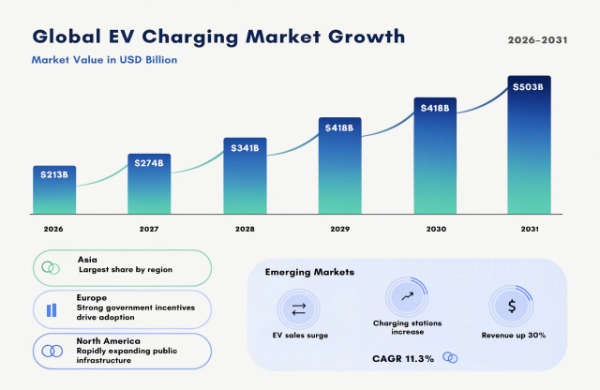
Global market size will expand significantly. Asia leads volume while Europe and North America push technology standards. Private charging stays dominant. Policy and cost reductions drive progress.
EV charging market forecasts point to strong compound growth from 2026 to 2031. Key drivers include rising EV sales, government support, and falling component prices. Regional and segment differences shape opportunities.
From my position at Parwatt I track these trends through customer orders and industry talks. Asia especially China and India will see the largest absolute numbers due to massive EV adoption. Europe focuses on quality and smart integration. North America mixes policy incentives with private investment. Emerging markets grow but face power infrastructure hurdles.
Overall Market Size and Pace
Analysts project the global market to multiply several times by 2031. Annual additions of chargers will accelerate. Revenue includes hardware, software, and services. Hardware like wall and fast chargers forms the base while smart platforms add recurring value.
Regional Breakdown
Asia leads with high volume growth. China already has extensive networks and continues expansion. India ramps up quickly with policy pushes. Europe emphasizes standardized smart and green solutions. North America sees strong private and fleet segments supported by incentives. Other regions advance at different speeds based on local EV sales and grid strength.
Key Growth Drivers
- Rising EV vehicle sales create charging demand.
- Government subsidies and building codes mandate more infrastructure.
- Technology cost drops make equipment more accessible.
- Corporate fleet electrification adds steady commercial demand.
- Consumer preference for home charging supports residential installs.
Table of main segments:
| Segment | Expected Growth 2026-2031 | Key Characteristics |
|---|---|---|
| Private Home/Work | Steady and dominant | Majority of sessions, lower risk |
| Public Fast Charging | High but variable | Travel support, utilization challenges |
| Fleet and Depot | Strong commercial | Predictable use patterns |
| Smart Software/Services | Fastest revenue growth | Recurring income, optimization tools |
Private charging will remain the backbone. This favors solutions like our EC01 wall charger series that fit homes and workplaces perfectly: https://www.parwattparts.com/ec01-wall-charger/
Policy support will continue but market economics will decide long term winners. Smart features that improve utilization will gain share. The next five years reward companies that align with these drivers.
What Will Separate Winners from Losers in the Next 5 Years of EV Charging?
Leaders will master smart integration, flexible business models, and regional adaptation. They combine hardware with software and focus on real user needs. Laggards overbuild without planning utilization.
Winners in the 2026 to 2031 EV charging market will stand out through innovation and practicality. Smart charging, energy storage, and strong execution turn challenges into advantages.
I have watched partners succeed and struggle over the years. A charge point operator who invested early in OCPP compliant smart systems now manages networks efficiently. They adjust loads in real time and offer value added services. Competitors with basic hardware face higher downtime and lower margins.
Smart Charging and Flexibility
Integration of smart controls helps manage grid demand and boost utilization. Dynamic load balancing allows more chargers on existing infrastructure. V2G turns vehicles into grid assets for extra revenue. These features separate modern solutions from legacy ones.
Energy Storage and Renewables
Pairing chargers with batteries smooths power draws. Solar integration reduces costs and appeals to green focused buyers. Winners design systems that work together instead of standalone units.
Innovative Business Models
Subscription services, advertising at stations, and fleet management contracts create diversified income. Location data and user experience improvements drive repeat use. Regional strategies that match local conditions win market share.
Bullet points on winning strategies we support at Parwatt:
- Deploy OCPP compliant equipment for interoperability and remote management.
- Offer bundled solutions with installation and ongoing support.
- Focus on high utilization locations using data analytics.
- Build modular systems that upgrade easily as technology advances.
Our power modules help public and commercial sites scale efficiently. Learn more about them and related options: https://www.parwattparts.com/30kw-power-module/
Winners also invest in people and partnerships. They train teams on new technology and work with utilities early. The next five years will favor adaptable companies that deliver real value to users and operators.
Ready to Prepare for the Next 5 Years of EV Charging Growth? Here’s Your Next Step?
Assess your role in the market whether as user, operator, or investor. Review current assets and future needs. Develop a phased plan that includes smart technology and realistic projections.
Preparation for EV charging growth starts now. Individuals should consider home solutions. Businesses need scalable systems. Investors should look for strong execution teams and diversified approaches.
As general manager I advise many partners on these steps. A real estate developer reviewed tenant EV interest and local grid capacity. They installed smart Level 2 units in phases. Occupancy rose and they attracted eco conscious buyers. The project delivered strong returns.
Steps for Individual Drivers and Homeowners
Evaluate daily driving and parking habits. Check electrical panel capacity. Explore incentives for smart wall chargers. Start with one reliable unit and expand later. Our portable and wall options provide flexible entry points.
Steps for Businesses and Fleets
Audit current and projected EV numbers. Map high use parking areas. Pilot smart charging on a small scale. Track utilization and costs closely. Partner with experienced suppliers for turnkey support.
Steps for Investors and Operators
Focus on markets with policy tailwinds and grid readiness. Evaluate technology roadmaps and management teams. Diversify across private, fleet, and public segments. Prioritize solutions with software and service revenue.
Key action points:
- Gather local utilization and grid data before large commitments.
- Choose equipment with upgrade paths and strong warranties.
- Build relationships with utilities and local governments.
- Monitor policy changes and technology advances regularly.
Parwatt offers end to end support from hardware to cloud management. Explore our full range and blog resources for deeper insights: https://www.parwattparts.com/blog/
The next five years will reward preparation. Start with assessment and small wins. Build toward scalable smart infrastructure that matches real demand.
Conclusion
The EV charging market is entering a critical growth phase from 2026 to 2031. While the overall trajectory is strongly upward, success will depend on more than just adding more chargers. Smart integration with the grid, realistic utilization planning, innovative business models, and regional adaptation will separate the winners from those who overbuild and underperform. The next five years will reward those who plan with clear data, balanced risk, and a deep understanding of actual user behavior rather than optimistic headlines. The charging infrastructure of tomorrow is being decided today. Make informed decisions now to stay ahead in this rapidly evolving market.

--- END ---
Related Posts


Industry News

Business Ideas

Business Ideas

Business Ideas
