

Hardwired vs. Plug-In Level 2 EV Chargers: Which Is Better for Your Home?
Oct 28,2026
The installation method of a Level 2 EV charger matters more than many homeowners expect. It affects available power, safety, upfront cost, outdoor suitability and how easily you can move or replace the equipment later. At Parwatt I see projects delayed or limited when this choice is treated as a minor detail.
Both hardwired and plug-in Level 2 chargers can deliver reliable home charging when correctly specified and professionally installed. Hardwiring suits permanent, higher-current or outdoor setups. Plug-in units offer easier removal and replacement. The right choice depends on vehicle AC limits, electrical capacity, location and long-term plans.
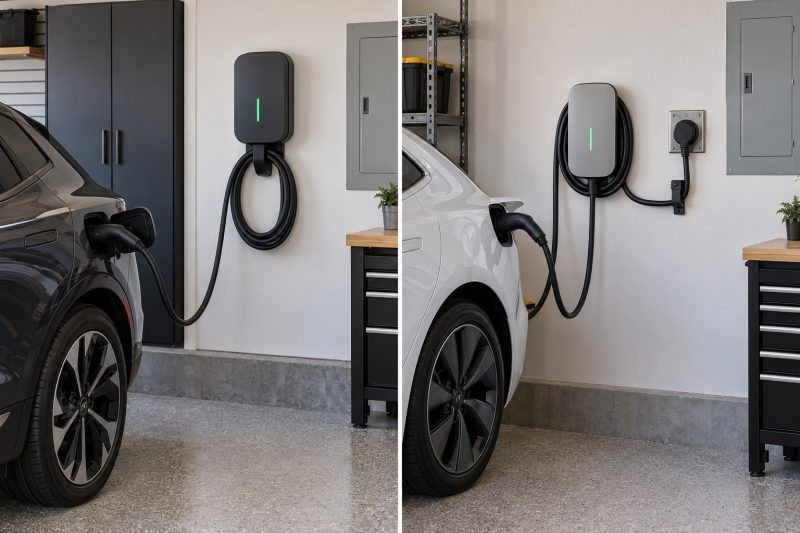
I have worked with residential installers, fleet managers and home EV users for years as general manager at Parwatt New Energy. We supply EV charging equipment and power modules used in home and commercial projects. I regularly help owners decide whether a hardwired wall unit or a plug-in Level 2 charger fits their garage, driveway and electrical panel. Our guidance for products in the EV Charger Category always starts with the vehicle’s AC limit and a proper electrical assessment. In this article I explain how hardwired and plug-in Level 2 installations differ and which option suits different homes in 2026.
Why Your EV Charger Installation Method Matters More Than You Think?
Installation method is not only about how the box looks on the wall. It decides the maximum continuous current you can use, how many heat points exist in the circuit, how the unit survives weather, and whether you can take the charger with you when you move. Choosing without these factors in mind can leave power on the table or create avoidable maintenance issues.
The installation method matters because it affects usable power, connection safety, initial cost, outdoor durability and the ease of future replacement or relocation.
How Installation Choice Shows Up in Daily Use
I have reviewed homes where a plug-in Level 2 unit on a NEMA 14-50 receptacle worked well for moderate daily energy needs. I have also seen cases where owners wanted 48A continuous charging and discovered that a hardwired connection on a properly sized 60A circuit was the practical path.
Outdoor installations highlight the difference quickly. An exposed plug and receptacle face weather, corrosion and physical wear. A hardwired unit removes that interface, provided the enclosure rating matches the location.
Renters and owners who expect to move care about removal. A plug-in charger can leave with the household. A hardwired unit is tied to the property unless the wiring is altered again.
Safety and heat management also differ. Every plug-and-receptacle connection is a potential resistance point under continuous load. Hardwiring eliminates that joint. Plug-in setups remain safe when the receptacle is high quality, correctly rated and installed on a dedicated circuit.
Here is a table that links installation method to practical outcomes:
| Factor | Why It Matters | Hardwired Tendency | Plug-In Tendency |
|---|---|---|---|
| Maximum continuous current | Sets real charging speed | Can support higher amps | Often limited by receptacle rating |
| Connection points | Heat and wear risk | Fewer joints | Plug and receptacle interface |
| Outdoor exposure | Weather and corrosion | No exposed plug | Receptacle must be protected |
| Relocation | Moving or upgrading | Fixed to property | Easier to unplug and take |
| Upfront work | Cost and timeline | Circuit and hard connection | Circuit plus rated receptacle |
This table reflects the trade-offs I discuss with residential customers of equipment from the EV Charger Category.
In 2026 the best method is the one that matches your power need, location and ownership horizon—not the one that simply looks simpler on day one.
The Mistakes Homeowners Make When Comparing Hardwired and Plug-In Chargers
Homeowners often assume a plug-in charger needs no electrician, that any household outlet will handle continuous EV load, or that the charger’s nameplate power is available regardless of circuit and vehicle limits. These mistakes lead to undersized receptacles, unexpected trips and unused capacity.
Common mistakes include assuming plug-in means no professional work, treating ordinary outlets as suitable for continuous charging, and judging only by charger rating while ignoring circuit, panel and vehicle limits.
Mistakes That Distort the Decision
One frequent mistake is treating a plug-in Level 2 unit as a simple appliance. Continuous EV load requires a dedicated circuit, correct breaker sizing and a receptacle rated for the duty. An electrician should still design and install that infrastructure.
Another mistake is using a low-cost or worn receptacle intended for occasional use. EV sessions last for hours. Contact resistance and heat build up. Discoloration, softness or repeated warmth at the plug are warning signs.
Some buyers compare only the maximum amperage printed on the charger. A 48A-capable wallbox cannot deliver 48A through a 40A continuous limit on a 50A NEMA 14-50 circuit. The vehicle’s onboard charger may impose a lower ceiling still.
Outdoor suitability is sometimes ignored. A plug-in interface in an open carport needs weather protection and a receptacle listed for the environment. Hardwiring does not remove the need for a correctly rated enclosure, but it does remove the exposed plug joint.
Cost comparisons that look only at hardware miss permits, labour, cable runs, breakers and possible panel upgrades. The total installed cost is the number that matters.
Here is a table of frequent mistakes:
| Mistake | Why It Misleads | Better Approach |
|---|---|---|
| Plug-in needs no electrician | Continuous load rules still apply | Professional circuit and receptacle design |
| Any outlet is fine | Not rated for long EV sessions | Dedicated, correctly rated receptacle |
| Nameplate power is guaranteed | Circuit and vehicle may limit | Check continuous rating and car AC limit |
| Outdoor plug-in is automatic | Weather and corrosion risk | Protected receptacle or prefer hardwired |
| Hardware price only | Misses electrical work | Compare full project cost |
This table keeps expectations realistic. At Parwatt we ask for vehicle AC limits and a site assessment before recommending any unit related to the FES-D30 DC EV Charger or residential Level 2 products.
I advise writing down the planned circuit rating and the car’s maximum AC current before choosing between hardwired and plug-in formats.
How Hardwired and Plug-In EV Charger Installations Actually Differ
Hardwired units connect the charger directly to a dedicated branch circuit. Plug-in units connect through a high-power receptacle such as a NEMA 14-50. Both normally need a dedicated circuit and proper overcurrent protection. They differ in continuous current capacity, the presence of a plug interface, GFCI and disconnect practices, and how local codes treat the installation.
Hardwired installations connect the charger directly to the circuit. Plug-in installations use a rated high-power receptacle. Both need dedicated wiring and correct protection; they differ in current limits, connection points and code details.
Technical and Practical Differences
A hardwired Level 2 charger is fixed to the branch circuit conductors. On a properly designed 60A circuit, some units can operate at 48A continuous. That extra current only helps if the vehicle accepts it and the cable and breaker are sized correctly.
A plug-in Level 2 charger typically uses a NEMA 14-50 or similar receptacle on a 50A circuit. Continuous load rules commonly limit charging current to 40A. The receptacle and plug become part of the thermal and mechanical system.
Both approaches require a dedicated circuit in normal residential practice. Sharing the circuit with other loads raises the risk of trips and heat.
GFCI and disconnect requirements vary by code cycle and location. Outdoor and garage installations often face stricter rules. The electrician must apply the rules that govern the address.
Installation labour differs. Hardwiring includes making the final connection inside the unit and ensuring strain relief and enclosure integrity. Plug-in work includes installing and testing the receptacle and verifying that the plug seats firmly without excess heat under load.
Future service also differs. A plug-in unit can be swapped without opening the fixed wiring. A hardwired unit requires electrical isolation and reconnection work for replacement.
Here is a side-by-side installation comparison:
| Aspect | Hardwired | Plug-In |
|---|---|---|
| Connection | Direct to circuit | Through rated receptacle |
| Typical continuous current | Up to 48A on suitable 60A circuit | Often 40A on 50A NEMA 14-50 |
| Extra interface | None | Plug and receptacle |
| Replacement ease | Needs electrical work | Unplug and replace unit |
| Common outdoor preference | Often preferred | Needs protected receptacle |
| Professional involvement | Required | Required for circuit and receptacle |
This comparison keeps the electrical reality visible. At Parwatt we use the same distinctions when advising customers who may later expand toward commercial systems built around the 30kW Power Module or 40kW Power Module.
I recommend treating the continuous current limit of the chosen method as a hard constraint when estimating overnight recovery time.
Which Option Is Better for Power, Safety, Flexibility and Outdoor Use?
Hardwiring generally supports higher continuous current and removes the plug interface, which helps permanent and outdoor installations. Plug-in units excel when flexibility, easier equipment swaps and the ability to take the charger to another property matter more than maximum amperage.
Hardwiring is usually stronger for higher power, permanent mounting and outdoor locations. Plug-in units are stronger for flexibility, relocation and simple equipment replacement. Safety depends on correct design and installation in both cases.
Matching Method to Priority
If the vehicle can accept 48A AC and the panel can support a 60A continuous-rated circuit, hardwiring unlocks the higher rate. A plug-in NEMA 14-50 path will normally stop at a 40A continuous limit.
For safety under long high-current sessions, fewer connection points mean fewer places for resistance and heat to develop. Hardwiring has the advantage here. Plug-in safety remains high when the receptacle is commercial-grade, correctly torqued and inspected for heat after early sessions.
Flexibility favours plug-in. Renters, military families and owners who expect to move can unplug the unit and take it to the next suitable circuit. Hardwired equipment stays with the house unless a second electrical job removes it.
Outdoor use often favours hardwiring because there is no exposed plug face. The charger enclosure must still carry an appropriate environmental rating, and cable routing must shed water and avoid damage.
Cost over the ownership period depends on how long you stay and whether you will upgrade. A slightly higher hardwired install cost can be repaid by higher usable power and fewer receptacle concerns. A plug-in path can be cheaper when a correct receptacle already exists and maximum amperage is not required.
Here is a priority-based guide:
| Priority | Better Fit | Reason |
|---|---|---|
| Maximum AC power | Hardwired | Higher continuous current possible |
| Permanent outdoor install | Hardwired | No exposed plug interface |
| Easy equipment swap | Plug-in | Unplug and replace |
| Renter or planned move | Plug-in | Take the unit along |
| Existing NEMA 14-50 in good condition | Plug-in | Lower incremental work |
| New high-power circuit from scratch | Hardwired often preferred | Matches long-term fixed use |
This guide keeps the decision tied to what you value most. At Parwatt we help households rank these priorities before they select equipment from the EV Charger Category.
I advise deciding power need and location first. Method usually becomes clear once those two points are fixed.
A Home EV Charger Installation Checklist Before You Decide
A practical checklist prevents most installation regrets. Confirm the vehicle’s maximum AC charging rate. Calculate the energy you must restore each night. Have a qualified electrician perform a load assessment. Inspect the mounting location and weather exposure. Compare total project cost for both methods. Install only with certified equipment and local code compliance.
Before deciding, confirm vehicle AC limits, estimate daily energy need, complete a professional load assessment, evaluate the installation environment, compare full costs and use qualified installers following local rules.
Steps That Lead to a Sound Installation
Read the vehicle specification for maximum AC current or power. That number caps the benefit of any circuit larger than the car can use.
Estimate daily kilowatt-hours from the car’s trip data or from average miles and efficiency. Confirm that the chosen continuous current can restore that energy in the available overnight window.
Engage an electrician early. Request a load calculation, panel capacity review, proposed circuit rating and a clear recommendation for hardwired versus plug-in based on the site.
Inspect the wall or post location. Note indoor versus outdoor exposure, cable reach to the inlet, working space and protection from impact.
Ask for written quotations that separate hardware, circuit work, receptacle or hardwire labour, permits and any panel upgrade. Compare complete totals, not only charger prices.
Select equipment listed for the environment and for continuous EV duty. Confirm residual-current and overcurrent protection arrangements with the installer.
After installation, run an early supervised session and check for unusual heat at any plug, receptacle or enclosure. Address warmth or odours before leaving the system in routine overnight use.
Keep documentation: circuit identification, breaker size, torque notes if provided, and the installer’s contact details.
Here is a pre-decision checklist:
- Vehicle maximum AC current or power recorded
- Typical daily energy need estimated
- Professional load and panel assessment completed
- Indoor or outdoor location evaluated
- Hardwired vs plug-in full cost compared
- Continuous current limit of each option understood
- Certified equipment and qualified installer selected
- Local code and permit requirements confirmed
- Post-install heat and function check planned
- Circuit and maintenance records retained
At Parwatt we encourage this sequence for every residential project. Further reading on charging technology is available in our articles on Electric Vehicle Charging and AC vs DC EV Charging. Product options and specifications can be reviewed on our main site and within the EV Charger Category, including higher-power platforms such as the Battery Buffered Ultra Rapid EV Charger.
Homeowners who follow the checklist obtain a Level 2 installation that matches real power need, location and ownership plans without surprise limitations later.
Conclusion
Both hardwired and plug-in Level 2 chargers can provide reliable home charging when correctly specified and professionally installed. At Parwatt we match the installation method to vehicle limits, site conditions and ownership plans so households avoid both under-powered and over-constrained systems. Hardwiring is generally the stronger choice for a permanent installation, higher charging current or an outdoor location because it removes the plug-and-receptacle connection and may support more power. A plug-in charger offers greater flexibility for renters, homeowners planning to move and users who want easier equipment replacement. However, it still requires a suitable dedicated circuit and a high-quality receptacle designed for sustained electrical loads. The right decision should be based on the vehicle’s AC charging limit, household electrical capacity, installation environment, local code requirements and long-term ownership plans—not convenience or charger price alone.

--- END ---
Related Posts
Business Ideas

Business Ideas

Business Ideas

How to Test EV Charger Samples Before a Bulk Order: A Buyer’s Checklist
November 06, 2026
Company News

Smart vs Basic EV Chargers: A Feature-Priority Guide for Distributors
November 05, 2026
Company News

Single-Phase vs Three-Phase EV Chargers: Which Should Importers Source?
November 04, 2026
Company News

How to Build the Right EV Charger Product Range for Your Target Market
November 03, 2026