

What is the IK Rating on EV Chargers and Why It Matters for Durability
May 12,2026
Worried your EV charger might break from a bump or kick? Many buyers overlook this key spec.
The IK rating measures how well an EV charger resists mechanical impacts. Higher ratings mean better protection against knocks, vandalism, and accidents. It helps your charger last longer in real use.
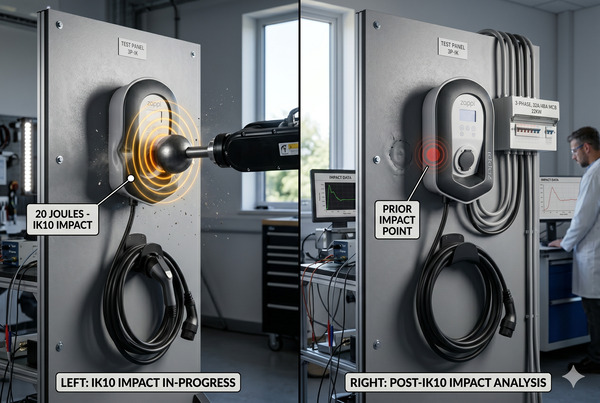
As Jacky Huang, general manager at XIAMEN PARWATT NEW ENERGY TECHNOLOGY CO.,LTD, I review these specs daily with charge point operators and fleet managers. Read on to understand IK ratings clearly and choose chargers that truly last.
What Is IK Rating and How Does It Work?
Confused about what IK rating actually means? Many customers see it on spec sheets but need simple facts.
The IK rating shows the mechanical impact protection level of an EV charger. It follows the IEC 62262 standard and uses joules to measure resistance. It differs from IP rating which covers dust and water.
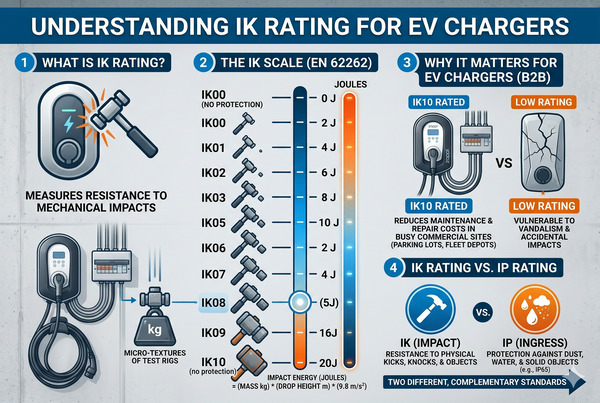
I often explain this to new partners. The rating comes from controlled hammer tests. Engineers drop weights or swing pendulums to simulate real hits. Higher numbers survive stronger impacts without cracks or failure.
The IK rating measures how much impact energy an EV charger can handle without damage. It uses joules as the unit. For example, IK08 resists 5 joules while IK10 handles 20 joules. This standard helps everyone compare durability fairly.
I remember supplying chargers to a public project in Europe. They asked specifically about IK because of high foot traffic. We delivered units with strong ratings and saw almost no repair calls in the first year.
The test method stays consistent worldwide. Labs strike the enclosure at different points. They check for broken parts, exposed wiring, or loss of function afterward.
This table helps our wholesale customers understand quickly:
| IK Rating | Impact Energy (Joules) | Equivalent Example |
|---|---|---|
| IK07 | 2 J | Heavy tool drop |
| IK08 | 5 J | Hammer swing |
| IK10 | 20 J | 5kg object from 40cm |
- IK focuses only on mechanical strength.
- IP rating handles water and dust instead.
- Both ratings together give full protection.
From my work with automotive OEMs and real estate developers, I see that ignoring IK leads to higher replacement costs. Our EC01 wall charger comes with solid IK ratings and smart features. Learn more here: EC01 Wall Charger.
Understanding this basic concept helps you buy smarter. You avoid cheap units that fail fast in daily use.
IK Rating Scale Explained: From IK07 to IK10
Want to know exactly what each IK level means? The scale runs from low to high protection.
IK07 to IK10 covers common needs for EV chargers. Each step increases impact resistance. IK10 offers the strongest everyday protection.
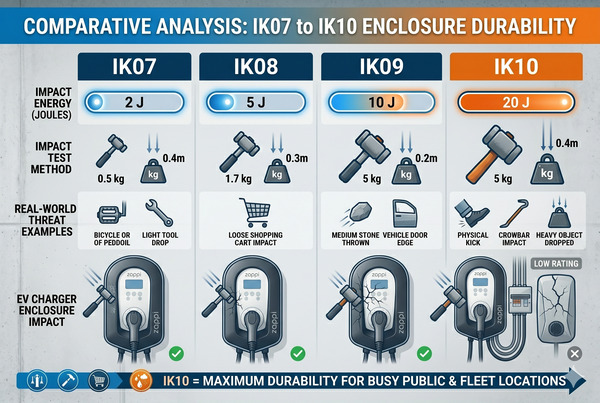
At Parwatt we test our products to these levels before shipping. I share the details with energy utilities and government buyers who need reliable public infrastructure.
The IK rating scale goes from IK07 to IK10 with clear impact levels. IK07 handles 2 joules. This works for light accidental bumps. IK08 manages 5 joules for moderate hits. IK09 reaches 10 joules. IK10 stands at 20 joules and survives strong impacts like vandalism or vehicle nudges.
Labs use a standardized pendulum or spring hammer for testing. They hit the charger multiple times on different spots. The enclosure must keep working and protect internal parts.
I prepared this detailed table for our CPO partners:
| IK Level | Joules | Typical Protection | Common Use Case |
|---|---|---|---|
| IK07 | 2 J | Light knocks | Indoor residential |
| IK08 | 5 J | Tool drops | Sheltered outdoor |
| IK10 | 20 J | Heavy impacts and vandalism | Public stations |
- Each level builds on the previous one.
- Testing repeats on corners and flat surfaces.
- Results must show no functional damage.
One fleet operator in Australia chose IK10 after early failures with lower ratings. Downtime dropped sharply.
We also link this to broader EV topics in our blog: Level 2 vs Level 3 Charging.
Higher IK ratings give you confidence in busy locations. I always recommend checking this spec first when you compare models. Our full range meets these durability needs: Parwatt EV Chargers.
Why IK Rating Matters for EV Charger Durability
Wonder why you should care about IK rating? It directly affects how long your charger lasts.
Strong IK ratings protect against daily damage and vandalism. They reduce repairs and keep charging stations running longer.
I discuss this with retail chains and workplace clients who install many units. Good ratings save money over time.
A high IK rating improves EV charger durability in many ways. It resists accidental bumps from cars or tools. It protects against vandalism common in public areas. Longevity increases because the enclosure stays intact. You spend less on replacements and maintenance.
I saw this clearly with a municipality project last year. They upgraded to IK10 chargers and cut repair visits by more than half.
This table shows the practical benefits we share with partners:
| Benefit | Low IK Charger | High IK Charger (IK10) |
|---|---|---|
| Vandalism Resistance | Weak | Excellent |
| Repair Frequency | Higher | Much lower |
| Lifespan | 3-5 years typical | 7-10+ years |
| Total Ownership Cost | Higher long term | Lower long term |
- Durability means fewer service calls.
- Safety improves when the unit stays intact.
- Resale value stays strong for used equipment.
From supplying EV resellers and integrators, I know customers return to high IK models. The small extra cost upfront pays back fast through reliability.
Our battery-buffered solutions also use strong enclosures: Battery Buffered Ultra-Rapid EV Charger.
You protect your investment when you choose proper IK ratings. This matters especially for outdoor and high-traffic installs.
IK Ratings in Real-World Use: Home vs Public Installations
How does IK rating perform in actual locations? Home and public needs differ greatly.
Home garages need moderate protection while public stations demand maximum strength.
I help both residential developers and CPOs select the right level. Real results guide every recommendation.
IK ratings show different value in home versus public installations. Home garages usually see light use so IK07 or IK08 works well. Outdoor home setups benefit from higher ratings against weather and occasional bumps. Public stations face constant risks from vehicles, people, and vandalism so IK10 becomes essential.
I worked with a real estate developer in the Middle East. They chose IK10 for apartment charging spots and tenants report excellent durability.
Comparison table we use with clients:
| Installation Type | Recommended IK | Main Risks | Outcome with Right Rating |
|---|---|---|---|
| Home Garage | IK07-IK08 | Accidental knocks | Reliable daily use |
| Outdoor Home | IK08-IK10 | Weather and minor impacts | Long term performance |
| Public Station | IK10 | Vandalism and heavy traffic | Minimal downtime |
- Public areas see more abuse every day.
- Home users enjoy simpler maintenance.
- Extreme environments need IK10 plus strong IP.
One hospitality chain in France installed our units and saw zero vandalism damage after six months.
Check our solutions for different environments: Parwatt Solutions. We design for real conditions faced by fleet operators and municipalities.
In my experience, matching IK rating to the actual location prevents most failures. This approach keeps charging available when drivers need it.
How to Choose the Right IK Rating for Your EV Charger
Unsure which IK rating fits your needs? A simple assessment helps you decide.
Evaluate your location, expected use, and future plans. Combine IK with proper IP for complete protection.
I guide many buyers through this process. Clear steps lead to smart purchases.
Choosing the right IK rating requires honest assessment of your setup. Start by checking the install location. Indoor garages can use IK07. Outdoor or public spots need IK10. Consider daily traffic and vandalism risk. Future-proof by selecting higher ratings if you plan to expand.
I always tell corporate clients to pair IK with IP65 or better. This combination handles weather and impacts together.
Buying guide checklist we share with partners:
- Assess environment first.
- Match IK to traffic level.
- Combine with strong IP rating.
- Check certifications and warranties.
- Consider smart monitoring extras.
Our EC01 series offers flexible IK options with excellent value. See the full details: Parwatt EV Charger Category.
We also provide portable units for temporary needs: EP02 Portable EV Charger.
From years of supplying different markets, I know proper selection reduces headaches. Take time to evaluate and buy once. This saves money and keeps your charging reliable for years.
Conclusion
The IK rating might look like technical jargon, but it’s one of the most important specs when buying an EV charger in 2026. Choose the right level for your location to protect your investment and enjoy reliable charging for years to come.

--- END ---
Related Posts


Business Ideas

11kW vs. 22kW Home EV Chargers: Which One Should You Choose in 2026?
October 21, 2026

Business Ideas

Business Ideas
