

Liquid-Cooled Cables in High-Power DC Chargers: Benefits, Technology & Why They Matter in 2026
Jan 11,2026
High-power DC fast charging promises quick top-ups for EVs. But many systems slow down or overheat during peak use. Drivers wait longer than expected and operators lose revenue.
Liquid-cooled cables solve the heat problem in high-power DC chargers. They allow sustained 350kW and higher charging without throttling, deliver faster and safer sessions, and support the ultra-fast infrastructure needed in 2026.
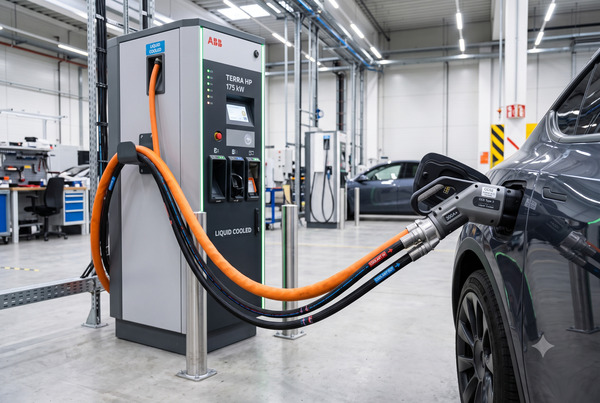
I have worked with charge point operators and fleet managers who struggled with high-power DC units that could not maintain full output. The cables got too hot and the system reduced power. This guide explains why liquid-cooled cables matter now and how they change the game for serious charging sites.
Why High-Power DC Charging Is Limited Without Liquid-Cooled Cables
You install a high-power DC charger expecting fast sessions. Then it slows down after a few minutes or trips on heat. Users get frustrated and your utilization drops.
High-power DC charging without liquid-cooled cables often hits thermal limits quickly. Cables overheat, power throttles, charging times stretch out, and safety risks rise. This creates long waits for drivers and lost revenue for operators.
I visited a busy highway corridor site last year. The 350kW chargers looked impressive on paper. During afternoon peaks the cables heated up fast. The system cut power to protect itself. Drivers who expected a 20-minute charge waited 40 minutes instead. One fleet lost two scheduled routes that day. Heat in traditional cables is the hidden bottleneck that kills performance.
The Heat Problem in Cables
Traditional cables rely on air or natural cooling. At high currents the copper heats up quickly. Insulation can degrade. Connectors get hot. The charger senses danger and reduces output or shuts down. This happens more often as power levels climb toward 500kW and beyond.
Real Impact on Users and Operators
Fleet managers tell me their drivers hate unpredictable charging times. A driver plans a 30-minute break and ends up stuck for an hour. Public sites see lower satisfaction scores and fewer repeat users. Charge point operators watch utilization numbers fall because chargers cannot deliver what the spec sheet promised.
Safety Concerns Grow
Overheated cables increase fire risk and cable wear. In extreme cases insulation fails. Maintenance teams spend more time on repairs. Insurance costs can rise when incidents occur. These problems become more serious as more vehicles demand ultra-fast charging at the same time.
Here is a table showing typical limits without liquid cooling:
| Power Level | Typical Throttle Time | Resulting Charge Time Increase | Common Complaint from Users |
|---|---|---|---|
| 150kW | After 10-15 min | 20-30% longer | "It slowed down halfway" |
| 250kW | After 8-12 min | 30-50% longer | "I waited much longer than expected" |
| 350kW+ | After 5-10 min | 40-70% longer | "The charger kept cutting power" |
Bullet points of daily frustrations:
- Drivers arrive with low battery and still face long waits.
- Fleets miss delivery windows because of heat-related delays.
- Site owners see lower daily session counts.
- Technicians replace cables more often due to heat damage.
Our FES-D30 DC EV Charger and Battery-Buffered Ultra-Rapid EV Charger are designed for high-power environments where thermal management matters. Without proper cable cooling even the best charger cannot perform at full potential.
This heat limitation is why many high-power sites under-deliver on their promise.
Common Misconceptions About Liquid-Cooled vs Traditional Cables
Buyers often assume natural cooling works fine or that liquid cooling is too complex and expensive for most sites.
Many people believe traditional cables handle high power without issues or that liquid-cooled cables add too much cost and maintenance. In practice traditional cables throttle early while liquid-cooled versions deliver consistent performance and often lower long-term costs through higher uptime.
I hear these ideas in almost every meeting. One operator told me liquid cooling sounded like overkill for his corridor. After six months of throttling complaints he upgraded. Another manager thought the extra cost would never pay back. His utilization numbers proved him wrong within a year. Let me address the most common misconceptions with real data.
Misconception 1: Natural Cooling Is Enough
At lower power levels air cooling works. At 250kW and above the heat generated exceeds what passive cooling can remove fast enough. The cable temperature rises until the charger protects itself by lowering power. Many sites only discover this during busy periods.
Misconception 2: Liquid Cooling Is Too Complex
Modern liquid-cooled systems use closed loops with simple pumps and heat exchangers. They require basic maintenance similar to other industrial cooling systems. Technicians do not need special certification in most cases. The added complexity is small compared to the performance gain.
Misconception 3: The Extra Cost Never Pays Back
Liquid-cooled cables cost more upfront. But they enable full power delivery for longer periods. This means more sessions per day and higher revenue. They also last longer because they run cooler. Downtime drops. Many commercial sites see payback in 12 to 24 months through increased utilization alone.
Misconception 4: Safety Risks Are the Same
Traditional cables at high power develop hot spots that can damage insulation over time. Liquid cooling keeps temperatures stable and lower. This reduces degradation and fire risk. Better thermal control is a clear safety advantage.
Here is a table that compares the two approaches:
| Aspect | Traditional Cables | Liquid-Cooled Cables | Practical Outcome |
|---|---|---|---|
| Heat Management | Limited at high power | Efficient even at 350kW+ | Consistent full power delivery |
| Charging Consistency | Throttles during peaks | Maintains rated power longer | Predictable session times |
| Cable Weight and Flexibility | Heavier for same power capacity | Often lighter and more flexible | Easier handling for users |
| Lifespan | Shorter due to heat stress | Longer because temperatures stay controlled | Fewer replacements |
| Safety | Higher risk of hot spots and degradation | Better thermal control reduces hazards | Lower incident risk |
Bullet points that clear up the confusion:
- Liquid cooling does not require constant refilling in closed systems.
- Maintenance is usually annual inspection plus occasional filter checks.
- Many utilities now favor sites that can deliver reliable high power without grid strain from throttling.
- Driver reviews improve when charging times match expectations.
Our 30kW Power Module and 40kW Power Module support high-power architectures where liquid-cooled cables make the difference between marketing specs and real-world performance. Reading our AC vs DC EV Charging post helps explain why thermal management becomes critical as power levels rise.
These misconceptions cost operators time and money until they see the data from their own sites.
How Liquid-Cooled Cables Work and Their Key Benefits for High-Power DC Chargers
You want to understand the technology so you can judge whether it fits your site.
Liquid-cooled cables circulate coolant around the conductors to remove heat efficiently. This allows sustained high-power output, faster charging sessions, lighter and more flexible cables, and improved safety compared with traditional air-cooled designs.
I have stood beside chargers during peak hours and watched the difference. A traditional cable gets hot to the touch within minutes at 350kW. A liquid-cooled cable stays much cooler. The charger keeps delivering full power. Drivers finish faster and move on. Let me explain how the technology works and the concrete benefits it delivers.
How the Cooling System Works
Coolant flows through channels inside the cable jacket or around the conductors. It absorbs heat and carries it to a heat exchanger or radiator, often integrated into the charger cabinet. A small pump keeps the fluid moving. Temperature sensors monitor the system and adjust flow as needed. The loop is usually closed, so fluid does not need frequent replacement.
Faster and More Consistent Charging
Because heat is removed actively, the cable can carry higher current for longer without the charger throttling. A 350kW session can run closer to the rated power for most of the time instead of dropping after a few minutes. Total charging time drops. Users get the speed they expect.
Lighter and More Flexible Cables
High-power traditional cables are thick and heavy to handle the current without overheating. Liquid cooling allows thinner conductors because heat is managed actively. The result is often a lighter, more flexible cable that is easier for drivers to handle. This improves user experience at public and fleet sites.
Better Safety and Longer Life
Stable lower temperatures reduce stress on insulation and connectors. Cables last longer. The risk of hot spots that can lead to failure or fire drops significantly. Operators report fewer emergency service calls.
Here is a benefits comparison table:
| Benefit | How Liquid Cooling Delivers It | Impact on Operations and Users |
|---|---|---|
| Sustained High Power | Efficient heat removal prevents early throttling | More kWh delivered per session |
| Reduced Charge Time | Full power maintained longer | Higher throughput and customer satisfaction |
| Easier Cable Handling | Lighter and more flexible design | Better experience for drivers and staff |
| Improved Safety | Lower operating temperatures reduce degradation | Fewer incidents and lower insurance exposure |
| Longer Component Life | Less thermal stress on cable and connectors | Lower replacement and maintenance costs |
| Higher Site Utilization | Chargers stay at rated output during peaks | Better revenue and ROI |
Bullet points of practical advantages I see on sites:
- Peak-hour performance stays close to nameplate ratings.
- Drivers report more predictable charging times.
- Maintenance teams spend less time on heat-related failures.
- Sites can support more vehicles per day without adding chargers.
Our Battery-Buffered Ultra-Rapid EV Charger and FES-D30 DC EV Charger pair well with liquid-cooled cable technology for locations that need reliable ultra-fast performance. Our Electric Vehicle Charging guide covers the broader context of why thermal management matters as power levels increase.
This technology turns high-power DC chargers from impressive on paper into reliable in daily operation.
When Liquid-Cooled Cables Are Worth It – And When They’re Not
You need clear guidance on whether the extra investment makes sense for your specific use.
Liquid-cooled cables are worth the higher upfront cost for high-utilization commercial sites, fleets, and any location targeting 350kW and above on a regular basis. They are often not necessary for low-power or low-usage sites where traditional cables perform adequately and keep costs down.
I advise customers based on their actual session volume and power targets. A quiet rural site with occasional 150kW use may not need liquid cooling. A busy urban hub or fleet depot running multiple high-power sessions daily usually does. Let me break down the decision with real factors.
When Liquid-Cooled Cables Make Strong Sense
High daily utilization, multiple vehicles charging back-to-back, and power levels at 250kW or higher are the clearest cases. Fleets that need predictable turnaround times benefit greatly. Public corridors with peak-hour surges see higher customer satisfaction and revenue. Any site planning for future 500kW+ capability should include liquid cooling from the start.
When Traditional Cables May Still Work
Low-traffic locations, power levels under 150kW, or sites with long gaps between sessions often do fine with traditional cables. The extra cost of liquid cooling brings less return when heat buildup rarely becomes an issue. Some small commercial sites fit this profile.
Cost and Payback Reality
Liquid-cooled systems add cost to the charger and may require slightly more complex installation. However, the ability to deliver full power more consistently increases the number of successful sessions per day. Reduced cable replacements and lower downtime also add up. Many operators see the investment recover through higher utilization within 18 months on busy sites.
Here is a decision table by site type:
| Site Type | Typical Power Need | Utilization Level | Liquid-Cooled Recommendation | Main Reason |
|---|---|---|---|---|
| Busy highway corridor | 350kW+ | High | Strongly recommended | Sustained performance during peaks |
| Fleet depot with shifts | 250-350kW | High | Strongly recommended | Predictable turnaround times |
| Urban workplace hub | 150-250kW | Medium to high | Recommended | Better user experience and throughput |
| Rural or low-traffic site | Under 150kW | Low | Usually not needed | Traditional cables sufficient |
| Future-proof new installation | 350kW and planning higher | Medium to high | Recommended | Avoid early replacement |
Bullet points to help your own evaluation:
- Count how many vehicles you expect to charge during the busiest two hours.
- Check if your current high-power units already throttle on hot days.
- Ask about cable replacement frequency on similar sites.
- Factor in driver satisfaction and repeat business.
Our Meta Mobile EV Charger with Battery offers flexible high-power options where liquid-cooled cables can be paired for maximum performance. Our Level 2 vs Level 3 Charging post provides useful background on why high-power DC infrastructure needs advanced thermal solutions as adoption grows.
The decision comes down to your numbers, not general rules.
Ready to Choose High-Power DC Chargers with Liquid-Cooled Cables? Here’s Your Next Step
You understand the technology and the trade-offs. Now turn that knowledge into action.
Assess your expected power levels and daily utilization, review charger specifications for liquid-cooled cable support, calculate long-term value including uptime and maintenance, and consult experienced suppliers before purchasing. This sequence helps you select systems that deliver reliable high-power performance from day one.
I guide customers through these steps regularly. The process works for both new installations and upgrades to existing high-power sites.
Step 1: Define Your Power and Volume Needs
List the maximum power you want to offer and how many vehicles will charge during peak windows. This tells you whether throttling will become a real problem.
Step 2: Check Charger Specifications Carefully
Look for explicit mention of liquid-cooled cables or advanced thermal management rated for your target power. Ask suppliers for real test data on sustained output rather than just peak numbers.
Step 3: Model Total Cost of Ownership
Include purchase price, installation, expected maintenance, cable replacement intervals, and lost revenue from downtime or throttling. Liquid-cooled systems often show better long-term economics on busy sites.
Step 4: Request References and Site Visits
Talk to other operators running similar power levels. Visit sites that use liquid-cooled cables during peak hours if possible. Real-world feedback is more valuable than spec sheets.
Step 5: Plan for Installation and Future Growth
Confirm that your electrical service and cooling infrastructure can support the chosen system. Leave headroom for higher power later if your volume may increase.
Step 6: Work with Knowledgeable Partners
Choose suppliers who understand both the charger and the cable cooling technology. Good partners help you avoid mismatched components that limit performance.
Bullet points of final reminders before you decide:
- Do not rely only on peak power ratings. Ask about sustained output.
- Factor in driver experience and site reputation.
- Plan for regular but simple maintenance of the cooling system.
- Consider future power needs so you do not outgrow the installation quickly.
Our team at Parwatt supports customers who need reliable high-power DC solutions. We can discuss specific models and how liquid-cooled cable technology fits your site requirements.
Conclusion
Liquid-cooled cables are becoming essential for high-power DC fast charging in 2026. They solve critical heat management issues, enable faster and more consistent charging, improve safety, and support the growing demand for ultra-fast charging. While they come at a higher initial cost, the performance, reliability, and user experience benefits make them a smart investment for commercial, fleet, and high-usage installations. As EV adoption accelerates, choosing chargers with advanced liquid-cooled technology helps future-proof your charging infrastructure and deliver the fast, reliable experience drivers expect.

--- END ---
Related Posts


Business Ideas

Business Ideas
