

Level 1 vs. Level 2 EV Charging: Which One Matches Your Daily Drive
Jul 13,2026
You bought an electric vehicle. You plugged the included charging cable into a regular wall outlet in your garage. The next morning, the battery was not full.
That moment is when most new EV owners start researching Level 2 chargers. But not everyone needs one. The right charging level depends on how far you drive each day and how long your car sits parked overnight.
Parwatt manufactures both Level 1 and Level 2 EV chargers for home and commercial use. This guide helps you pick the setup that fits your actual driving habits.
EV Charging Levels
Level 1 uses a standard 120-volt household outlet. It adds about 3 to 5 miles of range per hour of charging. A full overnight charge of 10 to 12 hours adds 30 to 60 miles. It covers most daily commutes.
Level 2 uses a 240-volt outlet, the same type that powers an electric dryer or oven. It adds about 20 to 30 miles of range per hour. A 6-hour overnight charge adds 120 to 180 miles. It covers nearly every daily driving scenario and fully recharges most EVs overnight.
Level 3 is DC fast charging. It uses 400-volt to 800-volt commercial equipment and adds 100 to 200 miles in 20 to 30 minutes. It is for road trips, not home installation. This article focuses on what goes in your garage.
Level 1 Charging: What It Is and When It Actually Works
Level 1 charging uses the same 120-volt outlet that powers your lamps and phone chargers. Every EV comes with a Level 1 charging cable in the trunk.
The charge rate is slow. Three to five miles per hour. That sounds worse than it is. If your car sits parked for 12 hours overnight, you wake up to 36 to 60 miles of added range.
The average American drives about 37 miles per day. For that driver, Level 1 charging fully recovers the daily commute every single night. No extra equipment. No electrician visit. No added cost.
Level 1 works best for drivers with short commutes who park in a garage or driveway with a nearby outlet. If you drive 40 miles a day or less and your car sits parked for 10 hours or more, Level 1 might be all you need.
Level 2 Charging: The Daily Driver’s Standard
Level 2 runs on 240 volts. It charges roughly five to seven times faster than Level 1.
A Level 2 charger can be a portable unit that plugs into a 240-volt outlet or a hardwired wall-mounted unit. Either way, the car charges fast enough that you stop thinking about range on a daily basis.
Plug in when you get home. The car is full by bedtime or early morning. No planning. No range anxiety. The charger becomes like a phone charger. You plug in and forget about it.
Level 2 also enables features that Level 1 cannot support. Scheduled charging during off-peak electricity rates. Load balancing when two EVs charge at once. Integration with solar and home battery systems.
The Real Speed Difference: Miles of Range Per Charging Hour
A Level 1 charger on a 12-amp circuit delivers about 1.4 kilowatts. A typical EV gets 3 to 4 miles per kilowatt-hour. That works out to roughly 4 to 5 miles of range per hour of charging.
A Level 2 charger on a 32-amp circuit delivers about 7.7 kilowatts. The same EV gets 23 to 30 miles of range per hour. In four hours, Level 2 adds the same range that Level 1 adds in 12 hours.
Here is what that means for real driving. A 60-mile daily round trip takes about 12 to 15 hours to recover on Level 1. It takes about 2 to 3 hours on Level 2. If you get home at 6 PM and leave at 7 AM, Level 1 barely covers it. Level 2 handles it with hours to spare.
What Level 2 Installation Requires That Level 1 Does Not
Level 1 needs nothing extra. Plug the included cable into any grounded 120-volt outlet. Done.
Level 2 needs a 240-volt circuit. If your garage already has a 240-volt outlet for a dryer or workshop equipment, a plug-in Level 2 charger may be a 5-minute setup.
If your garage does not have 240 volts, an electrician needs to run a new circuit from your electrical panel. The installation typically costs $300 to $1,000 depending on the distance from the panel to the garage and whether your panel has spare capacity.
A hardwired wall-mounted Level 2 charger adds another $100 to $300 for the mounting and wiring labor. Some utility companies offer rebates that cover part or all of the installation cost.
Who Should Stick With Level 1
You drive less than 40 miles a day. Your car sits parked for at least 10 hours overnight. You have a 120-volt outlet near your parking spot. Level 1 is enough. Do not spend money on equipment you do not need.
You rent your home or live in an apartment with access to a standard outlet but no permission to install 240-volt wiring. Level 1 portable chargers are your practical option.
You own a plug-in hybrid with a small battery. A plug-in hybrid typically has 20 to 50 miles of electric range. Level 1 fully recharges it in 5 to 12 hours. Level 2 is nice but not necessary.
Who Should Upgrade to Level 2
You drive more than 50 miles a day. Level 1 cannot recover a 50-plus-mile commute in a typical overnight window. You will start each day with less than a full charge and the deficit grows through the week.
You have two EVs sharing one charger. A single Level 1 charger cannot keep two cars topped up unless both are driven very short distances. Level 2 handles two vehicles by charging one overnight and the other during the day, or with a load-sharing dual-port charger.
You want to take advantage of time-of-use electricity rates. Many utilities charge less for electricity between midnight and 6 AM. A Level 2 charger with scheduled charging finishes the job during the cheap window. Level 1 is too slow to complete a full charge in a 6-hour off-peak period.
You want future-proofing. Even if Level 1 covers your commute today, your next EV may have a bigger battery or your driving patterns may change. Installing Level 2 now avoids the scramble later.
Portable vs. Wall-Mounted: Which Level 2 Setup Fits Your Garage
A portable Level 2 charger plugs into a 240-volt outlet. You can take it with you when you move. You can throw it in the trunk for road trips. It works anywhere with the right outlet. The trade-off is a slightly lower maximum charging speed, typically 32 amps instead of 40 or 48.
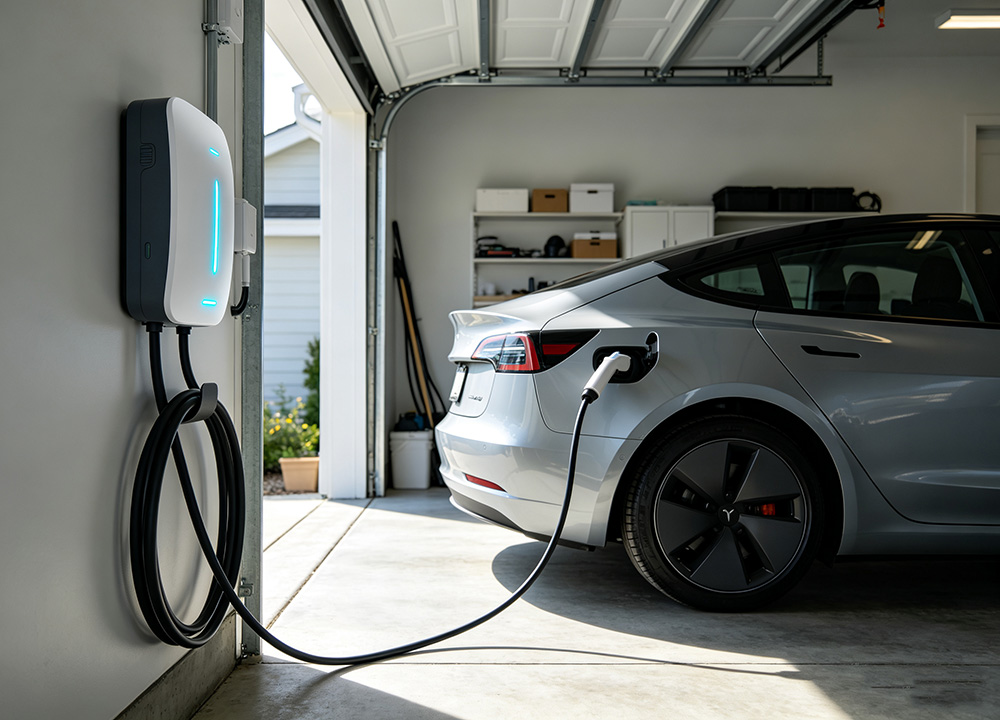
A wall-mounted Level 2 charger is hardwired or plugged into a dedicated 240-volt outlet. It stays on the wall. It supports higher amperage, faster charging, and features like cable management, LED status displays, and smart home integration. It looks cleaner and feels more permanent.
If you own your home and plan to stay for years, wall-mounted is the cleaner setup. If you rent or move frequently, portable gives you flexibility. Both deliver Level 2 speeds. The difference is in installation permanence and maximum amperage.
Parwatt EV Charging Solutions
Parwatt manufactures Level 1 and Level 2 EV chargers for home, fleet, and commercial use. Portable chargers for on-the-go flexibility. Wall-mounted chargers for permanent home installations with smart scheduling and Wi-Fi connectivity.
Every charger is tested for safety, charging speed, and compatibility with all major EV makes and models. Wholesale and OEM partnerships are available.
Frequently Asked Questions
A: Level 1 adds about 3 to 5 miles of range per hour. Over 10 to 12 hours overnight, that is 30 to 60 miles. It covers the average American commute of about 37 miles per day.
A: If your garage already has a 240-volt outlet in the right location, you may not need one. A plug-in Level 2 charger connects in minutes. If you need a new 240-volt circuit run from your electrical panel, hire a licensed electrician. The cost is typically $300 to $1,000.
A: Most EV manufacturers advise against it. If you must use one, get a heavy-duty outdoor-rated 12-gauge or 10-gauge extension cord no longer than 25 feet. A thin or long cord can overheat and create a fire risk.
A: Nothing. The plug will not fit. Level 2 chargers use a NEMA 14-50 or similar 240-volt plug that is physically different from a standard 120-volt outlet.
A: No. Level 2 charging is well within the safe charging rate for every EV on the market. DC fast charging generates more heat and should be used for road trips, not daily top-ups. Level 2 is the recommended daily charging method by every major automaker.
A: Parwatt manufactures Level 1 and Level 2 EV chargers in portable and wall-mounted configurations. Contact us for product specifications, pricing, and wholesale options.

--- END ---
Related Posts


Business Ideas

Business Ideas

Business Ideas
