

Modular vs Fixed EV Charging Systems: Pros, Cons & Which Is Better in 2026?
Jul 10,2026
Many buyers want EV charging that lasts for years. They hear modular systems offer flexibility while fixed systems promise simplicity. The choice feels risky and confusing.
Modular EV charging systems let you add power or swap parts easily, while fixed systems offer lower upfront costs and strong reliability for steady use. The better option depends on your growth plans, daily volume, and maintenance priorities in 2026.
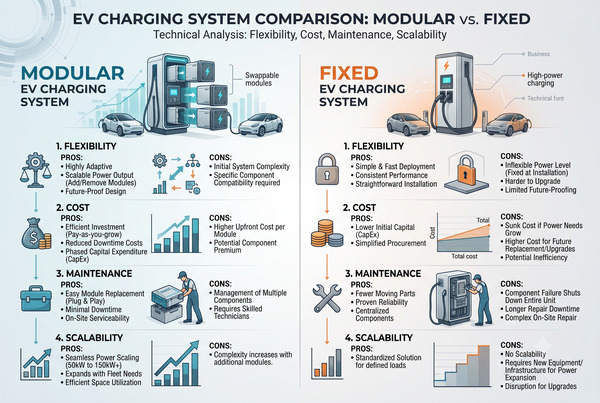
I have helped charge point operators, fleet managers, and property developers make this exact decision at Parwatt. Some chose modular and scaled fast. Others picked fixed and saved money on stable sites. This guide clears the confusion with real comparisons so you pick the system that fits your needs today and tomorrow.
Why Choosing Between Modular and Fixed EV Charging Systems Is So Confusing for Buyers
You see ads for both modular and fixed chargers. Each side claims big advantages. You worry about picking wrong and wasting money on something that cannot grow or breaks often.
Choosing between modular and fixed EV charging systems creates confusion because modular promises easy expansion but costs more upfront, while fixed systems seem simple yet may limit future changes. Buyers often fear high investment risk, difficult maintenance, or systems that cannot scale with their EV plans.
Last year a fleet operator called me after buying a fixed system for his growing delivery vans. He liked the low price. Six months later he needed more power for new vehicles. The whole system had to be replaced. He lost time and money. Stories like this make buyers hesitate. Let me explain why the decision feels so hard and what really matters.
High Investment Risk
Both options require real money. Modular systems often cost 20 to 40 percent more at the start because of extra components and design. Fixed systems look cheaper but can force full replacement later if needs change. Many buyers cannot predict their exact EV numbers in three years. This uncertainty makes every quote feel risky.
Future Expansion Worries
EV adoption keeps growing. A site that handles ten vehicles today may need twenty next year. Fixed systems usually need new electrical work and new units for growth. Modular systems let you add power modules without touching the whole setup. Yet some modular designs still have limits on total expansion or require specific brands for new parts.
Maintenance and Downtime Fears
Fixed chargers can be very reliable when used in steady conditions. But one failure can shut down the whole unit. Modular systems let you swap one bad module while the rest keep working. This reduces downtime. However, modular designs sometimes need more skilled technicians and spare parts on hand. Buyers worry about who will service them in remote areas.
Conflicting Advice from Sellers
Some sellers push modular because it sounds modern. Others push fixed because it has fewer parts to fail. Without clear data on your site, it is hard to know who is right. I always tell customers to start with their actual daily use and growth forecast instead of marketing claims.
Here is a quick table of why the choice feels risky:
| Buyer Concern | Modular Side Effect | Fixed Side Effect | Real Impact |
|---|---|---|---|
| Upfront cost | Higher initial investment | Lower purchase price | Budget strain or surprise bills |
| Future growth | Easy module adds | Often needs full replacement | Extra projects and downtime |
| Maintenance | Swap single modules | Repair or replace whole unit | Different downtime lengths |
| Technical support | May need special training | Simpler but less flexible | Service delays or extra training |
Bullet points that add to the confusion:
- Marketing materials rarely show real total cost over five years.
- Local installers may only know one type well.
- Utility rules on power expansion change by region.
- New EV models may need higher power than current systems provide.
Our 30kW Power Module and 40kW Power Module show how modular designs work in practice. They let operators add capacity without replacing the base system. Understanding these real trade-offs removes the fear of making a costly mistake.
Common Misconceptions About Modular and Fixed EV Chargers
Buyers often believe simple rules that do not hold up in real sites. These wrong ideas lead to poor choices and later regret.
Common misconceptions include thinking modular systems are always more flexible, that fixed systems have no upgrade path, and that initial price tells the full story. In reality both types have limits, and long-term costs matter more than the first invoice.
I hear these myths almost every week. One workplace manager told me he avoided modular because he thought it would be too complex for his team. He later learned a simple modular setup would have saved him from a full replacement two years later. Another fleet buyer assumed fixed systems were always cheaper to run. His high-volume site had more downtime than expected. Let me clear up the biggest misconceptions with facts from actual projects.
Misconception 1: Modular Is Always More Flexible
Modular designs do allow easier power increases and faster repairs. You can often add a module or swap a faulty one in hours instead of days. But flexibility has limits. Some modular systems only work with the same brand modules. Others need extra space or cooling when you add capacity. Fixed systems can sometimes accept limited upgrades through software or external load management. The real flexibility depends on the specific product design, not just the word modular.
Misconception 2: Fixed Systems Cannot Grow
Many fixed chargers have no easy way to increase power output. Yet some newer fixed models support parallel connection or external power sharing. They still cannot match full modular expansion, but they are not completely frozen. Buyers who dismiss all fixed systems miss options that fit stable sites with predictable growth.
Misconception 3: Lower Initial Cost Means Lower Total Cost
Fixed systems usually win on purchase price. But when you add installation, possible future replacement, and downtime losses, the gap shrinks. Modular systems can cost more at day one yet save money through quicker repairs and longer useful life. I have seen modular installations pay back the extra cost in under three years on high-use fleet sites because of reduced downtime.
Misconception 4: Modular Always Means Less Downtime
Modular systems do allow partial operation during repairs. One bad module does not stop everything. However, if the control system or shared cooling fails, the whole setup can still go down. Fixed systems sometimes prove more robust for continuous high-power use because they have fewer connection points that can loosen over time.
Here is a table that challenges common beliefs:
| Misconception | Reality Check | Better Way to Think |
|---|---|---|
| Modular = total flexibility | Limited by brand and site constraints | Check exact expansion path first |
| Fixed = no future options | Some allow software or parallel upgrades | Ask about growth paths even on fixed |
| Cheap upfront = smart buy | Ignores downtime and replacement costs | Calculate five-year total cost of ownership |
| Modular always reduces downtime | Control failures can still stop the system | Review failure modes of each design |
Bullet points of questions that cut through the myths:
- Will this system support my expected vehicle count in three years?
- How quickly can I get spare parts in my region?
- What does the five-year maintenance and energy cost look like?
- Does my site have space and cooling for added modules?
Our FES-D30 DC EV Charger combines modular thinking with strong reliability for commercial sites. Reading our Electric Vehicle Charging guide helps buyers separate marketing claims from practical performance.
These misconceptions disappear when you look at your actual usage numbers and long-term plans instead of general rules.
Modular vs Fixed EV Charging Systems: Detailed Pros and Cons Comparison
You need a clear side-by-side view of cost, expansion, maintenance, reliability, and installation to make the right call.
Modular systems shine in flexibility, easier repairs, and future-proofing but usually cost more upfront. Fixed systems deliver lower initial investment, simpler design, and strong reliability for steady high-volume use but can require full replacement when needs change.
I compare both types across the factors that matter most to my customers. Home and small business sites often lean one way. Large fleets and high-traffic commercial locations lean the other. The data comes from real 2026 installations and feedback from operators across different regions.
Cost Comparison
Fixed systems generally have lower purchase and installation prices. Fewer parts and simpler wiring reduce labor time. Modular systems require more components and sometimes extra electrical planning, which raises the first invoice. Over five years the picture changes. Modular repairs are faster and cheaper, and you avoid full replacement costs. Fixed systems may need complete new units sooner if power demand grows.
Expansion and Scalability
This is where modular wins clearly. You can add power modules as your EV count rises without replacing the base cabinet or electrical service in many cases. Fixed systems usually require new chargers and possibly new electrical work for any meaningful growth. For sites with uncertain future volume, modular protects the investment.
Maintenance and Downtime
Modular designs let technicians replace one module while others keep charging vehicles. This keeps most of the system online. Fixed systems often need the whole unit serviced or replaced, creating longer downtime. However, fixed units sometimes have fewer points of failure and can be more robust in harsh outdoor conditions with continuous high power.
Reliability for Different Loads
Fixed systems tend to handle steady high-power use very well because they have simpler internal connections. Modular systems can match this when properly designed but may show more issues at connection points between modules over time. Both types meet safety standards when installed correctly.
Installation Difficulty
Fixed systems are often quicker to install on simple sites. Modular systems may need more planning for module spacing, cooling, and future access. Yet once the base is in place, adding capacity later is much easier with modular.
Here is a detailed comparison table:
| Factor | Modular Systems | Fixed Systems | Winner Depends On |
|---|---|---|---|
| Upfront Cost | Higher (20-40% more typical) | Lower purchase and install price | Stable sites favor fixed |
| Expansion | Add modules without full replacement | Usually requires new units and wiring | Growing sites favor modular |
| Maintenance Downtime | Low – swap single modules | Higher – whole unit often offline | High-use sites favor modular |
| Reliability | Good with proper design | Often stronger for continuous high power | Harsh steady use favors fixed |
| Installation Complexity | More planning for modules and cooling | Simpler on most sites | Simple sites favor fixed |
| Long-term Value | Better for changing needs | Better for predictable long-term use | Depends on growth forecast |
Bullet points of key decision questions:
- How many vehicles will charge here in one, three, and five years?
- What is my tolerance for downtime during repairs?
- Do I have space and power headroom for added modules?
- How important is it to keep most chargers online during service?
Our Meta Mobile EV Charger with Battery offers a practical middle path for some fleet operators who want modular flexibility in a mobile package. Our AC vs DC EV Charging post also helps explain power architecture choices that affect both modular and fixed designs.
This structured comparison removes guesswork and shows exactly where each system wins or loses.
When to Choose Modular vs Fixed EV Chargers – Real-World Recommendations
You want practical advice for your specific situation instead of general theory.
Home and small stable sites often do best with fixed or simple modular systems for lower cost and reliability. Large fleets, high-traffic commercial locations, and any site expecting growth benefit more from full modular architectures because of easier scaling and lower downtime in 2026.
I give these recommendations based on hundreds of projects and ongoing conversations with operators. The right choice always starts with honest numbers about current use and expected growth.
Home and Small Business Use
Most homes and small offices have predictable daily charging and limited space. A well-chosen fixed Level 2 wall charger meets needs at the lowest cost. If slight future growth is possible, a basic modular unit with one or two expansion slots works well without overcomplicating the install. Our EC01 Wall Charger represents the fixed approach that keeps things simple and reliable for residential and light commercial sites.
Workplace and Retail Locations
These sites often have moderate growth and multiple users. A modular system with load management lets managers add capacity as more employees get EVs. It also supports scheduling and reporting that fixed basic units may lack. When the site has very stable usage and tight budgets, a quality fixed system with good smart features can still deliver excellent results.
Fleet and High-Volume Commercial Sites
Fleets live on uptime. Modular systems reduce downtime because one module can be serviced while others continue working. They also scale power as the fleet adds vehicles or adopts higher-power models. Fixed systems work for very predictable overnight charging with no expected growth, but most fleet operators I advise choose modular or hybrid designs for long-term value. Our power module series and FES-D30 DC EV Charger give fleets the durability and expansion they need.
Here is a recommendation table by real-world use case:
| Use Case | Recommended Type | Key Reasons | Parwatt Example Fit |
|---|---|---|---|
| Home / Small Business | Fixed or basic modular | Low cost, simple install, predictable use | EC01 Wall Charger |
| Workplace / Retail | Modular with smart controls | Growth potential, user management, reporting | Modular systems with load management |
| Fleet / Logistics | Full modular or hybrid | Low downtime, easy scaling, high utilization | 30kW/40kW Power Modules + FES-D30 |
| High-traffic Commercial | Modular architecture | Fast repairs, future power increases | Scalable modular cabinets |
Bullet points of 2026 trends I see:
- More operators choose modular when utility incentives reward flexible load management.
- Fixed systems remain popular for new residential construction where growth is limited.
- Hybrid approaches that combine fixed base cabinets with modular power blocks are gaining ground.
- Battery-buffered mobile units add another flexible option for temporary or remote fleet needs.
Our Level 2 vs Level 3 Charging guide and Charge EV Faster Home vs Public post provide extra context on power choices that interact with modular and fixed decisions.
These recommendations turn the comparison into clear actions for your site.
Ready to Decide on Your EV Charging System? Here’s Your Action Plan
You now understand the real differences. It is time to move from information to decision with a simple sequence of steps.
Assess your current and future vehicle numbers, calculate total cost over five years, check your electrical capacity, and consult experienced installers before choosing modular or fixed. This process prevents most expensive mistakes and matches the system to your actual needs.
I walk every serious customer through these steps. It works whether you manage one home charger or a multi-site fleet operation.
Step 1: Gather Your Numbers
Write down how many vehicles charge today and how many you expect in one, three, and five years. Note daily energy use and peak simultaneous charging. This data drives every later choice.
Step 2: Review Your Electrical Service
Have an electrician confirm available amps and whether upgrades will be needed. Modular systems sometimes need more headroom for future modules. Fixed systems may need less now but more later if you grow.
Step 3: Calculate Five-Year Total Cost
Include purchase price, installation, expected maintenance, electricity rates, possible downtime losses, and any utility incentives. Modular often looks better over time on growing sites. Fixed often wins on stable sites.
Step 4: Compare Specific Products
Request detailed specs and references for both modular and fixed options that fit your numbers. Ask about spare parts availability, software update policy, and real expansion limits.
Step 5: Get Professional Quotes and Advice
Work with installers who know both system types. Ask them to model your site with each option. Good installers will point out site-specific issues you may have missed.
Step 6: Make the Decision and Plan Installation
Choose the system that best matches your growth forecast and downtime tolerance. Schedule installation during low-activity periods and arrange training for your team on monitoring and basic maintenance.
Bullet points of final checks before you sign:
- Does the warranty cover both parts and labor for the expected life?
- Can I get local service support within 24 hours if needed?
- Does the system support the payment or access control my users require?
- Have I left room in the budget for small unexpected electrical work?
Our team at Parwatt helps customers run these exact steps every week. Contact us through the site for product details or installer recommendations that fit your location and scale.
Conclusion
Modular and fixed EV charging systems each have clear strengths. Modular systems excel in flexibility and future-proofing, while fixed systems often provide better reliability and lower upfront costs for stable, high-volume locations. In 2026, the best choice depends on your specific needs — growth expectations, budget, and usage patterns. Understanding the trade-offs helps you invest wisely and avoid costly mistakes later. Take time to evaluate your long-term plans before deciding. The right charging system will support your EV journey efficiently for years to come.

--- END ---
Related Posts


Business Ideas

Industry News
