

Battery Charger vs. Battery Maintainer vs. Jump Starter: Which Is Best for Your Vehicle?
Jul 14,2026
You turn the key. Click. Nothing. The dashboard lights flicker and die. Your battery is dead. You need something to get the car running again. But do you need a battery charger, a maintainer, or a jump starter? The three devices look similar on a store shelf. They do completely different jobs. Buying the wrong one wastes money or leaves you stranded with a tool that cannot solve your problem.
Parwatt manufactures all three types of devices. This guide explains what each one does and when to reach for it.
Your Battery Is Dead in a Parking Lot. What Do You Reach For?
A jump starter. You connect the clamps to the battery terminals, press the power button, and start the car. Total time: under two minutes. You drive home.
A battery charger would not help here. It needs an AC outlet and hours of time. A maintainer would not help either. It is designed to prevent batteries from dying, not revive a dead one in a parking lot. The jump starter is the only tool for this situation.
This is why knowing the difference matters. Each device solves a different problem. The rest of this guide breaks down what each one does so you buy the right tool before you need it.
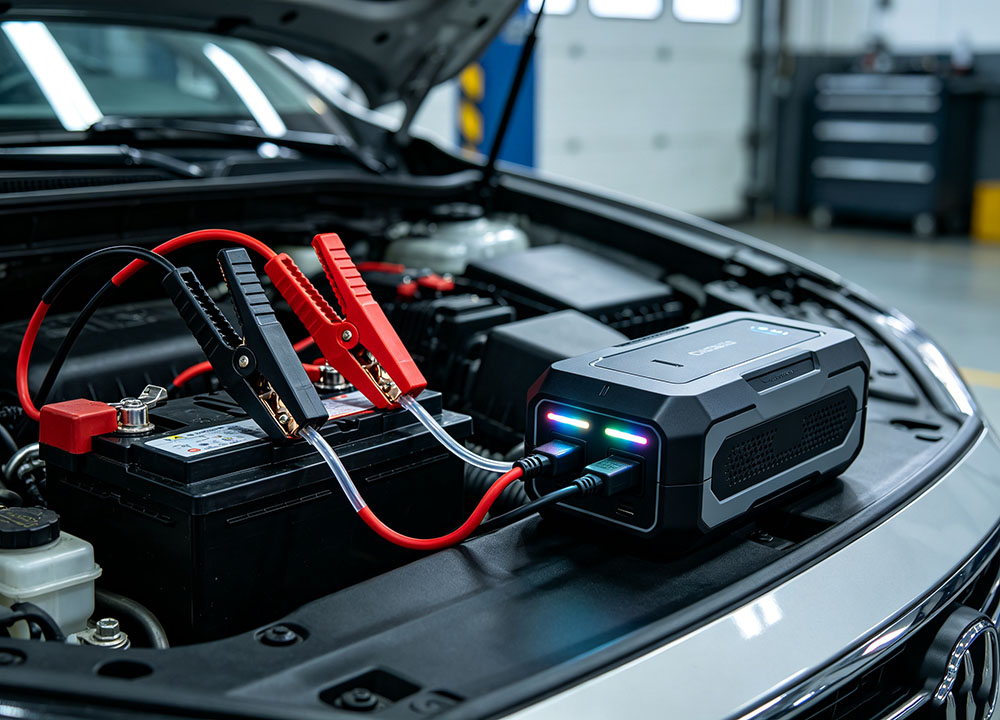
Charger, Maintainer, or Jump Starter: Three Tools, Three Jobs
Battery Charger
A battery charger takes a dead or low battery and brings it back to full charge. It plugs into a wall outlet. It delivers enough current to refill the battery over several hours. You use it when the car is at home and you have time.
Battery Maintainer
A battery maintainer keeps a charged battery from losing its charge during storage. It plugs into a wall outlet and delivers a tiny current, just enough to offset natural self-discharge. You leave it connected for weeks or months. It is for cars, motorcycles, boats, and lawn equipment that sit unused for long periods.
Jump Starter
A jump starter is a portable battery pack with enough power to start an engine. It does not plug into a wall outlet while in use. It does not charge the battery. It provides a surge of current to crank the starter motor. Once the engine starts, the alternator takes over.
How a Battery Charger Works and When You Need One
A battery charger converts AC power from a wall outlet into DC power at the voltage your battery needs. It pushes current into the battery until the voltage reaches the full charge level.
You need a charger when your battery is too low to start the car and you have access to an electrical outlet and several hours of time. The charging time depends on the charger’s amp rating and the battery’s capacity. A 10-amp charger on a typical 50 amp-hour car battery takes about 5 to 6 hours for a full charge from empty.
You also need a charger if your car has been jump-started and you want to fully recharge the battery afterward. The alternator can maintain a charged battery but is not designed to recharge a deeply discharged one from scratch. A full charge from a plug-in charger restores the battery to its proper state and prevents repeat failures.
How a Battery Maintainer Extends Battery Life During Storage
All lead-acid batteries self-discharge over time. A sitting car battery loses about 1 to 3 percent of its charge per day, more in hot weather. After a month of sitting, the battery may be too weak to start the car.
A maintainer solves this by delivering a very small current, typically 0.5 to 2 amps. It monitors the battery voltage. When the voltage drops below a set threshold, the maintainer sends a pulse of current. When the battery is full, it stops. This is called float charging.
Maintainers are for seasonal vehicles. The sports car that sits in the garage all winter. The motorcycle that does not get ridden between November and March. The boat battery that sits for six months between summers. The lawn tractor that hibernates from fall to spring. Connect the maintainer and walk away. The battery is ready when you are.
How a Jump Starter Gets You Moving in Two Minutes
A jump starter is a lithium battery pack with heavy-duty clamps. It stores enough energy to deliver a short, high-current burst to the starter motor. Most portable jump starters fit in a glove box.
To use one, connect the red clamp to the positive terminal and the black clamp to a grounded metal surface. Turn on the jump starter. Start the car. Disconnect immediately. The entire process takes less than two minutes.
Jump starters do not charge the battery. They bridge the gap between a dead battery and a running engine. After jumping, drive the car for at least 20 to 30 minutes to let the alternator partially recharge the battery. Then connect a plug-in charger when you get home for a full recharge.
Modern jump starters include safety features that older jumper cables do not. Reverse polarity protection. Spark-proof connection. Over-temperature shutoff. These make them safer for people who are not comfortable with traditional jumper cables.
Amp Ratings Explained: 2A, 10A, and 50A Chargers
Amp rating is the maximum current the charger can deliver. It directly determines charging speed.
A 2-amp charger is a maintainer or trickle charger. It takes 24 to 48 hours to fully charge a dead car battery. It is for long-term maintenance, not for bringing a dead battery back to life quickly.
A 10-amp charger is the standard for home use. It charges a typical car battery in 5 to 6 hours from empty. It is fast enough to be useful but gentle enough to not overheat the battery if left connected.
A 50-amp charger is a fast charger or jump starter with a charging mode. It can start charging a deeply discharged battery in 30 to 60 minutes. It generates more heat. Use it only when you need speed and disconnect once the battery reaches a reasonable charge level.
Higher amps are not always better. Fast charging generates heat that can reduce battery life if used frequently. For routine charging, 10 amps is the sweet spot between speed and battery care.
Smart Chargers: The Multi-Stage Difference
Old chargers delivered a constant current until you unplugged them. Leave one connected too long and it overcharges the battery, boiling off the electrolyte and permanently damaging the cells.
Smart chargers use a microprocessor to manage the charging process in stages. Bulk stage delivers full current until the battery reaches about 80 percent. Absorption stage slows the current to top off the remaining 20 percent without overheating. Float stage maintains the full charge indefinitely with tiny pulses.
A smart charger can stay connected for weeks without damaging the battery. It switches to float mode automatically. This means the same device can function as both a charger and a maintainer. If you are buying one device today, make it a smart charger with automatic float mode.
Three Real Scenarios and the Right Tool for Each
Scenario One
Your daily driver will not start on a cold morning. The battery is completely dead. You need to get to work. Solution: jump starter. Start the car and drive. Charge the battery fully when you get home with a plug-in charger.
Scenario Two
Your weekend convertible sits in the garage from November to April. The battery was new last summer but you know it will be dead by spring. Solution: battery maintainer. Connect it in November. Disconnect in April. The battery stays at full charge all winter.
Scenario Three
Your car battery is weak but not dead. The engine cranks slowly. The headlights dim at idle. The battery is several years old and you want to see if a full charge revives it before you buy a replacement. Solution: smart charger. Run a full charge cycle overnight. Test the battery the next day.
Frequently Asked Questions
A: No. A jump starter provides a short burst of current to start the engine. It does not charge the battery. The alternator partially recharges the battery while you drive. Use a plug-in charger for a full recharge after a jump start.
A: If it is a smart charger with automatic float mode, yes. It will switch to maintenance mode when the battery is full. If it is an old manual charger without automatic shutoff, no. It can overcharge and damage the battery.
A: At 2 amps, 24 to 48 hours. At 10 amps, 5 to 6 hours. At 50 amps, 30 to 60 minutes for a partial charge. The exact time depends on battery size and depth of discharge.
A: A trickle charger delivers a constant low current whether the battery needs it or not. A maintainer monitors the battery and only delivers current when the voltage drops. Maintainers are safer for long-term connection.
A: Not usually. Most modern chargers are designed to be connected with the battery still in the vehicle. Check the charger manual. Disconnect if you are charging a battery that has been frozen or if the vehicle will sit unused for an extended period.
A: Parwatt manufactures battery chargers, maintainers, and portable jump starters for consumer and wholesale markets. Contact us for product specifications and pricing.
Parwatt Battery Charging Solutions
Parwatt manufactures battery chargers, maintainers, and portable jump starters for home users, auto shops, and wholesale distributors.
Smart chargers with multi-stage charging and automatic float mode. Compact maintainers for seasonal vehicle storage. High-power portable jump starters with reverse polarity and spark protection. Every device is tested for safety and reliability before shipping.

--- END ---
Related Posts


Business Ideas

Industry News
