

How to Source Reliable Cordless Car Vacuum Cleaners from China: A B2B Buyer’s Guide
Aug 31,2026
Cordless car vacuum specifications are easy to misjudge when suppliers use different suction units and test methods. Peak numbers look impressive on paper, yet real cleaning power, runtime, and durability often fall short. Returns and battery complaints then rise. At Parwatt I see these gaps create problems for B2B buyers every season.
Sourcing reliable cordless car vacuum cleaners from China requires verifying sustained suction, real battery runtime, filtration, safety, and supplier repeatability rather than relying on advertised peak figures. In 2026 buyers who test samples under consistent conditions and confirm battery compliance, certifications, and after-sales support reduce returns and protect margins.
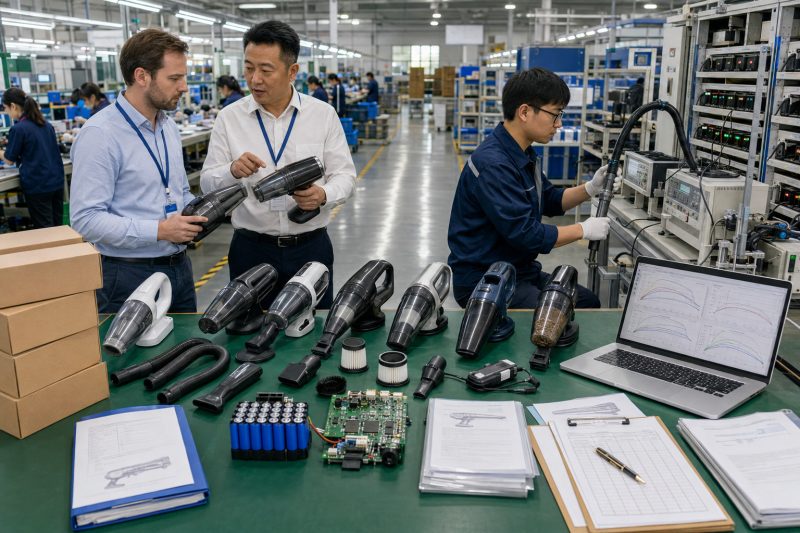
I have worked with automotive accessory wholesalers and importers for years as general manager at Parwatt New Energy. We supply a range of car care products including cordless vacuums alongside charging solutions. I regularly review orders where buyers focused only on the highest suction claim and later faced weak real-world performance or battery issues. Our own product lines, such as those in the car vacuum cleaner category, are developed with consistent testing so partners receive repeatable quality. In this article I explain how B2B buyers can source reliable cordless car vacuums from China and avoid the most common pitfalls in 2026.
Why Cordless Car Vacuum Specifications Are Easy to Misjudge?
Suppliers promote suction in Pa, kPa, AW, or motor wattage, yet the test methods behind those numbers are rarely the same. Peak suction measured at the motor can differ greatly from sustained suction at the nozzle once the dust cup fills or the battery voltage drops. Runtime, noise, filtration, and battery life also involve clear trade-offs that a single headline figure cannot reveal.
Cordless car vacuum specifications are easy to misjudge because suction claims use inconsistent units and test methods. Peak values often overstate real cleaning ability, while runtime, noise, filtration, and battery performance create important trade-offs that buyers must verify under the same conditions.
The Gaps Between Claimed and Actual Performance
I have compared samples that listed very high Pa figures yet lost noticeable suction within minutes of continuous use. The peak reading was taken at the motor inlet under ideal conditions. Once air flowed through the hose, filter, and dust cup, and once the battery began to discharge, the effective cleaning power dropped.
Runtime claims based solely on battery capacity in mAh are equally unreliable. A larger cell can still deliver short runtimes if the motor draws high current or if the battery management system cuts power early for protection. Temperature and suction mode further change the result.
Noise and ergonomics matter for end users who clean inside a vehicle. A powerful motor that produces high noise or awkward weight distribution leads to lower satisfaction even when suction is adequate.
Filtration quality affects both cleaning results and maintenance. Fine dust that escapes the filter returns to the cabin or clogs the motor over time. Buyers who never test filtration under load discover the limitation only after customer feedback arrives.
Here is a table that shows why specifications need careful interpretation:
| Specification Claim | Common Limitation | Real-World Effect | Verification Method |
|---|---|---|---|
| High peak Pa / kPa | Measured at motor, not nozzle | Lower sustained cleaning power | Measure at nozzle under load |
| Large mAh battery | Ignores motor draw and BMS | Shorter actual runtime | Continuous runtime test to shut-off |
| High motor wattage | Does not equal airflow efficiency | Heat and noise without better cleaning | Compare sealed suction and airflow |
| Basic filter claim | No efficiency data under dust load | Dust escape or rapid clogging | Dust retention and airflow test |
| Lightweight design | May sacrifice structure or seal | Reduced durability or suction loss | Drop and continuous-use checks |
This table reflects the mismatches I see most often when reviewing supplier data sheets. At Parwatt we apply consistent test methods across our accessory lines, including products in the car vacuum cleaner category, so partners can compare performance fairly.
In 2026 the market remains full of attractive peak numbers. Buyers who treat those numbers as the main decision factor consistently experience higher return rates and more battery-related complaints.
The Sourcing Mistakes That Lead to Returns and Battery Complaints
Several recurring mistakes drive returns and negative feedback. Buyers compare only maximum suction and battery capacity. They accept untested runtime claims. They overlook suction drop at low battery, plastic strength, filter availability, charger safety, lithium battery transport documents, and spare-part support. These oversights turn an attractive unit price into higher total cost after sales.
Sourcing mistakes that cause returns include comparing only peak suction and capacity, trusting unverified runtime data, ignoring low-battery suction loss, weak plastics, filter supply, charger safety, lithium shipping documents, and spare-part availability. These gaps create customer complaints and margin erosion.
Errors That Appear in Many First Orders
One frequent mistake is ranking suppliers by the highest advertised suction number. Without a shared test protocol, the comparison is meaningless. A lower but sustained suction value often cleans better in real vehicle interiors than a higher peak that collapses quickly.
Runtime is another common source of disappointment. Buyers estimate operating time from mAh ratings and later receive complaints that the vacuum dies after a few minutes of high-power use. Continuous testing in each mode until automatic shut-off is the only reliable method.
Low-battery performance is rarely checked. Many units maintain strong suction only at high state of charge and then weaken noticeably. Customers notice this during longer cleaning sessions.
Mechanical durability and consumables receive too little attention. Weak plastic housings crack after normal use. Filters that cannot be reordered or that clog quickly generate support tickets. Charger quality and safety protection affect both user experience and compliance.
Lithium battery transport and compliance documents are sometimes treated as an afterthought. Missing or incomplete UN 38.3 test summaries, material safety data, and shipping classifications delay cargo or create customs problems.
Here is a table of the main sourcing traps:
| Mistake | Why It Happens | Result | Better Practice |
|---|---|---|---|
| Peak suction ranking | Easy headline comparison | Weak real cleaning | Test sustained suction under load |
| mAh-based runtime | Simple calculation | Customer battery complaints | Continuous runtime to cut-off |
| Ignoring low-battery drop | Tests done only at full charge | Performance fade in use | Test across full discharge |
| Weak filter / spare support | Focus on initial unit cost | Repeat complaints and returns | Confirm consumable supply |
| Incomplete battery documents | Treated as logistics detail | Shipping delays or rejection | Require full transport file |
This table captures the issues that most often turn a promising sample into a costly bulk order. At Parwatt we emphasize complete documentation and repeatable testing for the accessory products we supply, including those alongside our car battery charger and car air pump ranges.
I have seen importers absorb high return rates because the bulk shipment could not match the carefully prepared sample. Avoiding these mistakes requires disciplined testing and clear quality agreements before production begins.
How to Compare Motors, Batteries, Filters and Accessories
A useful comparison examines the complete system rather than isolated headline numbers. Motor type, rated and sustained suction, working modes, cell quality and protection, measured runtime, charge time, filter design, dust-cup capacity, noise, weight, and accessory usefulness all influence the final customer experience and the product’s position in the market.
Compare motors, batteries, filters, and accessories by measuring sustained suction, real runtime in each mode, filtration efficiency, noise, ergonomics, and accessory fit for vehicle cleaning tasks. Brushless motors, quality cells, and practical attachments support higher-value positioning when the full system is properly engineered.
Key Elements That Determine Real Performance
Brushed motors remain common at lower price points. They are simple and cost-effective yet generally offer shorter service life and less refined speed control. Brushless motors can deliver better efficiency, longer life, and more stable performance, but only when airflow, sealing, and battery output are also well designed. A brushless motor in a poorly sealed air path still produces mediocre results.
Suction should be evaluated as sustained performance at the nozzle, not only as a peak motor reading. Testing with a partially filled dust cup and at lower battery states reveals how the unit behaves during actual cleaning.
Battery cells and the protection board determine both runtime and safety. Consistent cell brands, proper matching, and a reliable battery management system reduce the risk of early cut-off, overheating, or premature capacity loss. Charge time and charger quality affect daily convenience.
Filtration and dust containment influence both cleaning results and maintenance frequency. Multi-stage filters or HEPA-style media capture finer particles. Washable filters lower consumable cost; replaceable filters require a stable spare-part channel.
Accessories must match real vehicle tasks. Narrow crevice tools, soft brushes for dashboards, and flexible hoses that reach footwells determine whether the vacuum is genuinely useful or quickly set aside.
Here is a practical comparison framework:
| Component | Lower-Cost Approach | Higher-Value Approach | What to Verify |
|---|---|---|---|
| Motor | Brushed | Brushless with good air path | Sustained suction and temperature |
| Battery | Generic cells, basic protection | Consistent cells, robust BMS | Runtime to shut-off in each mode |
| Filtration | Single basic filter | Multi-stage or higher-efficiency | Dust retention and airflow under load |
| Dust cup | Small, awkward empty | Adequate volume, easy empty | Capacity vs typical cleaning task |
| Accessories | Minimal or poorly fitting | Task-specific, secure fit | Real vehicle interior reach |
| Noise / weight | Secondary consideration | Balanced for hand-held use | Measured dB and ergonomics |
This framework keeps the evaluation grounded in customer experience. At Parwatt we apply similar system-level checks across our car-care products so partners receive balanced performance rather than isolated high numbers.
I recommend that buyers create a simple scorecard with weighted criteria for suction, runtime, filtration, noise, and accessories before they begin sample testing. The scorecard prevents decisions driven by a single impressive claim.
What Separates a Reliable Car Vacuum Manufacturer from a Generic Supplier
A reliable manufacturer can demonstrate consistent process control, not just one good sample. Buyers should look for repeatable performance testing, stable battery-cell sources, proper protection design, incoming and aging inspection, export compliance documentation, OEM packaging capability, spare-part supply, and a clear method for handling defective batches. These capabilities separate factories that can scale quality from those that cannot.
A reliable car vacuum manufacturer provides repeatable test data, stable cell sourcing, battery protection design, incoming and aging inspection, export compliance files, OEM packaging, spare-part support, and defined handling of abnormal batches. These systems enable consistent bulk quality rather than one-off sample success.
Evidence of Manufacturing Discipline
Performance testing should be documented and repeatable. The factory should be able to show how suction, runtime, and noise are measured and how those methods will be applied to production units. A single golden sample without a matching test protocol is insufficient.
Battery-cell control is critical. Reliable makers maintain approved cell lists, incoming inspection records, and traceability. Protection circuits are designed and verified rather than added as an afterthought.
Aging and charge-discharge testing catch early failures before shipment. Drop, vibration, and temperature checks further reduce field problems.
Compliance files must be complete for the target markets. Electrical safety, EMC, chemical restrictions, and labeling requirements vary by destination. Lithium battery transport documents, including UN 38.3 related evidence, must be ready for shipping.
OEM and packaging capability matter for brand buyers. The factory should support custom labeling, manuals, and packaging that protect the product and meet retail expectations.
Spare-part availability and defect handling determine after-sales cost. Filters, brushes, and chargers should remain obtainable. A clear process for quarantine, analysis, and corrective action on defective lots protects both parties.
Here is a checklist of manufacturer capabilities:
- Documented, repeatable suction and runtime test methods
- Stable, traceable battery-cell sources and incoming checks
- Verified battery protection and charge control design
- Aging, charge-discharge, and mechanical stress testing
- Complete compliance and lithium transport documentation
- OEM packaging and labeling support
- Ongoing supply of filters and key accessories
- Written process for defective-batch isolation and correction
At Parwatt we maintain these controls across the accessory products we manufacture and supply, including cordless vacuums and related car-care items. Partners can review our approach through the ranges shown on our main site.
I have compared factories that could only present a polished sample with those that opened their test records and process documents. The second group consistently delivered more uniform bulk shipments and fewer post-sale surprises.
A Step-by-Step Process for Testing and Placing Your First Order
A controlled sourcing process begins with a clear market and price position, moves through specification and supplier verification, requires thorough sample testing, confirms certifications and transport files, locks a golden sample and packaging, starts with a trial order, applies pre-shipment inspection, and expands only after return data is reviewed. Skipping steps increases the chance of costly bulk problems.
Place a reliable first order by defining the target market and price band, writing a clear specification, verifying the supplier, testing multiple samples under consistent conditions, confirming certifications and lithium documents, approving a golden sample and packaging, running a trial order with inspection, and expanding on the basis of actual return data.
From Specification to Controlled Expansion
Define the intended retail or wholesale position and the primary cleaning tasks the vacuum must handle. This clarity guides suction, runtime, and accessory requirements and prevents over-specification.
Create a written specification that lists minimum sustained suction, runtime in each mode, noise limits, filter type, battery and charger requirements, safety protections, certifications, and packaging standards. Use this document for all supplier discussions.
Verify the supplier’s capability through references, process audits if possible, and review of test and compliance records. Request evidence of cell sourcing and aging procedures.
Test multiple samples from the short-listed makers under identical conditions. Measure sustained suction, continuous runtime to shut-off, noise, temperature, filtration, and accessory fit. Record results in a simple comparison sheet.
Confirm all required certifications for the destination markets and collect the full lithium battery transport file. Do not treat these as post-order formalities.
Approve a signed golden sample and locked packaging artwork. The golden sample becomes the quality reference for production.
Place a trial order of limited quantity. Conduct pre-production and pre-shipment inspections against the approved specification and golden sample.
After the trial goods reach the market, track returns, battery complaints, and customer feedback. Only then increase order volume with the same supplier and specification.
Here is a concise process list:
- Define target market, price band, and key cleaning tasks.
- Write a measurable product specification.
- Short-list and verify suppliers with process evidence.
- Test multiple samples under the same protocol.
- Confirm certifications and lithium transport documents.
- Approve golden sample and packaging.
- Place and inspect a limited trial order.
- Monitor returns and field performance.
- Expand volume only after data confirms stability.
- Maintain the specification and quality agreement for future orders.
At Parwatt we support buyers who follow this disciplined path with products that meet consistent internal standards. Our car-care range, including cordless vacuums, is managed alongside other accessory lines such as those in the car vacuum cleaner category. Further product information is available across our main catalog.
Buyers who treat the first order as a controlled test rather than a full commitment consistently achieve lower return rates and more stable long-term supply. The process protects both product performance and commercial results.
Conclusion
Sourcing cordless car vacuum cleaners from China should begin with the intended cleaning task and retail position—not the highest advertised suction figure. At Parwatt we apply consistent testing and process controls to the accessory products we supply so partners receive repeatable performance. Buyers need to verify sustained suction, real operating time, charging safety, filtration, noise, ergonomics and accessory usefulness under consistent test conditions. Battery-cell sourcing, protection circuitry, certification status, lithium-battery transport documents and replacement-filter availability should also be confirmed before mass production. A controlled trial order, signed golden sample and measurable quality agreement can reveal whether the supplier is capable of repeating the approved performance across an entire batch. The most reliable sourcing decision balances product performance, compliance, landed cost and after-sales risk.

--- END ---
Related Posts


Business Ideas

Industry News
