

What Does 15,000Pa Suction Really Mean? A Verification Guide for Vacuum Buyers
Sep 01,2026
A 15,000Pa suction claim looks strong on a product page, yet it does not guarantee real cleaning performance. Two vacuums with the same number can pick up debris very differently. Buyers who treat the figure as complete proof often face returns and complaints. At Parwatt I see this mismatch create problems for importers every season.
A 15,000Pa rating measures pressure difference, not complete cleaning power. It becomes useful only when buyers know the test method, measurement location, battery state, and airflow. In 2026 verifying sustained suction, airflow, and controlled debris pickup gives a far more reliable picture than the headline number alone.
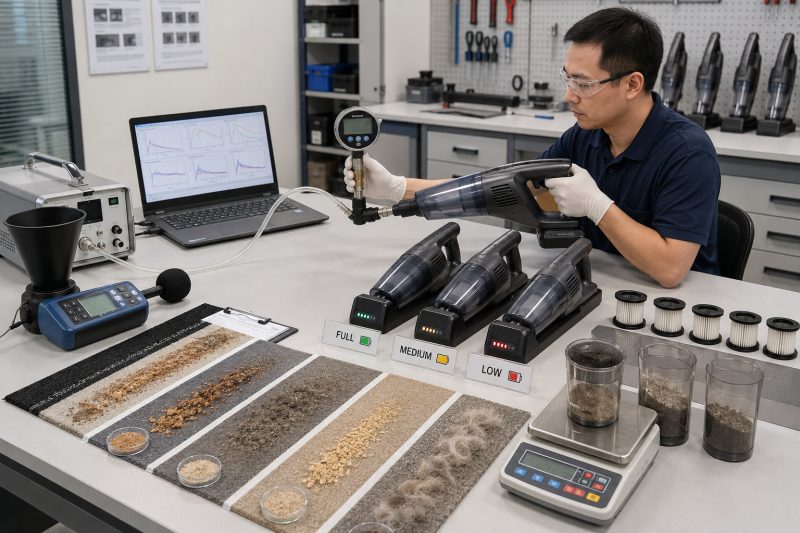
I have worked with automotive accessory wholesalers and B2B buyers for years as general manager at Parwatt New Energy. We supply cordless car vacuums and related car-care products. I regularly review samples where the advertised Pa figure looked excellent yet real debris pickup and sustained performance fell short. Our own range in the car vacuum cleaner category is tested under consistent conditions so partners can compare results fairly. In this article I explain what 15,000Pa actually means and how buyers can verify suction claims before placing bulk orders in 2026.
Why a 15,000Pa Claim Does Not Tell the Whole Performance Story?
Pa measures the pressure difference a vacuum can create. 15,000Pa equals 15 kPa. This static pressure helps lift debris, yet cleaning also requires airflow to carry that debris into the dust cup. Nozzle design, filter resistance, seals, and battery condition all change the final result. Two products with the same Pa rating can therefore perform very differently in a real car interior.
A 15,000Pa claim describes pressure difference only. It does not show airflow, nozzle efficiency, filter restriction, or how performance holds as the battery discharges or the dust cup fills. Real cleaning ability depends on the complete system, not the single pressure number.
The Limits of a Pressure-Only Specification
I have tested units that posted high Pa readings at the motor yet delivered weak pickup at the nozzle. Air leaked around seals, the filter restricted flow, or the nozzle opening was poorly matched to the fan. The pressure number stayed high in a sealed test while actual cleaning suffered.
Airflow and pressure work together. Strong static pressure can dislodge sand or crumbs. Adequate airflow then transports the material into the cup. When either factor is weak, performance drops.
Battery state further changes the outcome. Many units deliver their peak pressure only at full charge in maximum mode. As voltage falls, both pressure and airflow decline. A claim measured only at the start of the discharge cycle overstates everyday results.
Filter and dust-cup condition also matter. A clean filter and empty cup produce the best numbers. Once dust loads the filter or the cup fills, restriction rises and effective suction falls. Claims that ignore these changes mislead buyers.
Here is a table that shows what the Pa figure leaves out:
| Factor Not Captured by Pa | Why It Matters | Effect on Real Cleaning |
|---|---|---|
| Airflow volume | Carries debris into the cup | Low flow leaves dirt behind |
| Nozzle and seal design | Determines how pressure reaches the surface | Leakage or poor contact reduces pickup |
| Filter resistance | Restricts air as it loads | Performance drops during use |
| Battery voltage decline | Lowers motor power over time | Weaker suction in longer sessions |
| Dust-cup fill level | Changes internal restriction | Gradual loss of effective power |
This table reflects the gaps I see when buyers rely only on the headline rating. At Parwatt we measure both pressure and real pickup across our car vacuum cleaner range so the complete picture is available.
In 2026 many listings still lead with a high Pa number. Buyers who stop there consistently underestimate the variation that appears once the product is used in a vehicle.
The Suction Marketing Claims That Buyers Should Question
Marketing materials often mix different units and test conditions. Pa, air watts, motor watts, and fan speed are presented as if they are interchangeable. Peak values are shown instead of sustained performance. Measurement location, inlet size, and battery state are omitted. Dramatic videos of lifting coins or steel balls replace controlled cleaning tests. These practices make objective comparison difficult.
Suction marketing claims that buyers should question include mixing Pa with air watts or motor watts, showing only peak values, omitting test location and battery state, and using non-standard demonstration videos. Transparent, repeatable test conditions are required for meaningful comparison.
Claims That Distort the Comparison
One common practice is placing Pa and motor wattage side by side as if higher watts automatically mean higher suction. Electrical power consumption does not equal cleaning power. An inefficient fan or leaky air path can consume many watts while delivering modest suction.
Peak versus sustained values create another distortion. A brief peak recorded at the motor inlet can be far higher than the pressure measured at the working nozzle after thirty or sixty seconds of continuous running. Buyers who never ask for the time and location of the measurement receive an incomplete picture.
Missing test details prevent fair comparison. Without knowing whether the reading was taken at the motor, at the dust-cup inlet, or at the end of the nozzle, and whether the system was sealed or open, two 15,000Pa claims cannot be treated as equal.
Demonstration videos that lift heavy objects look impressive yet rarely reflect normal car-cleaning tasks. Sand, crumbs, pet hair, and fine dust on seat fabric and carpet behave differently. Controlled pickup tests with weighed debris give more relevant data.
Here is a table of marketing claims that need scrutiny:
| Claim Type | Why It Misleads | What to Request Instead |
|---|---|---|
| Peak Pa only | Ignores sustained performance | Pressure after continuous running |
| High motor watts | Measures consumption, not output | Airflow and nozzle pressure |
| No test location stated | Prevents comparison | Motor vs nozzle, sealed vs open |
| Full-battery maximum mode only | Overstates everyday use | Readings at mid and low battery |
| Coin or steel-ball videos | Not representative of car debris | Weighed sand, crumb, and hair pickup |
This table helps buyers filter supplier materials quickly. At Parwatt we provide clear test conditions for the products we supply, including those in our car vacuum cleaner category, so partners can evaluate performance without guesswork.
I have reviewed supplier sheets that listed impressive numbers with no method attached. Once the same units were tested under identical conditions, the ranking often changed. Questioning the claim is the first step toward reliable data.
How to Verify Suction Pressure, Airflow and Debris Pickup
Verification requires consistent methods. Buyers should measure static pressure under controlled inlet conditions, record open airflow where possible, test at full, mid, and low battery states, and run practical debris-pickup trials with fixed quantities of sand, crumbs, and hair. The same nozzle, surface, time, and movement pattern must be used for every sample.
Verify suction claims by measuring static pressure and airflow under identical conditions, testing across battery levels, and calculating debris-pickup rates with weighed test material. Consistent setup and repeated samples turn a marketing number into usable performance data.
Practical Verification Steps
Begin with static pressure. Use a suitable gauge and a consistent test adapter at the nozzle or a defined inlet point. Record the reading at the start of the run and again after a set period of continuous operation. Note the battery state and mode for every measurement.
Open airflow provides complementary information. When equipment allows, measure how much air the vacuum moves. Pressure and airflow together give a clearer indication of cleaning potential than pressure alone.
Battery-state testing is essential. Fully charge every sample, then repeat key measurements at approximately mid-charge and near the low-voltage cut-off. Performance that collapses early in the discharge cycle will disappoint end users.
Debris-pickup tests deliver the most commercially relevant result. Weigh a fixed amount of sand, mixed crumbs, or pet hair. Spread it evenly on a defined area of carpet or seat fabric. Vacuum for a fixed time with the same number of passes and the same nozzle. Weigh the recovered material and calculate the percentage picked up. Repeat for each sample under the same conditions.
Temperature rise and noise can be recorded at the same time. Excessive heat or noise may indicate design limits even when short-term suction looks acceptable.
Here is a verification checklist:
- Measure static pressure at a defined point with a consistent adapter
- Record pressure at start and after continuous running
- Note battery state and operating mode for every reading
- Measure or estimate airflow where practical
- Run weighed debris-pickup tests on identical surfaces
- Calculate recovery percentage for sand, crumbs, and hair
- Repeat tests at full, mid, and low battery
- Record temperature and noise during continuous operation
- Test at least two or three samples of each model
At Parwatt we apply these methods when evaluating units for our own car vacuum cleaner range and when supporting partners who need comparable data. Related accessory performance is also assessed across our car battery charger and car air pump lines.
I recommend that buyers write the test protocol before samples arrive. A written method prevents later arguments about whether the results are fair.
Why Two 15,000Pa Car Vacuums Can Perform Very Differently
Even when two units claim the same peak pressure, differences in motor efficiency, impeller design, air-path sealing, nozzle area, filter resistance, dust-cup structure, cell discharge capability, and thermal management produce different real-world results. Stable output across a full cleaning cycle is usually more valuable than a short peak.
Two vacuums with the same 15,000Pa claim can perform differently because motor efficiency, sealing, nozzle design, filter restriction, battery discharge, and heat control all affect sustained cleaning. Stable system performance matters more than a brief peak reading.
System Elements That Drive the Difference
Motor and impeller efficiency determine how much of the electrical power becomes useful air power. A well-designed brushless system with a matched impeller can maintain pressure and flow longer than a less efficient combination drawing the same watts.
Air-path sealing and internal geometry decide whether the generated pressure reaches the nozzle. Leaks around the dust cup, filter housing, or hose connections waste performance. Smooth, unrestricted channels preserve it.
Nozzle size and shape influence both pressure and the ability to agitate debris. A narrow crevice tool concentrates pressure; a wider nozzle spreads it. The best design depends on the intended task.
Filter resistance rises as dust accumulates. A high-resistance filter or one that loads quickly reduces airflow even if the motor still produces high static pressure at its inlet.
Battery cells and the protection circuit control how long the motor can run at effective power. Cells with weak discharge capability or a conservative BMS cause earlier power reduction. Thermal limits can also throttle the motor to protect the pack or the windings.
Dust-cup design affects both capacity and restriction. A cup that fills unevenly or allows dust to block the filter early shortens the useful cleaning period.
Here is a comparison of factors that separate similar Pa claims:
| System Element | Strong Design | Weak Design | Resulting Difference |
|---|---|---|---|
| Motor + impeller | Efficient, matched | High loss or mismatch | Sustained vs fading power |
| Sealing and air path | Tight, smooth | Leaks or restrictions | Pressure reaches nozzle or is lost |
| Nozzle design | Task-appropriate | Poor contact or size | Better or weaker pickup |
| Filter behavior | Low restriction, slow loading | High restriction or rapid clog | Airflow holds or collapses |
| Battery discharge | Stable under load | Early voltage sag | Runtime at useful power |
| Thermal control | Maintains output | Early throttling | Consistent vs reduced performance |
This comparison explains why identical Pa labels can hide large performance gaps. At Parwatt we evaluate the complete system when selecting products for our catalog, including cordless vacuums and complementary items shown on our main site.
I have ranked samples that shared the same advertised Pa yet finished in very different order once sustained suction and debris recovery were measured. The system-level view consistently predicts customer satisfaction better than the single pressure figure.
A Practical Suction-Claim Checklist for B2B Sample Approval
A disciplined approval process turns verification into a repeatable routine. Buyers should request the supplier’s test conditions and raw data, standardize sample preparation, measure pressure and airflow, complete debris-pickup trials, record runtime and temperature, compare multiple units, and lock the accepted results into the golden sample and purchase agreement.
Approve suction claims by obtaining test conditions, standardizing samples, measuring pressure and airflow, running controlled pickup tests, recording runtime and heat, comparing several units, and writing the accepted values into the golden sample and purchase specification.
From Supplier Data to Locked Standards
Request the measurement method, location, battery state, and mode used for the advertised Pa figure. If the supplier cannot provide this information, treat the claim as unverified.
Charge all samples to the same level and fit clean filters of the production type. Consistency at the start of testing prevents later disputes.
Measure static pressure and, where possible, airflow at the defined point. Record values at the beginning and after continuous operation. Repeat at mid and low battery.
Perform weighed debris-pickup tests on the same surface with the same nozzle and technique. Calculate recovery percentages for each debris type.
Record runtime to automatic shut-off in each mode and note temperature rise at the motor and battery areas.
Test at least two or three samples of the same model. Variation between units signals process control issues that will appear in bulk production.
Write the accepted pressure, pickup, runtime, and noise values into the golden-sample record and the purchase specification. These numbers become the reference for incoming inspection and any later quality claims.
Here is a concise approval checklist:
- Obtain supplier test method, location, and conditions
- Standardize charge level and filter condition across samples
- Measure static pressure at start and after continuous running
- Record pressure at full, mid, and low battery
- Measure or estimate airflow under the same setup
- Run weighed sand, crumb, and hair pickup tests
- Calculate recovery percentages under identical technique
- Record runtime to cut-off and temperature rise
- Compare results across multiple samples
- Lock accepted values into golden sample and purchase agreement
At Parwatt we follow this disciplined approach when approving products for our partners. The same standards apply across our car vacuum cleaner category and related car-care lines. Further product details are available on our main catalog.
Buyers who complete this checklist before mass production consistently reduce the gap between sample promise and bulk reality. The process protects both product performance and commercial results.
Conclusion
A 15,000Pa rating describes pressure difference, not complete cleaning performance. At Parwatt we verify sustained suction, airflow, and real debris pickup so the products we supply meet practical expectations. It may indicate strong static suction for a compact car vacuum, but the figure becomes meaningful only when the measurement method, test location, inlet condition, battery state and operating mode are disclosed. Buyers should combine pressure testing with airflow, runtime, temperature and controlled debris-pickup tests. They should also repeat the assessment across several samples and at different battery levels. A supplier that can provide transparent, repeatable test data offers more value than one advertising the highest unsupported number.

--- END ---
Related Posts


Business Ideas

11kW vs. 22kW Home EV Chargers: Which One Should You Choose in 2026?
October 21, 2026

Business Ideas

Business Ideas
