

Runtime vs. Battery Capacity vs. Suction Power: How to Balance Cordless Vacuum Performance
Sep 03,2026
Longer runtime or higher suction does not automatically create a better cordless vacuum. Chasing maximum battery size or peak Pa can make the product heavier, slower to charge, and hotter in use without improving real cleaning results. At Parwatt I see buyers over-focus on single numbers and later face returns from unbalanced designs.
Runtime, battery capacity, and suction power must be balanced for practical cordless vacuum performance. Watt-hour capacity, sustained suction in each mode, and real debris pickup matter more than the largest isolated claim. In 2026 well-engineered systems deliver useful cleaning per charge without excessive weight, heat, or charging time.
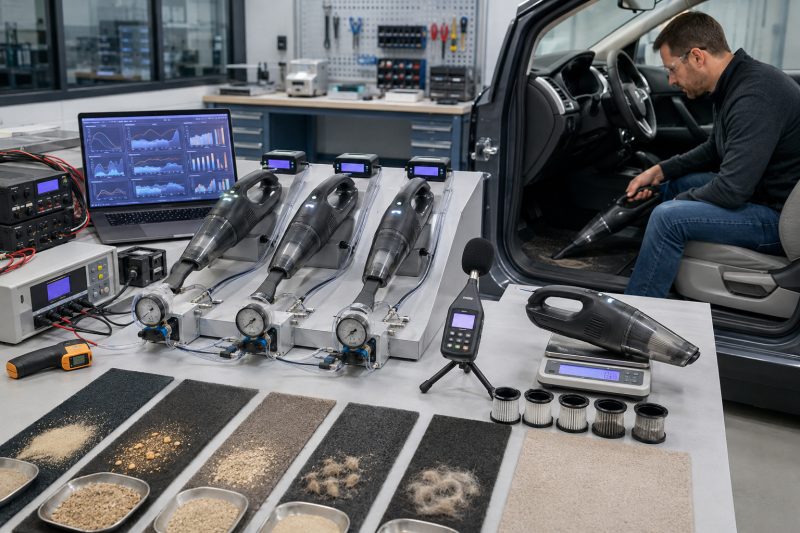
I have worked with automotive accessory wholesalers and B2B importers for years as general manager at Parwatt New Energy. We supply cordless car vacuums and related car-care products. I regularly review samples where a large battery or high Pa figure looked attractive yet the unit became heavy, ran hot, or lost suction quickly in normal use. Our products in the car vacuum cleaner category are developed with balanced performance so partners receive practical cleaning results. In this article I explain how to balance runtime, battery capacity, and suction power when sourcing cordless vacuums in 2026.
Why Longer Runtime or Higher Suction Does Not Always Mean Better Performance?
Pushing any single specification to the extreme creates side effects. A very large battery increases weight and charging time. Maximum suction mode drains the battery quickly and raises heat and noise. A product optimized only for one headline number often feels less practical in daily vehicle cleaning. Real performance depends on how well the system maintains useful cleaning power across a full charge.
Longer advertised runtime or higher peak suction does not always improve real performance. Oversized batteries add weight and charge time. Maximum suction shortens runtime and increases heat. Balanced design that sustains adequate cleaning power is more valuable for everyday use.
The Trade-offs Behind Extreme Specifications
I have tested units with very high claimed runtime that achieved the figure only in the lowest mode with no load. In standard or maximum mode the operating time dropped sharply. Users who expected the headline number felt disappointed after a few minutes of normal cleaning.
High peak suction creates a similar gap. The vacuum may deliver strong pressure for a short period at full charge, then throttle or fade as the battery voltage falls or the motor temperature rises. Cleaning efficiency declines before the task is finished.
Weight and ergonomics suffer when battery capacity is increased without attention to overall design. A heavier unit becomes tiring inside a vehicle, especially when cleaning footwells or reaching corners. Charging time also lengthens, reducing convenience for daily or multi-vehicle use.
Heat and noise rise with sustained high power. Thermal protection may reduce output automatically, so the strong performance promised by the peak figure is available only briefly.
Here is a table that shows the common trade-offs:
| Pushed Specification | Typical Side Effect | Impact on User Experience | Better Goal |
|---|---|---|---|
| Maximum runtime claim | Measured only in Eco mode | Short real cleaning time | Useful runtime in standard mode |
| Very large battery | Higher weight and longer charge | Fatigue and inconvenience | Enough energy for the task |
| Peak suction focus | Fast drain and heat rise | Fading performance mid-task | Sustained cleaning power |
| High continuous power | Noise and thermal throttling | Uncomfortable and unstable output | Efficient standard mode |
This table reflects patterns I see when products are designed around a single marketing number. At Parwatt we balance these factors across our car vacuum cleaner range so the units remain practical for real vehicle cleaning.
In 2026 buyers who still rank products only by the largest battery or highest Pa consistently encounter higher return rates. The market rewards balanced performance more than extreme isolated claims.
The Battery and Runtime Claims Buyers Often Misinterpret
Battery and runtime claims are frequently presented in ways that make direct comparison difficult. Buyers compare mAh ratings across packs with different voltages. They treat the longest Eco-mode runtime as the expected operating time. They overlook the effect of powered brushes, filter loading, battery age, and test conditions. These misinterpretations lead to unrealistic expectations and later complaints.
Battery and runtime claims are often misinterpreted when buyers compare mAh across different voltages, accept Eco-mode figures as normal runtime, or ignore load, filter condition, and test method. Watt-hours and mode-specific runtime data give a clearer picture.
Claims That Create False Expectations
One common error is ranking battery packs by mAh alone. Milliamp-hours measure charge, not energy. A 4,000 mAh pack at 18 V stores less energy than a 3,000 mAh pack at 25 V. Watt-hours (voltage × amp-hours) provide the correct basis for comparison.
Runtime headlines usually reflect the most favorable conditions. The test may use the lowest power mode, a clean filter, no brush load, and a new fully charged battery. Standard and maximum modes can deliver substantially shorter times. Without disclosure of mode and conditions, the number misleads.
Powered brush heads and higher suction settings increase current draw. A runtime measured without the brush will not match the time a user experiences when cleaning carpet or fabric seats.
Filter resistance and battery age further reduce available time. A loaded filter makes the motor work harder. An aged pack holds less energy than a new one. Claims based only on fresh, clean samples overstate long-term performance.
Here is a table of frequently misinterpreted claims:
| Claim Type | Why It Misleads | What to Request Instead |
|---|---|---|
| mAh without voltage | Ignores energy difference | Watt-hour (Wh) capacity |
| Eco-mode runtime only | Overstates normal use | Runtime in every power mode |
| No load or brush stated | Understates real current draw | Test with intended attachments |
| New battery, clean filter | Ignores aging and loading | Performance after realistic use |
| Unstated cut-off method | Hides early power reduction | Clear end-of-run criteria |
This table helps buyers filter supplier statements. At Parwatt we provide mode-specific runtime data and Wh figures for the cordless units in our car vacuum cleaner category so partners can compare energy and operating time fairly.
I have seen buyers select a product for its long claimed runtime only to discover that the figure applied solely to the lowest mode. Clear mode-by-mode data prevents that disappointment.
How to Compare Watt-Hours, Power Modes and Sustained Suction
A useful comparison starts with battery energy in watt-hours, then measures actual runtime in each power mode, and finally checks whether suction or airflow remains stable throughout the discharge. This approach reveals how much useful cleaning the vacuum can deliver on one charge rather than how large any single number appears.
Compare watt-hours for battery energy, test runtime in low, standard, and maximum modes, and record whether suction stays stable across the full run. Sustained cleaning power per charge is more meaningful than peak figures or Eco-mode runtime alone.
A Practical Comparison Method
Calculate or request watt-hour capacity. Multiply the nominal voltage by the amp-hour rating. Use this value to compare energy storage across different pack voltages.
Test runtime in every available mode. Fully charge the sample, attach the intended nozzle, and run continuously until automatic shut-off. Record the time for Eco, standard, and maximum settings separately. Note any early power reduction before final cut-off.
Measure suction or airflow at the beginning, middle, and near the end of each run. A vacuum that starts strong and then fades delivers less total cleaning than one that holds steadier output.
Repeat key tests with a partially loaded filter if possible. The added resistance shows how the system behaves as the user progresses through a real cleaning task.
Record temperature at the motor and battery areas. Excessive heat may trigger throttling and explains why some high-power modes cannot be sustained.
Here is a structured comparison approach:
| Parameter | How to Measure | Why It Matters |
|---|---|---|
| Battery energy | Voltage × Ah = Wh | Enables fair pack comparison |
| Runtime by mode | Continuous run to shut-off | Shows real operating time |
| Suction stability | Readings at start, mid, end | Reveals fading performance |
| Filter-loaded behavior | Repeat tests with added resistance | Matches later-stage cleaning |
| Temperature rise | Monitor motor and battery | Indicates thermal limits |
This method keeps the evaluation focused on usable performance. At Parwatt we apply the same disciplined testing to products in our car vacuum cleaner range and related accessories such as those in the car air pump category.
I recommend that buyers prepare a simple test sheet before samples arrive. Recording the data in a consistent format makes supplier comparison straightforward and objective.
What Creates a Well-Balanced Cordless Vacuum in Real-World Use
A well-balanced cordless vacuum maintains useful cleaning power for the duration of a typical task without becoming too heavy, hot, or noisy. Efficient motors, low-resistance air paths, good sealing, quality cells, effective battery management, thermal control, and sensible power steps achieve this balance more effectively than simply increasing battery size or peak suction.
A well-balanced cordless vacuum combines efficient airflow design, quality cells, intelligent power control, and thermal management to deliver sustained cleaning per charge. System efficiency and practical ergonomics matter more than the largest individual specification.
Design Elements That Deliver Balance
Brushless motors with well-matched impellers convert battery energy into airflow more efficiently. Less energy is wasted as heat, so more of the pack capacity becomes useful cleaning time.
A sealed, low-resistance air path preserves pressure and flow from the fan to the nozzle. Leaks or sharp restrictions force the motor to work harder for the same result and shorten runtime.
Quality cells and a competent battery-management system support stable voltage under load and protect against over-discharge or overheating. Consistent cells also improve long-term capacity retention.
Thermal management allows the vacuum to hold standard or high mode longer without automatic throttling. Heat sinks, airflow over the motor, or intelligent current limits keep temperatures within safe ranges.
Logical power modes give users a practical choice. A standard mode that provides enough suction for most car-interior tasks, paired with a higher mode for stubborn debris, is more useful than a single extreme setting that drains the battery in minutes.
Weight distribution and handle design affect whether the balanced performance can actually be used comfortably inside a vehicle.
Here is a list of balance-driven design factors:
- Efficient brushless motor and matched impeller
- Sealed, low-resistance air path
- Quality cells with stable discharge
- Effective battery management and protection
- Thermal control that limits throttling
- Practical power steps matched to real tasks
- Manageable weight and ergonomics
- Filters that maintain airflow as they load
At Parwatt we design for this balance across the cordless vacuums we supply. The same principle guides related products shown on our main site and in categories such as car battery chargers.
I have compared units with larger batteries against more efficient designs with smaller packs. The efficient systems often delivered equal or better total cleaning per charge while remaining lighter and cooler. Balance consistently outperforms raw capacity.
A Practical B2B Testing Checklist Before Sample Approval
A disciplined testing process confirms whether a sample delivers balanced performance before bulk orders are placed. Buyers should standardize nozzles, filters, debris, and battery state, then measure cleaning efficiency, runtime in each mode, temperature rise, noise, charge time, and any early power loss. The accepted results become part of the golden sample and purchase specification.
Approve samples by standardizing test conditions, measuring cleaning efficiency and mode-specific runtime, recording temperature and noise, checking charge time and suction stability, and writing the accepted values into the purchase agreement. Consistent testing reveals true balance before mass production.
From Sample Arrival to Locked Specification
Fully charge every sample and fit clean production-type filters. Use the same nozzle or attachment for all comparative tests.
Run weighed debris-pickup tests on a consistent surface. Calculate recovery rates for sand, crumbs, or hair under identical technique and time.
Measure continuous runtime to shut-off in every power mode. Note the time and any visible reduction in suction before final cut-off.
Record suction or airflow at the start, middle, and end of the standard-mode run. Stability across the discharge cycle is a key balance indicator.
Monitor housing temperature at the motor and battery areas during continuous operation. Excessive heat signals design limits.
Measure noise at a fixed distance and record charge time from empty to full under the supplied charger.
Repeat critical tests on two or three samples of the same model to check consistency.
Write the accepted runtime, pickup, temperature, noise, and charge-time values into the golden-sample record and the purchase specification. These numbers become the reference for incoming inspection and quality claims.
Here is a concise B2B testing checklist:
- Standardize charge level, filter, nozzle, and debris type
- Perform weighed debris-pickup tests and calculate recovery
- Measure runtime to shut-off in every power mode
- Record suction or airflow at start, mid, and end of run
- Monitor motor and battery temperature under continuous load
- Measure noise and full charge time
- Compare results across multiple samples
- Lock accepted values into golden sample and purchase agreement
- Require mode-specific runtime disclosure from the supplier
- Confirm Wh capacity alongside any mAh claims
At Parwatt we follow this disciplined process when approving products for our partners. The same standards protect the quality of units supplied through our car vacuum cleaner category and complementary lines. Further product information is available across our main catalog.
Buyers who complete this checklist before mass production consistently select vacuums that perform as expected in the field. The process reduces returns and strengthens long-term supplier relationships.
Conclusion
The best cordless vacuum is not necessarily the model with the largest battery, longest advertised runtime, or highest peak suction. At Parwatt we balance energy capacity, sustained cleaning power, and practical ergonomics so the products we supply meet real vehicle-cleaning needs. Buyers should look for enough sustained cleaning power to complete the intended task without excessive weight, heat, noise, or charging time. Compare battery energy in watt-hours, request runtime figures for every power mode, and verify performance using consistent debris, tools, filters, and test conditions. A well-balanced product combines efficient airflow, reliable cells, intelligent power control, thermal protection, and practical ergonomics. For B2B sourcing, real cleaning output per charge is ultimately more valuable than any isolated specification.

--- END ---
Related Posts


Industry News

Business Ideas
