

Corded vs. Cordless Car Vacuum Cleaners: A Wholesale Buyer’s Guide
Sep 04,2026
Choosing the wrong power type for car vacuums can lead to slow sales and high returns. Cordless models may disappoint with short runtime or battery fade. Corded models may frustrate users with cable limits or less convenience. At Parwatt I see these mismatches reduce wholesale margins every season.
Corded and cordless car vacuums serve different customers and use cases. Cordless models offer portability for quick personal cleaning. Corded models provide consistent power for longer sessions or budget buyers. In 2026 a balanced wholesale mix matched to real user needs delivers better sales and lower after-sales cost.
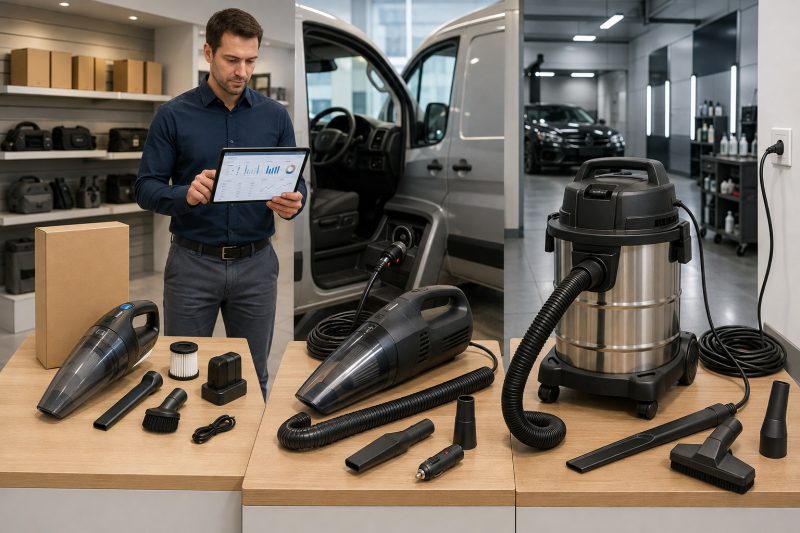
I have worked with automotive accessory wholesalers and importers for years as general manager at Parwatt New Energy. We supply both corded and cordless car vacuums along with related car-care products. I regularly review product mixes where buyers favored only the newest cordless designs and later faced runtime complaints or where they stocked only basic corded units and missed convenience-driven demand. Our range in the car vacuum cleaner category includes options for different channels so partners can build a practical assortment. In this article I explain how wholesale buyers can choose and balance corded and cordless car vacuums in 2026.
Why the Wrong Power Type Can Lead to Poor Sales and Customer Returns?
The power source shapes the entire user experience. A cordless vacuum that runs out of power before the car is clean generates complaints and returns. A corded vacuum that cannot reach or that feels inconvenient in a modern vehicle sells slowly. When the chosen type does not match how customers actually clean, both sell-through and after-sales costs suffer.
The wrong power type leads to poor sales and returns because cordless models can disappoint on runtime and battery life while corded models can frustrate users with power access and cable limits. Matching the format to real cleaning behavior protects both revenue and reputation.
How Mismatches Appear in the Market
I have seen cordless units return in high numbers when buyers expected the longest advertised runtime to apply in maximum mode. Customers cleaned for a few minutes at high suction, the battery dropped, and the product felt inadequate. Negative reviews then slowed further sales.
Corded 12V models face different issues. Users who want to clean away from the vehicle or who dislike running a cable through the door find the format limiting. In markets where convenience is the main purchase driver, these units sit on shelves longer.
Professional corded machines that draw mains power suit detailing bays yet feel oversized and impractical for individual car owners. Placing them in the wrong retail channel creates slow movement and eventual discounting.
After-sales cost also differs by type. Cordless products carry battery-related risks—degradation, charging faults, and replacement availability. Corded products may generate cable or connector complaints. Choosing the wrong mix raises the total cost of supporting the range.
Here is a table that shows the commercial impact of mismatches:
| Power Type | Common Mismatch | Sales or Return Effect | Typical Customer Reaction |
|---|---|---|---|
| Cordless | Overstated high-mode runtime | Higher returns and poor reviews | “Battery dies too fast” |
| 12V Corded | Sold as premium convenience | Slow sell-through | “Cable is inconvenient” |
| Mains Corded | Offered to personal users | Low relevance and discounting | “Too big for home use” |
| Any type | Weak accessories or filtration | Dissatisfaction despite power | “Does not clean well” |
This table reflects patterns I observe across wholesale accounts. At Parwatt we help partners match formats to channels so the products in our car vacuum cleaner category move with fewer returns.
In 2026 customer expectations continue to split between convenience and consistent power. Buyers who ignore that split pay for it in inventory and support costs.
The Corded vs. Cordless Claims Wholesale Buyers Should Question
Marketing claims often blur important differences. Peak Pa figures are presented as equal to real cleaning power. Cordless Eco-mode runtimes are shown as normal operating times. Compact 12V units are compared directly with professional mains machines. Battery after-sales costs are left unmentioned. These claims lead buyers to incorrect conclusions about value and risk.
Claims that wholesale buyers should question include treating peak Pa as sustained cleaning power, accepting Eco-mode runtime as standard, comparing 12V and mains products as equals, and ignoring battery-related after-sales costs. Clear, comparable data prevent costly assortment mistakes.
Claims That Distort the Decision
One frequent claim is a high Pa number presented without test conditions. A cordless model may reach that figure only briefly in maximum mode at full charge. A corded model may list motor watts without showing nozzle performance. Neither figure alone predicts debris pickup inside a vehicle.
Runtime claims for cordless units usually reflect the lowest power setting. When customers use standard or maximum mode, the operating time shortens significantly. Buyers who plan inventory around the headline number later face complaints.
Direct comparison of 12V cigarette-lighter models with mains-powered shop vacuums creates false expectations. The available power, duty cycle, and target user are completely different. Treating them as interchangeable leads to wrong channel placement.
Battery costs are often omitted from the initial calculation. Replacement packs, charger failures, and capacity fade over time add to the true cost of supporting cordless lines. Ignoring these items understates the risk.
Here is a table of claims that need scrutiny:
| Claim Type | Why It Misleads | What to Verify Instead |
|---|---|---|
| Peak Pa only | Ignores sustained performance | Nozzle pressure and pickup tests |
| Long Eco runtime | Overstates normal use | Runtime in every power mode |
| 12V vs mains as equals | Different power and users | Separate category evaluation |
| Low unit price focus | Ignores battery support cost | Total landed and after-sales cost |
| “Professional power” label | Vague without duty data | Continuous-use temperature and stability |
This table helps buyers filter supplier presentations. At Parwatt we supply clear performance data for both corded and cordless options in our car vacuum cleaner category so partners can compare formats on equal terms.
I have watched buyers over-weight a single impressive claim and then adjust the assortment after the first season of returns. Questioning the claim early saves that cost.
How to Match Each Vacuum Type to the Right Customer and Market
Each power type fits specific users and channels. Cordless handheld models suit personal car owners, ride-share drivers, and quick-clean routines. 12V corded models suit drivers who want simple plug-in operation without charging anxiety. Professional mains-powered machines suit detailing shops and high-intensity cleaning. Matching type to customer improves sell-through and reduces mismatch returns.
Match cordless models to convenience-focused personal users, 12V corded models to budget or continuous-use drivers, and professional corded machines to commercial detailing. Correct matching raises sales velocity and lowers after-sales pressure.
Customer and Channel Fit
Cordless vacuums appeal to buyers who value portability and modern design. They work well for quick interior cleanups, for users who park away from power outlets, and for e-commerce shoppers who respond to lifestyle imagery. Runtime must still be adequate for a typical car interior in standard mode.
12V corded vacuums serve customers who prefer not to manage batteries. They plug into the vehicle socket and run as long as the engine or accessory power allows. These units fit price-sensitive retail, fleet drivers, and markets where charging infrastructure is less convenient.
Professional corded machines with mains power deliver higher continuous duty and larger dust capacity. They belong in car-wash and detailing environments where the operator stays near a wall outlet and needs sustained performance for multiple vehicles.
Regional habits and power infrastructure also influence the mix. Markets with strong e-commerce and lifestyle retail often absorb more cordless units. Markets that emphasize value and simple operation may favor 12V corded models. Commercial buyers need the professional tier.
Here is a practical matching guide:
| Vacuum Type | Best Customer | Strongest Channels | Key Requirement |
|---|---|---|---|
| Cordless handheld | Personal owners, ride-share | E-commerce, lifestyle retail | Adequate standard-mode runtime |
| 12V corded | Budget and fleet drivers | Mass retail, auto shops | Reliable plug and cable |
| Mains professional | Detailing and wash bays | Trade and B2B supply | Continuous duty and capacity |
| Mixed assortment | Broad wholesale coverage | Multi-channel distributors | Clear positioning per SKU |
This guide keeps assortment decisions grounded in real use. At Parwatt we support partners with options across these types within the car vacuum cleaner category and complementary products such as those in the car air pump category.
I recommend that buyers map each proposed SKU to a primary customer and channel before ordering. The exercise quickly reveals over- or under-representation of any format.
What Separates a Reliable Wholesale Product from a Low-Cost Alternative
Unit price alone does not determine wholesale success. Reliable products deliver sustained suction, proper sealing, dependable batteries or cables, safety protection, effective filtration, useful accessories, complete certifications, and available spare parts. Low-cost alternatives often cut these elements and generate higher hidden costs after the sale.
A reliable wholesale car vacuum separates itself through sustained performance, robust construction, safety protection, practical accessories, certifications, and spare-part support. These factors reduce returns and protect margin better than the lowest purchase price.
Quality Factors That Affect Total Cost
Sustained suction and airflow at the nozzle matter more than a peak claim. Sealing quality and filter design keep performance stable as the dust cup fills. Units that fade quickly create customer dissatisfaction regardless of power type.
For cordless models, cell quality and battery-management protection determine runtime consistency and long-term reliability. Replacement battery availability further reduces support burden. For corded models, cable gauge, connector strength, and strain relief affect durability.
Safety features—over-current, over-temperature, and proper insulation—protect both the user and the seller’s reputation. Certifications appropriate to the destination market support smooth import and retail acceptance.
Accessories often decide whether the vacuum is genuinely useful inside a vehicle. A good crevice tool, soft brush, and flexible hose increase customer satisfaction more than a small increase in peak power.
Spare filters, brushes, and (for cordless) battery packs keep the product usable over time and reduce the risk of complete unit returns.
Here is a comparison of reliable versus low-cost characteristics:
| Aspect | Reliable Product | Low-Cost Alternative | Commercial Effect |
|---|---|---|---|
| Suction delivery | Sustained at nozzle | Peak only, fades fast | Lower vs higher returns |
| Battery / cable | Quality cells or robust cord | Weak cells or thin cable | Fewer vs more support cases |
| Filtration | Effective and serviceable | Basic and quick to clog | Better vs poorer long-term use |
| Accessories | Task-appropriate set | Minimal or poor fit | Higher vs lower satisfaction |
| Certifications & spares | Complete and available | Incomplete or missing | Smoother vs problematic sales |
This comparison keeps the focus on total cost of ownership. At Parwatt we build these reliability factors into the products we supply, including those in our car vacuum cleaner category and related lines such as car battery chargers.
I have compared landed cost plus return cost for seemingly cheaper units against slightly higher-priced reliable ones. The reliable products usually delivered better net margin once after-sales expenses were included.
How to Build and Test the Right Wholesale Product Mix
A successful wholesale mix combines formats according to channel needs, validates each SKU with practical testing, and adjusts quantities based on early sales and return data. Buyers should select portable cordless models for convenience channels, economical 12V corded models for value channels, and professional units for trade accounts, then confirm performance before scaling.
Build the wholesale mix by assigning cordless, 12V corded, and professional models to the right channels, testing sustained performance and accessories, running limited trial quantities, and adjusting the assortment according to sell-through and return rates.
From Assortment Plan to Validated Range
Map each channel’s primary customer. E-commerce and lifestyle retail usually need cordless convenience. Mass and value retail often respond to simple 12V corded options. Trade and detailing accounts require professional continuous-duty machines.
Select candidate models that fit those positions. Avoid forcing one format into a channel where its limitations will be obvious.
Test samples under consistent conditions. Measure sustained suction or pickup, runtime by mode (for cordless), temperature, noise, and accessory usefulness. Confirm certifications and spare-part availability.
Place small trial orders. Track sell-through speed, customer reviews, and return reasons for each SKU.
Adjust the ratio. Increase quantities of formats that move cleanly and reduce or replace those that generate complaints or slow inventory turns.
Maintain clear positioning in sales materials so retailers and end users understand which type suits which need.
Here is a practical build-and-test sequence:
- Define primary customer and channel for each intended SKU
- Short-list cordless, 12V corded, and professional candidates
- Test sustained performance, runtime, heat, and accessories
- Verify certifications and spare-part supply
- Launch limited trial quantities per channel
- Monitor sell-through, reviews, and return rates
- Adjust mix and volumes based on real data
- Keep positioning clear in all sales materials
- Re-test any revised specification before reordering
- Review the full assortment at regular intervals
At Parwatt we support this process with a range of corded and cordless options and with the testing discipline needed for reliable wholesale supply. Partners can explore the available selection in the car vacuum cleaner category and complementary products on our main site.
Buyers who treat the assortment as a tested portfolio rather than a single bet on the newest format consistently achieve more stable sales and lower support costs. The mix itself becomes a commercial advantage.
Conclusion
Neither corded nor cordless car vacuums are universally better for wholesale buyers. At Parwatt we supply both formats so partners can match products to real customer needs. Cordless models offer portability, modern styling, and convenience, making them attractive for personal car care, e-commerce, and lifestyle retail. Corded models avoid battery-runtime limitations and can provide more consistent operation, making them suitable for price-sensitive users or longer cleaning sessions. Buyers should match each power type to the intended customer, test sustained performance rather than headline specifications, and calculate after-sales costs associated with batteries, cables, chargers, and replacement parts. In many markets, a carefully selected combination of corded and cordless models creates a safer and more profitable product range than relying on one format alone.

--- END ---
Related Posts


Industry News

Business Ideas
