

Maximum PSI vs. Airflow: What Really Determines Tire Inflator Performance?
Sep 08,2026
A high maximum PSI looks impressive on a product page, yet many inflators still fill car tires slowly. Buyers who rank units only by the largest pressure number often face customer complaints about speed. At Parwatt I see this mismatch create returns and weak reviews every season.
Maximum PSI shows pressure capability, while airflow largely determines inflation speed. For most passenger-car and light-truck use, loaded airflow, time-to-pressure, gauge accuracy, and duty cycle matter more than an extremely high PSI claim. In 2026 buyers who test under real load select better-performing products.
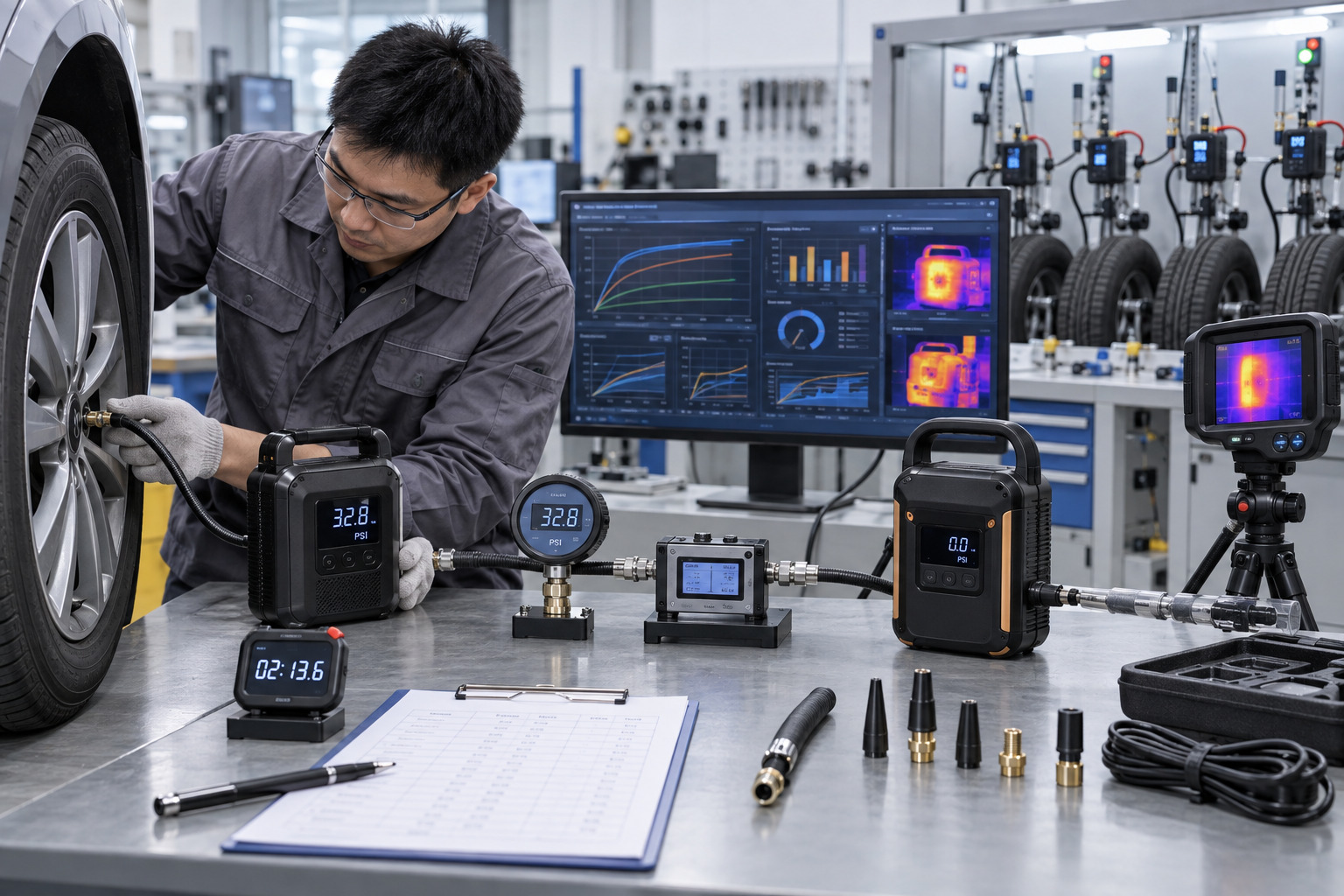
I have worked with automotive accessory wholesalers and importers for years as general manager at Parwatt New Energy. We supply portable tire inflators and related car-care products. I regularly review samples where a 150 PSI or higher claim looked strong yet the unit took too long to raise a standard tire to the target pressure. Our products in the car air pump category are evaluated on both pressure capability and real inflation speed so partners can compare results fairly. In this article I explain the difference between maximum PSI and airflow and how buyers can judge tire inflator performance more accurately in 2026.
Why a High Maximum PSI Can Still Produce Disappointing Inflation Speed?
Maximum PSI tells you the highest pressure the inflator can reach. It does not tell you how quickly the unit delivers air into a tire that already contains pressure. A compressor may be able to climb to 150 PSI in a sealed test yet move only a small volume of air once it works against the back pressure of a real tire. The result is a slow fill, especially on larger SUV or light-truck tires.
A high maximum PSI can still produce slow inflation because pressure capability and air-delivery volume are different. Low airflow under load means the tire receives air slowly even when the unit can eventually reach a high final pressure.
The Gap Between Pressure Capability and Delivery Speed
I have timed units that both claimed 150 PSI. One raised a common passenger tire from 25 PSI to 35 PSI in a reasonable time. The other took much longer. Both could reach high pressure; only one moved enough air under load to feel practical.
As tire pressure rises, the compressor works against increasing resistance. Airflow that looks acceptable at low pressure often falls as the tire approaches the target. Units with weak loaded airflow slow down noticeably in the upper part of the fill.
Heat compounds the problem. A compact compressor may deliver acceptable flow on the first tire and then lose speed or trigger protection as internal temperature climbs. Buyers who only test a single inflation miss this drop.
Hose diameter, valve design, and seal quality also affect how much of the generated flow reaches the tire. Restrictions anywhere in the path reduce effective performance even when the pump itself is capable.
Here is a table that shows why high PSI alone disappoints:
| Situation | What High PSI Guarantees | What It Does Not Guarantee | User Experience |
|---|---|---|---|
| Passenger-car top-up | Ability to reach target pressure | Fast delivery of required air volume | May feel slow |
| SUV / light-truck tire | Pressure capability | Adequate loaded airflow | Noticeably longer fill time |
| Repeated inflations | Final pressure possible | Stable flow as unit heats | Speed drops or shutdown |
| Marketing comparison | Impressive headline number | Real task time | Misleading ranking |
This table reflects the complaints I hear most often. At Parwatt we measure time-to-pressure under load for the units in our car air pump category so the practical speed is visible.
In 2026 many listings still lead with the highest PSI figure. Buyers who stop there consistently underestimate the importance of airflow under real conditions.
The PSI and Airflow Claims Buyers Often Compare Incorrectly
Buyers frequently treat maximum PSI as a speed rating. They also compare airflow numbers that were measured under different conditions—some free-flow, some under pressure—without noticing the difference. These incorrect comparisons produce rankings that do not match real inflation performance.
Incorrect comparisons include treating maximum PSI as inflation speed, matching free-flow airflow with loaded airflow, and accepting figures without stated test pressure or tire conditions. Consistent loaded testing is required for valid results.
Common Comparison Errors
One widespread error is ranking products by maximum PSI and assuming the higher number is faster. PSI is a pressure ceiling. Speed depends on how much air the unit moves while working against the tire’s existing pressure.
Airflow claims create another problem. A free-air or open-flow figure looks high because the compressor faces little resistance. The same unit delivers less flow once it pushes into a tire that already holds 20–30 PSI. Comparing a free-flow number from one supplier with a loaded number from another is meaningless.
Test conditions are often omitted. Without knowing the tire size, start and target pressures, ambient temperature, power source state, and whether the result is from the first or a later cycle, two claimed times or flow rates cannot be compared.
Gauge and auto-stop claims are sometimes accepted without verification. A unit may display a value that differs from a calibrated reference gauge, or it may stop several PSI above or below the set point once hot.
Here is a table of comparison traps:
| Trap | Why It Misleads | Better Approach |
|---|---|---|
| Ranking by max PSI | Pressure ≠ speed | Measure time-to-pressure on same tire |
| Free-flow vs loaded airflow | Different resistance conditions | Request flow at defined pressure or use tire test |
| Unstated test conditions | Results not comparable | Fix tire, pressures, temperature, power state |
| Single-cycle data only | Hides heat-related drop | Run consecutive inflations |
| Unverified gauge accuracy | Display may drift | Compare with calibrated reference |
This table helps buyers reject incomplete data. At Parwatt we provide loaded performance figures under defined conditions for products in our car air pump category and related accessories.
I have re-ranked sample sets after standardizing the tire and pressure points. The order often changes once free-flow claims are replaced by real load results. Clean comparisons prevent costly selection mistakes.
How to Test Tire Inflator Pressure and Airflow Under Real Load
Reliable testing uses the same tire, the same start and target pressures, the same ambient temperature, and the same power condition for every sample. Buyers record the time required to reach the target, the final pressure versus a reference gauge, any overshoot, and the temperature rise. Consecutive cycles reveal duty-cycle limits.
Test under real load by fixing tire size, start and target pressures, temperature, and power state. Measure inflation time, gauge accuracy, overshoot, temperature, and performance across repeated cycles. This converts claims into comparable results.
A Practical Load-Test Method
Select a representative tire—commonly a passenger-car or light-truck size that matches the intended market. Record its size for the test report.
Set a realistic starting pressure (for example 25 PSI) and a clear target (for example 35 PSI). Use a calibrated reference gauge to confirm both values.
Fully prepare each sample: charge cordless units to the same level, or confirm stable 12V supply. Fit the standard hose and connector.
Start the inflator and record elapsed time until the unit stops or the reference gauge reaches the target. Note the displayed pressure at stop and calculate any overshoot or undershoot.
Measure surface or exhaust temperature after the run. Allow a controlled cooling interval if needed, then repeat the same inflation to observe changes in time and accuracy.
For cordless models, repeat key tests at mid-battery and near low-battery states to check voltage-sag effects.
Document hose condition, connector seal, noise, and any automatic protection events.
Here is a concise test protocol:
- Fix tire size, start PSI, target PSI, and ambient temperature
- Confirm power state (full charge or stable 12V)
- Measure time to target with reference gauge verification
- Record displayed vs actual pressure and overshoot
- Note temperature rise after the run
- Repeat consecutive cycles to check duty cycle
- Test cordless units at lower battery states
- Log any thermal shutdown or speed loss
- Keep the identical setup for every sample
- Write results into a comparison sheet
At Parwatt we use controlled load tests when evaluating units for our car air pump category. The same method supports related products such as those in the car battery charger category.
I recommend that buyers write the protocol before samples arrive. A fixed method eliminates later disputes about whether one unit was tested more favorably than another.
How to Match PSI and Airflow to Different Vehicle Applications
Different vehicles place different demands on an inflator. Passenger-car top-ups prioritize reasonable speed, portability, and accuracy. SUV and light-truck tires need higher loaded airflow and better continuous-duty behavior because of larger air volume. High-pressure bicycle or motorcycle applications emphasize pressure capability and fine control. Matching the balance of PSI and airflow to the application improves customer satisfaction.
Match PSI and airflow to the application. Passenger cars need practical speed and portability. SUVs and light trucks need stronger loaded airflow and heat control. High-pressure specialty tires need accurate high-PSI capability. One extreme specification rarely serves all users.
Application-Based Requirements
For everyday passenger-car use, the inflator must reach common pressures (usually 30–40 PSI) in an acceptable time and stop accurately. Extremely high maximum PSI adds little value once the required range is covered. Portability, noise, and ease of use matter more.
SUV and light-truck tires contain more air. The same pressure increase requires greater air volume, so loaded airflow and the ability to sustain output without rapid overheating become critical. A unit that feels adequate on a small car may feel slow or thermally limited on a larger tire.
Bicycle or specialty high-pressure tires may need 60 PSI or more. Here the maximum PSI rating and fine control accuracy gain importance, while total air volume remains relatively small. Overshoot protection and gauge precision help prevent damage.
Commercial or fleet users who inflate multiple vehicles in sequence need strong duty-cycle performance. Thermal management and recovery time after each tire determine whether the unit stays practical throughout a shift.
Cordless versus 12V power further influences the match. Cordless favors portability for roadside or parking-lot use. 12V favors continuous power for users who stay near the vehicle.
Here is an application matching guide:
| Application | Priority | Less Critical | Key Risk if Mismatched |
|---|---|---|---|
| Passenger-car top-up | Speed to 30–40 PSI, accuracy, portability | Extreme max PSI | Slow feel or overshoot |
| SUV / light truck | Loaded airflow, heat control, duty cycle | Ultra-compact size | Long fill times or shutdown |
| Bicycle / high-pressure | High PSI capability, fine control | High airflow volume | Inability to reach target |
| Fleet / multiple tires | Continuous duty, recovery time | Single-cycle peak flow | Thermal limits mid-task |
| Roadside cordless | Portability, battery stability | Maximum possible PSI | Voltage sag under load |
This guide keeps specification choices practical. At Parwatt we help partners select configurations that fit their target vehicles within the car air pump category and complementary products on our main site.
I have seen buyers specify unnecessarily high PSI for car-focused products and then receive complaints about speed on larger tires. Matching the balance to the real application avoids that outcome.
A Better B2B Specification Sheet for Comparing Tire Inflators
A useful specification sheet goes beyond maximum PSI. It should include loaded inflation time on a defined tire, airflow or performance under pressure, continuous operating expectation, cooling requirements, pressure accuracy and auto-stop tolerance, gauge reference comparison, and the exact test conditions used. These items allow buyers to compare products on the performance that customers actually notice.
A better B2B specification sheet includes loaded inflation time, performance under pressure, duty-cycle data, accuracy tolerances, and full test conditions. These details enable objective comparison and reduce reliance on maximum PSI alone.
Essential Elements of a Practical Spec Sheet
State the maximum PSI, but treat it as a capability ceiling rather than a speed rating.
Require a standard inflation-time result: tire size, start pressure, target pressure, ambient temperature, power condition, and elapsed time. This single metric is easy for sales teams and customers to understand.
Ask for airflow data at a stated pressure, or accept that the time-to-pressure test already embeds loaded performance.
Define duty-cycle expectations: how many consecutive tires, what cooling interval is required, and whether output declines as temperature rises.
Include pressure accuracy: allowed deviation from a calibrated gauge at several set points, plus auto-stop overshoot limits when hot and cold.
List power details—battery Wh and voltage for cordless, or current draw for 12V—along with any thermal-protection behavior.
Specify accessories, hose length, connector type, and noise level if relevant to the channel.
Record the complete test method so future samples and production units can be checked against the same standard.
Here is a recommended specification checklist:
- Maximum PSI (capability only)
- Defined tire size for testing
- Start and target pressures
- Ambient temperature and power state
- Measured time to target pressure
- Reference-gauge accuracy and auto-stop overshoot
- Consecutive-cycle performance and temperature rise
- Cooling interval requirements
- Battery Wh / voltage or 12V current data
- Hose, connector, and accessory details
- Full test-method description
- Certification and transport documents (especially lithium)
At Parwatt we use detailed, condition-based specifications when approving products for our partners. The same approach supports the inflators in our car air pump category and related lines such as car vacuum cleaners. Further product information is available across our main catalog.
Buyers who insist on these elements before ordering consistently select units that perform as expected once they reach the market. The specification sheet itself becomes a quality-control tool.
Conclusion
Maximum PSI and airflow describe different parts of tire inflator performance. At Parwatt we evaluate both pressure capability and loaded air delivery so the products we supply meet practical needs. PSI determines whether the unit can reach the pressure required by the application, while airflow strongly influences how quickly it can deliver the necessary volume of air. For most passenger-car products, an extremely high maximum PSI provides little commercial value once the required pressure range has been covered. Buyers should instead compare inflation time, airflow under pressure, gauge accuracy, duty cycle, and thermal performance. Testing every sample on the same tire under controlled conditions offers a more reliable comparison than specification labels alone. The best inflator is not necessarily the one with the largest PSI number, but the one that reaches the target pressure safely, accurately, and consistently within an acceptable time.

--- END ---
Related Posts


Business Ideas

Business Ideas
