

Smart vs Basic EV Chargers: A Feature-Priority Guide for Distributors
Nov 05,2026
The difference between a smart EV charger and a basic EV charger is not necessarily charging power. Two products may deliver the same electrical output while offering very different levels of control, connectivity, data collection and user management.
A basic charger can provide reliable plug-and-charge operation without requiring an app, cloud platform or permanent internet connection. A smart charger may add scheduled charging, energy monitoring, dynamic load balancing, solar integration, RFID, OCPP, remote diagnostics, payment support and over-the-air updates.
More functions, however, do not automatically create a better product. Every connected feature can add hardware cost, software complexity, cybersecurity responsibilities and after-sales requirements. If the target users do not need those functions, the charger may become too expensive or difficult to support.
Distributors should therefore build their product ranges around customer scenarios rather than feature counts. A practical portfolio usually needs a dependable basic charger, a smart home charger and a commercial networked charger. Each tier should have a clear customer, installation environment and reason to exist.
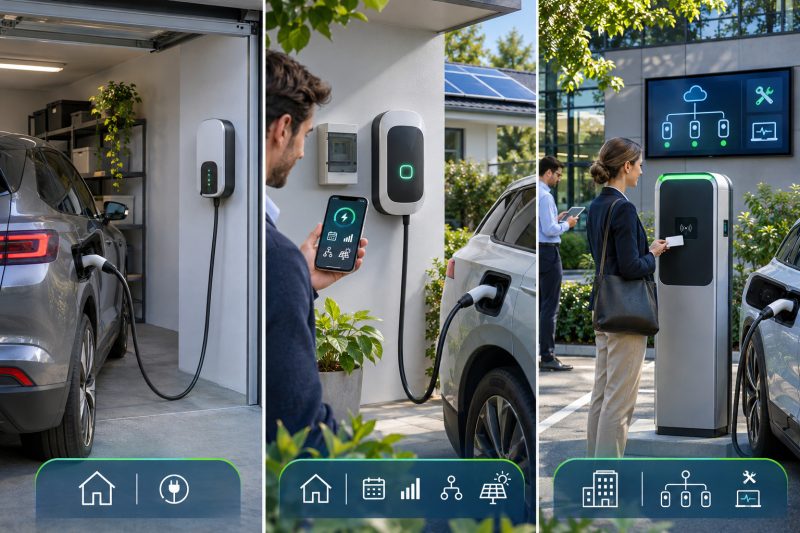
Why More Smart Features Do Not Always Create a Better-Selling Charger
Smart features create value only when they solve a specific customer or site problem. Adding Wi-Fi, RFID, OCPP and payment capability to every model can make a product range look technologically advanced, but it can also create unnecessary overlap and higher costs.
Smart and basic chargers can provide the same power
A 7kW basic wallbox and a 7kW smart wallbox may deliver similar charging power when they are connected to the same electrical circuit and vehicle. The smart model does not necessarily charge faster.
The main difference is how charging can be controlled and monitored.
A basic charger may provide:
- Plug-and-charge operation
- Local status indicators
- Basic current selection
- Start and stop control
- Electrical protection
- A physical emergency or isolation function where required
A smart charger may add:
- Mobile-app control
- Scheduled charging
- Energy-use records
- Remote start and stop
- Dynamic load balancing
- Solar integration
- RFID authorization
- Multiple-user management
- OCPP connectivity
- Remote diagnostics
- Secure firmware updates
The distributor must decide whether the customer will use these additional functions and whether the sales price can support them.
More features create more dependencies
A connected charger depends on more than its electrical hardware. It may also rely on:
- A mobile application
- A cloud server
- Wi-Fi, Ethernet or cellular communication
- User-account management
- Firmware maintenance
- Third-party platform compatibility
- Cybersecurity controls
- Data storage
- Technical support
- Subscription or transaction services
If any of these elements fail, customers may perceive the complete product as unreliable even when the charger can still deliver electricity.
For example, a customer may complain that the charger is defective because the app cannot connect. The actual cause could be a router configuration, cloud outage, expired SIM card, software update or account problem. Distributors therefore need a support process that can separate electrical faults from connectivity and software issues.
A feature must justify its total cost
The purchase price of a smart charger is only one part of its commercial cost. Importers and distributors should also consider:
- Cloud-platform fees
- SIM and data charges
- Payment-processing fees
- Backend integration
- App localization
- Software testing
- Firmware maintenance
- Technical training
- Remote-support time
- Warranty administration
- Cybersecurity response
- Long-term server availability
A feature that appears free in the quotation may depend on a platform subscription after installation. Buyers should establish who pays recurring costs and whether the charger remains usable if those services end.
App control is not always the highest priority
For many residential sites, dynamic load management may create more practical value than a large app with numerous screens.
Load management can adjust charging power when other household or building loads are operating. It helps the site remain within its available electrical capacity and may reduce the need for an expensive service upgrade.
Scheduling can also create direct value when customers use time-of-use tariffs. Parwatt’s guide to peak-hour EV charging and smart scheduling explains how scheduled charging and load control can shift demand to more suitable periods.
These functions address electricity cost and capacity. By comparison, a decorative app interface may influence the initial sale without solving an important operating problem.
The Smart-Charger Claims Distributors Should Never Accept at Face Value
A brochure may describe a charger as intelligent, cloud-enabled or OCPP-compatible without explaining how these functions have been implemented. Distributors should convert every marketing claim into a testable requirement.
“App controlled”
Seeing an app interface is not enough. The distributor should test the complete customer journey:
- Downloading the app
- Creating an account
- Adding the charger
- Connecting through Bluetooth, Wi-Fi or cellular service
- Starting and stopping a session
- Setting a schedule
- Changing current limits
- Viewing energy records
- Receiving fault notifications
- Updating firmware
- Recovering a forgotten password
- Transferring ownership to another user
The app should also be checked on the main mobile operating systems used in the target market. A demonstration video does not prove that the production version will work reliably with local phones, networks and languages.
“OCPP supported”
OCPP should be evaluated by version, implementation and interoperability. A logo or a single line in a specification does not prove that the charger will communicate correctly with the distributor’s intended management platform.
OCPP 1.6 remains widely used, while OCPP 2.0.1 provides newer capabilities related to device management, security and transaction handling. The versions are not automatically interchangeable.
Before approving an OCPP charger, ask:
- Which OCPP version is supported?
- Is JSON, SOAP or another implementation used where relevant?
- Which profiles and functions have been implemented?
- Has the charger been tested with the intended backend?
- Can the backend URL and credentials be changed?
- Who controls the charger’s certificates and security settings?
- What happens if the connection is interrupted?
- Are local charging records stored?
- Can firmware be updated through the platform?
- How are transaction conflicts reconciled?
A charger may connect successfully to one backend while failing to support functions required by another. Interoperability testing should use the actual charger firmware and platform intended for the project.
“Free cloud platform”
A free platform requires careful commercial review. Distributors should clarify:
- Whether the service is permanently free
- Whether there is a limit on users, chargers or data
- Whether payment features require another agreement
- Who owns the platform
- Where the servers are located
- Who owns the charging and customer data
- Whether data can be exported
- What support is included
- What happens if the supplier stops maintaining the service
- Whether the charger can migrate to another backend
A charger should not become unusable simply because a cloud service, app or supplier account is unavailable.
“Supports OTA updates”
Over-the-air updates are valuable only when the update process is secure and controlled.
The distributor should verify:
- How firmware is authenticated
- Whether updates are encrypted
- Who can authorize an update
- Whether firmware is signed
- What happens if power or connectivity fails during installation
- Whether the charger can roll back to a previous version
- How update history is recorded
- How long software support will continue
- How urgent security fixes will be distributed
An OTA function without adequate security can introduce risk instead of reducing maintenance costs.
“Works offline”
Offline behavior should be physically tested. The distributor should disconnect the charger from Wi-Fi, cellular service and the cloud platform while observing how it behaves.
Important questions include:
- Can an authorized user still charge?
- Does plug-and-charge remain available?
- Can an RFID card be validated locally?
- Are existing schedules retained?
- Can a charging session finish safely?
- Are transaction records stored?
- Does the charger recover automatically?
- Are stored records synchronized after reconnection?
- Does a failed payment or authorization create an incorrect session?
Offline charging is especially important in garages, basements, rural locations and commercial sites with inconsistent network coverage.
How to Prioritize Smart Features by Customer and Charging Scenario
The most important smart function changes according to who controls the charger, who uses it and whether electricity must be allocated or billed.
Feature-priority table
| Feature | Home charging | Apartment or workplace | Public or commercial charging | Purchasing priority |
|---|---|---|---|---|
| Scheduled charging | High | Medium | Medium | Core home function |
| Energy monitoring | High | High | High | Recommended across smart tiers |
| Dynamic load balancing | High | High | High | Very important where electrical capacity is limited |
| Remote start/stop | Medium | High | High | Select according to operating model |
| RFID access | Low | High | High | Important for shared and paid charging |
| Multiple-user management | Low | High | High | Essential for apartments, offices and fleets |
| OCPP | Low | Medium to high | High | Core requirement for many commercial products |
| Remote diagnostics | Medium | High | High | Can reduce after-sales and site-visit costs |
| Secure OTA updates | High | High | High | Important for every connected charger |
| Solar integration | Medium to high | Low to medium | Project dependent | Select where photovoltaic demand exists |
| Payment processing | Low | Project dependent | High | Priority for public charging operations |
| Offline charging | High | High | High | Must be tested on every connected product |
| Data export or API | Low | Medium | High | Important for fleets and operators |
Home charging priorities
Most home users do not need commercial billing or complex user management. They are more likely to value:
- Off-peak scheduling
- Energy-use records
- Adjustable charging current
- Dynamic load balancing
- Solar integration
- Remote status monitoring
- Reliable offline charging
- Secure firmware updates
Scheduling can help users align charging with electricity tariffs. Dynamic load balancing can reduce charging power when household demand increases, while solar integration may help selected users make better use of on-site generation.
A smart home charger should remain simple to operate. Customers should not need to navigate a commercial management platform merely to schedule overnight charging.
Parwatt’s overview of single-phase and three-phase smart charging functions shows how scheduling, load management and solar integration can support different residential power systems.
Apartment and workplace priorities
Shared charging creates questions that do not exist at a private parking space:
- Who is authorized to use the charger?
- How is electricity allocated?
- How are users identified?
- Can several chargers share one electrical supply?
- Who pays for each session?
- Can new chargers be added later?
- How are faults monitored?
- What happens when the network is offline?
RFID, account management, power sharing and centralized reporting become much more valuable in these environments.
For apartment developments, the charging design should follow the parking model. Assigned spaces, shared parking and visitor charging may require different authorization and billing arrangements. Parwatt’s guide to EV charging strategies for multi-unit dwellings explains how assigned and shared systems affect access control, load management and expansion.
Public and commercial priorities
Public chargers normally require a stronger combination of hardware, software and operating support.
Important features may include:
- OCPP connectivity
- Multiple authorization methods
- Payment integration
- Remote monitoring
- Real-time charger status
- Fault notifications
- Remote reset
- Tariff management
- Transaction records
- Data export
- Secure firmware updates
- Role-based operator access
The distributor should verify whether these functions are included in the charger, supplied through the manufacturer’s platform or provided by a third-party operator.
Payment support should be tested as a complete workflow rather than as an isolated feature. The test should cover successful payment, failed authorization, interrupted charging, refunds, session receipts and backend reconciliation.
Fleet priorities
Fleets need charging systems that support vehicle schedules and operating decisions.
Useful fleet functions include:
- Vehicle or driver identification
- Departure-time priorities
- Dynamic power allocation
- Charging-status dashboards
- Energy reporting
- Charger availability
- Fault escalation
- API or data export
- Remote diagnostics
- Maintenance records
A fleet operator may value reliable reporting and load management more than a consumer-oriented mobile app. Product selection should follow the fleet’s operating process instead of adapting a residential product without proper testing.
When a Basic Charger Is Better—and When Smart Functions Are Essential
Basic does not mean low quality, unsafe or outdated. A basic charger may be the better product when the customer needs dependable charging without network or platform complexity.
When a basic charger makes commercial sense
A basic product can be suitable for:
- One vehicle and one regular user
- A private garage or dedicated parking space
- Price-sensitive retail channels
- Occasional charging
- Locations with unreliable internet access
- Customers who schedule charging through the vehicle
- Markets where app support would be difficult to localize
- Installations without billing or access-control requirements
Its advantages can include:
- Lower purchase price
- Simpler installation and setup
- Fewer software-related support cases
- Reduced dependence on cloud services
- Easier customer training
- Lower risk of account or connectivity problems
However, a basic charger must still meet the same essential safety, electrical and compliance expectations as a connected model.
Buyers should verify:
- Electrical protection
- Charging stability
- Connector and cable quality
- Environmental protection
- Temperature behavior
- Product certification
- Clear operating status
- Installation documentation
- Warranty support
A basic charger should not be approved merely because it has fewer functions.
When smart functions become important
Smart functionality becomes valuable when the installation must manage electricity, users, money or maintenance.
A smart charger is more appropriate when customers need:
- Off-peak tariff scheduling
- Dynamic load management
- Solar-energy coordination
- Multiple EVs
- Shared parking
- RFID authorization
- Tenant or employee reporting
- Commercial billing
- Fleet scheduling
- Remote maintenance
- Centralized charger management
At multi-charger sites, dynamic load balancing may allow more charging ports to operate within the available site capacity. The system monitors total demand and adjusts individual chargers according to an allocation strategy.
Parwatt’s guide to dynamic load balancing for commercial EV charging explains how charging demand can be measured, limited and redistributed among connected vehicles.
The core product tiers
| Product tier | Main functions | Suitable channels |
|---|---|---|
| Basic Charger | Plug-and-charge operation, local status display and basic current settings | Price-sensitive retail, private parking and occasional charging |
| Smart Home Charger | App, scheduled charging, energy records, dynamic load balancing and secure OTA | Home retail, installers, solar households and multi-EV homes |
| Commercial Networked Charger | OCPP, RFID, remote diagnostics, multiple-user management, power sharing and payment integration | Apartments, offices, hotels, fleets and public operators |
These tiers should remain commercially distinct. If the basic charger and smart home charger have nearly identical prices, the basic model may lose its purpose. If the smart home charger contains the same platform requirements as the commercial unit, it may become unnecessarily complicated.
How to Build and Test a Tiered EV Charger Product Range
A well-structured range gives every SKU a specific customer and operating role. It also gives the distributor a clear test standard for each tier.
Tier 1: Basic Charger
The basic model should provide stable charging with straightforward local operation.
Test:
- Connection with representative vehicles
- Charging start and stop
- Current selection
- Status indicators
- Error warnings
- Recovery after power loss
- Overtemperature response
- Connector locking
- Cable and enclosure quality
- Operation without internet access
If the product is portable, verify the plug, socket requirements, cable temperature and continuous-current settings. If it is wall-mounted, confirm wiring, mounting and external protection requirements.
Tier 2: Smart Home Charger
The smart home model should add useful residential energy functions without becoming difficult to operate.
Test everything required for the basic model, plus:
- App registration
- Charger pairing
- Scheduled charging
- Energy records
- Remote start and stop
- Current adjustment
- Dynamic load balancing
- Solar modes where applicable
- Local operation during internet failure
- Firmware updates
- Account transfer
- Data privacy settings
Dynamic load management should be tested by changing other building loads and observing whether the charger adjusts correctly. A slider or switch in the app does not prove that the physical load-management system works.
Tier 3: Commercial Networked Charger
The commercial product should be tested with the exact backend, authorization methods and operating model intended for the customer.
Test:
- OCPP connection
- Remote commands
- RFID authorization
- Multiple-user permissions
- Tariff configuration
- Transaction records
- Payment workflow
- Power sharing
- Fault reporting
- Remote reset
- Firmware deployment
- Offline authorization
- Data synchronization
- Data export or API
- Administrator roles
- Charger migration between platforms
A commercial charger should also be evaluated for serviceability. The distributor should know which components can be replaced locally and what diagnostic information is available before sending a technician.
Smart-charger procurement checklist
| Area | What the distributor should verify |
|---|---|
| Hardware identity | Exact model, power, connector, communication modules and production revision |
| App ownership | Who develops, operates and updates the application? |
| Cloud service | Server location, service fees, uptime responsibility and data ownership |
| OCPP | Version, implemented functions and compatibility with the intended backend |
| Offline operation | Local authorization, schedule retention, session recovery and later synchronization |
| OTA updates | Authentication, encryption, rollback and support period |
| User management | Account roles, RFID control, charger sharing and ownership transfer |
| Load management | Required meter or controller, response speed and failure behavior |
| Solar integration | Compatible inverter, meter, control method and operating modes |
| Payment | Supported methods, transaction fees, refunds and reconciliation |
| Data | Retention, export, API access, privacy and deletion procedures |
| After-sales support | Remote diagnosis, spare parts, software escalation and response time |
Test failure conditions, not only successful operation
Product demonstrations usually show a charger working under ideal conditions. Distributor testing should also create controlled failure scenarios.
Disconnect:
- Wi-Fi
- Ethernet
- Cellular communication
- Cloud service
- Load-management meter
- Backend connection
- Mobile-app access
Then test whether the charger behaves safely and predictably.
Also verify what happens after:
- Power interruption
- Failed firmware update
- Incorrect RFID authorization
- Vehicle disconnection
- Charging-cable fault
- Backend restart
- Internet recovery
- App-account transfer
A reliable smart charger should have documented fallback behavior. The distributor should not discover its offline limitations after hundreds of units have been installed.
Confirm long-term supplier support
A smart charger remains dependent on its software after shipment. Supplier approval should therefore cover long-term support, not only manufacturing.
Ask the supplier to define:
- Firmware-support period
- App-maintenance responsibility
- Security-update process
- Vulnerability-reporting channel
- Cloud-service ownership
- Data migration options
- OCPP platform support
- Spare-parts availability
- Escalation contacts
- Software change notifications
- End-of-life policy
Parwatt presents its hardware, charging systems and support services through its broader EV charging solutions platform, which can help buyers evaluate the relationship between the product and its continuing technical support.
Control the first order by product role
A first order should not allocate equal quantities to every charger tier.
A lower-risk allocation may include:
- Deeper stock for the dependable basic model
- Strong but controlled stock for the smart home charger
- Smaller or project-based quantities for networked commercial products
- Spare units for after-sales replacement
- Communication modules and service parts
- Representative accessories
The correct allocation depends on the distributor’s channels. An e-commerce seller may need more basic and smart home units, while an installer serving apartment and hotel projects may need greater commercial-network capability.
Use operating data to adjust the range
After launch, monitor:
- Sales by charger tier
- Enquiries by feature
- App activation rate
- Successful charging sessions
- Connectivity failures
- OCPP connection issues
- RFID problems
- Load-management demand
- Firmware-update success
- Support cases per installed unit
- Return reasons
- Warranty costs
- Inventory age
- Reorder frequency
The distributor should distinguish a genuine product defect from a feature-selection problem. For example, weak sales of an OCPP charger may result from its price, the absence of local commercial projects or the lack of a compatible backend—not necessarily poor hardware.
Likewise, repeated customer requests for load balancing may justify upgrading the smart home range even if customers rarely use remote start or decorative app functions.
Conclusion
The right choice between smart and basic EV chargers depends on the customer, installation environment and operating model—not on the number of features listed in a brochure. A certified basic charger can be suitable for a private parking space where the user only needs reliable plug-and-charge operation.
Smart functionality becomes more valuable when customers need off-peak scheduling, load management, solar integration, access control, billing, fleet reporting or remote maintenance. Distributors should prioritize stable operation, secure software updates, offline charging and long-term supplier support before adding optional features.
A practical range can include one dependable basic model, one smart home charger and one OCPP-enabled commercial model. This structure allows the distributor to cover distinct markets without creating unnecessary SKU overlap or paying for functions that customers will not use.
FAQ
1. What is the difference between a smart and basic EV charger?
A basic charger focuses on local plug-and-charge operation, status display and essential electrical control. A smart charger adds communication and data functions such as an app, scheduling, energy monitoring, RFID, load management, OCPP or remote diagnostics.
2. Can a basic EV charger provide the same charging power as a smart model?
Yes. A basic and smart charger can have the same rated electrical output. Actual charging speed depends on the electrical supply, charger configuration, cable and vehicle capability—not on whether the product has an app or cloud connection.
3. Which smart features are most useful for home EV charging?
Scheduled charging, energy monitoring and dynamic load balancing are usually the most practical home features. Solar integration can also be valuable for households with photovoltaic systems. Remote status and secure OTA updates support convenience and long-term maintenance.
4. Do commercial EV chargers need OCPP support?
Many commercial projects benefit from OCPP because it can connect chargers to a central management platform. However, distributors should verify the required version, implemented functions and interoperability with the intended backend. A general OCPP claim is not enough.
5. Can a smart EV charger continue charging without an internet connection?
A properly designed product should have documented offline behavior, but capabilities vary. Distributors should test local charging, RFID authorization, schedule retention, transaction storage and synchronization after connectivity returns.
6. What should distributors test before importing smart EV chargers?
They should test charging stability, app setup, scheduling, energy records, offline behavior, load management, OCPP, RFID, user permissions, firmware updates, remote diagnostics and data export. They should also verify cybersecurity, cloud fees, support responsibilities and the exact certification scope.

--- END ---
Related Posts
Business Ideas

Level 1 vs Level 2 EV Charging: What Buyers Should Check Before Ordering
November 20, 2026
Business Ideas

Industry News

Company News


