

How Long Does It Take to Charge an EV with a 7kW Charger?
Apr 15,2026
Are you wondering how long it takes to charge an electric vehicle with a 7kW EV charger? As electric vehicles continue to gain adoption, home charging solutions have become an important part of daily use. Among the available options, the 7kW EV charger is widely used in residential settings.
It offers a balance between charging speed, installation cost, and compatibility with most vehicles. Understanding how it performs and what affects charging time can help drivers plan their energy usage more effectively.
What Is a 7kW EV Charger and Why Is It So Popular?
A 7kW EV charger is a Level 2 AC charging unit typically installed at homes or workplaces. It operates on a single-phase power supply and delivers up to 7 kilowatts of power to the vehicle’s onboard charger. This type of charger is common in regions where single-phase electricity is standard, such as residential areas.
Its popularity comes from several practical advantages. First, it is compatible with most electric vehicles currently on the market. Second, it offers a noticeable improvement over standard household outlets, which usually provide only 2 to 3 kW. Third, installation is relatively straightforward compared to higher-power systems that may require electrical upgrades.
For many EV owners, a 7kW charger fits well with overnight charging habits. It allows the battery to recharge while the vehicle is parked, reducing the need for frequent public charging.
How Long Does It Take to Charge an EV with a 7kW Charger?
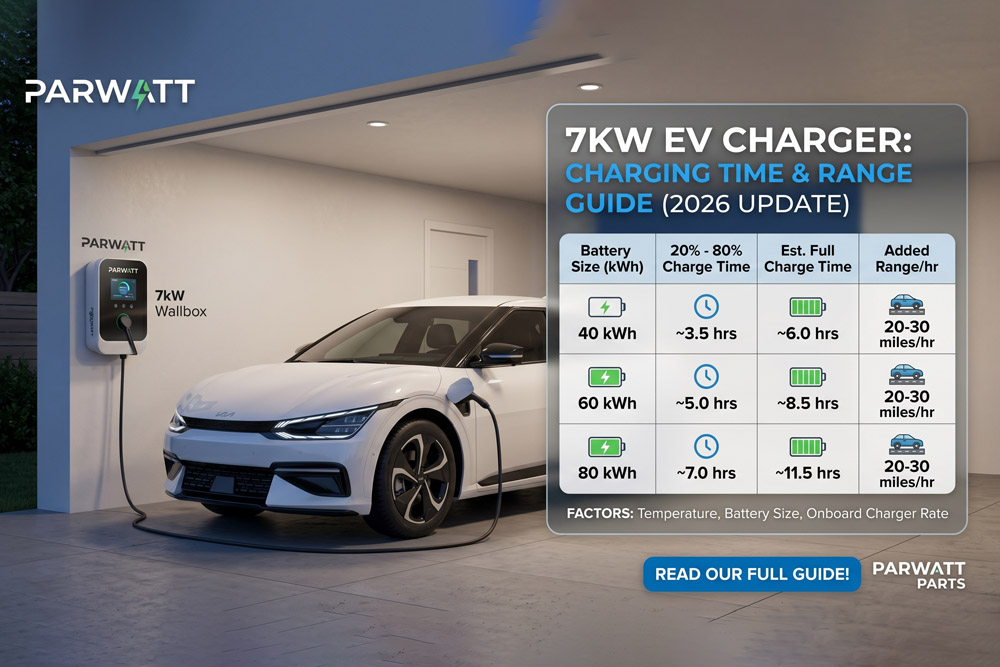
Charging time depends on battery capacity, the vehicle’s onboard charger, and the starting state of charge. A 7kW charger typically delivers about 7 kWh per hour under ideal conditions.
Estimated Charging Time with a 7kW Home Charger
| Battery Capacity | Charging Time (20% to 80%) | Approx. Full Charge Time |
| 40 kWh | 3.5 to 4.5 hours | 5 to 6 hours |
| 60 kWh | 5 to 6 hours | 8 to 9 hours |
| 75 kWh | 6.5 to 8 hours | 10 to 11 hours |
| 90 kWh | 8 to 10 hours | 12 to 13 hours |
How Many Miles of Range Can You Add Per Hour with a 7kW Charger?
How Fast Does a 7kW Charger Add Range?
This is one of the most common questions among EV owners. While there is no single answer for every vehicle, a 7kW charger typically adds around 20 to 30 miles of range per hour under normal conditions.
A practical way to understand charging is to think in terms of range added per hour rather than total charging time. For most drivers, this is more relevant to daily use.
- 20 to 30 miles of range per hour
- 2 to 3 hours of charging can cover a typical daily commute
- Overnight charging is sufficient to recharge most EVs
In everyday driving, a full charge is rarely necessary. Most users only need to replenish enough range for the next trip.
What Affects Charging Speed?
Several factors influence how quickly a vehicle charges with a 7kW unit:
Battery Size
Vehicles with larger batteries require more energy to reach the same charge level, which increases total charging time. This is similar to filling larger and smaller containers using the same flow rate.
State of Charge (SoC)
Charging speed is not constant throughout the process. EVs generally charge faster when the battery level is low. As the battery fills, the system gradually reduces power input to protect battery health.
Temperature Conditions
Extreme heat or cold can affect charging efficiency. The vehicle may adjust charging speed to maintain optimal battery temperature.
Vehicle Onboard Charger
Each EV has an onboard AC charger with a specific power limit. Some vehicles can utilize the full 7kW, while others may be restricted to a lower rate, which extends charging time.
Typical Charging Time Examples
The following examples illustrate how different vehicles perform with a 7kW charger under standard conditions:
Nissan Leaf (40 kWh battery)
Full charge: approximately 5 to 6 hours
Tesla Model 3 (57.5 kWh battery)
Full charge: approximately 7 to 8 hours
Kia e-Niro (64 kWh battery)
Full charge: approximately 8 to 9 hours
These values are estimates and may vary depending on usage conditions and system limitations. For precise data, it is recommended to consult the vehicle manufacturer or charger specifications.
Charging Habits and Battery Health
In practice, charging from 0% to 100% is not typical and is not always recommended. Most electric vehicles use lithium-ion batteries, which perform better when maintained within a moderate charge range.
- Maintaining a charge between 20% and 80% helps reduce long-term battery degradation
- Keeping the battery near 100% for extended periods can increase chemical wear
- Charging slows significantly in the final 10% to 20% as the system reduces power to protect the battery
Because of this, charging to full capacity is generally reserved for longer trips when additional range is required. For daily use, partial charging is more efficient and supports longer battery life.
The Benefits of 7kW Home Charging
Home charging with a 7kW unit offers several practical advantages for EV owners. It supports daily driving needs while providing a stable and controlled charging environment.
Convenience for Daily Use
One key benefit is convenience. Charging at home eliminates the need to visit public charging stations regularly. The vehicle can be plugged in after returning home and left to charge automatically. This fits naturally into daily routines without requiring additional time or planning.
Cost Management
Another advantage is cost control. Electricity rates at home are often lower than public charging prices. Many utility providers also offer off-peak tariffs, allowing users to charge during periods of lower demand at reduced rates. This helps lower overall operating costs over time.
Reliable Access to Charging
Reliability is also important. Home chargers provide consistent access to power without waiting in line or relying on station availability. This is particularly useful in areas where public charging infrastructure is still limited or heavily used.
Smart Charging Capabilities
A dedicated home charger can support smart charging features. These may include scheduling, energy monitoring, and integration with renewable energy systems such as solar panels. These functions help improve energy efficiency and allow users to better manage their electricity usage.
Why Charging Times Vary?
Electric vehicle charging times are not always the same. Charging time varies depending on the following factors:
- Battery Capacity: Larger capacity batteries require longer charging times.
- Battery Level: Charging from 10% takes longer than charging from 50%.
- Charging Speed: Vehicle’s Charging Speed
- Temperature: Low temperatures reduce battery charging speed.
- Charger Type: The charger used.
This is why two electric vehicles using the same 7kW charger may take different times to fully charge.
7kW Home Charger vs Public Chargers
| Charging Type | Power Output | Charging Speed | Typical Use Case | Cost Level | Key Considerations |
| 7kW Home Charger | Up to 7kW (AC) | ~20 to 30 miles per hour | Daily home charging | Low | Stable, convenient, suitable for overnight use |
| Public AC Charger | 7kW to 22kW (AC) | Similar to home or slightly faster | Workplace or destination charging | Medium | Limited by vehicle onboard charger capacity |
| DC Fast Charger | 50kW to 150kW+ (DC) | Rapid charging in under 1 hour | Long-distance travel | High | Higher cost, potential impact on battery health |
Conclusion
For most electric vehicle owners, a 7kW EV charger is a practical solution. It strikes a balance between charging speed and convenience, making it ideal for everyday home use.
Charging times typically range from a few hours for a partial charge to an overnight full charge, depending on battery capacity. Each hour adds approximately 20 to 30 miles of range, sufficient for daily driving needs.
While charging speeds can vary depending on vehicle specifications and environmental conditions, the overall performance of a 7kW charger remains consistently reliable. Combined with public charging infrastructure, it forms a flexible and efficient charging strategy.
For many households, installing a 7kW charger is a direct and effective way to support electric vehicle travel and reduce reliance on traditional fuels.

--- END ---
Related Posts

Business Ideas

11kW vs. 22kW Home EV Chargers: Which One Should You Choose in 2026?
October 23, 2026

Business Ideas

Business Ideas

Business Ideas
