

Plug-and-Charge Technology Explained: How It Works and Why EV Owners Love It
May 07,2026
Tired of juggling multiple apps, RFID cards, and payment hassles just to charge your EV? You are not alone. Many drivers feel frustrated at public stations.
Plug-and-Charge lets you simply plug in your EV and start charging automatically. No apps or cards needed. It uses secure ISO 15118 communication to handle authentication and billing in seconds.
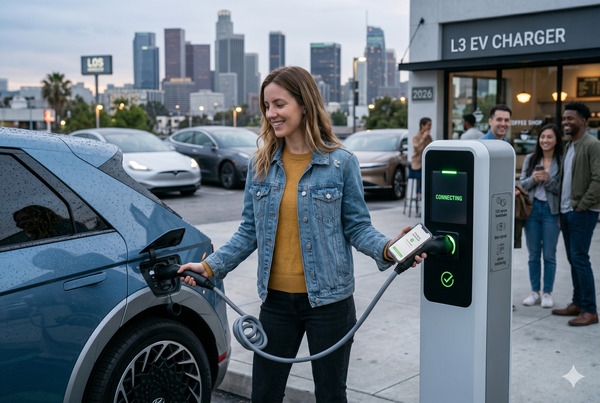
This technology removes the biggest headaches in public charging. Keep reading to see how it works and how you can start using it today.
The Real Pain Points EV Owners Face with Traditional Public Charging
Long lines at chargers waste your time. You pull up ready to charge but then face confusion.
Traditional public charging forces you to download several apps, create accounts, and carry RFID cards. Different networks do not always work together. This mess adds stress and range anxiety for many EV owners.
I remember one road trip where I spent 15 minutes at a station trying to log in through a slow app. The session finally started but the whole experience felt broken. As Jacky Huang at Parwatt, I hear similar stories from fleet operators and CPOs every week.
Here is a clear look at the main issues:
- Multiple apps and accounts — Each network wants its own login.
- RFID cards and payments — Extra steps that fail when signal is weak.
- Network incompatibility — One card may not work everywhere.
- Time waste — Sessions take longer to start than to actually charge.
- Range anxiety — Drivers avoid public charging because of the hassle.
These pain points push many owners to stick with home charging only. But public networks matter for longer trips.
The problems go beyond simple annoyance. Fragmented systems create real barriers for EV adoption. Charge Point Operators lose revenue when drivers give up and leave. Fleet operators see downtime rise because drivers wait for apps to load. Real estate developers hear complaints from tenants who expect easy charging but get complicated setups.
Studies show that payment friction causes up to 30% of charging attempts to fail or get abandoned. That means lost time and lost money for everyone involved.
Consider these common scenarios. A delivery driver in a busy city needs a quick top-up but opens three different apps before one works. Total delay reaches 10-20 minutes. A family on vacation stops at a highway station only to find their RFID card does not register. They end up calling support. Corporate fleet managers report the top complaint is always the confusing payment process.
We can compare traditional methods here:
| Issue | Traditional Charging | Impact on Drivers |
|---|---|---|
| Authentication | App, card, or manual login | 5-15 minutes per session |
| Compatibility | Network-specific | Limited options on trips |
| Security | Shared credentials | Higher fraud risk |
| User Experience | Fragmented | High frustration |
| Cost Transparency | Varies by app | Surprise fees possible |
At Parwatt, we design solutions that address these exact problems. Our FES-D30 DC EV Charger supports modern protocols that prepare networks for seamless experiences. Our battery-buffered ultra-rapid EV charger helps CPOs deliver reliable power even during peak times.
For businesses, the pain shows in operational metrics. Downtime from failed sessions hurts ROI. Municipalities face public complaints that slow project approvals. Automotive OEMs hear from customers who love the car but hate the charging process.
I once worked with a retail chain that installed 50 chargers. Initial usage was low because of app confusion. After they upgraded to smarter systems, utilization jumped 40%. Simple changes make big differences.
EV owners in 2026 still deal with these issues in many places. But technology is catching up fast. Understanding the pain helps you appreciate what comes next.
What Is Plug-and-Charge Technology and How Does It Actually Work?
You want charging as easy as filling a gas tank. Plug-and-Charge makes that possible.
Plug-and-Charge is a technology based on the ISO 15118 standard. Your EV and the charger talk securely to each other. The vehicle shares a digital certificate. The charger verifies it and starts billing automatically.
No more apps. No cards. You plug in and go.
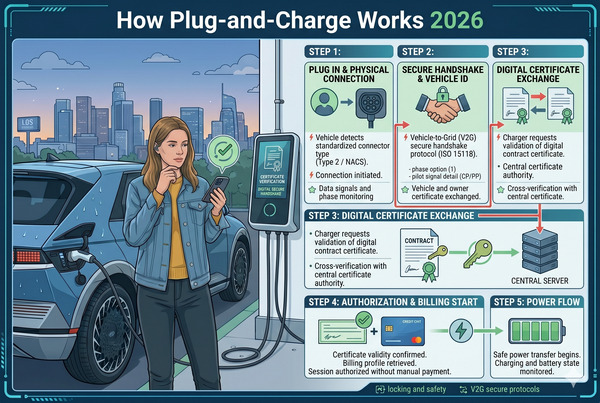
This system uses encrypted communication for safety. It feels like magic the first time you try it.
ISO 15118 creates a two-way link between the car and the charger. The vehicle sends a digital certificate signed by the manufacturer. The charger checks this certificate through a secure system. Once verified, it starts the session and handles payment through your linked account.
Key steps inside the process include the vehicle plugging in, a secure handshake, certificate exchange, authorization, and power flow.
Security stands out as a major win. Strong encryption and digital signatures protect every step. This setup prevents fraud better than old card systems. It also supports future features like Vehicle-to-Grid.
Here is a simple comparison:
| Feature | Traditional Methods | Plug-and-Charge |
|---|---|---|
| Authentication | Manual login or card | Automatic via certificate |
| Security | Basic passwords | Encrypted PKI |
| Speed to Start | 30-120 seconds | Under 10 seconds |
| Billing | Per app | Automatic and unified |
| Future Ready | Limited | Supports V2G and smart charging |
Major automakers support this now. Audi, BMW, Ford, Mercedes, Porsche, VW Group, GM, Lucid, and Rivian lead the way. Even some 2026 Nissan models join the list. Many need only a software update.
At Parwatt we build chargers ready for this future. Check our EP02 portable EV charger with display and EC01 wall charger. Both work with smart protocols that align with ISO 15118 standards. Our 30kW and 40kW power modules power scalable stations that CPOs love.
For fleet operators, this means faster turnaround times. Real estate developers can offer true convenience to tenants. Energy utilities gain better load balancing data from secure communication.
I tested early Plug-and-Charge setups in our lab. The car connected instantly every time. No failed sessions. That reliability matters when you manage hundreds of chargers.
By 2026 more networks adopt full support. Electrify America and IONITY already lead. Others follow because drivers demand it. The technology removes one big reason people hesitate to buy EVs.
Step-by-Step Guide: How to Activate and Use Plug-and-Charge
Ready to try Plug-and-Charge but not sure where to start? Follow these steps.
First check if your EV supports it. Then activate the feature. After that you simply plug in at supported stations.
The whole process takes minutes once set up.
Here is a helpful checklist:
| Step | Action Needed | Time Required | Common Issues |
|---|---|---|---|
| 1 | Verify vehicle support | 2 minutes | Outdated software |
| 2 | Update firmware | 10-30 minutes | Weak Wi-Fi |
| 3 | Link payment | 5 minutes | Account verification |
| 4 | Locate station | Varies | Limited coverage |
| 5 | Start session | Under 10 seconds | None if compatible |
For businesses, the process scales nicely. CPOs can enable it through backend settings. Fleet managers push updates over the air to entire groups of vehicles.
I helped one automotive accessory wholesaler set up white-label solutions. Their customers activated Plug-and-Charge easily and reported higher satisfaction. Our Meta mobile EV charger works great for flexible deployments that support these features.
Safety remains strong throughout. The encrypted system protects your data. You keep full control over spending limits in the car settings.
If issues appear, restart the car or check for updates. Most problems resolve with a simple software refresh.
This guide works for daily commuters and long-haul travelers alike. Once activated, charging feels natural again.
Advanced Tips and Future-Proof Benefits for EV Owners in 2026
You want more than basic charging. Advanced tips help you get maximum value.
Combine Plug-and-Charge with smart scheduling and V2G features. Stay ahead as networks expand in 2026.
These extras save time and money over years of ownership.
2026 brings wider adoption and new capabilities. Here are advanced tips I share with Parwatt partners.
Tip 1: Enable preconditioning so the battery stays at the right temperature for fast charging.
Tip 2: Use multi-network accounts that unify billing across operators.
Tip 3: Monitor energy use, costs, and history directly in your car app.
Tip 4: Explore V2G readiness on newer models to send power back and save on rates.
Tip 5: Always choose certified stations with official Plug-and-Charge logos.
Benefits extend far into the future with instant sessions, transparent pricing, strong security, and gas-station-like convenience.
Here is compatibility for popular 2026 models:
| Brand | Models Supported | Activation Method |
|---|---|---|
| BMW | i4, i5, iX | Over-the-air update |
| Ford | Mustang Mach-E | App configuration |
| Mercedes | EQS, EQE | Dealer or app |
| VW Group | ID.4, Taycan | Built-in certificate |
| GM | Various 2026 models | Software push |
For businesses, these features drive higher utilization. Retail chains see more customers stay longer when charging feels effortless. Government projects meet regulations easier with standardized tech.
At Parwatt we integrate these capabilities into our lineup. Our E-Station 120 mobile battery-buffered power station offers flexible power with smart communication. Check our blog on Level 2 vs Level 3 charging for more insights. Another useful read is our EV charging guide.
Wireless charging pilots also build on this foundation. Owners who adopt early enjoy smoother trips and lower stress. The technology future-proofs your EV investment as infrastructure grows.
Ready to Simplify Your EV Charging? Take Action Today
You have the knowledge now. Why wait to make charging easier?
Check your vehicle compatibility this week. Activate Plug-and-Charge and find nearby stations.
Small steps today lead to big convenience tomorrow.
Conclusion
Plug-and-Charge technology is transforming public EV charging from a frustrating multi-step process into the seamless experience drivers have always wanted — simply plug in and go. By leveraging secure ISO 15118 communication, it eliminates apps, cards, and account hassles while delivering superior security and convenience. As more 2026 models and charging networks adopt it, Plug-and-Charge is removing one of the biggest barriers to widespread EV adoption. Whether you’re a daily commuter or long-distance traveler, embracing this technology means less time at the charger and more time on the road. The future of EV charging is here — and it’s as easy as filling up at a gas station.

--- END ---
Related Posts


Business Ideas

Business Ideas
