

How to Choose the Right EV Charging Cable in 2026?
May 06,2026
Frustrated with slow charging, heavy tangled cables, or cables that simply do not fit your EV? You are not alone. Many owners waste money on the wrong cable every year.
The right EV charging cable matches your vehicle connector, charger power, and daily parking needs. It delivers faster, safer charging while lasting for years. In 2026 this choice matters more than ever with mixed home, work, and public use.
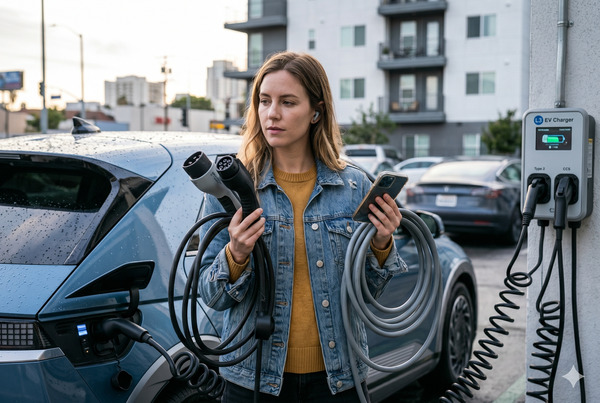
This guide walks you through real pain points, clear basics, and practical steps so you pick the perfect cable the first time.
The Biggest Pain Points EV Owners Face When Choosing the Wrong Charging Cable
You park at home or a public spot and realize your cable falls short or charges too slowly.
Wrong cables create daily headaches. They overheat, feel too heavy, or fail to match your car. This leads to extra costs and lost time.
I remember helping a fleet operator in 2025 who bought cheap cables for 20 vans. Half overheated during summer use and needed replacement within months. As Jacky Huang at Parwatt, I see these issues daily from CPOs, real estate developers, and everyday EV owners.
Here are the most common problems:
- Slow charging — Cable amp rating too low for your charger or car.
- Overheating risks — Poor materials or wrong power match.
- Cable too short or too heavy — Limits parking flexibility or hard to handle.
- Compatibility issues — Wrong connector wastes money.
- Frequent replacements — Low-quality cables wear out fast and raise long-term costs.
These issues hit harder in 2026 with more mixed-use scenarios.
The problems affect both personal drivers and businesses. Fleet operators lose valuable uptime. Real estate developers get tenant complaints about unreliable charging. Automotive accessory wholesalers see returns spike on mismatched products.
Consider these real situations. A commuter buys a 3-meter cable but parks in different spots each day and struggles to reach the charger. A family on a road trip carries a cable that does not match public stations and wastes 30 minutes searching for adapters. Corporate fleet managers track higher maintenance budgets because cables degrade quickly under daily use.
We compare common mistakes here:
| Mistake | Result | Real Cost to You |
|---|---|---|
| Wrong connector | No charging at all | Full replacement + downtime |
| Low amp rating | Slow 3.7kW instead of 7.4kW+ | Hours of extra wait time |
| Cheap materials | Overheating and early failure | Safety risk + repeated buys |
| Too short cable | Parking limitations | Daily frustration |
| No weatherproofing | Damage from rain or sun | Short lifespan |
At Parwatt we focus on solutions that solve these exact pains. Our EP02 portable EV charger with display comes with high-quality cables built for daily use. The EC01 wall charger pairs perfectly with durable tethered options. Check our car battery charger guide for related power tips too.
Understanding these pain points helps you avoid expensive mistakes. Good choices save time, money, and stress every single day you drive your EV.
EV Charging Cable Basics: Connectors, Power Ratings, Length & Phases Explained
You need clear facts before you buy. Cable basics make the entire decision easier.
EV charging cables differ by connector type, power rating, length, and phase support. Match them correctly and you get reliable performance.
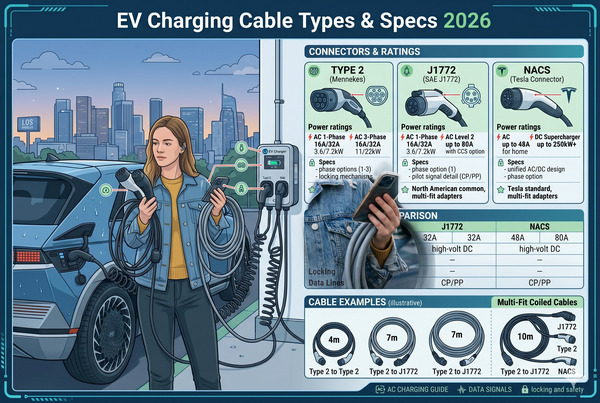
Start with your vehicle inlet and work from there.
Type 2 dominates in Europe and many other markets while J1772 and the growing NACS standard rule in North America. Power ratings run from 16A (about 3.7kW single-phase) to 32A (7.4kW single-phase or up to 22kW three-phase). Lengths from 3m to 10m suit different parking needs. Three-phase cables offer strong future-proofing even if your current home supply is single-phase.
Key basics include thick copper conductors for low heat, strong insulation, and proper strain relief. Certified cables carry IEC 62196, CE, or UKCA marks for safety.
Here is a quick reference table:
| Feature | Common Options | Best For |
|---|---|---|
| Connector | Type 2, J1772, NACS | Match your car inlet |
| Power Rating | 16A / 32A single or three-phase | Match charger and car limits |
| Length | 3-5m home, 5-10m flexible | Balance reach and handling |
| Phases | Single or three-phase | Future higher power needs |
At Parwatt we test cables under real conditions. Our LP8 multi-functional car air pump and other accessories follow the same quality standards we demand for charging cables. Fleet operators love our Meta mobile EV charger because it includes robust cable options built for heavy daily use.
These basics remove guesswork. Once you know them, choosing the right cable becomes straightforward and confident.
Step-by-Step Guide: How to Choose the Right EV Charging Cable for Your Needs
Ready to pick the perfect cable? Follow this simple process.
Start with your car, then match power, length, and quality. You finish with a cable that works reliably for years.
Check your vehicle inlet first. Look at the manual or the port itself. Most 2026 models clearly show Type 2, J1772, or NACS.
Next match the cable amp rating to your charger and car onboard charger. A 32A cable gives headroom for future upgrades. Decide length based on where you park. Five meters works for most home setups while longer options help public or awkward spaces.
Finally verify certifications and build quality. Feel the weight, check the plug, and confirm weatherproof rating.
Here is the exact checklist we recommend:
| Step | What to Do | Why It Matters |
|---|---|---|
| 1 | Identify your car connector | Prevents buying useless cable |
| 2 | Check charger and car power limits | Ensures full speed charging |
| 3 | Choose length for your parking | Avoids daily reach struggles |
| 4 | Select single or three-phase | Prepares for faster future use |
| 5 | Confirm certifications & materials | Guarantees safety and longevity |
For businesses this process scales well. Real estate developers use it when equipping multiple units. Charge Point Operators specify consistent cables across sites. I once guided an automotive OEM partner through bulk selection and they reduced returns by over 60 percent.
Our FES-D30 DC EV charger works seamlessly with quality AC cables for hybrid setups. The 30kW power module supports higher power scenarios where robust cables become essential. Read our Level 2 vs Level 3 charging article for deeper power context.
This step-by-step approach takes the stress out of buying. You end up with a cable that fits your exact lifestyle and future plans.
Advanced Tips for 2026: Future-Proofing Your Cable Choice for Speed, Durability & Convenience
You want a cable that lasts and grows with your EV needs through 2026 and beyond.
Smart choices now pay off later with faster charging, easier handling, and fewer replacements.
Consider three-phase cables even for single-phase homes. They work at reduced power today but unlock full speed when you upgrade. Watch the NACS trend in North America as more stations adopt it. For longer cables use good strain relief and storage solutions to avoid tangles.
Premium materials with thick copper and flexible yet tough insulation extend life dramatically. Look for IP67 weatherproofing if you charge outdoors often.
Advanced tips we share with partners:
- Buy slightly higher amp rating than you need today.
- Choose tethered cables for home convenience or untethered for public flexibility.
- Test cable temperature during first few charges.
- Store cables properly to prevent kinks and sun damage.
- Consider bundled kits with adapters for mixed networks.
Here is 2026 compatibility and recommendation table:
| Vehicle Type | Recommended Cable | Key Benefit |
|---|---|---|
| European models | Type 2 32A three-phase 5-7m | Future 11-22kW readiness |
| North American | J1772 or NACS 32-48A 5m | Full home and public coverage |
| Fleet vehicles | Heavy-duty 32A with extra strain | Daily high-cycle durability |
| Home + travel | 7-10m portable with carry bag | Maximum parking flexibility |
Retail and hospitality chains benefit from standardized high-quality cables that guests trust. Government projects meet strict safety rules easier with certified options. Energy utilities appreciate cables that support smart load balancing.
At Parwatt our battery-buffered ultra-rapid EV charger pairs beautifully with advanced AC cables. Our how to choose a vacuum cleaner for a car shows the same attention to detail we put into every accessory. We help wholesalers and resellers offer reliable solutions their customers love.
Early adopters of these tips enjoy noticeably better daily experiences and lower total ownership costs. The right cable becomes an invisible hero in your EV journey.
Ready to Upgrade? Choose Your Perfect EV Charging Cable Today
You now know exactly what to look for. Why settle for mediocre charging?
Check your current cable against the steps above. Upgrade to a quality match and feel the difference immediately.
Small improvements in your charging setup create big wins in convenience and peace of mind.
Conclusion
Choosing the right EV charging cable in 2026 is no longer just about “any cable that fits” — it directly impacts your daily charging speed, safety, convenience, and long-term costs. By understanding connector types, power ratings, optimal lengths, and build quality, you avoid common frustrations like slow charging, tangled heavy cables, or compatibility issues. Whether you charge at home, work, or on public networks, a well-matched high-quality cable makes EV ownership truly effortless. Invest once in the right solution and enjoy faster, safer, and more reliable charging for years to come.
Find Your Perfect EV Charging Cable – Get Recommendations
Shop Type 2 / J1772 / NACS Cables Now
High-Quality | Certified | Fast Shipping. Compatible with 2026 Models.

--- END ---
Related Posts


Business Ideas

Business Ideas
