

How to Build the Right EV Charger Product Range for Your Target Market
Nov 03,2026
An EV charger range should be designed around the vehicles, electrical infrastructure and charging behavior of a specific market. It should not be copied directly from a supplier’s complete catalogue or from a successful assortment in another country.
A charger that sells well in one region may be unsuitable elsewhere because of differences in voltage, connector standards, residential parking, installation rules, vehicle charging limits or customer budgets. Even within one country, a product intended for apartment residents may require a different installation model from equipment sold to homeowners, workplaces, retailers or fleet operators.
For distributors, the objective is not to offer every available charging power and feature. It is to build a focused range that covers the most commercially important applications without creating overlapping SKUs, difficult installations or slow-moving inventory.
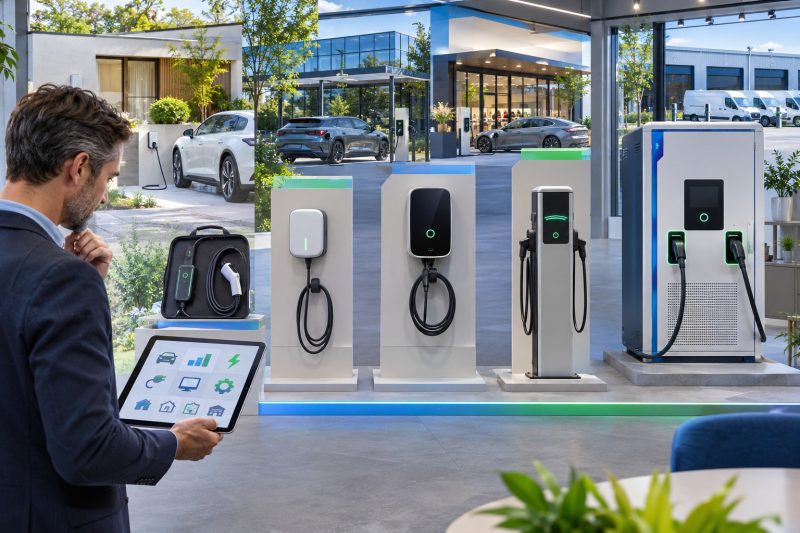
What Distributors Must Confirm Before Selecting EV Chargers for a Market
Product selection should begin with market research rather than charger specifications. Before requesting quotations, distributors should define who will use the equipment, where it will be installed and which vehicles it must support.
Understand the local vehicle parc
The local EV and plug-in hybrid vehicle population determines connector demand, practical charging power and the likely customer base for each product.
Distributors should examine:
- The number of battery-electric vehicles and plug-in hybrids
- Leading vehicle brands and models
- Vehicle age and expected fleet growth
- Maximum AC charging rates
- DC charging capabilities
- Charging-port locations
- Connector standards
- Adoption of new connector systems
- Dependence on adapters
A 22kW AC wallbox may look more competitive than a 7kW unit, but many vehicles cannot accept 22kW AC. If most local vehicles use single-phase onboard chargers, stocking too many high-power three-phase products may increase cost without producing faster charging for the end user.
The same principle applies to DC charging. A station’s maximum output is not the speed every vehicle will receive. Battery temperature, state of charge, voltage architecture and the vehicle’s charging curve can all limit actual performance.
Confirm the electrical environment
A charger must match both the vehicle and the installation site. Buyers should investigate:
- Residential and commercial voltage
- Grid frequency
- Single-phase and three-phase availability
- Typical household service capacity
- Circuit-breaker requirements
- Earthing arrangements
- Permitted installation methods
- Demand charges for commercial sites
- Local electrician practices
- Grid-connection approval procedures
For residential applications, the difference between Level 1 and Level 2 charging can affect the circuit, installation method and customer expectations. Parwatt’s Level 1 vs. Level 2 home EV charger guide provides a practical comparison of voltage, charging speed and installation requirements.
Study parking and charging behavior
Charging demand is influenced by how long vehicles remain parked. A commuter who parks at home for ten hours has different requirements from a driver stopping at a retail location for twenty minutes.
Important questions include:
- Where do customers normally park overnight?
- Do apartment residents have assigned parking spaces?
- Are electrical outlets available near the vehicles?
- How many kilometres do users drive each day?
- How long do vehicles remain at workplaces or hotels?
- Do fleet vehicles return to a central depot?
- Are public chargers expected to provide rapid turnover?
- Will customers pay directly at the charger?
The answers help determine whether the range should prioritize portable chargers, residential wallboxes, networked AC chargers or DC fast-charging equipment.
Identify the required compliance path
Certifications and market access requirements must be checked for the exact model and configuration being purchased. A certificate issued for one power rating, connector or internal design may not automatically cover another version.
Depending on the destination, buyers may need to verify:
- Electrical-safety requirements
- EMC compliance
- Radio or wireless approvals
- Environmental protection
- Energy metering rules
- Accessibility requirements
- Grid communication requirements
- Installation standards
- Payment regulations
- Cybersecurity and data-protection obligations
The supplier should provide model-specific reports, certificate numbers and product labels. The name and specifications on the documents should match the unit, packaging and quotation.
Market-selection framework
| Target market or application | Products to prioritize | Main purchasing checks |
|---|---|---|
| Apartment and urban users | Portable or compact AC chargers | Available outlets, parking access, weather protection and theft resistance |
| Single-family homes | Wall-mounted AC chargers | Panel capacity, single- or three-phase supply, plug-in or hardwired installation |
| Premium home charging | Smart AC wallboxes | Load balancing, scheduled charging, solar integration and app stability |
| Workplaces | Networked multi-user AC chargers | RFID, user permissions, billing, OCPP and power sharing |
| Hotels and destinations | Medium-power AC chargers | Parking duration, number of spaces, backend management and payment |
| Retail locations | AC and medium- or high-power DC products | Customer dwell time, space turnover, payment and remote monitoring |
| Highway and public charging | DC fast chargers | Connector coverage, uptime, remote diagnostics and field service |
| Fleets | Scalable AC or DC systems | Vehicle schedules, return times, load management and operating data |
The Product-Selection Mistakes That Create Slow-Moving Inventory
Many distributors build their opening range by comparing power ratings and FOB prices. This approach may produce an impressive catalogue, but it does not necessarily produce sellable inventory.
Assuming that higher power is always better
Higher charging power can increase equipment cost, cable weight, installation complexity and grid requirements. It creates value only when the vehicle, site and parking duration can use it.
For example, a household may not benefit from a high-power charger if:
- The vehicle has a lower onboard AC limit
- The property has limited electrical capacity
- The car remains parked overnight
- The customer’s daily energy use is modest
- A service upgrade costs more than the charger
- Dynamic load management is unavailable
Distributors should estimate how much energy users need to restore during a normal parking period. This calculation is more useful than choosing the highest nameplate rating.
Comparing only FOB prices
The charger price is only one part of the delivered commercial cost. Buyers should also consider:
- International freight
- Import duties and taxes
- Local certification
- Mounting accessories
- Electrical protection equipment
- Installation labor
- Software or cloud fees
- SIM or connectivity charges
- Payment-processing costs
- Spare parts
- Warranty replacements
- Technician training
- Field-service visits
A lower-priced product may become more expensive if its app is unstable, its spare parts are unavailable or every support issue requires returning the unit to the factory.
Stocking too many overlapping models
A catalogue containing 7kW, 7.2kW, 7.4kW, 9.6kW, 11kW and 22kW wallboxes may include unnecessary overlap. If these units serve similar customers and differ only slightly in appearance or current settings, sales become fragmented across too many SKUs.
A more productive opening range might assign each product a clear role:
- Entry portable charger
- Mainstream home wallbox
- Premium smart home wallbox
- Commercial networked AC charger
- Selected DC charger for faster public or fleet applications
Every SKU should solve a distinct installation, vehicle or customer problem.
Ignoring installation habits
Portable and wall-mounted products require different sales explanations and after-sales support. Customers who rent their homes may value portability, while homeowners may prefer permanent cable management and smart energy features.
The comparison in Parwatt’s portable versus wall-mounted EV charger guide can help distributors define which installation format belongs in each price tier.
Other installation factors include:
- Hardwired versus plug-in connection
- Tethered cable versus socket outlet
- Wall mounting versus pedestal installation
- Indoor versus outdoor positioning
- Cable length and parking orientation
- Existing electrical-panel capacity
- Availability of trained installers
Treating software as an optional accessory
For commercial charging, software is part of the product. A charger may have strong electrical specifications but still fail commercially because of unreliable communication, difficult user registration or poor backend integration.
Before approval, buyers should test:
- Account creation
- Charger activation
- RFID authorization
- Remote start and stop
- Charging records
- Tariff settings
- User permissions
- Firmware updates
- Offline behavior
- OCPP communication
- Error notifications
- Remote diagnostics
The supplier should also explain who operates the cloud platform, where data is stored and what happens if the distributor changes software providers.
How to Match Power, Connector and Features to Local Demand
The correct range connects vehicle needs with site limitations and customer expectations. Power, connector and smart functions should be selected together rather than as independent specifications.
Choose AC or DC according to use case
AC charging generally suits locations where vehicles remain parked for extended periods, including homes, workplaces and hotels. DC charging is more relevant when shorter charging times or rapid vehicle turnover justify higher equipment and infrastructure costs.
| Charging format | Typical applications | Main advantages | Key limitations |
|---|---|---|---|
| Portable AC | Apartments, travel, emergency backup and light daily use | Flexible, easy to transport and lower installation commitment | Limited by outlet quality, current and local electrical rules |
| Wall-mounted AC | Homes, workplaces and destinations | Practical daily charging, smart controls and manageable installation | Speed is limited by the vehicle’s onboard charger |
| Networked AC | Offices, apartments, hotels and shared parking | User control, reporting, billing and power sharing | Requires reliable software and network support |
| Medium-power DC | Retail, fleets and urban charging | Faster charging without the highest-power infrastructure | Higher cost and service requirements than AC |
| High-power DC | Highways, public hubs and intensive fleet operations | Rapid energy delivery and higher vehicle turnover | Greater grid, cooling, maintenance and site-planning demands |
Buyers considering public charging should understand the technical and service differences explained in Parwatt’s Level 3 and DC fast-charging guide.
Select connectors from vehicle data
Connector selection should be based on actual vehicle registrations and new-model trends. Regional descriptions alone are not sufficiently precise.
Potential connector requirements include:
- Type 1/J1772
- Type 2
- NACS
- CCS1
- CCS2
- GB/T
- CHAdeMO
- Market-specific adapters or cables
A North American distributor may need to manage a transition involving J1772, CCS1 and NACS. A European range will normally prioritize Type 2 and CCS2, while other markets may contain mixed imported fleets.
Before ordering, verify:
- Which connectors are currently used by local vehicles
- Which connectors appear on newly registered models
- Whether vehicles use native ports or adapters
- Whether the charger cable is fixed or replaceable
- Which charging protocols are supported
- Whether connector certification covers the complete cable assembly
- Whether replacement cables and holsters are available
Cables, adapters, holders and pedestals should also be included in range planning. Parwatt’s EV charger accessories range shows how supporting products can complete residential and commercial installations.
Match power to energy demand
A useful planning calculation is:
Required charging power ≈ energy to be restored ÷ available parking time
If a driver needs to replace 28kWh during eight hours of overnight parking, the theoretical average requirement is 3.5kW before allowing for charging losses and operational margins. This does not automatically mean that 3.5kW is the best permanent charger, but it prevents the selection process from being driven only by the highest advertised power.
For home charging, a 7kW-class charger may cover many daily routines without requiring the infrastructure associated with much higher ratings. Buyers can review the practical variables in Parwatt’s guide to 7kW home EV charger charging time.
Choose smart functions according to the customer
Not every charger needs every feature. Unnecessary functionality can increase purchase cost, setup difficulty and support requirements.
For home users, useful functions may include:
- Scheduled charging
- Adjustable current
- App monitoring
- Dynamic load balancing
- Solar-energy integration
- Charging-history reports
- User-defined current limits
For workplaces, apartments and commercial locations, priorities may include:
- RFID authorization
- Multiple user accounts
- OCPP compatibility
- Centralized monitoring
- Energy allocation
- Tariff management
- Payment integration
- Remote fault diagnosis
- Firmware management
- Role-based access
A distributor should distinguish between functions included as standard, functions requiring optional hardware and functions that depend on a paid cloud subscription.
Complete the purchasing checklist
| Purchasing item | Question the buyer should confirm |
|---|---|
| Target vehicle parc | Which connectors and maximum charging rates are supported by leading local EVs and PHEVs? |
| Grid and installation | What voltage, phase arrangement and electrical capacity are common at residential and commercial sites? |
| Connector | Does the market require Type 1, Type 2, NACS, CCS1, CCS2 or another interface? |
| Charging power | How much energy must users restore during their typical parking period? |
| Compliance | Which safety, EMC, wireless, metering and market-access requirements apply? |
| Smart functions | Are app control, RFID, OCPP, load balancing, payment or remote management required? |
| Installation model | Does the market prefer portable, plug-in, hardwired, wall-mounted or pedestal equipment? |
| Environmental protection | Must the product withstand outdoor exposure, heat, cold, rain, dust or coastal conditions? |
| Software support | Can the firmware, backend and app be updated and localized throughout the product lifecycle? |
| After-sales service | Will the supplier provide diagnostics, parts, warranty handling and technical training? |
Home, Workplace, Retail and Fleet Charging Require Different Products
A balanced range should reflect the operating priorities of each customer group. One charger platform may support several applications, but its configuration, software and accessories may need to change.
Home charging
Home users usually prioritize predictable overnight charging, safe installation, cable convenience and reasonable cost. A residential range can include:
- One portable entry-level unit
- One mainstream wall-mounted charger
- One smart wallbox with load balancing
- Appropriate cables, adapters and holders
A wide range of nearly identical home chargers can confuse customers and dilute inventory. A clearer good-better-best structure is easier for distributors, installers and homeowners to understand.
Workplace and apartment charging
Shared sites need more than individual hardware. The distributor must consider how several chargers operate on one electrical supply.
Important functions include:
- Dynamic power sharing
- User identification
- Access control
- Session reporting
- Department or tenant billing
- Remote monitoring
- Charger grouping
- Expandable networking
- OCPP integration
In many workplaces, installing more controlled charging ports can create more value than providing maximum power at every parking space. Vehicles remain parked for hours, allowing the available capacity to be distributed over time.
Hotels and destination charging
Hotels, restaurants and leisure destinations usually serve customers with longer dwell times. Moderate-power AC charging may therefore provide an appropriate balance of cost and convenience.
The operator may value:
- Simple user authorization
- Free or paid charging options
- Guest validation
- Visible charger status
- Durable cable management
- Reliable remote support
- Custom branding
The correct product depends on whether charging is intended as a complimentary amenity, a paid service or a customer-acquisition tool.
Retail and public charging
Retail locations must connect charging speed with customer dwell time. A supermarket, shopping center and convenience store may require different power levels even if they serve similar vehicles.
Public and retail operators should evaluate:
- Expected charging-session duration
- Required vehicle turnover
- Number of charging ports
- Payment methods
- Connector mix
- Screen and user interface
- Remote operating tools
- Availability monitoring
- Preventive maintenance
- Field-replaceable components
Reliability also affects whether drivers return to a site. Parwatt’s guide to finding reliable public EV charging stations highlights the importance of recent operating status, connector availability and accurate station information.
Fleet charging
Fleet operators buy charging capacity to support vehicle schedules. Their priority is not simply the fastest individual charger but the ability to prepare the required vehicles for the next shift.
Fleet planning should consider:
- Number and type of vehicles
- Battery capacity
- Daily energy consumption
- Return-to-depot times
- Departure deadlines
- Simultaneous charging demand
- Route predictability
- Grid limits
- Backup charging arrangements
- Maintenance access
A fleet may benefit from multiple managed AC chargers, selected DC units or a combination of both. Charging management should assign energy according to departure time and operational priority.
How to Launch a Lower-Risk EV Charger Range and Expand It with Data
A first wholesale order should test the market without dividing inventory across too many power ratings, connectors and software configurations.
Start with a focused product architecture
A practical opening range could include:
- A portable AC charger for flexible and entry-level demand
- A mainstream home wallbox
- A smart wallbox with load balancing
- A networked AC charger for workplaces or destinations
- A selected DC solution only where commercial demand is already identifiable
- Essential cables, adapters, holders or pedestals
The exact number depends on the market. The important point is that each model should have a distinct customer, installation scenario and price position.
Test complete configurations
Sample approval should cover more than the enclosure and charging cable. Test the exact combination intended for sale, including:
- Rated voltage and current
- Connector and cable length
- Plug or hardwired input
- Leakage protection
- RFID cards
- App version
- Communication module
- OCPP configuration
- Metering option
- Mounting accessories
- Product label
- Packaging
- Installation manual
- Market language
A sample should be tested with representative vehicles and realistic electrical conditions. Buyers should confirm successful connection, charging initiation, current adjustment, scheduled operation, error recovery and session termination.
Verify documents against the product
Before a bulk order, compare the sample with the certificate, report, specification sheet and label. Confirm that the documents cover:
- Exact model number
- Rated input and output
- Connector version
- Wireless modules
- Protection configuration
- Applicable standards
- Manufacturer identity
- Product revision
If the supplier changes internal components, cable assemblies or communication modules, determine whether the existing compliance evidence remains valid.
Evaluate after-sales capability
The supplier should provide a clear support structure before the product is launched.
Ask who will handle:
- Installation questions
- App and account problems
- Firmware updates
- OCPP configuration
- Remote fault diagnosis
- Replacement components
- Warranty approval
- Failed-unit analysis
- Installer training
- Software-platform continuity
For commercial products, request a list of field-replaceable parts and expected replacement procedures. The ability to replace a cable, display, communication module or power module locally can reduce downtime and international return costs.
Use a controlled trial order
The first order can be allocated among proven scenarios instead of distributed evenly across every available model.
For example:
- Deeper stock for the main residential charger
- Moderate stock for portable and premium home products
- Small quantities for new connector formats
- Project-based purchasing for higher-power commercial equipment
- Spare units and service parts for warranty support
This structure protects working capital while maintaining enough inventory to test different customer segments.
Track launch performance
After launch, review both commercial and technical data.
Useful metrics include:
- Enquiries by application
- Sales by charger type and power
- Quote-to-order conversion
- Installation completion rate
- Installation cost
- Charging-session success rate
- App activation success
- Communication failures
- Connector-related questions
- Return and warranty reasons
- Support cases per installed unit
- Spare-part usage
- Inventory age
- Reorder frequency
Customer enquiries should also be recorded. Repeated requests for another connector, cable length, power level or payment method can identify genuine range gaps.
Expand only where the evidence supports it
Add a new SKU when it serves a measurable demand that the current range cannot cover efficiently. Appropriate reasons may include:
- Growth of a new vehicle connector
- Demand for a different residential plug
- Three-phase home installations
- Workplace requests for OCPP
- Fleet demand for centralized load management
- Retail projects requiring payment
- Public sites needing higher DC power
- Climate conditions requiring another specification
Do not add a product only because it appears in the supplier’s catalogue. Every model introduces documentation, training, software, spare-parts and warranty obligations.
A product should remain in the range when it generates sales, protects important market coverage or supports strategic projects. It should be reviewed when sales remain weak, support costs are excessive or another model covers the same applications more efficiently.
Conclusion
Choosing an EV charger range for a target market requires more than selecting several products at different power levels. Distributors should begin with the local vehicle parc, electrical infrastructure, connector standards, parking patterns, installation practices, compliance requirements and customer price expectations.
Home, workplace, retail, public and fleet applications each require a different balance of charging speed, connectivity, user management and service support. A lower-risk launch normally starts with a focused group of products that covers the market’s most common use cases rather than a large catalogue of overlapping models.
Before placing a bulk order, buyers should verify samples, certifications, vehicle compatibility, software functions, installation requirements and after-sales arrangements. The range can then be expanded using actual sales, installation and operating data.
FAQ
1. What should distributors consider when choosing an EV charger range?
Distributors should evaluate local vehicles, connector standards, grid voltage, available electrical capacity, parking behavior, installation practices, compliance requirements and customer budgets. They should also assess software stability, spare-parts availability and after-sales support.
2. How do local voltage and grid capacity affect EV charger selection?
Voltage and phase availability determine which charger configurations can be installed. Grid and panel capacity may limit actual charging power, even when the charger and vehicle support a higher rate. Load balancing can help several chargers share limited site capacity.
3. Which EV charging connector should buyers choose for each market?
The decision should be based on local vehicle registrations and upcoming model adoption. Type 2 and CCS2 are common in Europe, while North America may require J1772, CCS1, NACS or a transitional combination. Other markets may require GB/T, CHAdeMO or mixed connector coverage.
4. Should distributors stock both portable and wall-mounted EV chargers?
In many markets, yes. Portable chargers serve renters, travelers, plug-in hybrid owners and customers seeking flexibility. Wall-mounted chargers suit regular residential use and can provide better cable management, higher power and more smart functions. The stock allocation should reflect local parking and installation conditions.
5. What smart functions are essential for commercial EV chargers?
Commercial sites commonly need RFID access, OCPP, remote monitoring, user management, charging records, tariff control, payment integration and power sharing. The exact requirements depend on whether the chargers serve employees, tenants, hotel guests, retail customers or fleet vehicles.
6. How many EV charger models should a first wholesale order include?
There is no universal number. A first order should contain a limited group of models with clearly different roles, such as a portable charger, a mainstream home wallbox, a premium smart wallbox and a networked commercial AC charger. DC equipment should usually be added according to identifiable projects or confirmed local demand.

--- END ---
Related Posts
Business Ideas

Level 1 vs Level 2 EV Charging: What Buyers Should Check Before Ordering
November 20, 2026
Business Ideas

Company News

Company News


