

Factors Affecting EV Charging Speed: Why Your Charger Isn’t Charging as Fast as Expected in 2026
Jul 08,2026
You plug in your EV expecting fast charging only to watch the rate stay lower than advertised. This frustration affects many drivers daily.
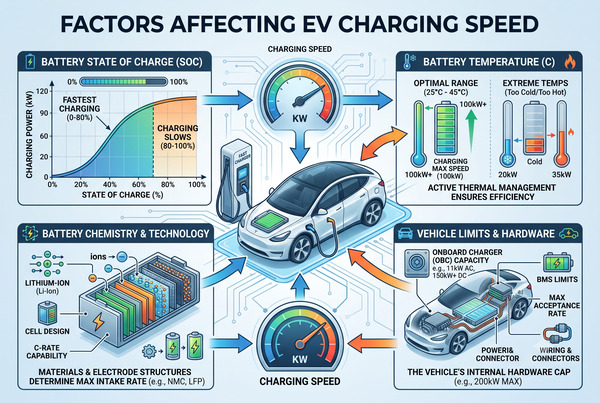
EV charging speed depends on battery temperature, state of charge, chemistry, vehicle limits, and charger capabilities. In 2026, understanding these factors helps you set realistic expectations and charge more efficiently.
As the general manager at XIAMEN PARWATT NEW ENERGY TECHNOLOGY CO.,LTD, I have discussed charging performance with countless customers and fleet operators. Real-world speeds rarely match peak ratings due to multiple variables. This guide explains the key factors and shows you how to optimize results.
Why Your EV Isn’t Charging at the Expected Speed – The Frustrating Reality
You look forward to quick top-ups but the session takes longer than planned. Plans get delayed and range anxiety builds.
Battery conditions, temperature effects, and vehicle systems often limit speed far below the charger’s maximum rating. This leads to longer wait times, higher effective costs, and disrupted schedules.
I hear similar stories often. One customer expected 150 kW but saw only 60 kW in cold weather. Let me explain the common causes.
Battery temperature plays a huge role. Cold batteries accept power slowly to protect cells. Optimal warmth around 20-30°C allows full speed.
State of charge matters too. Charging slows as the battery fills to prevent damage. Peak rates occur in the middle range.
Vehicle onboard systems control acceptance. The car decides how much power it takes safely. Charger capability alone does not determine results.
These realities create frustration when expectations come from marketing numbers.
Here is a table of typical speed reductions:
| Condition | Expected Speed Drop | Common Scenario |
|---|---|---|
| Cold Battery | 30-60% | Winter mornings |
| High SOC | 40-70% | Above 80% charge |
| Hot Weather | 20-40% | Summer peak heat |
| Small Battery | Limits acceptance | Older or entry models |
Bullet points on daily impacts:
- Plan extra time for charging sessions.
- Monitor conditions before plugging in.
- Use apps to track real-time rates.
- Adjust driving habits around charging needs.
Our EP01 Portable EV Charger helps in various conditions with flexible use.
I worked with a logistics fleet that faced consistent winter slowdowns. Understanding temperature effects helped them adjust routes and preconditioning.
Thermal management systems work hard in extremes. This safety feature reduces speed temporarily.
Real-world results vary by model and age. Newer vehicles handle conditions better.
These factors explain most disappointments. Knowledge reduces frustration.
Our charge EV faster home vs public guide compares different scenarios effectively.
Recognizing the reality helps you charge smarter.
Common Misconceptions About EV Charging Speed That Lead to Wrong Expectations
You believe simple rules like higher power always means faster charging. These ideas set you up for disappointment.
Many assume charger kW rating alone controls speed, ignore battery limits, or expect constant peak performance. These misconceptions create unrealistic hopes and poor decisions.
I correct these points in many conversations. Let me address the biggest ones.
Misconception one claims "Bigger charger always charges faster." Vehicle acceptance rate caps the actual power used. A 350 kW charger helps little if the car accepts only 150 kW.
Another idea ignores temperature completely. People charge in cold weather and wonder why results disappoint. Preconditioning changes everything.
Some focus only on peak numbers in marketing. Real sessions show tapering as SOC rises.
Assuming all EVs behave the same leads to surprises. Chemistry and size create big differences.
Here is a table of misconceptions:
| Misconception | Reality | Resulting Issue |
|---|---|---|
| Higher kW = faster | Vehicle limits apply | Wasted money |
| Constant peak speed | Tapering is normal | Disappointment |
| Temperature irrelevant | Major effect | Slow winter charging |
| All EVs same | Chemistry varies | Wrong expectations |
Bullet points to correct thinking:
- Learn your specific vehicle capabilities.
- Check conditions before each session.
- Read owner manuals for optimal practices.
- Compare real user reports for your model.
Our EP02 Portable EV Charger with Display shows real-time information to set accurate expectations.
Battery chemistry evolves in 2026. Newer packs handle wider ranges better.
I advised a workplace charging program where misconceptions caused complaints. Education improved satisfaction greatly.
Marketing sometimes highlights ideal lab conditions. Daily use differs.
These corrections build better understanding. You make choices based on facts.
Key Factors Affecting EV Charging Speed: Battery, Temperature, and More
You want detailed explanations of what controls the rate. Here they are.
Battery state of charge, temperature, chemistry, vehicle thermal systems, and charger compatibility all influence speed. Each factor interacts in complex ways during every session.
At Parwatt we design equipment considering these realities. Let me break them down.
Battery temperature ranks among the top influences. Cold conditions reduce ion movement. Systems limit power to avoid damage. Optimal range allows maximum rates.
State of charge affects speed dramatically. Low to medium SOC accepts high power. Above 80% the car slows charging to protect longevity.
Battery chemistry determines limits. Different lithium formulations accept varying power levels. Newer chemistries improve performance.
Vehicle size and design matter. Larger packs sometimes handle sustained high power better. Onboard chargers set hard limits.
Charger power provides the supply but the vehicle controls intake. Compatibility and communication protocols matter.
Here is a key factors table:
| Factor | Influence on Speed | Optimization Tip |
|---|---|---|
| Temperature | High | Precondition battery |
| State of Charge | Very High | Charge in 10-60% range |
| Chemistry | Medium-High | Check vehicle specs |
| Thermal Management | High | Park in moderate conditions |
| Charger Compatibility | Medium | Match power curves |
Bullet points on interactions:
- Cold plus high SOC compounds slowdown.
- Good thermal systems mitigate extremes.
- Software updates sometimes improve limits.
- Regular maintenance supports best performance.
Our EC01 Wall Charger works efficiently within vehicle limits.
Thermal management uses energy. This affects overall efficiency.
I reviewed data from many installations. Patterns match these technical explanations.
Public stations face additional variables like shared grid power.
Understanding these helps explain session variations. You adjust habits accordingly.
How to Optimize Your EV Charging Speed in Real-World Conditions
You want practical ways to charge faster. Here are effective strategies.
Precondition your battery, charge during optimal SOC windows, choose right locations and times, use smart features, and maintain your vehicle. These steps improve real-world results significantly.
We share optimization advice with customers at Parwatt. Try these approaches.
Preconditioning warms or cools the battery before plugging in. Many vehicles allow this through apps. It reduces charging time notably in extremes.
Time your sessions for lower SOC. Plug in before the battery drops too low or tops off completely.
Select moderate temperature locations. Shaded or indoor spots help in hot or cold weather.
Use smart scheduling. Charge during off-peak hours when grid conditions favor higher rates.
Keep software updated. Manufacturers release improvements for charging performance.
Here is an optimization table:
| Strategy | Expected Improvement | When to Use |
|---|---|---|
| Preconditioning | 20-40% faster | Extreme temperatures |
| Optimal SOC | Sustained high rates | Daily routines |
| Location Choice | Reduced thermal limits | Weather dependent |
| Smart Features | Better efficiency | All conditions |
Bullet points for daily habits:
- Set departure times in the vehicle app.
- Monitor battery temperature trends.
- Clean charging ports regularly.
- Track sessions to learn patterns.
Our Battery Buffered Ultra Rapid EV Charger supports advanced optimization in demanding setups.
Maintenance like proper tire pressure improves overall efficiency.
I helped fleet operators implement these practices. Charging times decreased measurably.
2026 technology brings better thermal systems. Stay informed about updates.
These methods deliver noticeable improvements. You enjoy faster and more predictable charging.
Ready to Charge Smarter and Faster? Here’s Your Next Step
You have the knowledge and want better results now.
Check your vehicle’s current conditions, review optimization features in the app, plan preconditioning, and consider equipment upgrades if needed. Start implementing changes today.
From my experience at Parwatt, small adjustments bring big benefits.
Open your vehicle app and explore charging settings. Enable preconditioning options.
Monitor a few sessions noting temperature and SOC. Identify patterns.
Plan your next charge with these factors in mind. Try preconditioning.
Evaluate your current charger. Does it match your vehicle needs?
Here is a quick action table:
| Action | Timeline | Expected Benefit |
|---|---|---|
| App Review | Today | Better controls |
| Test Preconditioning | Next charge | Faster sessions |
| Condition Monitoring | Ongoing | Pattern recognition |
| Equipment Check | This week | Upgrade decision |
Bullet points for quick wins:
- Set reminders for optimal charging windows.
- Park strategically for temperature control.
- Update all related software.
- Join owner forums for model-specific tips.
Our FAQ and solutions pages offer additional practical guidance.
I have seen drivers transform their experience with these steps. Consistency matters.
Grid conditions and time of day still influence results. Combine strategies.
This plan moves you toward faster charging. Take the first step immediately.
Conclusion
EV charging speed is influenced by far more than just the charger’s power rating. Battery state of charge, temperature, chemistry, and vehicle systems all play major roles in determining how quickly you can charge. Understanding these factors helps set realistic expectations and optimize your charging routine. In 2026, with advancing battery technology and smarter charging systems, managing these variables effectively can significantly improve your daily EV experience and reduce charging costs. The fastest charging isn’t always about the most powerful charger — it’s about charging smartly under the right conditions.
FAQ
What is the biggest factor affecting EV charging speed?
Battery temperature and state of charge often have the largest impact.
How does cold weather affect EV charging speed?
It can reduce speed by 30-60% or more until the battery warms.
Does charging speed slow down when the battery is nearly full?
Yes, it slows significantly above 80% SOC for battery protection.
Can I charge faster by preconditioning my EV?
Yes, preconditioning often improves speed by 20-40% in extreme conditions.
Why does my EV charge slower than the advertised maximum speed?
Vehicle limits, temperature, SOC, and other factors reduce actual rates.
Does using a higher kW charger always mean faster charging?
No, the vehicle’s acceptance rate is the limiting factor.
Explore more on our site including the solutions page for chargers designed with real-world conditions in mind.

--- END ---
Related Posts


Business Ideas

Business Ideas
